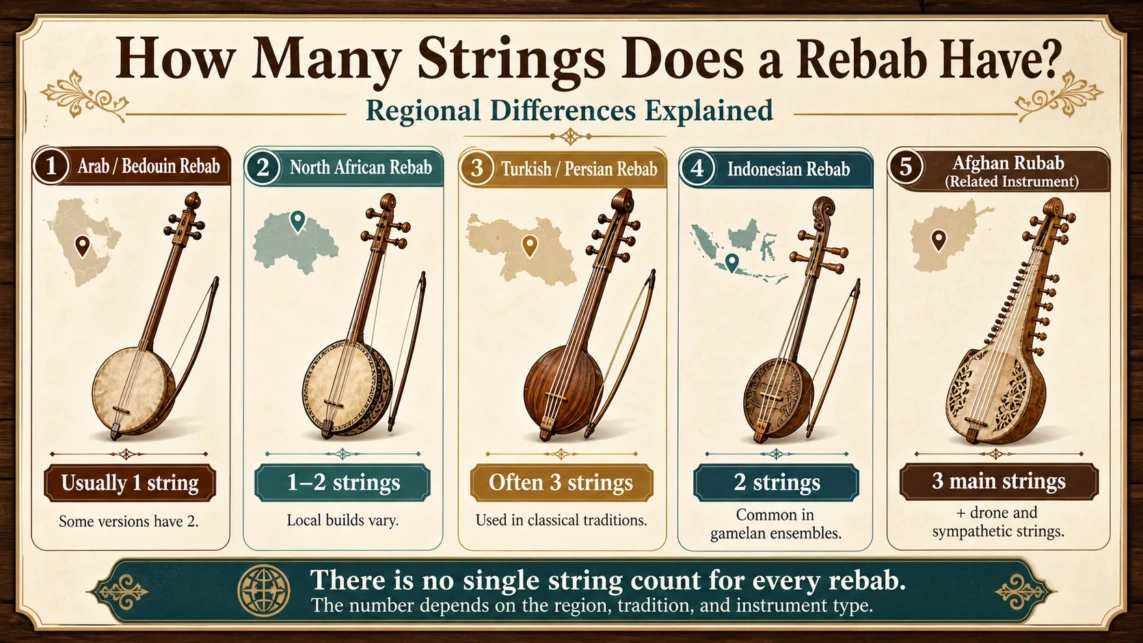
A rebab does not have one fixed string count. In many bowed rebab and rabāba traditions, the instrument has one, two, or three main strings. In Afghan and Central Asian rubab forms, the count rises because the instrument may include melody strings, drone strings, and sympathetic strings on the same body.
The safest answer is this: a rebab may have from one string to more than twenty strings, depending on which regional form is being discussed and whether hidden or sympathetic strings are included in the count.
Why the String Count Changes by Region
The name rebab is not attached to a single standardized instrument. It covers a family of related chordophones known by spellings such as rabab, rubab, rabāb, rababa, rebap, rubob, and robab. Some are bowed. Some are plucked. Some have a skin-covered soundboard; others have a carved wooden body with extra resonating strings.
This is why two correct descriptions can seem to disagree. A North African rebab may be a two-string bowed fiddle. A Malay rebab may have three strings. An Afghan rubab may have three main melody strings plus drones and sympathetic strings. They share a name family, but not one build standard.
Short answer: if someone says “the rebab has two or three strings,” they are usually talking about bowed rebab or rabāba types. If someone says “the rubab has around 18 to 21 strings,” they are usually counting the full string set of the Afghan-style rubab, including drones and sympathetic strings.
Main Regional String Counts
The table below keeps the counts practical. It separates the strings that are normally played for melody from drone or sympathetic strings, because this is where most confusion starts.
| Regional Form | Usual String Count | Played With | What the Count Usually Means |
|---|---|---|---|
| Arabic rabāba or poet’s fiddle | Often 1 string; some forms have 2 | Bow | A simple bowed spike fiddle used to support singing or recitation in some regional traditions. |
| Egyptian rabāba | Often 2 strings | Bow | Two horsehair or similar strings over a skin-covered resonator, often linked with folk singing. |
| North African rebab | Most often 2 strings | Bow | A boat-shaped, fretless bowed fiddle, often held across the body. |
| Javanese rebab | 2 strings | Bow | A two-string bowed lute used in gamelan, with a delicate melodic role. |
| Balinese rebab | 2 strings | Bow | A bowed rebab used in Balinese musical settings, closely tied to melodic ornament. |
| Malay rebab of Kelantan and nearby traditions | 3 strings | Bow | A three-string bowed instrument associated with forms such as Mak Yong and related performance settings. |
| Afghan or Kabuli rubab | Usually 3 main strings, 2 or 3 drones, and 13–15 sympathetic strings | Plectrum | A plucked short-necked lute; total string count is often around 18–21 when all strings are counted. |
| Central Asian rubob or robab forms | Varies by local type | Mostly plucked in many modern forms | The name can refer to several regional lutes, so the count should be checked by exact instrument type. |
Main Strings, Drone Strings, and Sympathetic Strings
String count only makes sense when the type of string is clear. A rebab family instrument may carry more than one kind of string, and each kind has a different job.
Main Melody Strings
Main strings are the strings the player uses most directly for melody. On many bowed rebabs, these are the only strings present. A one-string rabāba uses a single melody string. A Javanese rebab uses two. A Malay rebab commonly uses three.
On an Afghan rubab, the three main strings carry much of the melodic playing. They sit above a skin-covered bridge area and are struck with a plectrum rather than bowed.
Drone Strings
Drone strings support the tonal center. They are not used in the same way as the main melody strings. On Afghan rubab types, the long drone strings help give the instrument a steady tonal floor, especially when the player brushes or strikes across them as part of a phrase.
This is one reason a plucked rubab can sound fuller than its visible melody strings suggest.
Sympathetic Strings
Sympathetic strings are thin strings that vibrate when nearby notes are played. The player does not normally finger them for melody. They respond to pitch, tension, and resonance.
In an Afghan rubab, these strings help create the shimmering after-sound often heard beneath the main notes. They also make tuning more demanding. A small change in the skin, bridge pressure, or peg tension can affect the whole instrument.
Luthier’s Note: on skin-topped instruments, string count is only part of the sound. The membrane, bridge pressure, body depth, wood choice, and string material all help shape attack and sustain. A two-string rebab with a responsive skin belly can carry more vocal color than its simple count suggests.
Why Many Bowed Rebabs Have Two or Three Strings
Many bowed rebab types are made for melodic line, vocal support, and ornament rather than wide chordal playing. Two or three strings give the player enough range for melodic movement while keeping the instrument light and direct.
The lack of a fingerboard on several rebab forms also matters. The player often stops the string by touching it with the finger rather than pressing it firmly to a board. This allows sliding, shading, and flexible pitch, but it does not need many strings.
One-String Rabāba Forms
Some Arabic rabāba forms use a single string. These instruments are often linked with sung poetry, storytelling, or solo vocal support. The single string gives a narrow but expressive pitch field. Its voice can be dry, nasal, and speech-like, especially when the bow hair, skin surface, and resonator are lightly built.
A one-string form should not be treated as “less developed.” It simply serves a different musical purpose.
Two-String Rebab Forms
Two-string rebabs are common in several regions. The North African boat-shaped rebab, the Egyptian rabāba, and the Javanese rebab are often described this way, though their bodies and playing positions differ.
Two strings allow contrast between a lower and higher register. On a bowed instrument, that small difference is enough to create call-like phrases, vocal turns, and graceful melodic support.
Three-String Rebab Forms
Three-string rebabs appear in parts of Southeast Asia, including Malay rebab traditions. The third string can extend the usable range and give the player a clearer low, middle, and high layout. In some documented Malay examples, the strings correspond to low, middle, and high pitch roles.
The body of the Malay rebab also differs from the Javanese form. It is usually more visually ornate, with a distinctive head, skin-covered resonator, and upright playing posture.
The Afghan Rubab Count: Why It Looks Much Higher
The Afghan or Kabuli rubab is often the reason people get confused by rebab string counts. It belongs to the same broad name family, but it is a plucked short-necked lute, not a simple bowed spike fiddle.
A standard Afghan rubab is often described with:
- 3 main melody strings
- 2 or 3 long drone strings
- 13 to 15 sympathetic strings
That gives a practical total of about 18 to 21 strings, depending on the instrument. Some individual examples may differ because makers, regions, and modern workshop habits are not identical.
The sympathetic strings are not decorative. They help give the rubab its ringing halo. When the main string sounds a pitch that matches or relates to a sympathetic string, that thin string can vibrate and add length to the note. The effect is felt as resonance rather than as a separate melody.
Bowed and Plucked Forms Compared
The easiest way to read a rebab string count is to ask whether the instrument is bowed or plucked.
| Feature | Bowed Rebab or Rabāba | Plucked Rubab or Robab |
|---|---|---|
| Typical main string count | 1, 2, or 3 | Often 3 main melody strings |
| Extra strings | Usually none, though museum examples may vary | Drone and sympathetic strings are common in Afghan-style rubab |
| Sound focus | Vocal, bowed, flexible pitch | Plucked attack, resonance, ringing sustain |
| Common soundboard type | Skin or parchment on many forms | Skin-covered bridge area on Afghan rubab forms |
| Best way to count | Count the strings bowed by the player | Separate main, drone, and sympathetic strings |
This comparison also explains why a “two-string rebab” and a “twenty-string rubab” can both be correct. They are not describing the same regional build.
How to Identify the String Count on a Real Instrument
When looking at a rebab, rabab, or rubab in a museum, shop, or performance video, the name alone is not enough. Use the instrument’s structure.
- Look at the playing method. A bow usually points toward a smaller string count. A plectrum often points toward a plucked rubab form.
- Check the pegs. Extra small pegs often mean sympathetic strings are present.
- Look near the bridge. A skin-covered bridge area can appear on both bowed and plucked forms, so do not use skin alone to decide the type.
- Separate string jobs. Count melody strings, drones, and sympathetic strings as different groups.
- Check the regional name. Rubab, rubob, rebap, rabāba, and rebab can point to different local builds.
Collector’s Note: a missing string can mislead the count. Older rebabs often lose strings, bridges, pegs, or tailpiece fittings over time. On a display instrument, peg holes and bridge marks may tell more than the strings currently fitted.
Materials That Influence the Feel of the Strings
String count does not explain the whole playing feel. A two-string bowed rebab can feel very different from another two-string rebab if the body, skin, bridge, and string material differ.
Skin Soundboards
Many rebab family instruments use skin, parchment, or another membrane as the vibrating top. This gives the attack a dry edge and lets the tone react quickly to bow or plectrum pressure. Skin tension can also change with humidity and age.
That matters for tuning. On instruments with many strings, especially rubabs with sympathetic strings, small tension shifts can make tuning slower.
Wooden Bodies
Wood choice can shape resonance, weight, and response, but it should not be treated as a magic formula. Regional makers may use mulberry, walnut, apricot, coconut shell, or other available materials, depending on the instrument type and local craft tradition.
A carved bowl, a boat-shaped body, and a coconut-shell resonator do not behave the same way. The string count may match, but the sound will not.
Horsehair, Gut, Nylon, Metal, and Modern Substitutes
Older and traditional instruments may use gut, horsehair, metal, or locally available string materials. Modern players may use nylon, steel, or workshop-specific substitutes. These choices can change brightness, volume, bow grip, and tuning stability.
For the reader trying to identify an instrument, the material is a clue, but not a final answer. Regional form comes first.
Common Misunderstandings About Rebab String Counts
“A Rebab Always Has Two Strings”
This is too narrow. Two-string rebabs are very common, especially in North African, Egyptian, Javanese, and related bowed contexts. But one-string and three-string bowed forms also exist, and plucked rubab types may carry far more strings.
“A Rubab Has Only Three Strings”
This usually counts only the main melody strings. On Afghan rubab, the full instrument can include drones and sympathetic strings. A player may talk about the three main strings while a maker counts the full set.
“More Strings Means a Better Instrument”
Not really. More strings mean a different design. A one-string rabāba can be highly expressive in a vocal setting. A two-string Javanese rebab can lead and decorate a gamelan line with great subtlety. A many-string rubab offers resonance and range in another way.
Practical Answer by Search Intent
If the question is about the general rebab, the answer should stay flexible: most bowed rebabs have one to three main strings, with two or three being common in many documented forms.
If the question is about the Afghan rubab, the answer should be more specific: it usually has three main melody strings, plus drones and sympathetic strings, often bringing the total to around 18–21 strings.
If the question is about Javanese or Balinese rebab, the answer is usually simple: two strings.
If the question is about Malay rebab, especially Kelantan-related forms, the expected answer is three strings.
For museum labels, older instruments, and handmade regional examples, the safest wording is still “usually” or “commonly.” These instruments were shaped by local craft practice, not by one factory standard.
FAQ
How many strings does a rebab usually have?
A bowed rebab usually has one, two, or three main strings, depending on the regional form. Two-string and three-string types are common, while some Arabic rabāba forms use one string.
Does every rebab have three strings?
No. Some rebabs have one string, many have two, and some Southeast Asian forms have three. Afghan rubabs often have three main strings plus drone and sympathetic strings.
Why does the Afghan rubab have so many strings?
The Afghan rubab has more strings because it uses different string groups. It normally has main melody strings, drone strings, and sympathetic strings that vibrate to enrich the sound.
Are sympathetic strings played directly on a rubab?
They are not normally used as melody strings. Sympathetic strings vibrate in response to notes played on the main strings, adding resonance and sustain.
Is a rabāba the same as an Afghan rubab?
Not exactly. The names are related, but a rabāba often refers to a bowed regional fiddle, while the Afghan rubab is a plucked short-necked lute with main, drone, and sympathetic strings.
Can string count help identify a regional rebab type?
Yes, but it should not be the only clue. Playing method, body shape, pegs, soundboard material, and regional name are also needed to identify the instrument more safely.