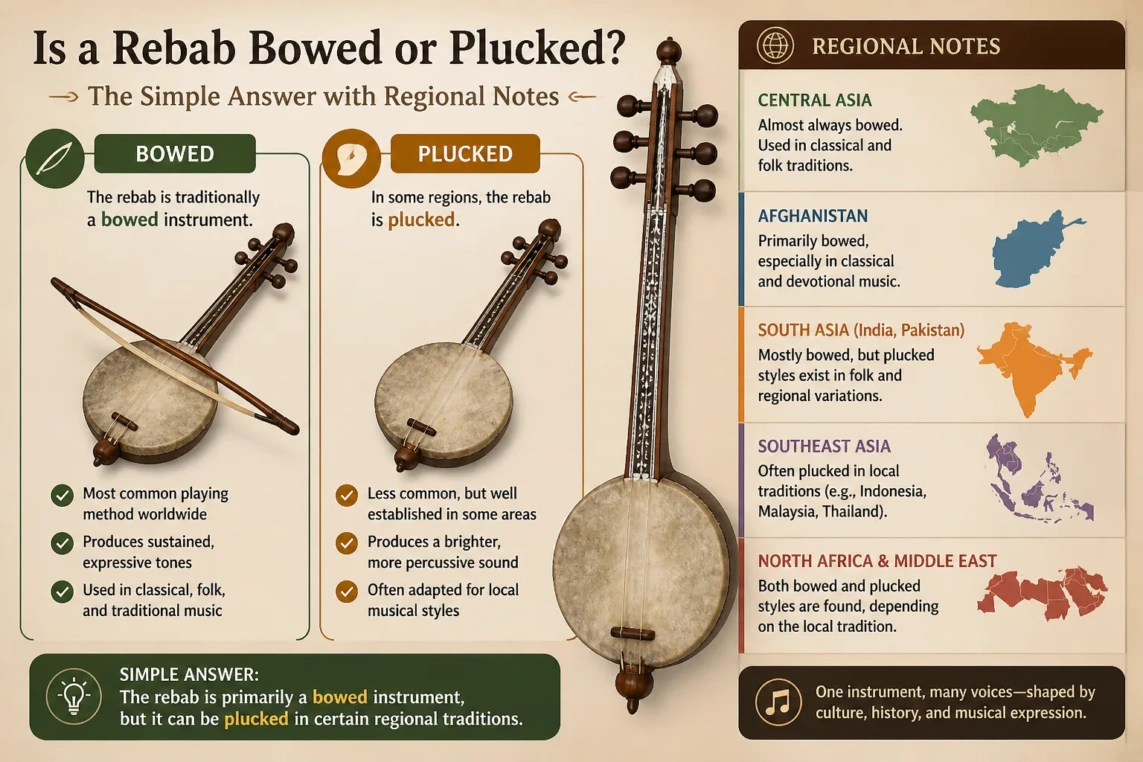
A rebab can be bowed or plucked, but the safer answer is this: the name belongs to a family of related string instruments, not one single standardized instrument. In many Arab, North African, Turkish, Persian, and Southeast Asian contexts, rebab or rabāb often points to a bowed instrument. In Afghan and Central Asian rubab traditions, the instrument is usually a plucked short-necked lute.
Is a Rebab Bowed or Plucked?
The rebab is not always played the same way. Some forms are bowed like a fiddle. Other forms are plucked with a plectrum or the fingers. This is why short answers can be misleading.
If someone says “rebab” in a general instrument-family sense, it may refer to either playing method. If someone says “Afghan rubab,” “Kabuli rubab,” or “rubob,” the instrument is usually plucked. If someone says “Arab rabāb,” “Maghrebi rebab,” “Indonesian rebab,” or “rebap” in several regional contexts, the instrument is usually bowed.
Simple answer: a rebab may be bowed or plucked. The playing method depends on the regional form, the local name, and the instrument’s construction.
Main Regional Answer
The table below gives the practical answer a reader usually needs first. It avoids treating every spelling as the same object.
| Name or Form | Common Playing Method | Typical Instrument Type | Notes |
|---|---|---|---|
| Arab rabāb or rababa | Bowed | Fiddle or spike fiddle in many forms | Often linked with older bowed chordophone traditions across Arabic-speaking regions. |
| Maghrebi rebab | Bowed | Short-necked bowed lute | Known in parts of North Africa, with local differences in body shape, neck covering, and decorative work. |
| Indonesian rebab or rebab in gamelan | Bowed | Two-string bowed lute | Usually used as a melodic instrument in ensemble settings. |
| Turkish rebab or rebap | Usually bowed | Bowed lute or fiddle-like instrument | Form and terminology may vary by period, region, and revival practice. |
| Afghan rubab or Kabuli rubab | Plucked | Short-necked lute | Commonly played with a plectrum; known for a carved body, skin-covered lower soundboard, and sympathetic strings in many examples. |
| Central Asian rubab, rubob, or robab forms | Often plucked | Lute-family instrument | Names and designs vary across Tajik, Uzbek, Iranian, and nearby traditions. |
Why the Same Name Causes Confusion
Rebab, rabab, rubab, rubāb, rababa, rebap, and rubob are related spellings shaped by language, transliteration, and local tradition. They do not always point to the same build.
The word has traveled across many musical areas. In one place it may describe a bowed fiddle with a skin soundboard. In another, it may describe a carved, plucked lute with frets and sympathetic strings. The shared name shows a broad chordophone family, not a single factory model.
This matters because playing method follows construction. A bowed rebab needs strings, bridge height, body response, and hand position suited to bow contact. A plucked rubab needs a different attack: the note starts with a sharper edge, then opens into a dry, woody resonance.
How a Bowed Rebab Works
A bowed rebab uses a bow to set the strings vibrating. The bow allows the player to sustain a note, lean into ornaments, and shape a melodic line with pressure and speed.
Many bowed rebab forms have a compact body, a skin or membrane soundboard, and one to several strings, depending on the regional type. Some are held upright. Some rest against the lap or body. The exact position changes by tradition.
Sound and Playing Feel
The bowed rebab often has a nasal, focused, and vocal sound. The tone can feel direct rather than wide. A skin-covered soundboard may give the note a quick, textured response, while the small body can keep the resonance tight.
A bow also changes the musical role. It helps the instrument carry long melodic phrases, slides, and speech-like ornaments. In ensemble settings, this can let the rebab trace the melodic line rather than only mark rhythm.
Listening Note: when a rebab is bowed, listen for sustained notes, small pitch bends, and a tone that seems close to the human voice. The sound may be thin in size but strong in character.
How a Plucked Rubab Works
A plucked rubab is played by striking or pulling the strings. In the Afghan rubab, the player commonly uses a plectrum. This gives the sound a clear attack before the resonance blooms through the body and sympathetic strings.
Many Afghan rubab examples have a short neck, a carved wooden body, a skin-covered lower soundboard, and sympathetic strings that vibrate along with the played strings. The number of strings can vary by maker, school, and instrument type, so it is better not to force one fixed count on every rubab.
Sound and Playing Feel
The plucked rubab has a more percussive start than a bowed rebab. The note is struck, not drawn out by a bow. On well-made instruments, the skin table and carved body can produce a dry, rounded tone with a firm center.
Sympathetic strings, where present, add shimmer around the main note. They do not replace the plucked voice of the instrument. They surround it.
Luthier’s Note: wood choice, body depth, skin tension, bridge fit, and string setup can all shape response. On a plucked rubab, a small change in bridge pressure or skin tension may change how fast the note speaks.
Regional Notes That Help Identify the Playing Method
The easiest way to identify whether a rebab is bowed or plucked is to look at the region and the build together. The name alone is not enough.
Arab Rabāb and Rababa
In many Arabic-speaking contexts, rabāb or rababa often refers to a bowed instrument. Some forms are simple in construction, with a skin-covered resonator and one or two strings. Others show more developed regional workmanship.
The bow is central to the sound. The instrument may carry sung-style melody, poetic recitation settings, or local ensemble lines, depending on the tradition.
North African and Maghrebi Rebab
The Maghrebi rebab is usually a bowed lute. Documented examples from Morocco, Algeria, and nearby traditions may show short necks, skin soundboards, and regional decorative features.
Here, the bow gives the instrument its drawn tone. The sound can be narrow, bright, and expressive, with ornaments shaped by the hand rather than by frets alone.
Afghan Rubab
The Afghan rubab is usually plucked. It is a short-necked lute with a carved body and a skin-covered lower soundboard in many known examples. It is often linked with art music, regional music, and small ensembles.
This form should not be described as a bowed rebab. Its playing feel, construction, and sound are closer to a plucked lute tradition, even though its name sits inside the broader rabab/rubab family.
Central Asian Rubab, Rubob, and Robab Forms
Central Asian naming can include rubab, rubob, robab, and related spellings. Many of these forms are plucked lutes, but local construction should be checked before making a firm statement.
Some instruments have frets, some have different body outlines, and some belong to specific conservatory or regional performance settings. The name opens the door; the object tells the rest.
Indonesian Rebab
In Indonesian gamelan contexts, the rebab is generally bowed. It often appears as a two-string bowed instrument with a small resonating body.
Its musical role is not the same as an Afghan rubab. It helps guide and color melodic movement inside an ensemble texture.
What Construction Reveals Before Anyone Plays It
A close look at the instrument can often answer the bowed-or-plucked question. The bridge, string angle, body shape, and wear marks all give clues.
- High arched bridge: often suggests bow access, especially when strings need separation for bowing.
- Flat or lower bridge: often suits plucking, though this is not a rule for every instrument.
- Skin-covered resonator: appears in both bowed and plucked forms, so it does not answer the question by itself.
- Plectrum wear near the strings: can point to plucked use.
- Bow rosin marks: may point to bowed use, especially near the strings and bridge.
- Sympathetic strings: are common in many plucked rubab forms but are not the only sign to check.
A museum label may say “rabab” or “rebab” without explaining the playing method. In that case, the safest reading combines object details with region, date, and collection notes.
Bowed and Plucked Forms Compared
The difference is not only a matter of technique. Bowed and plucked rebab-family instruments ask the maker to solve different acoustic problems.
| Feature | Bowed Rebab Forms | Plucked Rubab Forms |
|---|---|---|
| Sound Start | Drawn by bow contact | Struck by plectrum or finger |
| Sustain | Can sustain as long as the bow moves | Decays after the pluck, with resonance shaped by the body and strings |
| Bridge Setup | Often needs enough arc for bow clearance | Often set for clean plucked attack and comfortable string access |
| Common Role | Melodic lines, ornaments, vocal-style phrasing | Melody, rhythmic drive, solo passages, ensemble support |
| Common Examples | Arab rabāb, Maghrebi rebab, Indonesian rebab | Afghan rubab, many Central Asian rubab or rubob forms |
Does the Spelling Tell You the Playing Method?
Spelling helps, but it does not give a perfect answer. Rubab often points readers toward plucked Afghan or Central Asian forms in English-language writing. Rebab and rabāb often appear for bowed forms in Arab, North African, Turkish, and Southeast Asian contexts.
But spelling is not a strict technical label. Transliteration changes across languages. A writer may use “rabab” for a plucked Afghan instrument, while another may use the same spelling for a bowed Arab instrument.
The best question is not “How is it spelled?” The better question is: which regional instrument is being described?
Common Misunderstandings
“Every Rebab Is Bowed”
This is too narrow. Many older and regional uses of rebab or rabāb refer to bowed instruments, but Afghan and Central Asian rubab forms are usually plucked.
“Rubab and Rebab Are Completely Different Instruments”
This is also too simple. They are not always the same object, yet they belong to overlapping naming traditions. The relationship is real, but it should not erase local differences.
“Skin Soundboard Means Bowed”
A skin soundboard appears on both bowed and plucked instruments. It can help produce a fast, textured response, but it does not prove the playing method on its own.
“A Rebab Has One Standard Tuning”
There is no single tuning that covers every rebab, rabab, rubab, rebap, and rubob form. Tuning belongs to a specific instrument type, region, and playing tradition.
How to Describe It Correctly
Use a regional label whenever possible. “Bowed rebab” is clear for many Arab, Maghrebi, Turkish, or Indonesian contexts. “Plucked Afghan rubab” is clearer than only saying “rabab.”
For object descriptions, include three details:
- The regional name or spelling used for the instrument.
- The playing method: bowed or plucked.
- The construction type: fiddle, spike fiddle, bowed lute, or plucked short-necked lute.
A good description might say: “The Afghan rubab is a plucked short-necked lute with a skin-covered lower soundboard in many examples.” Another might say: “The Maghrebi rebab is a bowed lute associated with North African performance traditions.”
Collector’s Note: when reading a label, do not rely on the word “rabab” alone. Check region, date, bridge shape, string layout, and whether the instrument was cataloged as bowed or plucked.
Where the Rebab Family Fits Among Related Instruments
The rebab family sits near several other traditional chordophones, but each comparison needs care. Some bowed rebab forms are often discussed near the rebec because of historical naming links and playing posture. Plucked rubab forms are often discussed near the sarod because the Afghan rubab is commonly treated as an ancestor or close predecessor in North Indian instrument history.
These links help orientation, but they should not flatten the instruments into one line of copies. A sarod is not simply a rubab under a new name. A rebec is not just a European rebab. Each has its own body design, repertoire, playing method, and cultural setting.
Best Short Answer to Use
The most accurate short answer is: a rebab can be bowed or plucked, depending on the regional form.
For a slightly fuller answer: Arab, North African, Turkish, and Indonesian rebab forms are often bowed, while the Afghan rubab and many Central Asian rubab or rubob forms are plucked. When accuracy matters, name the regional type instead of treating “rebab” as one fixed instrument.
FAQ
Is a rebab usually bowed or plucked?
Answer
A rebab can be either bowed or plucked. Many Arab, North African, Turkish, and Indonesian rebab forms are bowed, while the Afghan rubab and many Central Asian rubab or rubob forms are plucked.
Is the Afghan rubab played with a bow?
Answer
The Afghan rubab is usually plucked, not bowed. It is commonly played with a plectrum and is built as a short-necked lute.
Why do some people call the rubab a rebab?
Answer
Rubab, rabab, rebab, and rubāb are spelling and transliteration variants used across different languages. The spelling may change, but the exact instrument depends on the region and tradition.
How can I tell if a rebab is bowed?
Answer
Look for bow use, bridge shape, playing posture, and regional context. A bowed rebab often has a setup that allows the bow to reach the strings cleanly.
Does every rebab have a skin soundboard?
Answer
No. Many rebab and rubab forms use skin soundboards, but construction varies by region and period. A skin soundboard alone does not prove whether the instrument is bowed or plucked.
Is rubab tuning the same in every region?
Answer
No. Tuning varies by instrument type, region, repertoire, and player. A general rebab answer should not be treated as a tuning rule for every rubab or rabab form.