How to Pronounce Rebab, Rabab and Rubab Correctly
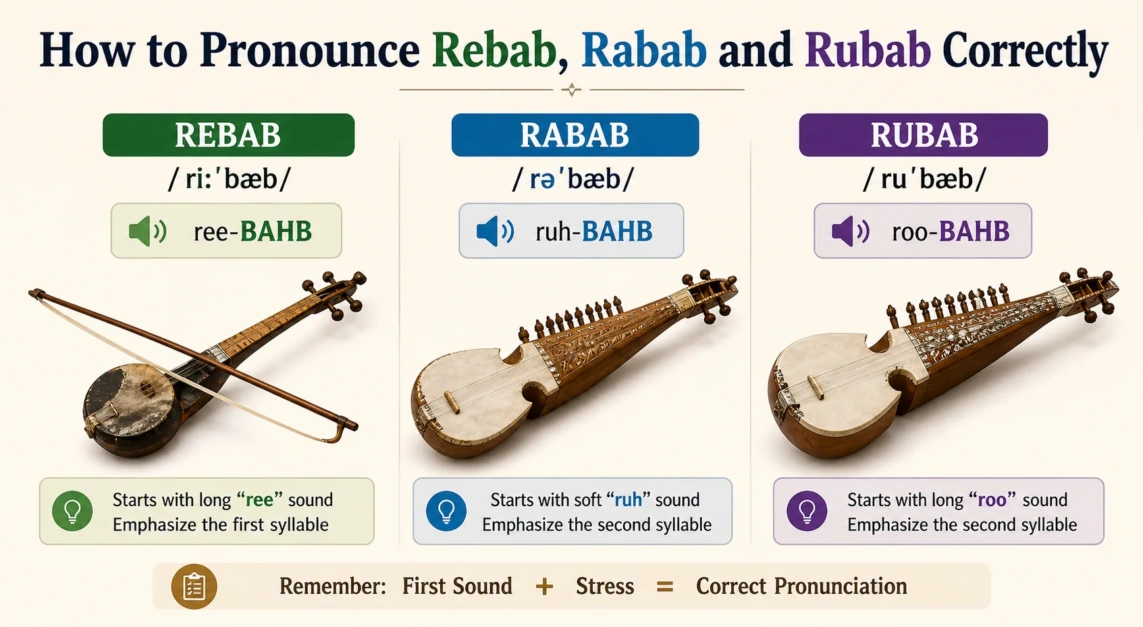
Rebab, rabab and rubab are usually stressed on the second syllable. The safest English pronunciation is not “REE-bab” and not “rehab.” Say the final syllable clearly: re-BAHB, ra-BAHB or roo-BAHB, depending on the spelling and regional form being named.
These words look similar because they belong to the same broad naming family for traditional string instruments. They do not always point to the same exact instrument. A bowed spike fiddle, a plucked Afghan rubab and a regional rabab may share a related name while having different bodies, strings, playing styles and local pronunciations.
Pronunciation Note: For general English use, place the stress on the last syllable: BAHB. The first syllable stays light.
Main Pronunciation Pattern
The main pattern is simple: two syllables, light first syllable, stronger second syllable.
| Spelling | Practical Pronunciation | Stress | Useful Note |
|---|---|---|---|
| Rebab | re-BAHB or ri-BAHB | Second syllable | Often used for bowed forms, especially in older English writing and Southeast Asian contexts. |
| Rabab | ra-BAHB or ruh-BAHB | Second syllable | A common transliteration for Arabic, Persian and South Asian naming traditions. |
| Rubab | roo-BAHB | Second syllable | Often used for the Afghan rubab and related plucked lutes in Central and South Asian contexts. |
| Rubāb | roo-BAHB | Second syllable | The macron over ā marks a long vowel. It does not add another syllable. |
How to Say Rebab
Rebab is best pronounced re-BAHB or ri-BAHB in English. The first syllable is short and light. The second syllable carries the weight.
A common mistake is to say it like “REE-bab,” with a long first vowel. That can sound too close to an English word pattern rather than the instrument name. Another mistake is to flatten the final syllable so it sounds like “reb-ub.” Keep the final vowel open.
Simple Mouth Position
- Start with a short “re” or “ri” sound.
- Move quickly into “BAHB.”
- Hold the final vowel slightly longer than the first vowel.
- Do not stress the first syllable.
Listening Note: The word should feel like it leans forward into the second syllable: re-BAHB. If the first syllable feels heavier than the second, the stress is probably wrong.
How to Say Rabab
Rabab is usually said ra-BAHB or ruh-BAHB. In careful transliteration, the second “a” often represents a longer open vowel, close to “ah.”
This spelling appears in several language settings, so one single English sound cannot cover every local form. In a general museum label, music class or instrument description, ra-BAHB is a safe and clear choice.
Why the Second Syllable Matters
The stress helps separate rabab from casual English guesses. Saying “RA-bab” puts too much weight on the first part. The better pattern is ra-BAHB.
That stress also reflects how many related transliterations behave: a light opening syllable followed by a stronger final syllable.
How to Say Rubab
Rubab is commonly pronounced roo-BAHB. The first vowel sounds like “oo” in “room,” then the word lands on “BAHB.”
This spelling is often used for the Afghan rubab, a plucked short-necked lute with a carved body, skin soundboard and sympathetic strings in many documented forms. Pronunciation alone does not identify every construction detail, but it does help separate rubab from the more general spellings rebab and rabab.
Luthier’s Note: The word rubab often points the reader toward a plucked lute family rather than a bowed spike fiddle. That is a naming clue, not a universal rule.
What the Macron in Rubāb Means
The spelling rubāb uses a macron over the letter ā. This mark signals a long “a” sound. It is not pronounced as a separate letter, and it does not turn the word into three syllables.
Read rubāb as roo-BAHB. The macron simply reminds the reader that the final vowel is open and held with more care than a short English “a.”
Rebab, Rabab, Rubab: Same Stress, Different First Vowel
The easiest way to compare the three names is to keep the ending stable and change only the first vowel.
- Rebab: re-BAHB or ri-BAHB.
- Rabab: ra-BAHB or ruh-BAHB.
- Rubab: roo-BAHB.
The shared ending is the anchor. Once the final BAHB is clear, the spelling becomes much easier to say.
Common Pronunciation Mistakes
Most mistakes come from reading the words as if they were ordinary English compounds. They are not. They are transliterated instrument names, and transliteration always carries some variation.
| Mistake | Why It Sounds Off | Use Instead |
|---|---|---|
| REE-bab | The first syllable becomes too strong. | re-BAHB |
| RA-bab | The stress falls too early. | ra-BAHB |
| ROO-bab with a flat ending | The final vowel becomes too short. | roo-BAHB |
| Rehab | It changes the instrument name into a different English word. | re-BAHB |
Why There Is More Than One Correct Form
These names moved through Arabic, Persian, Turkish, South Asian, Central Asian, Southeast Asian and European writing traditions. As a result, English spellings try to represent sounds that do not always map neatly onto English vowels.
That is why rebab, rabab, rubab, rabāb, rubāb, rebap and rubob can appear in instrument writing. Some forms point to local pronunciation. Others reflect older cataloging habits, colonial-era spelling, museum records or modern academic transliteration.
Pronunciation Should Follow the Instrument Context
If the text is about a bowed instrument in an Arab, Malay, Javanese or Turkish setting, rebab or rabab may be the spelling used. If the text is about the Afghan plucked lute, rubab is often the clearer English form.
Pronunciation should respect that context. A player, maker or regional source may say the name with a local vowel shape that differs from the broad English version.
How to Use the Names in Spoken English
For a general English audience, clarity matters more than forcing a single “perfect” accent. Say the word slowly once, then use the natural rhythm of speech.
- Use re-BAHB when reading rebab.
- Use ra-BAHB when reading rabab.
- Use roo-BAHB when reading rubab.
- Keep the stress on the final syllable.
- Use the local pronunciation if a performer, maker or teacher provides one.
Regional Note: A local speaker may not use the same vowel as an English dictionary spelling. That does not make the local form wrong. Instrument names often keep regional sound habits.
How Pronunciation Connects to Instrument Identity
The names are not just spelling variants. They can also guide the listener toward a particular instrument family.
A rebab may refer to a bowed instrument with a skin soundboard and a small resonating body in several regional traditions. A rubab often suggests a plucked lute with a carved wooden body, skin face and multiple string courses, especially in Afghan and related Central Asian contexts. A rabab can sit between these uses, depending on the language and region.
This is why pronunciation works best when paired with context. The sound of the word helps, but the body shape, playing method, strings and regional tradition tell the rest of the story.
Mini FAQ
Is rebab pronounced like rehab?
See the answer
No. Rebab is usually pronounced re-BAHB or ri-BAHB, with stress on the final syllable. Rehab has a different English rhythm and meaning.
What is the easiest way to pronounce rabab?
See the answer
The easiest English pronunciation is ra-BAHB. Keep the first syllable light and place the stress on BAHB.
How do you pronounce rubab?
See the answer
Rubab is commonly pronounced roo-BAHB. The first syllable sounds like “roo,” and the second syllable carries the stress.
Does the spelling rubāb change the pronunciation?
See the answer
The macron in rubāb marks a long “a” sound. It does not add another syllable. A practical pronunciation is still roo-BAHB.
Are rebab, rabab and rubab the same word?
See the answer
They are related spellings from a shared naming family, but they do not always name the same exact instrument. The local region and instrument type matter.