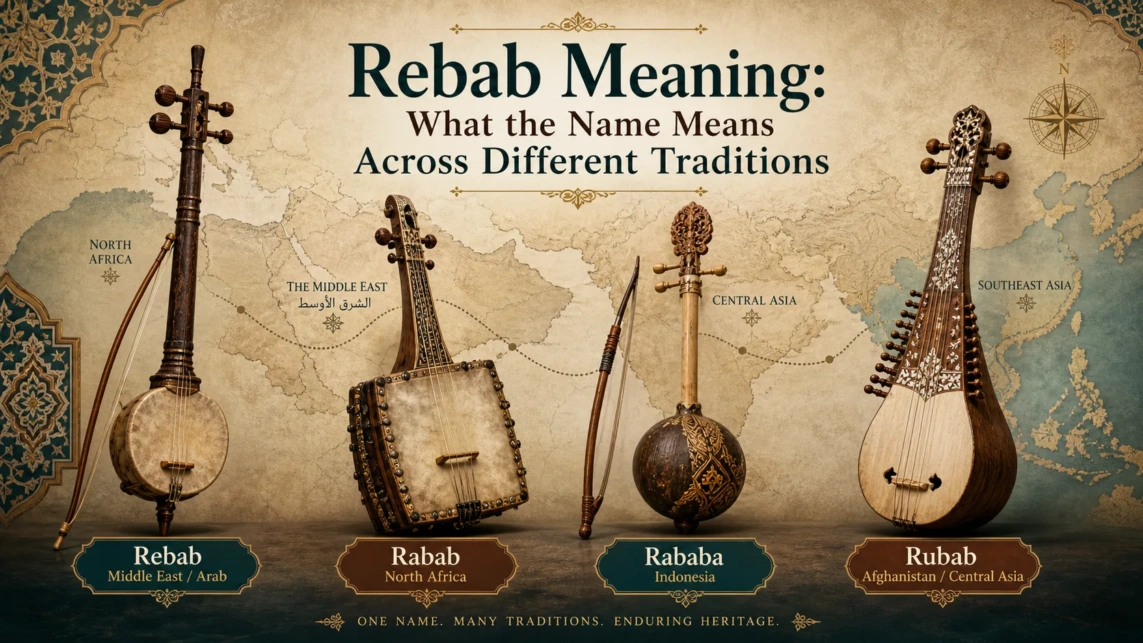
Rebab does not have one neat meaning in every tradition. In musical use, rebab, rabab, rubab, rabāb, rababa, rebap, and rubob usually point to a family of string instruments rather than one fixed object. In one region the name may mean a bowed spike fiddle; in another, it may name a plucked short-necked lute with a skin soundboard.
What Does Rebab Mean?
The word rebab is best understood as an old instrument name attached to several related chordophones. In many Arabic-linked contexts, rabāb refers to a bowed string instrument. In Central and South Asian contexts, rubab often refers to a plucked lute, especially the Afghan or Kabuli rubab form.
That shift matters. A reader who sees “rabab” in a North African museum label may be looking at a bowed lute. A reader who sees “rubab” in Afghan music may be looking at a plucked instrument with a carved wooden body, skin belly, drone strings, and sympathetic strings.
The name stayed familiar while the instrument form changed. That is why the meaning of rebab is not only linguistic. It is also regional, organological, and practical.
Why the Name Has So Many Spellings
The spellings vary because the name moved through different languages, scripts, and scholarly habits. Arabic, Persian, Pashto, Turkish, Tajik, Uzbek, Malay, Indonesian, and European-language writing systems do not render the same sound in one uniform way.
Long vowels and consonants also get handled differently. That is why rabāb, rabab, rebab, rubab, robab, rubāb, rababa, rebap, and rubob can all appear in serious writing.
| Spelling | Common Context | Usual Meaning in That Context |
|---|---|---|
| Rabāb | Arabic transliteration, older scholarship, museum wording | Often a bowed string instrument or a general older term for bowed instruments |
| Rabab | Arabic, North African, South Asian, and English writing | May refer to a bowed fiddle or a plucked lute, depending on region |
| Rebab | English, Indonesian, Malay, Turkish-related writing | Often a bowed instrument, especially in Southeast Asian and Ottoman-linked contexts |
| Rubab | Afghan, Central Asian, Persianate, and South Asian writing | Often a plucked short-necked lute with a skin soundboard |
| Rubob | Uzbek and Tajik-related transliteration | Usually a Central Asian lute-type instrument |
| Rebap | Turkish spelling | Usually a bowed or historical string instrument related to the wider rebab family |
| Rababa | Arabic folk-instrument contexts | Often a bowed spike fiddle used with sung or recited traditions |
The Core Meaning: A Name for a String Instrument Family
In plain English, rebab means a traditional string instrument, but that answer is too narrow unless the region is known. The name does not behave like “violin,” where most readers picture one fairly stable form. It behaves more like a family name.
Across documented traditions, the rebab name can point to instruments with these shared traits:
- a resonating body made from wood, shell, or another hollow material;
- a skin or wooden soundboard, depending on the regional type;
- one or more strings;
- a bow or plectrum, depending on the instrument form;
- a tone shaped strongly by the soundboard, bridge, string tension, and playing method.
This is the cleanest way to read the name: rebab is a historical name attached to several bowed and plucked string instruments.
Rebab, Rabab, and Rubab Are Not Always the Same Instrument
The spelling often gives a clue, but it does not give a full answer. A rabab in one catalog may be a North African bowed lute. A rubab in Afghan music is normally a plucked lute. A rebab in Javanese gamelan is a bowed instrument with a delicate, vocal line.
The safest reading depends on three details: region, playing method, and body form.
Luthier’s Note: The name alone cannot tell how the instrument feels under the hand. A bowed spike fiddle, a short-necked Maghrebi rabāb, and an Afghan rubab ask for different construction choices. Neck angle, bridge height, skin tension, and string layout all change the sound and the playing response.
Meaning in Arabic and North African Traditions
In Arabic-linked usage, rabāb is strongly tied to bowed string instruments. Older descriptions also use the word more broadly for bowed instruments. In that setting, the meaning is not simply “lute” or “fiddle” in the modern European sense. It points to a skin-faced, bowed chordophone tradition with its own forms.
North African rabāb types can be short-necked bowed lutes. Some examples have decorative fingerboards or hollowed wooden necks. Their bodies and soundboards are not made to behave like a violin body. The tone is more direct, nasal, and speech-like, with the skin surface giving a dry edge to the resonance.
In this context, rabab often means a bowed instrument used in ensemble and song traditions, not a plucked Afghan-style lute.
Meaning in Afghan and Central Asian Traditions
In Afghan and Central Asian contexts, rubab usually points to a plucked lute. The Afghan rubab, often called the Kabuli rubab, has a carved wooden body, a skin belly under the bridge, main playing strings, drone strings, and sympathetic strings in many examples.
Here the old name carries a small puzzle: a name associated with bowed instruments in some Arabic contexts becomes attached to a plucked instrument. That does not make the name wrong. It shows how instrument names travel with musicians, makers, courts, workshops, and local vocabularies.
In this tradition, the meaning of rubab is closer to “a regional plucked lute with a skin soundboard” than to “bowed fiddle.” The sound is short, warm, percussive, and resonant, especially when the sympathetic strings respond well.
Meaning in Persianate and South Asian Usage
Persianate and South Asian writing can use rabab, rubab, or robab for lute-type instruments connected with court, devotional, folk, and classical settings. The exact form depends on period and region.
In northern India, the rabab is often discussed near the sarod because the sarod’s later design is commonly linked to rabab ancestry. This does not mean the two are the same. The sarod has its own metal fingerboard, smooth gliding surface, and modern concert identity. The rabab keeps a more visibly carved, lute-like character in many descriptions.
The name, then, can signal a lineage of plucked lutes rather than one fixed body plan.
Meaning in Turkish and Ottoman-Linked Contexts
In Turkish, rebap is a common spelling connected with the wider rebab family. Ottoman and neighboring musical contexts include bowed string instruments whose names and forms overlap with rebab-related vocabulary.
This does not mean every Turkish or Ottoman bowed lute should be folded into one simple “rebab” label. Names such as kemençe, kamancheh, and related regional terms need their own care. Still, rebap helps show how the name adapted to local spelling and pronunciation.
Meaning in Southeast Asian Traditions
In Indonesia and nearby traditions, rebab often refers to a bowed instrument used in ensemble settings such as gamelan. The instrument may have a small resonator covered with skin and a long neck. Its musical role can be melodic and ornamental, often moving with a flexible, voice-like line.
Here, the meaning returns closer to the bowed side of the family. The player does not use the instrument like an Afghan rubab. The bow, light left-hand contact, and delicate melodic shaping give the Southeast Asian rebab its own identity.
Listening Note: A bowed rebab often speaks with a narrow, vocal tone. A plucked rubab gives a firmer attack, then a quick bloom from the skin soundboard and sympathetic strings. The shared name does not create a shared sound.
How the Name Changes by Instrument Form
The fastest way to understand the name is to look at the object in front of it. Shape, soundboard, stringing, and playing method tell more than spelling alone.
| Instrument Form | Likely Meaning of the Name | What to Check |
|---|---|---|
| Bowed spike fiddle | A rebab or rababa used upright with a bow | Spike, small resonator, skin face, one or two main strings in many regional forms |
| Short-necked bowed lute | A North African or Arabic-linked rabāb type | Short neck, bowed use, decorative body or fingerboard, ensemble role |
| Plucked short-necked lute | An Afghan, Central Asian, or South Asian rubab/rabab type | Carved wooden body, skin belly, plectrum use, drones, sympathetic strings in many examples |
| Southeast Asian bowed rebab | A melodic bowed instrument used in court, theatre, or gamelan-related settings | Small resonator, long neck, bowing technique, flexible melodic line |
| European rebec connection | A related name path rather than the same living instrument | Medieval bowed fiddle context, different construction and repertory |
What the Name Does Not Mean
Rebab does not simply mean “violin.” Some rebab forms are bowed, and some later European bowed instruments share historical links with rabāb vocabulary, but a rebab is not just an early violin with another name.
Rebab does not always mean “Afghan rubab.” The Afghan rubab is one of the best-known plucked forms today, but the name covers more than that one instrument.
Rebab does not always mean “bowed.” In many Arabic and Southeast Asian contexts that reading works well. In Afghan and Central Asian contexts, it often does not.
How to Read the Name on a Museum Label or Album Credit
When a label says rebab, rabab, or rubab, the next step is not to translate the word. The next step is to identify the tradition.
- Look for the region: North Africa, the Arab world, Afghanistan, Central Asia, South Asia, Turkey, or Southeast Asia.
- Check whether the instrument is bowed or plucked.
- Look at the body: spike fiddle, short-necked lute, carved wooden lute, or small skin-covered resonator.
- Notice the soundboard: skin often gives a dry, direct attack; wood can support a different kind of resonance.
- Read the function: song accompaniment, court ensemble, devotional music, solo lute performance, or melodic ensemble line.
This method keeps the name useful without forcing one definition onto many living and historical forms.
Why the Meaning Matters for Instrument Study
The meaning of rebab matters because the name can lead readers toward the wrong sound, shape, or playing style. A maker studying a plucked rubab needs different information than a player studying a bowed rebab. A curator describing a Maghrebi rabāb should not borrow details from an Afghan rubab unless the comparison is clearly marked.
For instrument study, the name works best as a doorway. It opens a family of related traditions, then the region and construction narrow the meaning.
Collector’s Note: A spelling on its own is not enough for identification. A useful record should include region, approximate date, body material, soundboard type, number of strings, playing method, and any local name supplied by the maker, player, or collection history.
Related Names That Can Cause Confusion
Rebab and Rebec
The European rebec is often discussed near the rabāb because the names and medieval bowed-instrument histories touch. Still, a rebec is not simply a rebab under a European name. It belongs to a different instrument setting, with its own body form and repertory.
Rubab and Sarod
The sarod is often linked to the rabab in South Asian instrument history. The connection is useful, but the instruments should not be merged. A sarod usually has a metal fingerboard and a later concert design, while the rabab or rubab keeps a different tactile and acoustic profile.
Rebab and Kamancheh
Kamancheh and rebab-related instruments can both appear in bowed-string discussions, especially across Middle Eastern and Central Asian music. The names are not interchangeable. Body shape, spike use, regional vocabulary, and performance practice need separate treatment.
FAQ
Does Rebab Mean One Specific Instrument?
Short answer
No. Rebab is a family name used for several related string instruments. In some traditions it means a bowed fiddle or bowed lute. In others, especially Afghan and Central Asian contexts, rubab often means a plucked lute.
Is Rabab the Same as Rubab?
Short answer
Sometimes the spellings point to related names, but they do not always mean the same instrument. Rabab may describe bowed or plucked forms depending on region. Rubab often points to plucked Afghan and Central Asian lute types.
Does Rebab Mean a Bowed Instrument?
Short answer
In many Arabic-linked and Southeast Asian contexts, yes, rebab or rabāb often refers to a bowed instrument. The rule is not universal because some rubab traditions use a plectrum instead of a bow.
Why Are There So Many Spellings of Rebab?
Short answer
The name passed through several languages and scripts, so English spellings vary. Rabāb, rabab, rebab, rubab, robab, rebap, and rubob can all appear in writing about related string instruments.
How Can I Tell Which Rebab Type a Text Means?
Short answer
Check the region, playing method, and body shape. A bowed North African rabāb, a Javanese rebab, and an Afghan rubab have different construction and sound, even when their names look related.
Is Rebab Related to the Rebec?
Short answer
Yes, the names are historically connected in discussions of medieval bowed instruments. Still, the rebec should be treated as a separate European instrument form, not as a direct synonym for every rebab.