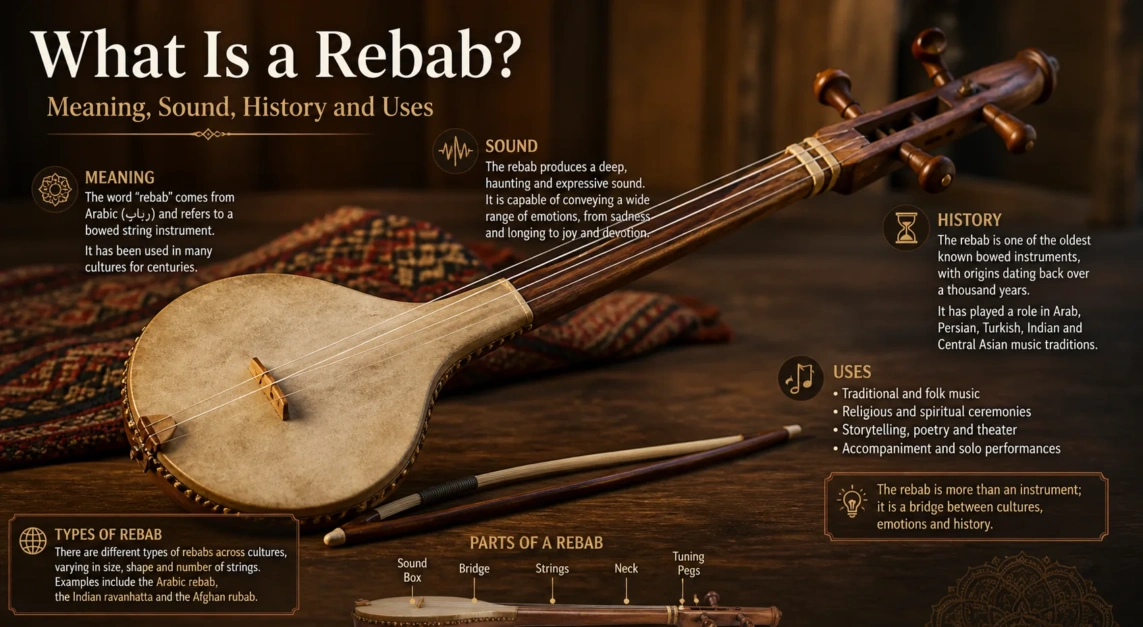
What Is a Rebab? Definition and Instrument Family Explained
A rebab is a traditional string instrument name used for a family of related chordophones found across Arabic, Persian, Central Asian, North African, South Asian, and Southeast Asian music. The term can describe bowed spike fiddles, short-necked bowed lutes, and related forms often spelled rubab or robab that are plucked lutes with skin soundboards.
A Moroccan rabāb, a Javanese rebab, a Bedouin rababa, and an Afghan rubab belong to the same broad naming family, while differing in body shape, string layout, playing method, and regional identity. Identifying the exact instrument therefore requires more than the word rebab alone.
Rebab as an Instrument Family
The rebab belongs to the chordophone group: instruments that produce sound through vibrating strings. In many Arabic and related traditions, rabāb became associated with bowed string instruments. Closely related spellings such as rubab, rabab, rebap, and rubob developed in other languages and regions.
Many bowed rebabs have a skin-covered resonator, a relatively long neck, and a small number of main strings. Some are spike fiddles held upright, while others have a short lute-like or boat-shaped body. Afghan and several Central Asian rubab forms belong to a plucked branch with carved wooden bodies, skin-covered lower soundboards, and more elaborate string systems.
| Feature | Common Pattern | Regional Variation |
|---|---|---|
| Instrument Type | Traditional string instrument | Bowed fiddle, bowed lute, spike fiddle, or plucked lute |
| Soundboard | Skin or membrane is common in many forms | Materials and construction differ by region and maker |
| Strings | A small number of main strings on many bowed forms | Plucked rubabs may add drone and sympathetic strings |
| Playing Method | Frequently bowed | Afghan and several Central Asian rubab forms are plucked |
| Body | Compact resonating body | Rounded, boat-shaped, bowl-like, spike-fiddle, or carved lute forms |
| Regions | North Africa, Middle East, Central Asia, South Asia, Southeast Asia | The name and physical design change with local tradition |
Meaning of the Word Rebab
The word rebab is commonly linked with Arabic rabāb and related spellings across several languages. It functions as a name family rather than a technical label for one standardized instrument.
In Arabic-speaking and North African settings, the name frequently refers to bowed instruments. In Indonesia, rebab commonly identifies a bowed instrument associated with gamelan. In Afghanistan, rubab usually refers to a plucked short-necked lute. Central Asian names such as rubob and robab can identify additional regional lute forms.
Spelling can provide a useful regional clue, though it cannot identify an instrument by itself. Museum catalogues, historical texts, performers, and modern writers may transliterate the same or related names differently.
Common Spelling Variants
- Rebab: common English spelling for several bowed forms, including instruments from Southeast Asia and the Middle East.
- Rabab: widely used transliteration in Arabic, South Asian, and general reference contexts.
- Rabāb: scholarly transliteration showing the long vowel.
- Rubab: often associated with Afghan and Central Asian plucked lute forms.
- Robab or Rubob: spellings found in several Persianate and Central Asian contexts.
- Rebap: spelling encountered in Turkish usage.
Region and playing method usually provide more information than spelling alone.
Bowed and Plucked Branches
Many instruments called rebab, rabāb, rababa, or rebap are played with a bow. This includes several Arab, North African, Turkish, and Southeast Asian forms. Afghan rubab and many related Central Asian forms are usually plucked with a plectrum.
The regional name and construction should be checked before assigning a playing method. A fuller comparison of these branches is available in Is a Rebab Bowed or Plucked?
Basic Construction and Materials
There is no single rebab blueprint. Regional forms can differ sharply, yet several recurring construction features make the family recognizable: strings under tension, a resonating body, a neck, a bridge, and frequently a skin or membrane soundboard.
Body Shape
Bowed rebabs may have rounded, box-like, boat-shaped, bowl-shaped, or small lute-shaped bodies. Spike-fiddle forms use a neck or shaft that passes through the resonator and may continue below it, allowing the instrument to rest against the leg or floor.
North African examples can have short-necked or boat-shaped bodies. Javanese and Malay rebabs are generally upright bowed instruments. Afghan rubabs have a more substantial short-necked lute form carved from wood.
Soundboard
A skin or membrane soundboard appears on many members of the rebab family. Traditional instruments may use goat, sheep, or other animal skin according to local craft practice. Membrane tension, thickness, humidity, and bridge pressure affect how the instrument responds.
Wood and Resonator Materials
Construction materials follow regional craft traditions. Afghan rubabs are closely associated with carved wooden bodies, often including mulberry, while other rebab forms may use hardwood, coconut shell, gourd, skin-covered wooden chambers, or combinations of locally available materials.
No single wood species or resonator shape defines the entire family. Body design is more useful when considered together with the regional name, neck form, soundboard, bridge, and playing method.
Strings
String count varies with the instrument. One-, two-, and three-string layouts occur among bowed rebab and rababa forms, while Afghan rubabs can carry main, drone, and sympathetic strings. Exact regional counts are covered separately in How Many Strings Does a Rebab Have?
Luthier’s Note
On skin-bellied instruments, the bridge transfers string vibration into a flexible membrane. Bridge height, membrane tension, string gauge, and body depth can therefore change response even between instruments with similar outlines.
Regional Rebab Forms
The rebab family is easier to identify when the regional name is included. The following forms share parts of the same naming history while remaining distinct instruments.
Arabic and Bedouin Rababa
Rababa forms found in Arabic-speaking regions are commonly bowed instruments with simple resonating bodies and skin soundboards. Some regional examples have only one main string, while others use two or more. Shape and construction vary across local traditions.
North African Rabāb
In Morocco, Algeria, Tunisia, and nearby traditions, the rabāb can take the form of a short-necked bowed lute. Surviving examples may have boat-shaped bodies, skin soundboards, decorative woodwork, inlay, and small string sets.
Javanese and Sundanese Rebab
The Indonesian rebab is a bowed instrument associated especially with gamelan traditions. It normally has a small resonator, a long neck, and a light construction suited to flexible melodic playing. Javanese examples are commonly two-string instruments.
Afghan Rubab
The Afghan rubab is a plucked short-necked lute rather than a bowed fiddle. Its carved wooden body, skin-covered lower soundboard, main strings, drones, and sympathetic strings distinguish it from many bowed instruments carrying related names.
Central Asian Rubab and Rubob Forms
Central Asia contains several instruments named rubab, rubob, robab, or related forms. Many are plucked lutes, though body design, fretting, string layout, and construction depend on the particular regional tradition.
Turkish Rebap
In Turkish and Ottoman-linked contexts, rebap can refer to bowed forms associated with classical, devotional, and regional traditions. Historical period and local practice matter when identifying the exact design.
Sound, History and Musical Role
Sound Character
Bowed rebabs often have a focused, voice-like tone shaped by the bow, compact resonator, and membrane soundboard, while plucked rubabs have a clearer attack and shorter decay. The differences between regional forms are covered in What Does a Rebab Sound Like?
Historical Context
Rebab-related names appear across long-established musical traditions in the Middle East, North Africa, Central Asia, South Asia, and Southeast Asia. Regional forms developed along different paths as the name moved between languages and musical cultures; the chronology and regional development are covered in Rebab Instrument History.
Musical Roles
Different rebabs can carry melody, accompany singing, ornament ensemble lines, or function as plucked melodic lutes. Their roles depend on the regional instrument and performance tradition; a regional breakdown is available in What Is a Rebab Used For?
What the Name Does Not Tell You
The label rebab does not reveal an exact string count, tuning, range, body shape, or playing method. Tuning changes with regional type, repertoire, performer, and ensemble, while string layouts range from simple one- or two-string bowed instruments to plucked rubabs with several categories of strings.
This is why an instrument should be identified as specifically as possible: Javanese rebab, Maghrebi rabāb, Arab rababa, Turkish rebap, Afghan rubab, Central Asian rubob, or another documented regional form.
How It Differs from Related Instruments
The rebab family is frequently compared with the violin, rebec, kamancheh, sarod, and oud. Those comparisons are most useful when the exact rebab form is named first.
| Instrument | Shared Features | Distinguishing Features |
|---|---|---|
| Violin | Bowed strings and melodic playing | Wooden soundboard, fingerboard, standardized four-string setup, and different playing posture |
| Rebec | Historical connections with medieval bowed instrument traditions | Developed within medieval European music and has its own construction history |
| Kamancheh | Bowed upright construction and spike-fiddle resemblance | Persianate instrument with its own body design, setup, repertoire, and regional variants |
| Afghan Rubab | Part of the wider rebab/rabab/rubab naming family | Plucked short-necked lute with a more complex string system in many examples |
| Oud | Plucked lute construction | Wooden soundboard, deep bowl, different bridge and string arrangement |
| Sarod | Historical and structural relationship with rubab-type lutes | Metal fingerboard and a separate North Indian classical playing tradition |
Common Misunderstandings About the Rebab
Rebab Does Not Identify One Fixed Design
The same family name appears on instruments with very different outlines. A small Indonesian bowed rebab and a carved Afghan rubab can both carry related names without sharing the same construction.
Rebab and Rubab Are Related Names, Not Perfect Synonyms
Rebab, rabab, and rubab belong to overlapping naming traditions. In present-day English usage, rubab often points toward Afghan and Central Asian plucked lutes, while rebab frequently appears for bowed forms. Historical sources are less consistent.
The Rebab Is More Than a Predecessor Label
Some rebab forms appear in discussions of early bowed instruments and the history of the European rebec. Rebab-family instruments also remain distinct regional instruments with their own construction traditions and repertoires, so identifying them only through later European instruments removes useful information.
A Museum Label May Need More Context
A label reading only “rabab” or “rebab” may leave the exact form unclear. Region, date, body shape, bridge, neck, surviving strings, and evidence of bow or plectrum use help narrow the identification.
How to Recognize a Rebab in a Museum or Collection
A rebab-family instrument can often be identified by combining its label with visible construction details. No single feature works for every regional form.
- Look for a skin or membrane soundboard, a recurring feature on many rebab and rubab forms.
- Check whether the resonator is rounded, boat-shaped, bowl-like, compact and skin-covered, or carved as a short-necked lute.
- Examine the neck. A long shaft passing through the body may indicate a spike-fiddle form.
- Count the surviving strings and look for additional peg holes that may indicate missing strings.
- Inspect the bridge and surrounding area for clues associated with bowing or plucking.
- Read the geographic attribution carefully. Moroccan, Algerian, Arabic, Javanese, Malay, Afghan, Central Asian, Persian, and Turkish contexts can point to different instruments.
Collector’s Note
Older instruments may have replacement skins, repaired bridges, missing pegs, modern strings, or later decorative work. Identification is more reliable when several construction clues agree with the documented region and date.
Is the Rebab Hard to Learn?
Learning difficulty depends on the exact rebab form. Many bowed instruments are fretless, so the player must control pitch by ear while also learning bow pressure, bow direction, and regional ornamentation.
Plucked rubab forms require different skills, including plectrum control, fingering patterns, and management of drone or sympathetic strings where those features are present. Previous experience with another lute or bowed instrument can help with basic coordination, though regional technique still needs to be learned on its own terms.
The practical first step is identifying the instrument precisely. Learning material for a Javanese rebab will not match an Afghan rubab, and instruction for an Arab rababa will not automatically match a North African rabāb.