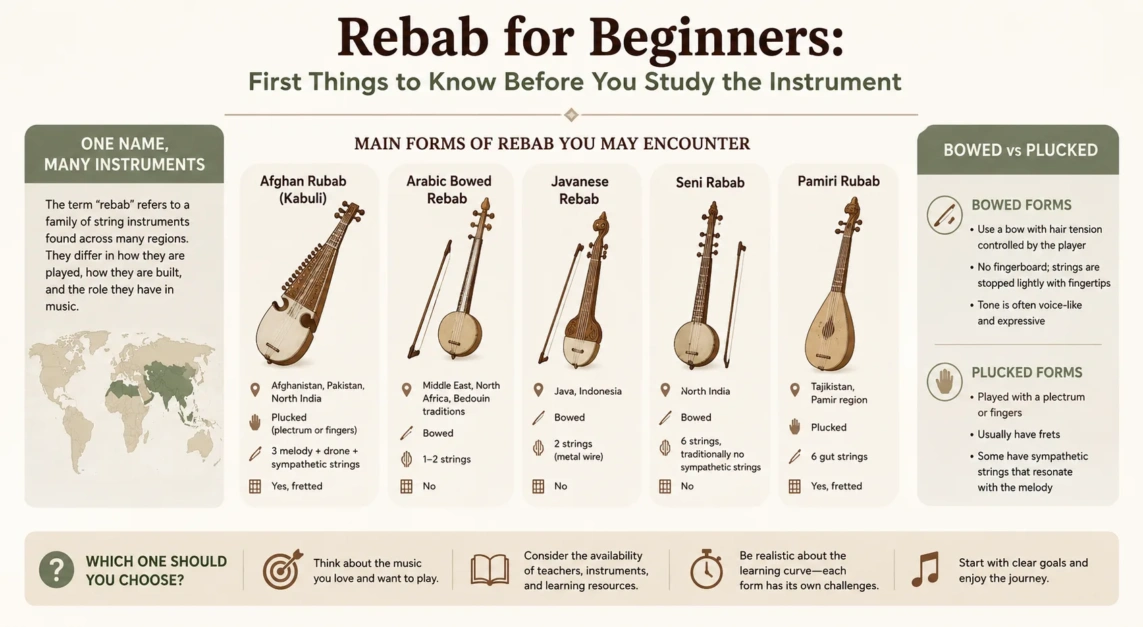
Before picking up a rebab, most beginners run into the same problem: the name covers a wide range of instruments that look different, sound different, and are played in entirely different ways. What someone in Kabul calls a rubab and what a gamelan musician in Central Java calls a rebab share a name and some distant ancestry — but they are not the same instrument, and starting on one teaches you almost nothing about the other. Knowing which form you are looking at, and why you want to study it, saves a lot of early confusion.
One Name, Many Instruments
The word rebab — also spelled rabab, rubab, rubob, rebap, or robab depending on the region and transliteration system — applies to a large family of string instruments spread across North Africa, the Middle East, Central Asia, South Asia, and Southeast Asia. Some of these instruments are bowed; others are plucked. Some have two strings; others have three melody strings plus several drone or sympathetic strings. Their construction, range, timbre, and role in music differ substantially.
For a beginner, the most useful starting point is not the instrument’s history — it is identifying which form you are actually interested in, and understanding what that choice means for how you learn.
| Form | Region | Technique | Strings | Fingerboard |
|---|---|---|---|---|
| Afghan Rubab (Kabuli) | Afghanistan, Pakistan, North India | Plucked (plectrum or fingers) | 3 melody + drone + sympathetic strings | Yes, fretted |
| Arabic Bowed Rebab | Middle East, North Africa, Bedouin traditions | Bowed | 1–2 strings | No |
| Javanese Rebab | Java, Indonesia | Bowed | 2 strings (metal wire) | No |
| Seni Rabab | North India | Bowed | 6 strings, traditionally no sympathetic strings | No |
| Pamiri Rubab | Tajikistan, Pamir region | Plucked | 6 gut strings | Yes |
Bowed and Plucked: Why This Distinction Matters Early
The divide between bowed and plucked forms is not a minor stylistic detail — it determines the physical technique, the sound production, and the learning resources available to you.
Bowed forms use a horsehair bow, but not in the way a violin bow works. On most bowed rebabs, the tension of the bow hair is controlled by the player’s bow hand rather than by a fixed frog mechanism. This means the player adjusts hair tightness while performing — a subtle but demanding motor skill that takes time to develop. The strings are also not pressed firmly against a fingerboard (there typically is no fingerboard at all) but stopped lightly with the fingertips at precise points along the neck, similar in principle to the technique used on a kamancheh.
Plucked forms — most notably the Afghan rubab — are played with a small plectrum or the fingers. These instruments have frets, a carved wooden body, and a set of sympathetic strings that run alongside the main playing strings. Those sympathetic strings are not plucked directly; they resonate in response to notes played on the melody strings, adding a characteristic shimmer to the sound. Managing the relationship between the melody strings, drone strings, and sympathetic strings is one of the central challenges of learning the Afghan rubab.
Which Form Most Beginners Are Looking For
The Afghan Rubab
Among English-speaking learners, the Afghan rubab — also called the Kabuli rebab — is the form most commonly sought out. It has a visible presence in world music recordings, a growing number of teachers outside Afghanistan, and more video tutorials than any other rebab form. The body is carved from a single block of wood (mulberry is traditional), with a skin-covered lower bowl acting as the primary resonating chamber. The neck is fretted and relatively short compared to some other lutes.
It is not an easy instrument for a complete beginner. The sympathetic strings need to be tuned alongside the melody strings, plectrum technique requires precision, and the instrument’s ornamental vocabulary is wide enough that knowing whether what you are doing sounds correct is hard to judge without a reference point — ideally a teacher. That said, the learning path is more mapped-out than for any of the bowed forms.
The Arabic Bowed Rebab
The Arabic bowed rebab is a slender instrument, typically with one or two strings, a skin soundboard, and a long spike that rests on the floor or the player’s knee. It produces a narrow, focused tone — voice-like in a way that has made it central to Bedouin music and certain Arabic classical traditions for centuries.
Finding a teacher, recorded instructional material, or commercially available instruments in consistent quality is harder for this form than for the Afghan rubab. A beginner interested in the Arabic bowed rebab usually needs to connect with a specialist in Middle Eastern music, rather than relying on general online resources.
The Javanese Rebab
The Javanese rebab is a specialist instrument within the gamelan orchestra. Its playing technique — loose bow, light fingertip string stopping, no fixed fingerboard — is considered demanding even for musicians already embedded in gamelan tradition. It is not typically approached in isolation by a complete beginner. Study is usually embedded in gamelan learning as a whole, which is a collective and context-specific practice, not something that transfers well to solo home practice.
If your interest is gamelan music specifically, this is worth knowing early: the rebab’s role in that tradition is not equivalent to a solo instrument you can learn independently and then apply elsewhere.
How Hard Is It to Learn?
Honest answer: it depends on the form, your musical background, and how you define progress.
The Afghan rubab is often compared in difficulty to instruments like the sitar or oud — achievable with dedicated practice, but not a quick project. The physical demands of plectrum technique, fret navigation, and simultaneous string management are real. Most players who have developed a working command of the instrument cite at least a year of consistent practice before playing repertoire with reasonable fluency.
Bowed rebab forms tend to be harder for learners without prior experience on similar bowed instruments. The absence of a fingerboard, the unusual bow mechanics, and the shortage of structured teaching material in English make the early stages particularly slow. A background in any bowed string instrument helps — not because the technique transfers directly, but because the physical intuition for how string and bow interact is useful.
What You Actually Need to Start
For the Afghan rubab, the minimum starting point is:
- The instrument — ideally from a maker or dealer who can confirm it arrives properly set up, with strings seated correctly and frets in reasonable condition
- A plectrum (a thin, flexible one is usually easier for beginners than a stiff one)
- A chromatic tuner or a tuning app — managing multiple string groups by ear alone is genuinely difficult at first
For bowed forms:
- The instrument and its bow (usually sold together)
- Rosin appropriate for the bow hair
- A tuner, along with a clear understanding of what target pitches apply to your specific form — bowed rebab tuning is not universal
String type is worth a note. Traditional Afghan rubabs use gut strings, which have a warmer tone but are more sensitive to humidity and temperature changes. Nylon strings are more stable and widely used today — for a beginner, they are generally more forgiving. The sympathetic strings are typically metal and replaced less frequently than the main playing strings.
Finding a Teacher
For the Afghan rubab, teacher availability has grown over the past decade. Cities with established Afghan diaspora communities often have teachers accessible in person. Online lessons with Afghan and Pakistani rubab players have also become more common, and some world music schools now include the instrument in their curriculum.
For bowed rebab forms, the situation is different. English-language teaching resources are sparse. The Arabic bowed rebab is taught mainly within Arabic or Bedouin music contexts, and finding instruction outside those communities takes some effort. The Javanese rebab is taught almost exclusively within established gamelan groups — typically at universities with ethnomusicology programs or at dedicated gamelan centers.
Learning a bowed rebab form without any teacher contact is possible, but it is slow and can build physical habits that are hard to correct later. Even a few sessions with a specialist in the relevant tradition are worth arranging early if the bowed forms are your focus.
Tuning — What to Understand Before You Begin
Rebab tuning does not follow a single universal standard. Different regional forms, teachers, and traditions use different systems — and within a single form, tuning may shift depending on the modal context being played.
For the Afghan rubab, the melody strings are typically arranged in a fourth-based tuning, though this can vary by teacher and regional tradition. Beginners are usually advised to learn one stable reference tuning and stay with it until the basic technique is established. The drone strings are tuned to support the melody strings and tend to stay consistent within a given piece.
On bowed rebab forms, tuning is even less standardized. The Arabic bowed rebab is often tuned to a fifth — similar in interval to some of the lower strings of a violin — but regional practice and individual tradition vary. Use a tuner as a reference point, especially in the early stages. The ear develops over time, but starting without any reference pitch and guessing by feel creates problems that compound quickly.
Listening Before You Start Playing
One habit that speeds up early learning: listen to a large amount of recordings before trying to play anything. This is especially useful for the rebab because the instrument’s ornamental style — slides, light pressure variations, microtonal inflections — is difficult to understand from description alone.
Listening also calibrates expectations. The rebab’s sound — particularly in its bowed forms — is relatively narrow in dynamic range and quiet compared to modern amplified instruments. That quality is intentional. These instruments were designed for intimacy, for ensemble blending, or for contexts where a focused, voice-like tone is needed over a small gathering. A beginner who expects large, projecting sound will be surprised; one who comes prepared for something more subtle tends to connect with the instrument faster.
Frequently Asked Questions
Does “rebab” always refer to the same instrument?
No. The word rebab — and its variants rabab, rubab, rubob, and others — covers a broad family of instruments spread across multiple continents. Some are bowed; some are plucked. They share a name and a degree of common ancestry, but their construction, technique, and musical role differ substantially depending on the region and tradition.
Is the rebab hard to learn for a complete beginner?
The difficulty depends on the form. The Afghan rubab has a moderate-to-steep learning curve, with plectrum technique, fret navigation, and multiple string types to manage simultaneously. Bowed forms tend to be harder for beginners without prior experience on similar instruments, partly because of the bow mechanics and partly because structured teaching material in English is limited for most bowed variants.
Do I need a teacher to learn the rebab?
For the Afghan rubab, self-directed learning with video resources is possible in the early stages, though a teacher speeds up progress considerably. For bowed rebab forms — the Arabic bowed rebab, the Javanese rebab, the seni rabab — learning without any teacher contact is significantly harder and risks developing technique that is difficult to correct later.
What is the difference between a bowed rebab and a plucked rubab?
A bowed rebab is played with a horsehair bow and typically has no fingerboard, requiring the player to stop the strings with fingertip pressure at precise points. A plucked rubab — such as the Afghan rubab — is played with a plectrum or fingers and has a fretted neck. The two forms produce different tones and require entirely separate techniques.
How do I know which type of rebab to start with?
The main deciding factors are the musical tradition you want to engage with, instrument availability in your area, and whether you can access a teacher or reliable resources. For most English-speaking beginners, the Afghan rubab is the most accessible starting point in terms of teachers, instructional material, and instrument availability. If your interest is tied to a specific regional tradition — Arabic music, Javanese gamelan, Sikh devotional music — that context should guide your choice from the beginning.
Can I tune a rebab myself as a beginner?
Yes, with a chromatic tuner as a reference. The Afghan rubab has multiple string groups — melody strings, drone strings, and sympathetic strings — that need to be tuned in relation to each other. A beginner should learn one stable reference tuning first and stay with it until the basic technique is established. Bowed rebab tuning involves fewer strings but can vary by tradition, so knowing the target pitches for your specific form matters before you begin.