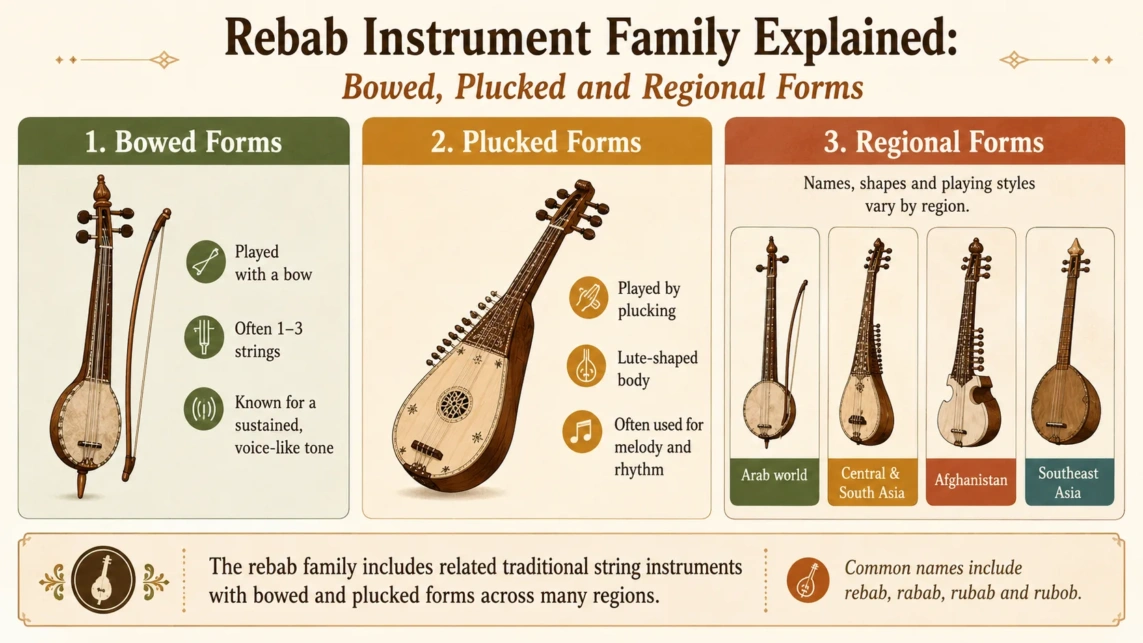
Rebab, rabab, rubab, rababa, rebap and rubob do not point to one single instrument with one fixed shape. They form a wide instrument family of skin-faced string instruments, some bowed and some plucked, found across parts of North Africa, the Middle East, Central Asia, South Asia and Southeast Asia. The shared name can be confusing because a Javanese rebab, an Egyptian rabāba and an Afghan rubāb may look, sound and function very differently.
The safest way to understand the rebab instrument family is to treat it as a group of related names attached to regional chordophones rather than as one standardized model. In many documented forms, the family is linked by a membrane soundboard, a light resonating body, a singing or nasal tone, and a close connection to vocal melody.
What the Rebab Instrument Family Includes
The rebab family includes bowed spike fiddles, short-necked plucked lutes, and several regional instruments whose names changed with language, court culture, craft practice and performance setting. Some are held upright and bowed. Others are held like a lute and played with a plectrum.
This is why a simple description such as “the rebab is a bowed instrument” is only partly true. It fits many Arab, Turkish, Egyptian, Javanese and Malay forms, but it does not fully describe the Afghan rubab, Kabuli rubab, Pamiri rubab or several Central and South Asian plucked forms.
Instrument Research Note: In organology, the rebab name is best read as a family label. Shape, string count, playing method and tuning may change by region, maker and musical tradition.
Bowed, Plucked and Regional Forms Compared
The table below shows the main families a reader is likely to meet when researching rebab, rabab or rubab instruments. It is not a fixed classification for every local form, but it helps separate the most common meanings.
| Form | Typical Playing Method | Common Features | Regional Context |
|---|---|---|---|
| Arab rabāb or rabāba | Bowed | Membrane belly, often one to three strings, no fingerboard in many forms | Arab music, folk singing, older court and ensemble settings |
| Egyptian rabāba / kamānja agūz | Bowed | Coconut or bowl-like resonator, skin face, horsehair strings in documented examples | Folk singing and older Arabic ensemble contexts |
| Javanese rebab | Bowed | Two strings, upright spike construction, membrane soundboard, no fingerboard | Central Javanese gamelan, especially soft-style repertoire |
| Afghan rubab / Kabuli rubab | Plucked | Short-necked lute, carved wooden body, skin-covered face, melody and sympathetic strings in many modern examples | Afghan, Pashtun, and wider Central and South Asian music |
| Pamiri rubab and related Central Asian forms | Usually plucked | Regional body shapes, skin or wood soundboard depending on type, local tunings | Tajik, Pamiri and neighboring traditions |
| Turkish rebap and related bowed forms | Bowed | Small resonator, skin face in many examples, upright playing position | Classical, Sufi, folk and historical instrument contexts |
Why One Name Covers So Many Instruments
The spellings rebab, rabab, rubab, rubāb, rababa, rebap and rubob reflect movement across languages, scripts and musical regions. Arabic, Persian, Turkish, Pashto, Tajik, Uzbek, Indonesian and Malay contexts all shaped local usage.
The name also traveled with musicians, courts, traders, religious settings and craft lineages. Over time, regional makers adapted the instrument to local music. A bowed spike fiddle could suit a singer’s line. A plucked short-necked lute could support rhythmic melody, drone and ornament.
That is why the family should not be forced into a single body plan.
Main Structural Ideas Behind the Family
Most rebab-family instruments share a simple but effective acoustic idea: strings vibrate through a bridge into a light resonator. In many forms, the soundboard is skin rather than carved wood. This helps produce a direct, slightly dry, speech-like attack.
Membrane Soundboards
A skin-covered face appears in many documented rebab and rubab types. The skin may be goat, hide, bladder membrane or another prepared animal membrane, depending on the region and maker. It is usually thin and sensitive to humidity, heat and tension.
A membrane soundboard often gives the instrument a clear attack and a compact resonance. It may not sustain like a large wooden lute top, but it can carry melodic detail well.
Resonating Bodies
Body shapes vary widely. Some bowed rabāb forms have pear-shaped, boat-shaped, round, rectangular or trapezoid bodies. Some spike fiddles use a coconut-shell or bowl-like resonator. The Afghan rubab is commonly carved from mulberry wood in many respected examples, with a skin-covered lower table.
Wood choice can shape resonance, but it should not be treated as the only reason an instrument sounds a certain way. Body depth, bridge design, skin tension, string material, playing hand and local tuning all matter.
Fingerboards and Stopping Technique
Many bowed rebab forms do not use a fingerboard in the violin sense. The player stops or touches the string directly with the fingers while the string remains free of a hard board underneath. This allows subtle slides, vocal turns and flexible intonation.
Plucked rubab forms may also be unfretted or built with regional fingerboard arrangements depending on type. The Afghan rubab, for example, is often discussed as a plucked lute with a short neck and a deep body, not as a bowed fiddle.
Luthier’s Note: On skin-faced instruments, the bridge is not just a string support. Its height, foot shape and contact with the membrane can change response, volume and playing feel. Small changes may be noticeable.
The Bowed Side of the Rebab Family
Bowed rebabs are often held upright. Some rest on the lap, some on the floor, and some use a spike or post that passes through the body. The bow may be looser than a modern violin bow, and in some traditions the player controls hair tension by hand while bowing.
The bowed sound is often described as close to the human voice because it can bend into pitches, sustain notes and decorate a melodic line with slides. That does not mean every bowed rebab sounds the same. A Javanese court rebab and an Egyptian rabāba have different bodies, musical roles and tone colors.
Arab Rabāb and Rabāba Forms
In Arabic-language contexts, rabāb and rabāba have been used for bowed instruments with membrane bellies and a small number of strings. Historical usage can be broad; in medieval writing, the term could also be used more generally for bowed instruments.
Many forms are light, portable and close to vocal performance. Some support poetry, narrative song or folk melody. Others belonged to older ensemble settings before newer bowed instruments became more common in urban music.
Javanese Rebab
The Javanese rebab is a bowed two-string lute used in gamelan. It often has a delicate upright body with a membrane face, a spike-like vertical structure and two long tuning pegs. The player sits on the floor and bows the instrument upright.
Its musical role is refined and demanding. Rather than carrying loud rhythm, it helps guide melodic flow, supports singers and introduces or shapes soft-style pieces. The instrument’s flexible pitch is part of its value because gamelan melody is not only a matter of fixed notes; it also depends on contour, timing and expressive placement.
Turkish Rebap and Nearby Bowed Traditions
Turkish rebap forms are usually discussed as bowed, upright instruments with a small resonator. In some modern examples, the body may use coconut shell and skin, with horsehair or metal-related string materials depending on the maker and tradition.
These forms sit near a wider family of bowed lutes and spike fiddles, including kemençe-type instruments in neighboring traditions. The names may overlap in casual speech, but the construction and repertory are not identical.
The Plucked Side of the Family
The plucked rubab is the form many readers know through Afghan music. It looks more like a short-necked lute than a spike fiddle. It is commonly played with a plectrum and has a firm, percussive attack.
The Afghan rubab, often called Kabuli rubab, is widely associated with Afghanistan and with musical traditions in nearby regions. It is also played in parts of Pakistan and India, and it has strong links with Pashtun, Afghan and Hindustani-influenced performance settings.
Afghan Rubab
The Afghan rubab usually has a carved wooden body, often associated with mulberry in respected descriptions, a skin-covered face, a short neck and multiple string groups. Many modern instruments include melody strings, drone strings and sympathetic strings that vibrate in response to the played notes.
Its tone is bright, dry and rhythmic, with a short punch at the front of the note. The skin face and plectrum attack help create that clear edge. Ornamentation comes from quick plucks, left-hand movement, resonance from sympathetic strings and the player’s control of rhythm.
Pamiri Rubab, Rubob and Related Central Asian Names
Central Asian names such as rubob, robab and rubab may refer to local lute forms that do not match the Afghan rubab exactly. Some are long-necked, some are short-necked, and their construction can differ by region.
For a reader comparing instruments, the important point is not the spelling alone. The body shape, neck length, soundboard material, string layout and playing method tell more than the name on its own.
Regional Note: A rubab in Afghanistan, a rubob in Tajik or Uzbek contexts, and a rebab in Java may belong to the same broad naming family, but they should be studied as regional instruments with their own craft logic.
Sound and Playing Feel
The rebab family often favors a sound that is direct rather than heavily sustained. Bowed forms can sing with a narrow, vocal line. Plucked forms can sound dry, bright and percussive.
Three details shape much of the listening experience:
- Skin tension: A tighter or looser membrane can change response and brightness.
- Bridge contact: The bridge transfers vibration into the body and may strongly affect clarity.
- String layout: One, two, three or multiple string groups create very different musical uses.
In bowed forms, slides and pressure-stopped notes give the instrument a flexible line. In plucked rubab forms, rhythmic clarity and sympathetic resonance become more central.
How It Differs from Related Instruments
The rebab family often appears near the rebec, sarod, kamancheh, kemençe and oud in instrument histories. These links are useful, but they need careful wording.
Rebab and Rebec
The medieval European rebec is often discussed in relation to older rabāb forms. Both names are linked in historical writing, and both belong to bowed string history. Still, a rebec is not simply a rebab under a European name. Its body, repertory and later musical context developed separately.
Afghan Rubab and Sarod
The Afghan rubab is often mentioned when discussing the ancestry of the sarod. The connection is musically plausible in many histories of North Indian instruments, especially because both are plucked and share some broad lute-family traits. Yet the sarod developed its own metal fingerboard, playing technique, repertory and tonal identity.
Rebab and Kamancheh
Bowed rebab forms and kamancheh-type spike fiddles may look related because both can be played upright and bowed. The difference lies in construction details, regional repertory, tuning habits and body design. A family resemblance should not erase local identity.
Common Misunderstandings
Several mistakes appear often when people first research the rebab instrument family.
- Assuming every rebab is bowed: Many are bowed, but important rubab forms are plucked.
- Assuming every rubab is Afghan: The Afghan rubab is famous, but rubab and rubob names also appear in other regions.
- Using spelling as the only guide: Spelling depends on language and transliteration. Construction gives better evidence.
- Treating all skin-faced lutes as the same: Similar materials can produce very different instruments.
- Ignoring musical role: A court gamelan rebab, a folk rabāba and a plucked Afghan rubab serve different musical needs.
How to Identify a Rebab-Family Instrument
When looking at an instrument in a museum, collection, shop or performance video, begin with structure rather than name.
- Check whether it is bowed or plucked.
- Look for a skin-covered soundboard.
- Notice the body shape: bowl, coconut shell, carved lute body, boat shape, rectangular frame or spike body.
- Count the visible strings, but remember that sympathetic strings may be hidden or partly obscured.
- Look for frets or a fingerboard; many bowed forms do not have either.
- Identify the region attached to the instrument, not only the spelling used in the label.
This approach avoids the common error of calling every rebab-family instrument the same object.
Museum and Collection Context
Rebab-family instruments can be difficult to document because many are fragile. Skin soundboards, organic string materials, light bridges, coconut-shell resonators, ivory or wood posts, and old glue joints may not survive heavy handling. A museum example may be missing strings, bridge, bow or part of the neck.
Labels may also reflect older cataloguing language. A single object might be listed as rabāba, rebab, spike fiddle, bowed lute or regional fiddle depending on the collector and the period of cataloguing.
Collector’s Note: For older rebab-family instruments, originality is not only about age. Look for consistent construction: body material, membrane type, peg style, bridge marks, string path, repair history and regional label.
Learning Context for Beginners
A beginner should first choose the regional form. Learning “the rebab” is too broad a goal. A Javanese rebab requires gamelan knowledge and subtle intonation. An Afghan rubab requires plectrum technique, string-group awareness and familiarity with regional melodic practice. An Arab rabāba may be closer to sung poetry or folk accompaniment.
For practical study, the first decision is simple:
- Choose a bowed rebab if the goal is vocal-style melody, slides and upright fiddle technique.
- Choose a plucked rubab if the goal is Afghan, Central Asian or related lute repertory.
- Choose a regional teacher rather than relying only on generic tuning charts.
Tuning, string gauges and setup can vary. Beginners should avoid forcing one online tuning onto an instrument that was built for another regional practice.
Why the Family Matters
The rebab instrument family matters because it shows how one name can travel while instruments change around it. A membrane-faced bowed fiddle, a court gamelan instrument and a plucked Afghan lute may not share the same playing technique, yet they remain linked through naming, materials, history and regional adaptation.
That variety is the point. The family is not a neat row of identical instruments. It is a set of related musical solutions shaped by singers, makers, courts, folk musicians, teachers and local ears.
FAQ
Is the rebab always a bowed instrument?
No. Many rebab and rabāba forms are bowed, especially spike fiddle types, but several rubab forms are plucked. The Afghan rubab is one of the best-known plucked members of the wider family.
What is the difference between rebab, rabab and rubab?
The spellings often reflect language and transliteration rather than one fixed design. Rebab and rabab often appear for bowed forms, while rubab is often used for plucked Central and South Asian lutes, but usage varies by region.
Does every rebab have a skin soundboard?
Many documented rebab-family instruments use a skin or membrane soundboard, but not every regional instrument with a related name is built in the same way. The soundboard should be checked on the actual instrument.
What makes the Afghan rubab different from a bowed rebab?
The Afghan rubab is usually a plucked short-necked lute with a carved body, skin-covered face and multiple string groups in many modern examples. A bowed rebab is usually played upright with a bow and often has fewer strings.
Is the Javanese rebab related to the Middle Eastern rabab?
The Javanese rebab is widely understood as part of the broader rebab naming and instrument family, but it developed its own role inside gamelan. Its construction, tuning practice and musical function should be studied in the Javanese context.
Can a beginner learn the rebab without knowing the regional style?
It is possible to begin, but progress is easier when the regional form is clear. A beginner should first decide whether the goal is Javanese rebab, Arab rabāba, Afghan rubab, Turkish rebap or another local type.