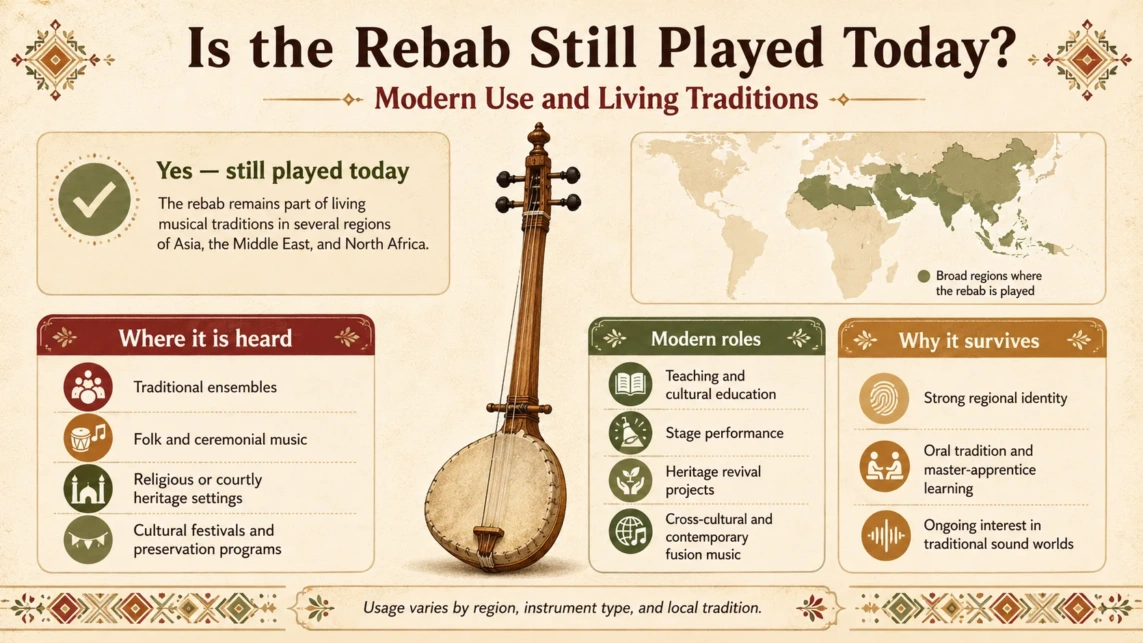
Yes, the rebab is still played today, but not as one single instrument with one fixed shape, tuning, or musical role. The name survives across several living traditions: the bowed rebab of Javanese and Sundanese gamelan, the three-string Malay rebab of Mak Yong theatre, the plucked rubab or rabab of Afghanistan and nearby regions, and related bowed rabāba forms used with folk singing in parts of the Arab world.
That answer needs care. A rebab in Java is not the same object as an Afghan rubab. A Malay rebab in Kelantan is not built like an Egyptian rabāba. They share a name-family and a broad history of bowed or plucked string instruments, yet their present-day use depends on local music, teaching lineages, ceremony, stage performance, museum study, and instrument making.
The rebab is therefore not only a historical instrument. It is a living instrument family, although some branches are more active, visible, and institutionally supported than others.
Main Point: The rebab is still played today in several forms. It remains active in gamelan, Mak Yong, Central Asian and Afghan rubab traditions, folk singing contexts, teaching settings, and some contemporary performance projects. Its survival is uneven, because each regional form has its own players, makers, audiences, and pressures.
Where the Rebab Remains a Living Instrument
The strongest answer comes from looking at actual performance settings. The rebab is not kept alive in one place only. It appears in court-linked ensemble music, village and regional theatre, family-based craft traditions, conservatory study, folk singing, staged heritage events, and new recordings.
The spelling often changes with language and region. Rebab, rabab, rubab, rubāb, rabāba, rebap, and rubob may point to related but different instruments. That is why the question “Is the rebab still played?” has several correct regional answers.
| Regional Form | Common Playing Method | Current Setting | What to Notice |
|---|---|---|---|
| Javanese and Sundanese Rebab | Bowed | Gamelan ensembles, teaching, formal performance | A flexible melodic instrument that ornaments, responds to singers, and helps shape the melodic line. |
| Malay Rebab | Bowed | Mak Yong theatre and related regional traditions | Often treated as a lead instrument with strong ceremonial presence. |
| Afghan Rubab / Rabab | Plucked | Solo music, ensemble music, teaching, recordings, heritage programs | A short-necked lute with a skin soundboard, sympathetic strings in many examples, and a bright, resonant attack. |
| Central Asian Rubab / Rubob Forms | Usually plucked | Regional art music, folk music, conservatory and stage settings | Names and construction vary across Tajik, Uzbek, and nearby traditions. |
| Arab Rabāba Forms | Bowed | Folk singing, oral poetry, regional heritage performance | Often simpler in construction, with one or two strings depending on the form. |
Modern Use Is Not the Same Everywhere
Some rebab traditions are strongly tied to ensemble life. Others survive through solo players, family makers, or cultural festivals. A few forms are now heard more often in staged heritage settings than in everyday social life.
This unevenness matters. An instrument can be alive even when it is no longer common in every village or household. It can also be endangered in one region while healthy in another.
For a curator, this is the most useful way to describe the present situation: the rebab is still played, but its continuity depends on the tradition being discussed.
In Gamelan Music
In Javanese and Sundanese gamelan, the rebab remains one of the bowed string voices of the ensemble. It is usually held upright and played seated. The instrument can support singers, shape melodic direction, and add ornament around the main melodic structure.
The sound is not loud in the way a gong or metallophone is loud. Its value lies in its curved melodic line, soft attack, and ability to move between fixed pitches with vocal-like nuance.
A 2026 Sundanese Performance Study
A study published on January 31, 2026, Rebaban Performance in The Song “Gorompol” at Kliningan Sunda, provides a documented example of how the rebab functions in current Sundanese performance. Researchers Soni Tresnadi, Marsel Ridky Maulana, Lili Suparli, and Endah Irawan examined Gorompol as performed within Sundanese Kliningan through observation, interviews with practitioners, and analysis of performance recordings.
The study identifies the rebab as a central melodic voice in the Gorompol sekar-gending. Its role includes pamurba lagu, the shaping and guidance of melodic movement, together with interaction between the bowed line, vocals, rhythm, and other gamelan instruments. The rebab is therefore doing more than adding sustained notes to a predominantly percussive ensemble.
Particular attention is given to reureueus, melodic embellishments used in Sundanese rebaban. Variations in ornament, dynamics, and phrasing help the rebab respond to the vocal line and shape the character of the Kliningan performance. This provides a concrete present-day example of the melodic guidance and ornamentation often associated with Sundanese rebab playing.
Listening Note: In Sundanese Kliningan, listen for how the rebab approaches and leaves vocal phrases rather than only following its pitch. Reureueus ornaments, changes in melodic contour, and the relationship between rebab and singer help give the performance its local character.
In Mak Yong and Malay Regional Performance
The Malay rebab is still linked with Mak Yong, a dance-theatre tradition associated especially with Kelantan and nearby cultural areas. This rebab is not merely background accompaniment. In many descriptions of the tradition, it holds a respected place in the small ensemble.
Its body, neck, pegs, skin face, and ornamental head can make it visually different from the slimmer Javanese spike fiddle. It is usually discussed as a three-string bowed instrument, though exact construction can vary by maker and local practice.
Mak Yong’s rebab tradition also shows why “played today” is more than a technical question. The instrument belongs to performance etiquette, story, movement, teaching, and regional identity. Remove it, and the musical color of the form changes.
In Afghan and Central Asian Rubab Traditions
The Afghan rubab is among the best-known plucked relatives in the wider rabab family. It is often built with a carved wooden body, a skin-covered soundboard area, gut or nylon-like main strings in some modern examples, and sympathetic strings in many documented instruments. Mulberry is often mentioned in relation to traditional bodies, but materials may vary by maker and period.
This form is still played by soloists, ensemble musicians, teachers, and diaspora performers. It appears in classical, folk, devotional, and contemporary settings, depending on the musician and context.
The art of crafting and playing rubab/rabab was inscribed on UNESCO’s Representative List of the Intangible Cultural Heritage of Humanity in 2024 for Afghanistan, Iran, Tajikistan, and Uzbekistan. That recognition does not make the instrument “safe” by itself, but it does show that the craft and performance practice are understood as living cultural knowledge, not only as museum history.
In Arab Rabāba and Folk Singing Contexts
Several Arab rabāba forms are still used in folk singing and oral poetry settings, although their public role has changed in some places. The instrument may have a simple body, skin or hide covering, one or two strings, and a bow. Some museum records describe forms that are still used to accompany folk singers even where the violin has replaced them in other ensemble roles.
This is a common pattern in living instrument history: a form may lose one musical job and keep another. The rabāba may no longer sit in the same ensemble place everywhere, yet it can remain meaningful for song, narration, and local memory.
What Keeps the Rebab Alive?
The rebab survives through use, not just preservation. A polished instrument in a display case can teach construction history, but a living tradition needs players, makers, listeners, and occasions where the instrument still has a reason to sound.
Teaching Lineages
Many rebab and rubab traditions are learned by close listening, imitation, and correction from a teacher. Written notation can help in some settings, especially in schools or conservatories, but it rarely captures the whole style.
Small details matter: bow pressure, plucking angle, ornament, timing, pitch shading, and how the player enters after a vocal line or drum cue. These are often learned by sitting near someone who already knows the practice.
The 2026 Gorompol research connects this directly with Sundanese rebab teaching. Because pamurba lagu, reureueus, dynamics, and interaction with the vocal part can be studied within an actual repertoire item, the performance offers material for teaching rebaban as a musical practice rather than as isolated bowing exercises. The researchers also relate this work to maintaining Sundanese gamelan aesthetics through transmission to players.
Instrument Makers
A rebab tradition also needs people who can build and repair instruments. Makers understand how wood, skin, bridge placement, string tension, and body shape interact. The craft is practical, but it is also cultural memory held in the hand.
Luthier’s Note: Skin soundboards can react to humidity and temperature more noticeably than many wooden soundboards. That does not make them weak or inferior. It means the player and maker must understand climate, tension, and storage with care.
Performance Occasions
The rebab stays active where it still has musical work to do. That work may include:
- leading or decorating a melodic line in ensemble music;
- supporting singers and theatre performers;
- carrying solo repertoire;
- marking ceremonies and regional gatherings;
- teaching students about older musical systems;
- appearing in recordings, concerts, and heritage programs.
When those occasions shrink, the instrument becomes harder to maintain as a normal part of musical life. When they grow, even a quiet instrument can regain public attention.
How Modern Players Use the Rebab
Modern rebab use ranges from careful traditional performance to new ensemble experiments. The best examples do not treat the instrument as a decorative antique. They let its actual sound and technique shape the music.
Traditional Ensemble Performance
In established traditions, the rebab is usually learned inside a musical grammar. A Javanese rebab player does not simply “add a bowed sound” to gamelan. The player responds to form, mode, tempo, vocal contour, and ensemble cues.
The same applies to Sundanese performance, although its playing vocabulary and ensemble relationships should not be collapsed into Javanese practice. The documented Gorompol performance shows a rebab player shaping ornament and melodic movement in relation to the singer and Kliningan ensemble. The instrument’s role depends on knowing when and how to phrase within that musical setting.
Likewise, a rubab player in Afghan or Central Asian practice works with melodic modes, rhythmic cycles, ornament vocabulary, and the physical response of the instrument. The hand position, plectrum stroke, and resonance all belong to the style.
Contemporary Recordings and Concert Stages
The rebab and rubab now appear in concert halls, university ensembles, online performances, and cross-cultural projects. Some players present traditional repertoire. Others place the instrument with guitar, percussion, strings, or electronic textures.
Not every fusion setting respects the instrument equally. A good modern arrangement leaves room for the rebab’s natural voice: the short decay of a plucked rubab, the vocal slide of a bowed rebab, or the dry, direct tone of a folk rabāba.
Diaspora and Online Learning
Diaspora communities have helped several rabab and rubab traditions remain visible. Recordings, remote lessons, and online demonstrations now allow students to hear players they might never meet in person.
This can widen access, but it also creates a problem. A student may learn finger positions or basic tunes from a screen without absorbing the deeper performance etiquette. For many rebab traditions, context still matters.
What the Instrument Sounds Like Today
There is no single rebab sound. The present-day sound depends on the regional form.
A bowed Javanese rebab can sound soft, nasal, and fluid, with pitch movement that resembles vocal phrasing. Sundanese rebaban may use finely shaped ornaments and melodic responses that interact closely with a singer. A Malay rebab may carry a more direct theatrical presence. An Afghan rubab has a plucked attack, a warm body response, and a ringing quality when sympathetic strings are present. A simple rabāba used with folk singing may sound raw, focused, and speech-like.
These differences are not minor. They explain why the rebab family cannot be judged by one recording or one museum object.
Material Note: Wood choice can shape resonance, but it is only one part of the sound. Skin thickness, bridge design, string material, body size, humidity, and the player’s touch can all change the final tone. Regional forms should not be reduced to one material formula.
Why Some People Think the Rebab Disappeared
The rebab is sometimes mistaken for an extinct instrument because it is less visible than guitar, violin, oud, sitar, or sarod in global media. In some places, it has also been replaced in certain ensemble roles by louder or more standardized instruments.
Another reason is naming. A listener may hear a living rubab tradition but not connect it to the word rebab. Or they may see a rabāba in a folk setting and assume it is unrelated to Southeast Asian rebab forms.
Museum displays can add to the confusion. A late nineteenth-century rebab behind glass may look like a relic. Yet similar instruments, or later regional descendants, may still be played in teaching rooms, theatres, homes, and ceremonial spaces.
Current repertoire research provides another type of evidence. A 2026 study built around an identifiable Sundanese song, named performers, recorded performances, observation, and practitioner interviews shows that the rebab can still be studied inside working musical practice rather than only through surviving historical objects.
Bowed Rebab and Plucked Rubab in Current Practice
The modern rebab family divides broadly into bowed and plucked forms. This division is useful, but it should not be treated as a strict family tree with one clean line of descent.
| Feature | Bowed Rebab / Rabāba Forms | Plucked Rubab / Rabab Forms |
|---|---|---|
| Sound Production | A bow draws sound from one or more strings. | A plectrum or fingers pluck the strings. |
| Common Role | Melodic ornament, vocal support, theatre, folk song. | Solo melody, ensemble lead, rhythmic-melodic patterns. |
| Typical Body Idea | Often a spike fiddle or small bowed lute form, depending on region. | Often a short-necked lute with a carved body and skin-covered soundboard area in Afghan examples. |
| Modern Visibility | Strong in gamelan and selected theatre or folk settings. | Strong in Afghan, Central Asian, diaspora, and heritage performance contexts. |
The names overlap because instrument names travel. A spelling alone does not prove the exact structure. The safest method is to identify the region, playing method, body shape, string layout, and performance setting.
Is the Rebab Easy to Find or Learn Now?
It depends on the type. A student in a city with a gamelan program may find a Javanese or Sundanese rebab through an ensemble. A student seeking Afghan rubab may find teachers through diaspora networks, music schools, or online lessons. A student looking for a specific Malay rebab or Arab rabāba form may need a much more local connection.
Learning also depends on the goal. Basic sound production can begin quickly on some forms, but style takes time. Bowed rebab technique can feel unfamiliar to violin players because the posture, bow tension, string contact, and pitch approach may be different. Plucked rubab technique brings its own challenges in right-hand control, ornament, tuning, and sympathetic resonance.
What Beginners Should Check First
- Which regional form is being studied: rebab, rabab, rubab, rabāba, rebap, or rubob.
- Whether the instrument is bowed or plucked.
- Whether the teacher works within a specific tradition or offers a general introduction.
- What tuning is used in that tradition.
- Whether the instrument needs climate care because of skin, hide, or older glue work.
- Whether replacement strings, bridges, and repair knowledge are available.
These points matter more than choosing the most ornate instrument. A playable, stable instrument with a good teacher is usually more useful than a decorative piece with uncertain setup.
The Rebab in Museums and Living Heritage
Museums help preserve older rebab forms by documenting materials, dimensions, regions, and object histories. A museum label may identify a rebab as a bowed unfretted lute, a spike fiddle, or a regional chordophone. That language helps compare instruments across cultures.
But museum study has limits. It can show how an instrument was built. It cannot fully show how a player shaped a phrase, adjusted a bow, tuned for a particular ensemble, or responded to a singer.
Performance research can record some of those relationships while they are still practiced. The 2026 Gorompol study is useful here because observation, recordings, and practitioner interviews preserve information about ornament, melodic leadership, dynamics, and vocal interaction that cannot be recovered from the physical rebab alone.
Living heritage fills that gap. A rebab in performance carries gesture, timing, posture, memory, and social meaning. Both museum records and living players are needed to understand the instrument well.
Collector’s Note: Older rebab-family instruments should be identified with region and playing method, not only by name. A label that says “rebab” may refer to a bowed spike fiddle, while “rubab” may refer to a plucked lute. Materials, string count, bridge type, and wear marks often reveal more than spelling.
Common Misunderstandings About the Rebab Today
“The Rebab Is One Instrument”
The name covers related instruments, not one fixed design. A single definition can mislead readers unless it names the region and form.
“It Is Only a Museum Instrument”
Many historical examples are preserved in museums, but related forms are still played. Gamelan rebab, Malay rebab, Afghan rubab, Central Asian rubab forms, and folk rabāba traditions all show present-day use in different ways. The 2026 study of Gorompol also documents Sundanese rebaban within active Kliningan performance rather than as a historical reconstruction.
“All Rebab Instruments Are Bowed”
No. Many rebab forms are bowed, especially in Southeast Asian and Arab contexts. The Afghan rubab and several Central Asian relatives are plucked. The spelling alone does not settle the question.
“Modern Use Means the Old Style Has Vanished”
New recordings and stage settings do not automatically erase older practice. In many cases, modern visibility helps students find the tradition. The risk appears when the instrument is used only as a visual symbol and its technique is ignored.
How to Recognize a Living Rebab Tradition
A living tradition usually shows more than one performer playing an old tune. Look for a chain of use.
- There are active players. They perform, teach, record, or accompany local events.
- There are makers or repairers. Instruments can be built, adjusted, and kept playable.
- There is repertoire. Tunes, modes, patterns, or theatre pieces remain connected to the instrument.
- There is social use. The instrument appears in ensembles, ceremonies, classes, or community spaces.
- There is transmission. Younger or newer players learn from experienced musicians.
The Sundanese Gorompol example meets several of these tests directly: there is named repertoire, active performance, identifiable rebaban technique, interaction with other ensemble members, practitioner knowledge, and material that can be used in teaching. This is much stronger evidence of continuity than the mere survival of an old instrument.