What Is a Rebab Used For?
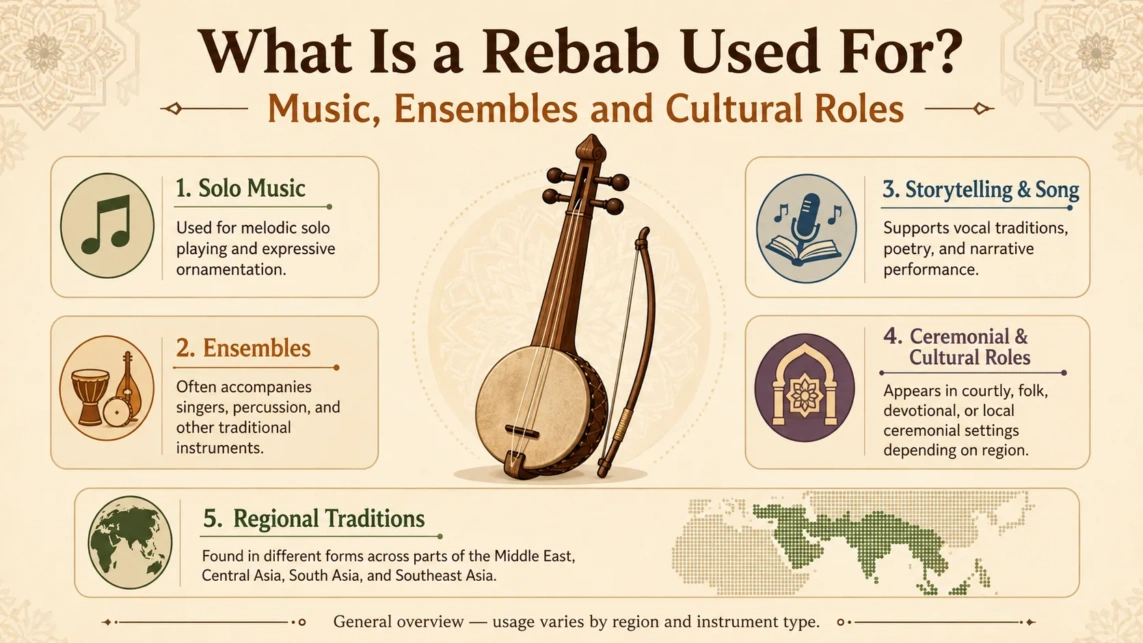
A rebab is used for melody, song accompaniment, poetry, storytelling, dance, theatre, court music, folk music and small ensemble performance. The exact use depends on which regional instrument is meant, because rebab, rabab, rubab, rubāb, rababa, rebap and rubob do not always describe the same instrument.
Some rebabs are bowed spike fiddles. Some are boat-shaped bowed lutes. Some rubabs are plucked, short-necked lutes with a skin-covered soundboard. This is why one answer can be misleading: a Javanese rebab does not work in an ensemble in the same way as an Afghan rubab, and an Arabic rababa does not carry the same role as a Central Asian rubob.
Main point: the rebab family is mainly used to carry or shape melody. In many traditions it supports the voice, leads an ensemble entry, decorates a modal line, or gives a performance its intimate melodic center.
Main Musical Uses of the Rebab
The rebab is rarely just a background instrument. Even when it plays quietly, it often gives musical direction. Its line may introduce a melody, follow a singer, answer a phrase, or add ornament around the main tune.
- Vocal accompaniment: many forms support singing, poetry, epic recitation, or narrative performance.
- Melodic leadership: some regional rebabs introduce the piece or guide other musicians toward the main pitch path.
- Ensemble color: bowed rebabs can add a vocal, flexible tone against drums, gongs, lutes, flutes, or metal percussion.
- Solo performance: plucked rubab types, especially Afghan-style instruments, can work as solo instruments.
- Dance and theatre: several Southeast Asian forms accompany stage traditions, dance, sung drama, and spoken sections.
- Cultural ceremony: some Central Asian rubab and rubob traditions appear in gatherings, holidays, rituals, and memorial settings.
Uses by Regional Form
The table below keeps the main uses separate so the regional differences stay clear.
| Regional Form | Typical Use | Playing Method | Musical Role |
|---|---|---|---|
| Arabic Rababa | Singing, poetry, Bedouin-style vocal traditions, narrative performance | Usually bowed | Supports the voice with a direct, speech-like melodic line |
| North African Rebab | Song accompaniment and ensemble singing traditions | Bowed | Often follows or frames the vocal melody rather than acting as a solo showpiece |
| Javanese Rebab | Gamelan, court repertoire, soft-style ensemble pieces | Bowed | Leads openings, supports singers, and guides melodic direction |
| Afghan Rubab | Solo music, regional music, art music, popular music, small ensembles | Plucked with a plectrum | Carries melody with a bright, percussive attack and resonant aftersound |
| Central Asian Rubab or Rubob | Traditional ensembles, community gatherings, holiday music, ceremonial settings | Usually plucked, depending on the form | Acts as a leading melodic lute in many local traditions |
| Malay and Related Southeast Asian Rebab Forms | Theatre, dance, sung drama, spoken performance | Bowed | Links voice, movement, and narrative pacing |
Why the Rebab Works So Well with the Voice
Many bowed rebab forms have a narrow but flexible melodic range. That makes them useful beside a singer. The player can slide between pitches, shade a note slightly high or low, and match the contour of sung language.
This matters in poetry and storytelling traditions. A rebab does not need to fill a large concert hall or dominate a full orchestra. It needs to follow breath, syllable, mood, and phrase ending. A single bowed line can do that with great clarity.
Listening Note: when a rebab accompanies singing, listen for how the instrument approaches the note before the singer lands on it. The small slides and ornaments often matter as much as the pitch itself.
How the Rebab Sits Inside an Ensemble
In ensemble music, the rebab often works as a melodic guide rather than a loud anchor. Drums may shape rhythm. Gongs or other percussion may mark structure. Lutes may add pulse or harmony-like support. The rebab can sit above this texture as a flexible line.
Leading the Opening
In some Javanese gamelan contexts, the rebab may play an opening phrase before the larger ensemble enters. This kind of entry does more than start the music. It gives the mode, mood, and melodic path.
Supporting Singers
The rebab can follow male or female vocal lines, decorate them, and help other instruments hear where the melody is moving. In softer ensemble textures, this role can be more audible than its volume suggests.
Answering the Main Melody
In some traditions, a rebab or rubab may answer a sung phrase or repeat a melodic idea in instrumental form. This creates a call-and-response feeling without turning the music into a display of speed.
Bowed and Plucked Uses Are Not the Same
The word rebab often makes readers imagine one instrument. The playing method changes the use.
Bowed Rebab Forms
Bowed forms are often close to the human voice. They can sustain a note, bend into it, and carry a singing line. That makes them useful in poetry, song accompaniment, theatre, court music, and intimate ensemble settings.
Plucked Rubab Forms
Plucked rubab forms, such as Afghan-style rubabs, have a firmer attack. Their skin-covered body can give the sound a dry, clear start, while resonating strings in many examples add a ringing aftertone. This makes the instrument strong in solo passages and small ensembles with drums or other lutes.
Luthier’s Note: use follows design. A skin soundboard can give a rubab a quick, percussive response. A bowed membrane fiddle can produce a thin but flexible line that suits vocal ornament. Wood choice, membrane tension, bridge shape, string material, and body size can all shape resonance, but the result varies by regional form and maker.
Storytelling, Poetry and Social Gatherings
One of the oldest-looking uses of the rebab family is the pairing of a simple bowed line with the spoken or sung word. In Arabic rababa traditions, the instrument is often linked with poetry, praise singing, and narrative performance.
This role makes sense. A one-string or two-string bowed instrument can keep a tonal center without crowding the text. The player can repeat small phrases, pause for the words, then return with a short melodic response.
The instrument can also mark social space. In a small gathering, the rebab is not only heard as a sound source. It helps set the pace of listening. It tells the audience that a sung line, story, or poem has entered a more formal musical frame.
Court, Theatre and Dance Contexts
Several rebab forms are tied to refined performance settings rather than casual entertainment alone. In Central Java, the rebab belongs to the softer side of gamelan performance and has a close link with courtly musical practice. Its tone is quiet, but its musical responsibility is high.
In Malay theatre traditions such as Mak Yong, the rebab can connect singing, spoken delivery, movement, and percussion. The instrument helps the performance breathe between dramatic sections. It can cue mood changes without needing a large melodic range.
These uses show a pattern: the rebab is often trusted with transition. It can lead a beginning, carry a phrase into song, or move attention from speech to dance.
Solo Playing and Modern Performance
Not every rebab is mainly an accompaniment instrument. The Afghan rubab is often used as a solo instrument and in small ensembles. It can carry a full melodic statement on its own, especially when paired with rhythmic support such as tabla, dholak, or other local drums.
Its plucked sound gives clear articulation. Fast notes can remain distinct. Slow phrases can still feel full because many Afghan-style rubabs include resonating strings that enrich the tone after the main string is plucked.
Modern performers also use rubab in cross-cultural ensembles, film music, educational concerts, and museum demonstrations. These settings do not erase older uses, but they do change how listeners meet the instrument: often as a named heritage instrument with a visible craft identity.
Cultural Roles Beyond Performance
The rebab family also carries meaning outside the notes themselves. In many places, the instrument is tied to craft, family teaching, regional identity, oral memory, and ceremonial life.
Craft and Apprenticeship
Making a rebab or rubab can involve carved wood, skin, gut or metal strings, bone or mother-of-pearl decoration, and careful bridge work. The craft knowledge is often passed through direct teaching. A maker learns not only measurements, but also how the instrument should feel in the hand and answer the player.
Community Identity
In Afghanistan, the rubab is widely recognized as a national instrument. In Central Asian contexts, rubab, robāb and rubob names can mark local heritage, regional repertoire, and community performance. In Java, the rebab’s place in gamelan gives it a different kind of identity: less as a solo emblem, more as a voice inside a highly ordered ensemble sound.
Museum and Heritage Value
Older rebabs and rubabs are often preserved as musical instruments and cultural objects. A museum may study the wood, skin, decoration, repair marks, and string layout. These details can show how the instrument was made, where it may have circulated, and what kind of performance life it likely had.
Collector’s Note: a rebab should not be identified by name alone. Body shape, soundboard material, string layout, neck form, bow or plectrum use, and regional decoration all help show what the instrument was probably used for.
How Use Changes the Instrument’s Design
A rebab made for vocal accompaniment does not need the same design priorities as a rubab made for solo plucked performance. Use affects construction.
- For singing: the instrument may favor a direct tone, flexible pitch, and easy response to vocal phrasing.
- For ensemble leadership: the sound must be clear enough for other musicians to follow, even if it is not loud.
- For dance or theatre: the player may need a tone that can cue motion, mood, and dramatic timing.
- For solo rubab: projection, note clarity, string response, and resonance become more visible to the listener.
- For ceremonial use: appearance, inherited form, and symbolic material choices may matter alongside sound.
This is why regional descriptions should be cautious. A “rebab” may have one string or several. It may be bowed or plucked. It may rest upright, lie across the body, or be held like a lute. The use becomes clearer only when the regional form is named.
How It Differs from Related Instruments
The rebab family overlaps with many other string instruments, but its use is not identical to each one.
Rebab and Violin
The violin can cover wide pitch ranges and loud concert settings. Many rebab forms have a smaller range and a more speech-like tone. In some traditions, violins later took over roles once held by local bowed instruments, but the playing feel and cultural setting are not the same.
Afghan Rubab and Sarod
The Afghan rubab is often discussed near the sarod because of historical and design links. The sarod has its own concert tradition, metal fingerboard, and modern classical role. The Afghan rubab keeps a different playing identity, with a skin-covered body and a plucked tone strongly tied to Afghan and regional music.
Rebab and Kamancheh
Both can be bowed and held upright in some contexts, but the kamancheh has its own Persian and neighboring traditions, construction details, and repertoire. A spike, skin soundboard, or bowed technique alone does not make two instruments the same.
Common Misunderstandings About Rebab Use
“Every Rebab Is Bowed”
No. Many rebabs are bowed, but several rubab and rubob forms are plucked. The spelling often gives a clue, but it is not a perfect rule.
“The Rebab Is Only a Folk Instrument”
Not quite. Some forms belong to folk singing or storytelling. Others appear in court music, theatre, art music, ceremonial practice, and museum collections.
“It Is Used the Same Way Everywhere”
The name travels across many languages and regions. The use changes with the body shape, string system, local repertoire, and performance setting.
“It Is Always a Solo Instrument”
Some rubabs are strong solo instruments. Other rebabs are mainly used with singers, dancers, poets, or ensembles. In some traditions, playing alone would not be the normal setting.
FAQ
What is a rebab mainly used for?
A rebab is mainly used to carry melody, support singing, accompany poetry or storytelling, and guide ensemble performance. The exact role depends on the regional type.
Is the rebab used for singing accompaniment?
Yes. Many bowed rebab and rababa forms are closely tied to singing, poetry, and narrative performance because their flexible tone can follow the human voice.
Can a rebab be used as a solo instrument?
Yes, but not every type is used that way. Afghan-style rubabs are often used for solo playing and small ensembles, while some bowed rebabs are mainly used for accompaniment.
What is the rebab used for in gamelan?
In Javanese gamelan, the rebab can lead an opening phrase, support singers, and guide melodic direction in softer ensemble pieces.
Is the rebab used in ceremonies?
In some Central Asian and related traditions, rubab or rubob forms are used in gatherings, holidays, rituals, and memorial settings. This depends on the local tradition.
Why do different rebabs have different uses?
Different rebabs have different uses because the name covers several regional instruments. A bowed spike fiddle, a boat-shaped fiddle, and a plucked Afghan rubab do not have the same design or musical role.