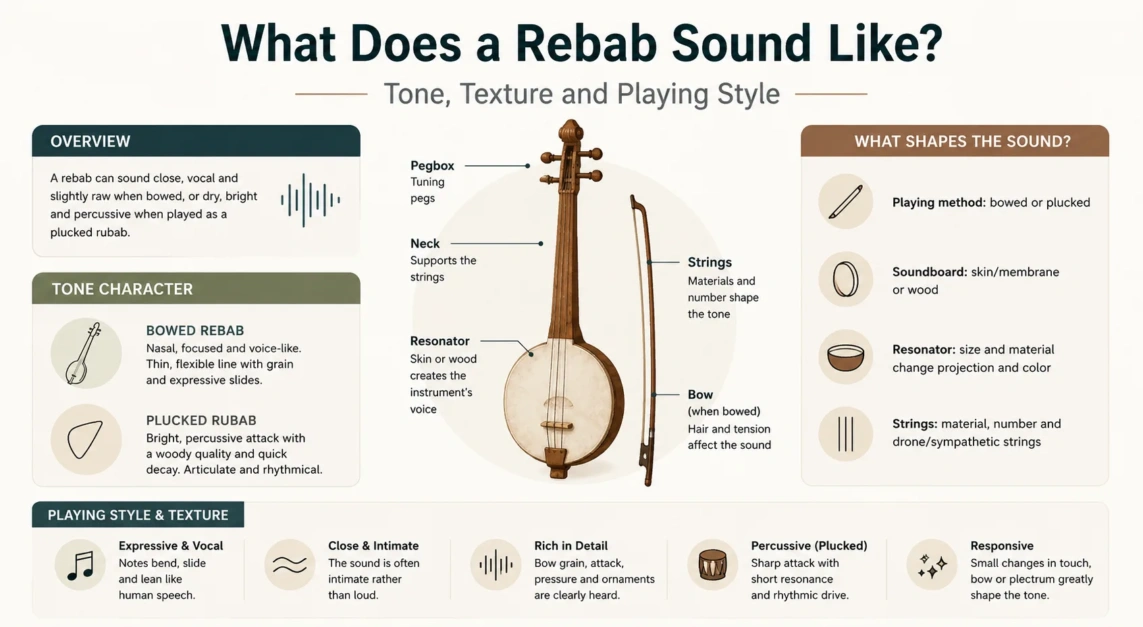
A rebab can sound close, vocal and slightly raw when bowed, or dry, bright and percussive when played as a plucked rubab. The first thing to know is that rebab, rabab, rubab, rababa and related spellings do not point to one single sound. They point to a family of regional string instruments with different bodies, strings, soundboards and playing methods.
The shared impression is usually intimate rather than loud. Many rebab-type instruments carry a compact tone, a clear attack and a texture shaped by skin, wood, gut, hair, metal or nylon strings, and the player’s touch. Some forms sing in a thin bowed line. Others speak with a sharp plucked snap followed by a short, woody resonance.
What a Rebab Usually Sounds Like
The most familiar bowed rebab tone is nasal, focused and voice-like. It does not usually have the broad polish of a violin. Instead, it often gives a slender, flexible line with visible grain in the sound. The bow may catch the string with a soft rasp at the start of a note, then settle into a sustained pitch.
On many bowed forms, the sound feels close to speech. Notes can bend, lean and slide. This makes the instrument well suited to ornamented melody, vocal imitation and expressive phrasing.
Plucked rubab forms sound different. The Afghan rubab, for example, is known for a lively, percussive attack. Its skin-covered body and short-necked construction give the plucked note a firm front edge, then a warm but quickly fading resonance. Where a bowed rebab may sing through a line, a plucked rubab often speaks in articulate pulses.
Listening Note: If the sound feels thin at first, listen for the movement inside the note. A rebab often reveals itself through slides, pressure changes, small pitch turns and the way the tone opens or tightens under the bow or plectrum.
Why the Sound Changes by Region
There is no single global rebab standard. The name has traveled across Arabic, Persian, Central Asian, South Asian, Southeast Asian and related musical settings. In one place it may mean a bowed spike fiddle. In another, it may mean a plucked lute with sympathetic strings. That is why two instruments with similar names can sound almost unrelated.
The sound depends on four main areas:
- How the string is activated: bowed, plucked with a plectrum, or in rare cases handled in a mixed way.
- The soundboard: skin or membrane gives a different response than a wooden top.
- The resonator: a small coconut shell, carved wooden bowl, hollowed wooden body or covered chamber changes projection and color.
- The string setup: horsehair, gut, metal, nylon, drone strings and sympathetic strings all change the surface of the sound.
Even within one region, workshop practice and player preference matter. A luthier may change bridge height, membrane tension, neck angle, string material or plectrum thickness. Small changes can make the instrument feel brighter, drier, softer or more open.
| Form | Playing Method | Typical Sound Character | Texture Heard by the Listener |
|---|---|---|---|
| Javanese Rebab | Bowed upright | Thin, flexible, vocal and ornamented | Sustained melodic line with slides and soft bow grain |
| Arab Rababa or Rabāb Forms | Usually bowed | Direct, nasal and speech-like | Lean tone with strong melodic expression |
| Malay Rebab | Bowed upright | Reedy, close and shaped by membrane response | Softly buzzing or muted color in many examples |
| Afghan Rubab | Plucked with plectrum | Woody, bright, percussive and resonant | Clear attack, short decay and sympathetic shimmer |
| Central Asian Rubab Variants | Often plucked | Clear, ringing and more lute-like | Patterned picking, drones or decorative resonance depending on type |
Bowed Rebab Tone: Thin, Vocal and Highly Shaped
A bowed rebab often uses a small resonator and a skin or membrane face. That construction tends to produce a tone with less long sustain than a modern violin, but with a sharper human edge. The sound can feel narrow, yet it can carry a melody with great clarity.
The bowing style matters as much as the instrument itself. On some traditions, the bow hair is not held under the fixed tension of a Western violin bow. The player may control tension by hand. That can make the attack feel softer, more flexible and more exposed.
Because the tone is so direct, small actions become audible:
- how firmly the bow touches the string,
- whether the pitch slides into place,
- how much pressure the left hand gives,
- how the bow changes direction,
- and how long the note is allowed to ring.
This is why a rebab line may sound almost vocal. It can hover around the pitch before landing. It can lean into a note, retreat, then rise again. The beauty is not in a wide, polished sound. It is in the controlled fragility of the line.
The Nasal Quality
The word nasal can sound negative, but for a rebab it is usually descriptive. It means the tone has a tight center and a forward upper color. A small membrane resonator can push the sound toward that focused, reed-like quality.
In ensemble music, this helps the rebab cut through soft percussion, metallophones, voices or other strings without needing great volume. It gives the ear a thread to follow.
The Bow Grain
Many bowed rebabs keep a little friction in the tone. The bow does not always hide its contact with the string. A faint scratch, breath or grain at the beginning of the note can be part of the instrument’s character.
That texture is one reason a rebab may feel older or more handmade to modern ears. The tone does not erase the physical act of playing.
Luthier’s Note: A skin or membrane soundboard can react strongly to bridge pressure and local humidity. Two rebabs with similar outlines may still sound different if the membrane tension, bridge fit or string material is changed.
Plucked Rubab Tone: Dry Attack and Warm Resonance
The plucked rubab, especially the Afghan rubab, belongs to a different listening experience. It is not a bowed line instrument in the same way. It has a more percussive front edge, and the plectrum gives each note a clear start.
A typical Afghan rubab body uses a carved wooden form with a skin-covered resonating face. Many examples use a short neck, melody strings, drone strings and sympathetic strings. The exact setup varies by maker and tradition, so it should not be treated as one fixed design.
The first sound is often a compact tak or pluck. After that comes a rounded wooden body tone. Sympathetic strings, when present and well set up, add a fine after-ring around the main note. This can create a halo without turning the sound soft.
Why It Can Sound Percussive
The rubab’s percussive feel comes from the meeting of plectrum, string and skin-covered body. The note begins with a strong attack, then decays more quickly than many long-necked lutes. Fast passages can therefore sound crisp and rhythmic.
This is one reason rubab playing can feel both melodic and drum-like. The melody has pitch, but the picking also shapes time.
The Sympathetic Ring
On rubab forms with sympathetic strings, some strings are not played directly in normal melody. They vibrate in response to nearby pitches. The listener may hear this as a light shimmer or inner resonance beneath the main notes.
This effect is not always loud. It depends on tuning, setup, touch and room acoustics. In a close recording it may be more obvious than in a noisy room.
Texture: What the Ear Notices After the First Note
Texture is the surface of the sound. With rebab-type instruments, texture often tells more than volume does.
A bowed rebab can have a fibrous, breath-like texture. The note may not be perfectly smooth. It may carry a gentle rasp, a sliding entry or a slight wavering around the pitch. These details are not flaws when controlled. They are part of the style.
A plucked rubab has a different texture: dry attack, short decay, body resonance and sometimes sympathetic after-ring. The sound may feel carved rather than flowing. Each note has an edge.
Texture can also come from ornaments:
- slides between nearby tones,
- grace notes before a main pitch,
- repeated strokes on a plucked rubab,
- bow pressure changes on a bowed rebab,
- small bends that mirror vocal phrasing.
Playing Style and Musical Role
The rebab often carries melody rather than harmony in the Western chordal sense. Its role is usually linear: one phrase follows another, with ornaments, turns and timing shaped by the tradition.
In Javanese gamelan, the rebab is a bowed melodic instrument that can guide or elaborate the musical line. It does not behave like a violin section in an orchestra. It gives a flexible path through the melody, often with a refined sense of timing and ornament.
In Arab rababa contexts, bowed forms often sit close to song and recitation-like melody. The tone supports storytelling, vocal gesture and direct melodic expression. Regional forms differ, but the speech-like quality is a common listening clue.
In Afghan rubab performance, the plucked sound supports melodic patterns, rhythmic drive and ornamented phrases. The plectrum hand is central. It can make the instrument feel agile, firm and bright.
Bow and Plectrum Change the Whole Character
The question “what does a rebab sound like?” cannot be answered well without asking how it is played. A bow sustains and bends sound. A plectrum strikes and releases it.
The bowed rebab often sounds like a narrow singing line. The plucked rubab sounds more like a carved lute with drum-like attack. Both belong to the wider rebab/rabab/rubab naming field, but they speak through different mechanics.
Materials That Shape the Sound
Materials do not create tone alone. Shape, string tension, bridge fit, player touch and regional setup all matter. Still, material choice can shape resonance and response.
Skin or Membrane Soundboards
A skin-covered soundboard can give a fast response and a dry, direct voice. It can also make the sound more sensitive to humidity and tension. In many documented rebab and rubab forms, the bridge works against a membrane rather than a thick wooden top.
This helps explain why the sound may feel immediate and close. It also explains why two instruments of the same type may not respond in the same way.
Wooden Bodies
Wood affects weight, resonance and durability. Afghan rubabs are often associated with carved wooden bodies, and mulberry is often mentioned in relation to traditional construction. The wood does not act alone; it works with the skin face, strings, bridge and internal air volume.
A dense, cleanly carved body may support a focused attack. A lighter or differently shaped body may feel more open or less controlled. These are maker-level details, not universal rules.
Strings and Hair
Older and regional instruments may use natural materials, while modern examples may use metal, nylon or other replacements. Bow hair, string material and surface condition affect friction and brightness.
Metal strings can add brightness and tension. Hair or gut-like materials can give a softer, more tactile response. Modern substitutions may improve stability but can change the older tonal profile.
Material Note: A rebab should not be judged only by its wood or string count. The bridge, membrane, neck angle and player technique can change the sound as much as the visible material.
How It Differs from Related Instruments
A rebab may remind listeners of a violin, kamancheh, rebec, sarangi, sarod or oud, depending on the regional form. The resemblance can be useful, but it can also mislead.
Rebab and Violin
A bowed rebab is usually more compact and more nasal than a violin. It often has fewer strings, a smaller resonator and a more exposed bow texture. The violin is built for a broader, more projected sound. The rebab often favors intimate melodic detail.
Rebab and Kamancheh
Both can be bowed upright and both can use a skin-covered resonator in some forms. The kamancheh often has its own tuning, body design and performance language. A rebab should not be treated as a local name for every spike fiddle, even when outlines look related.
Rubab and Sarod
The Afghan rubab and sarod are often discussed together because of historical and organological links. The sarod has a metal fingerboard and a different modern concert identity. Its tone can be smoother, more sliding and more sustained in certain passages. The rubab keeps a more wooden, percussive and folk-classical character in many playing contexts.
Rubab and Oud
Both are plucked lutes, but their sound is not the same. The oud has a deeper bowl and a different stringing system, with a rounder and often more flowing tone. The rubab usually has a shorter, punchier attack, especially when its skin face and plectrum style are central to the sound.
Common Misunderstandings About the Rebab Sound
The main mistake is expecting all rebab-named instruments to sound alike. The spelling alone does not tell the full story.
- Not every rebab is bowed. Some rubab forms are plucked lutes.
- Not every rebab sounds soft. A plucked rubab can have a firm attack.
- Not every nasal tone is poor tone. In many bowed traditions, that focused color is part of the voice.
- Not every regional form uses the same tuning. Tuning belongs to local practice, ensemble needs and maker design.
- Not every old-looking instrument is historically accurate. Decorative copies may not carry the same sound as working instruments.
How to Listen More Closely
Start with the attack. Does the note begin with a bow scrape, a soft pull or a sharp plectrum stroke? That first moment tells whether the instrument is being sustained or struck.
Then listen to the decay. A bowed rebab can hold and shape a note. A plucked rubab may fade sooner, leaving resonance or sympathetic ringing behind it.
Finally, listen to pitch movement. Rebab-type instruments often use slides, bends and ornaments that make a note feel alive before it fully settles. A plain written pitch cannot show that movement.
- Hear whether the instrument is bowed or plucked.
- Notice whether the tone is nasal, woody, bright, dry or warm.
- Listen for membrane response: a tight, skin-like snap or buzz.
- Follow the ornaments instead of only the main notes.
- Compare solo playing with ensemble playing, because the role can change the perceived tone.
FAQ
Does every rebab sound the same?
No. Rebab, rabab, rubab and rababa are names used across different regions and instrument types. Some are bowed, while others are plucked. Their sound can range from thin and vocal to woody and percussive.
Why does a bowed rebab sound nasal?
The nasal quality often comes from a small resonator, a skin or membrane soundboard, string material and bowing technique. In many traditions this focused tone is part of the desired sound, not a defect.
Is a rubab louder than a bowed rebab?
A plucked rubab can feel more forceful at the start of each note because the plectrum gives it a sharp attack. A bowed rebab may sustain notes more easily, but it often has a softer and narrower projection.
What makes the Afghan rubab sound percussive?
The plectrum attack, skin-covered body and short decay help create its percussive feel. Sympathetic strings, when present, can add a light ringing layer around the main plucked notes.
Can a rebab sound like a violin?
A bowed rebab can share the idea of sustained string sound with the violin, but the tone is usually more compact, nasal and textured. It often keeps more bow grain and less polished projection than a modern violin.
What should beginners listen for first?
Beginners should first identify whether the instrument is bowed or plucked. Then they can listen for attack, decay, slides, ornamentation and the way the soundboard colors each note.