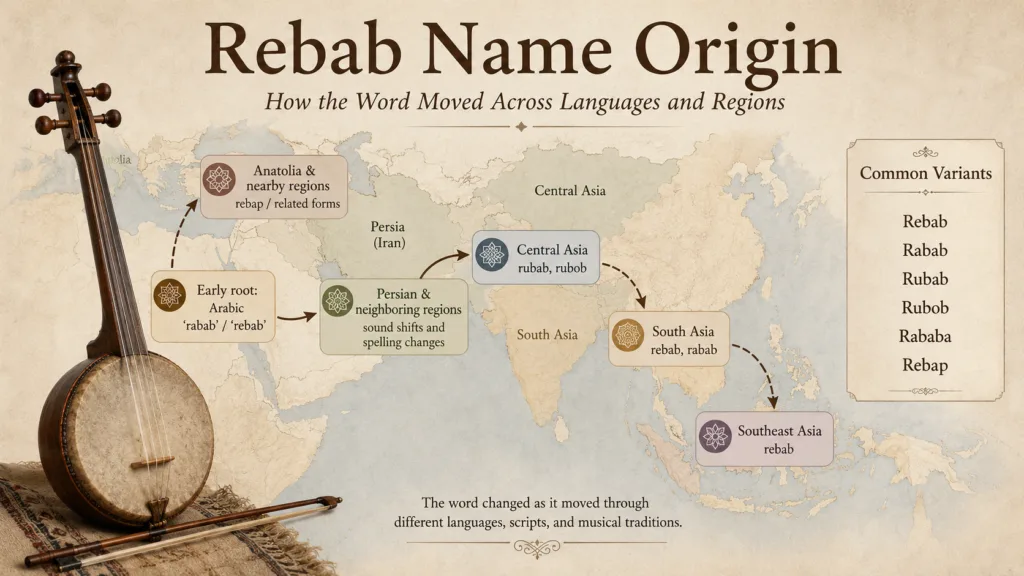
Rebab is not one fixed spelling with one fixed instrument behind it. The name belongs to a wider family of words that usually trace back to Arabic rabāb or rabābah, then appear in English, French, Turkish, Persianate, Central Asian, South Asian, North African, and Southeast Asian settings as rabab, rebab, rubab, robāb, rubob, rebap, and related forms. The shared name matters, but it does not mean every instrument with that name has the same body, stringing, tuning, or playing method.
Why the Rebab Name Has So Many Spellings
The main reason is simple: the word moved across languages that do not write sounds in the same way. Arabic, Persian, Turkish, Urdu, Pashto, Tajik, Uzbek, Uyghur, French, English, and Indonesian writing systems all handle vowels, long vowels, and final consonants differently.
The form rabāb uses a long ā. In plain English writing, that long vowel often loses its mark and becomes rabab. In other spellings, the first vowel shifts in writing to e, u, or o, giving forms such as rebab, rubab, and robab. These are not random mistakes. They are often attempts to fit a traveling word into a local alphabet, local pronunciation, or museum catalog style.
Name Note: A spelling such as rubab may point to a Central or South Asian plucked lute, while rebab may point to a bowed fiddle in North Africa or Southeast Asia. The spelling gives a clue, not a final identification.
| Name Form | Common Setting | Useful Reading Clue |
|---|---|---|
| rabāb / rabābah | Arabic and scholarly transliteration | Often used for bowed string instruments and older Arabic musical references. |
| rabab | Plain English and South Asian writing | A simplified form without the long vowel mark; it may describe bowed or plucked forms. |
| rebab | North Africa, Southeast Asia, English museum labels, and older European writing | Often linked with bowed fiddles, though the exact form depends on region. |
| rubab / rubāb | Afghanistan, Pakistan, northern India, and Persianate contexts | Often points to a plucked short-necked lute with a skin-covered resonator. |
| robāb / rubob | Iran, Tajikistan, Uzbekistan, and Central Asian heritage writing | Usually reflects local romanization for related short-necked string instruments. |
| rebap | Turkish writing | A Turkish spelling used for rebab-type instruments, especially bowed skin-fronted forms. |
| rebec | Medieval European instrument history | A European bowed instrument name historically linked to Arabic rabāb, but not the same object as every rebab. |
| rawap / rewāb | Uyghur and Central Asian contexts | A related regional lute name; it should be read through its local tradition, not flattened into one generic label. |
The Arabic Starting Point
Most reliable etymological accounts connect the name to Arabic rabāb and rabābah. In Arabic musical history, the word was not only a narrow label for one exact object. It could also work as a broader name for bowed string instruments.
This explains why the name traveled so well. A word that already covered more than one related string instrument could attach itself to new regional forms without sounding strange to players, scribes, or later collectors.
Older Arabic and medieval musical references connect the name with bowed instruments. Some documented rebab types had a membrane belly, two or three strings, and no fingerboard. Others had different body shapes. Pear-shaped, boat-shaped, round, flat, trapezoidal, and rectangular bodies all appear in the wider rebab record. That variety is part of the name’s history.
One mistake is to treat rabāb as though it always meant one standardized instrument. It did not. The word often worked more like a family label.
How the Word Moved Without Keeping One Shape
Instrument names often travel more easily than instrument designs. A musician may carry an instrument into a new court, workshop, port city, or teaching line. A scribe may record the name using local spelling. A maker may adapt the body to available wood, skin, gut, horsehair, metal strings, or local playing needs. Over time, the name remains recognizable while the instrument changes.
That process helps explain the rebab family. The name moved through performance practice, trade routes, manuscript culture, court music, devotional settings, oral teaching, colonial-era collecting, and modern museum cataloging. It also crossed the border between bowed and plucked instruments.
- Language changed the spelling. Long vowels, consonants, and final sounds were written differently in each language.
- Local music changed the instrument. Bowed spike fiddles, boat-shaped fiddles, and plucked lutes all carried related names in different places.
- Cataloging changed the label. Museum and encyclopedia entries often selected one romanized spelling, even when local usage was more varied.
This is why the name origin is not just a dictionary question. It is also an organology question: the word moved with real instruments, and those instruments did not stay identical.
Regional Name Paths
Arabic-Speaking and North African Rebab
In Arabic-speaking contexts, rabāb and rabābah are closely tied to bowed string instruments. In North Africa, rebab may refer to a boat-shaped, fretless bowed fiddle. Documented examples from Algeria and Morocco often show a narrow body, skin or parchment elements, and two strings, though regional forms should be checked case by case.
In this setting, the name points not only to sound but also to use. Some North African rebab forms are associated with vocal accompaniment rather than solo display. The instrument supports the singer, shapes the melodic line, and adds a focused bowed tone.
Regional Note: A North African rebab and an Afghan rubab can share a name history while looking and sounding quite different. One may be bowed; the other is usually plucked.
Persianate and Central Asian Rubab, Robāb, and Rubob
Across Persianate and Central Asian settings, spellings such as rubab, robāb, and rubob are common. These forms often describe short-necked string instruments rather than the early bowed fiddle type alone.
In Iran, Tajikistan, and Uzbekistan, the related forms Robāb, Rubāb, and Rubob are used in cultural heritage contexts for a short-necked string instrument made from woods such as apricot, mulberry, or other local materials. Shape and size vary within and across countries, so the name should not be read as a single workshop template.
The Afghan rubāb is one of the best-known modern forms in this broader name family. It is usually described as a plucked short-necked lute, often with a skin-covered resonating face and a carved wooden body. Its spelling with u reflects a regional and transliteration path, not a complete break from the wider rabāb name history.
Turkish Rebap and Rebab
Turkish uses rebap and rebab in musical and historical writing. The final p in rebap fits Turkish spelling habits, while the older written source is still linked with Arabic rabāb. Turkish usage can refer to bowed, skin-fronted instruments and to a wider group of related string instruments.
In Ottoman and Mevlevi musical contexts, the rebap is often discussed as a bowed instrument with a small resonating body, skin face, and vertical playing position. That context deserves its own study, because it involves playing posture, repertoire, tuning practice, and workshop tradition. For the name origin, the main point is narrower: Turkish adapted the word and gave it a local written form.
Southeast Asian Rebab
In Java and other Southeast Asian settings, rebab usually refers to a bowed spike fiddle used in ensemble music. The Javanese and Sundanese rebab differs from North African rebab forms in shape, playing setting, and musical function. In gamelan contexts, the bowed rebab can ornament and guide melodic movement rather than simply duplicate a fixed line.
This shows how far the name traveled. The spelling stayed recognizable, but the instrument entered a new musical grammar.
European Rebec
The European rebec is a related name, not a synonym for every rebab. Etymological dictionaries usually trace rebec through medieval French and Occitan forms back to Arabic rabāb. The instrument itself became part of medieval European bowed-string practice, often with a pear-shaped body and a small number of strings.
The name link is useful, but it needs care. A rebec is not simply “a European rebab” in every detail. It is a European instrument whose name and historical development are tied to the wider rabāb story.
Why Vowels Shift: Rabab, Rebab, Rubab, and Robab
The vowels in rabab, rebab, rubab, and robab can look confusing to English readers because English spelling gives vowels a heavy role. In many source languages, the written system works differently.
Arabic and Persian scripts do not always show short vowels in ordinary writing. When the word moves into Latin letters, a writer must choose how to represent what they hear, what their academic system requires, or what their local language expects. That is why one catalog may write rabāb, another rabab, and another rebab.
The long ā is especially easy to lose. Once the macron disappears, rabāb becomes rabab. In a French, Turkish, Indonesian, or English environment, the vowel may shift again in spelling. This does not always signal a different instrument.
When the Name Does and Does Not Identify the Instrument
The name is useful, but it is not enough for identification. A label reading rebab may point to a bowed spike fiddle, a North African boat-shaped fiddle, a Southeast Asian bowed instrument, or a related catalog term. A label reading rubab may point toward an Afghan, North Indian, or Central Asian plucked lute, but even there details vary.
For a reliable identification, the name should be checked beside physical features.
- Body shape: boat-shaped, pear-shaped, round, waisted, carved, or bowl-like.
- Soundboard: skin, parchment, wood, or a mixed structure.
- Playing method: bowed, plucked with a plectrum, or strummed in regional practice.
- Neck and fingerboard: fretless, fretted, long-necked, short-necked, or spike-like.
- Strings: gut, silk, horsehair, metal, melody strings, drones, or sympathetic strings, depending on the form.
- Region: North Africa, the Arabic-speaking Middle East, Turkey, Afghanistan, Central Asia, South Asia, or Southeast Asia.
Collector’s Note: When a museum card, auction label, or family note says “rebab,” do not identify the object by name alone. Look first at the body, skin face, neck, bridge, pegs, bow marks, and playing wear. The name family is broad enough to mislead a careful reader.
Common Folk Explanations and Safer Etymology
Some later explanations treat rubab as a poetic compound meaning “door of the soul.” This kind of explanation appears in cultural storytelling, but it should not be used as a firm etymology. It works better as symbolic interpretation than as a reliable language history.
A safer reading is more modest: rabāb is an Arabic musical-instrument name that spread into many languages and became attached to related string instruments. Some regional forms may have deep local histories of their own, but the name itself is widely connected with the Arabic term.
This careful approach avoids two common errors. It does not reduce every regional instrument to one origin story. It also does not treat every spelling as a separate, unrelated word.
What the Name Tells a Reader
The rebab name tells a reader that the instrument belongs near a broad historical network of bowed and plucked chordophones. It suggests contact among Arabic, Persianate, Turkish, Central Asian, South Asian, North African, Southeast Asian, and European naming traditions. It also warns against overconfidence.
A name can travel farther than a design. That is the main lesson of rebab, rabab, rubab, rubāb, robāb, rubob, rebap, and rebec.
In a luthier’s or curator’s hands, the word is a starting point. The instrument itself gives the rest of the evidence.
How to Read Rebab Names in Catalogs and Articles
Catalog labels often compress complex traditions into one line. A short entry may give only the object name, country, date, and materials. That can hide the fact that rebab is a moving name rather than a single design.
- Start with the spelling. Rubab may suggest a Central or South Asian plucked form; rebab may suggest a bowed form in North Africa or Southeast Asia.
- Check the region. The same spelling can mean different instruments in Algeria, Afghanistan, Java, Turkey, or Uzbekistan.
- Look at the playing method. Bowed and plucked rebab-family instruments should not be grouped by name alone.
- Read the materials. Skin, parchment, mulberry wood, apricot wood, metal strings, gut strings, and horsehair can all help narrow the identification.
- Notice the date. A medieval name path and a 19th-century museum object may belong to the same name history, but not the same instrument type.
Related Instruments and Name Boundaries
The rebab name touches several neighboring instruments, but those links should be kept tidy. The rebec belongs to medieval European bowed-string history. The Afghan rubab sits closer to the South and Central Asian plucked-lute tradition. The Southeast Asian rebab belongs to ensemble settings such as gamelan. The Turkish rebap is better read through Ottoman, Mevlevi, and Anatolian contexts.
Other instruments, such as the sarod, kamancheh, oud, kemenche, and rawap, may appear near the rebab family in organology discussions. They should not be merged into the same instrument just because names, routes, materials, or playing methods overlap.
| Instrument Name | Connection to Rebab Naming | Boundary to Keep Clear |
|---|---|---|
| Rebec | The name is historically linked to Arabic rabāb. | It developed as a European bowed instrument with its own form and repertory. |
| Afghan Rubab | The spelling belongs to the wider rabāb/rubāb name family. | It is usually a plucked lute, not a bowed Arab fiddle. |
| Southeast Asian Rebab | The name shows the spread of the rebab word into island Southeast Asia. | Its ensemble role and construction differ from North African forms. |
| Turkish Rebap | The Turkish spelling adapts the older rebab name. | It should be read within Turkish and Ottoman musical practice. |
| Rawap | The name is related in several Central Asian discussions. | It has its own local identity and should not be renamed casually as rubab. |
FAQ
Is Rebab an Arabic Word?
Yes, the main historical name is usually traced to Arabic rabāb or rabābah. The word later appeared in many languages and spellings, including rabab, rebab, rubab, robāb, rubob, and rebap.
Are Rebab, Rabab, and Rubab the Same Word?
They are closely related name forms, but they do not always point to the same instrument. Rebab may describe bowed fiddles in some regions, while rubab often points to plucked lutes in Afghan, South Asian, or Central Asian contexts.
Why Is the Afghan Rubab Spelled with a U?
The u reflects regional pronunciation and transliteration practice. It does not make the name unrelated to rabāb, but it often signals a different instrument tradition from the older bowed rebab types.
Is the European Rebec Named After the Rebab?
Most etymological accounts connect rebec with Arabic rabāb through medieval European language forms. The name link is strong, but the rebec developed in its own European musical setting.
Does Every Rebab Use a Bow?
No. Some rebab-family instruments are bowed, while others are plucked. The name traveled across regions, and the playing method changed in several traditions.
What Is the Best Way to Identify a Rebab-Type Instrument?
Use the name as the first clue, then check the region, body shape, soundboard material, string layout, neck type, and whether the instrument is bowed or plucked. The spelling alone is not enough.