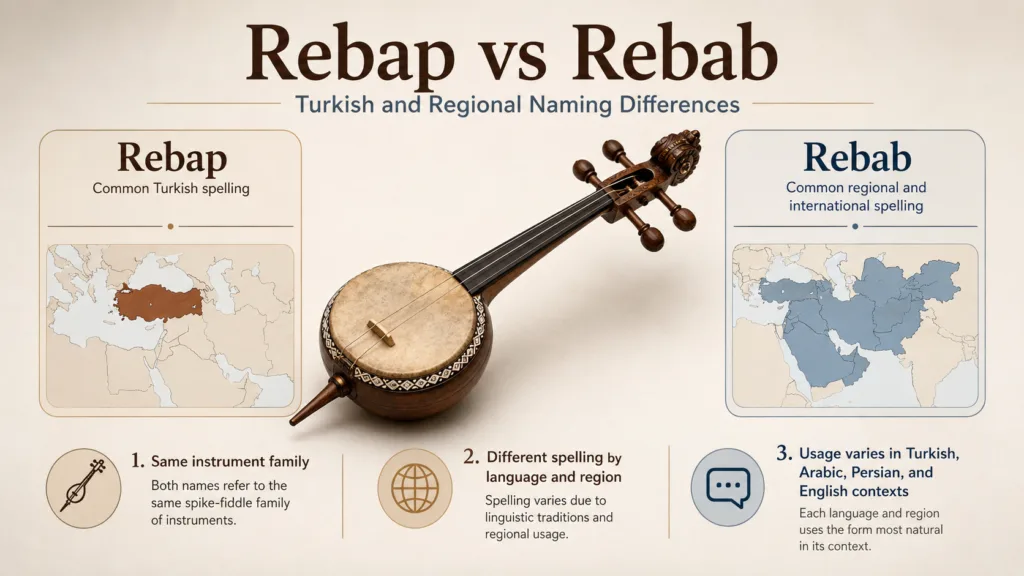
Rebap and rebab usually point to the same broad instrument-name family, but they do not always point to the same exact instrument. Rebap is the modern Turkish spelling most often used for the Turkish/Ottoman bowed form, while rebab is a wider regional and museum spelling used for several related chordophones across Arabic, Persian, North African, Central Asian, South Asian, and Southeast Asian contexts.
Rebap vs Rebab: The Short Difference
The difference is mainly one of language, spelling, and regional labeling, not a clean instrument-versus-instrument divide.
In Turkish, rebap is the natural written form. In many English-language museum labels, Arabic-transliterated sources, and regional music studies, rebab, rabāb, rubāb, robab, or rubab may appear instead. These forms can describe bowed spike fiddles, skin-faced lutes, plucked Afghan rubabs, North African bowed lutes, or other local relatives, depending on the region.
That is why a label alone is not enough. The body, soundboard, playing method, string layout, and local tradition must also be checked.
| Name Form | Common Context | What It Often Refers To | Main Caution |
|---|---|---|---|
| Rebap | Modern Turkish spelling | A Turkish bowed rebab type, often linked with Ottoman and Mevlevi musical contexts | Not every instrument called rebap has identical construction |
| Rebab | English, museum, Arabic-influenced, and broad regional usage | A wider family of bowed or plucked chordophones | The word may refer to different instruments in different regions |
| Rabāb | Scholarly transliteration | Arabic-root name for related bowed and lute-type instruments | The macron marks a long vowel, not a separate instrument |
| Rubab | Afghan, Persianate, and South/Central Asian contexts | Often a plucked short-necked lute, especially the Afghan rubab | Should not be assumed to be the same as the Turkish bowed rebap |
| Rübab or Rebâb | Older Turkish/Ottoman-style writing and scholarly texts | Historical or transliterated forms of the same name family | Spelling may reflect older orthography rather than a new object type |
Why Turkish Uses Rebap Instead of Rebab
Turkish normally avoids many voiced stop consonants at the end of words. Loanwords that historically or regionally end in b often appear with final p in modern Turkish writing. A familiar pattern is visible in Turkish words such as kitap, from a source form with final b.
The same spelling habit helps explain rebap. The final sound is adapted to Turkish orthography, so the Turkish dictionary form ends with p. When a vowel-starting suffix is added, the final consonant may soften in normal Turkish usage, so related forms can show the older b sound again.
Language Note: Rebap is not a “wrong” spelling of rebab. It is the Turkish spelling. Rebab is also valid in broader English, Arabic-transliterated, and museum contexts. The best choice depends on the language and the instrument being described.
When Rebap Means the Turkish Bowed Instrument
In Turkish musical writing, rebap often refers to a bowed instrument with a small resonating body, a skin soundboard, a long neck, and a playing posture that places the instrument upright or nearly upright. Historical descriptions connect this form with the family of spike fiddles sometimes called ayaklı kemane in Turkish organological language.
Many documented Turkish rebaps have a rounded or cut-spherical body, sometimes associated with coconut-shell construction, a thin skin or membrane top, a cylindrical neck, and two or three strings. Older examples may use horsehair, silk, gut, or wound strings depending on period and maker. The bridge is usually small and movable, and the bow draws sound from strings that can feel very different from modern violin strings.
The sound is often narrow, nasal, and direct rather than large and polished. Its strength is not orchestral volume. It is color, speech-like inflection, and the ability to shape ornamented melodic lines in a restrained space.
Ottoman and Mevlevi Usage
The Turkish rebap is often discussed in relation to Ottoman art music and Mevlevi musical practice. In that setting, it is not simply a generic “old fiddle.” It belongs to a sound ideal shaped by makam, melodic nuance, slow bow control, and close listening.
Historical sources do not always agree on every tuning detail, and surviving instruments vary. For that reason, a careful description should avoid presenting one tuning, one number of strings, or one body size as the only valid standard.
When Rebab Has a Wider Regional Meaning
Rebab is broader than the Turkish word rebap. Across different regions, the same name family can refer to bowed lutes, spike fiddles, lyres, and plucked lutes with skin or wooden soundboards. This is the main reason the two names can confuse readers.
In North Africa, a rebab may be a boat-shaped bowed lute with two strings and no frets. In Afghanistan, the related spelling rubab usually points to a plucked short-necked lute with a carved wooden body, skin-covered lower soundboard area, melody strings, drone strings, and sympathetic strings. In Central Asian contexts, related names may appear as rubob, robob, rabab, or local variants.
These are not small spelling differences only. They can signal different body plans, different playing techniques, and different musical roles.
How to Tell Which Instrument the Name Means
The safest way to identify a rebap or rebab is to read the name together with physical clues. A curator, collector, player, or researcher should look first at how the instrument is made and played.
- Playing method: bowed instruments belong to a different practical group than plucked rubabs.
- Soundboard: a skin or membrane top often points toward rebab-family construction, but it does not identify the region by itself.
- Body shape: coconut-shell bowl, boat-shaped body, carved block body, and shallow wooden body suggest different traditions.
- Neck type: a long cylindrical neck, short thick neck, fretted neck, or metal-covered finger surface changes the identification.
- Strings: two or three bowed strings differ from the melody, drone, and sympathetic string layout of many Afghan-style rubabs.
- Local name: Turkish rebap, Arabic rabāb, Persianate rubab, and Central Asian rubob should be read inside their own language setting.
Luthier’s Note
A bowed Turkish rebap and a plucked Afghan rubab ask for different construction logic. The bowed form needs a responsive contact point for the bow, a bridge suited to string crossing, and a body that can speak under continuous friction. The Afghan rubab needs a plucked response, a stable bridge area, and a body that supports attack, decay, and sympathetic resonance.
Wood choice can shape resonance, but the sound is never controlled by wood alone. Skin tension, bridge mass, string material, body depth, neck angle, and the player’s touch all matter.
Rebap, Rebab, and Rubab Are Not Always Interchangeable
In casual writing, people often use rebap, rebab, and rubab as if they were simple spelling variants. Sometimes that is harmless. In instrument description, it can create real confusion.
A Turkish rebap is normally understood as a bowed instrument in Turkish/Ottoman reference. An Afghan rubab is normally understood as a plucked lute. A North African rebab may be a bowed lute used in ensemble and vocal settings. A general English label rebab may need extra description before the reader knows which one is meant.
| Written Form | Likely Reading | Playing Method Often Implied | Region or Context Often Seen |
|---|---|---|---|
| Rebap | Turkish adapted form | Usually bowed | Turkey, Ottoman music, Mevlevi-related references |
| Rebab | Broad regional or English form | Bowed or plucked, depending on context | Arabic, North African, museum, and general reference writing |
| Rabāb | Transliterated scholarly form | Usually depends on the source tradition | Arabic and academic writing |
| Rubab | Persianate and Afghan/South Asian form | Often plucked | Afghanistan, Pakistan, parts of North India, Persianate contexts |
| Rubob or Robob | Central Asian spelling forms | Often plucked, but local forms vary | Uzbek, Tajik, and neighboring traditions |
Why Museum Labels May Use Different Names
Museum labels often preserve the name used by a donor, older catalogue, regional informant, or earlier scholarly source. This means one institution may label a North African object rebab, another may use rabāb, and a Turkish-focused catalogue may prefer rebap.
A label is a starting point, not the whole identification. Older catalogues sometimes group instruments by family resemblance. Newer labels may be more specific about region, material, and technique. Both can be useful, but the object itself must still be read closely.
Collector’s Note: If an instrument is sold as a “rebab,” check the physical design before assuming it is Turkish. A bowed coconut-shell type, a North African boat-shaped fiddle, and an Afghan plucked rubab can all appear under related names in trade, museum, and educational settings.
Sound and Playing Differences Behind the Names
The naming difference matters because the sound world changes with the instrument type. A Turkish rebap is usually discussed as a bowed melodic instrument. Its tone can be dry, close, and flexible, with a strong vocal character in slow ornaments and makam phrases.
A North African rebab may have a different bowed response because of its boat-shaped body, two-string layout, and regional ensemble role. An Afghan rubab has a plucked attack, a short-necked body form, and resonance shaped by drone and sympathetic strings in many examples.
So the word alone does not tell the ear what to expect. Bowing, plucking, body depth, membrane tension, and stringing all change the result.
Listening Note
When comparing recordings, listen first for attack. A bowed rebap or rebab begins with a drawn tone. A plucked rubab begins with a struck or snapped attack, followed by decay and resonance. That single difference often tells more than the spelling on the album cover.
Common Misunderstandings
“Rebap Is the Turkish Rebab” Is Mostly True, but Too Simple
It is fair to call rebap the Turkish form of the name. It is not safe to assume every object labeled rebab is the same as the Turkish rebap. The family name travels farther than the Turkish instrument type.
“Rebab Always Means a Bowed Instrument” Is Not Safe
Many rebabs are bowed, especially in Arabic, Turkish, and North African settings. But related names also apply to plucked lutes in Afghan, Persianate, South Asian, and Central Asian contexts. The playing method must be stated.
“Rubab Is Just Another Spelling” Can Hide a Different Instrument
Rubab is related by name, but in many modern English contexts it points first to the Afghan rubab. That instrument is usually plucked, has a different body plan, and should not be merged with the Turkish bowed rebap without explanation.
Best Usage in English Writing
For English readers, the clearest wording is usually specific and regional. Use Turkish rebap when the subject is the Turkish bowed instrument. Use rebab-family instruments when discussing the wider name group. Use Afghan rubab when the plucked Afghan instrument is meant.
If the article or catalogue must choose one main spelling, match the tradition being described:
- Use rebap for modern Turkish spelling and Turkish cultural context.
- Use rebab for broad English reference, North African labels, or general family discussion.
- Use rabāb when following a scholarly transliteration system.
- Use rubab for the Afghan and many Persianate/South Asian contexts, unless a local source uses another spelling.
The most precise choice is often a paired label: Turkish rebap, a bowed rebab-family instrument. That gives both the local spelling and the wider family connection without flattening the differences.
FAQ
Is Rebap the Turkish Spelling of Rebab?
Yes. Rebap is the modern Turkish spelling commonly used for the Turkish form of the rebab-family instrument. The final p fits Turkish spelling patterns for many loanwords.
Are Rebap and Rebab the Same Instrument?
Sometimes they refer to the same general family, but not always to the same exact instrument. Rebap usually points to the Turkish bowed form, while rebab can refer to several regional bowed or plucked instruments.
Why Is There a P in Rebap?
Turkish often writes final voiced consonants from older or foreign forms as voiceless consonants. In this case, final b becomes p in the Turkish dictionary form.
Does Rebab Always Mean a Bowed Instrument?
No. Many rebabs are bowed, but related names can also refer to plucked lutes, especially in Afghan, Persianate, South Asian, and Central Asian contexts. The region and construction must be checked.
Should I Write Turkish Rebab or Turkish Rebap?
For modern Turkish context, Turkish rebap is clearer. Turkish rebab may still appear in English or older scholarly writing, but it should be explained so readers know it refers to the Turkish bowed form.
Is Rubab the Same as Rebap?
Not in normal modern usage. Rubab is related by name, but it often means the Afghan plucked rubab or another Persianate/Central Asian form. A Turkish rebap is usually a bowed instrument, so the two should be compared with care.