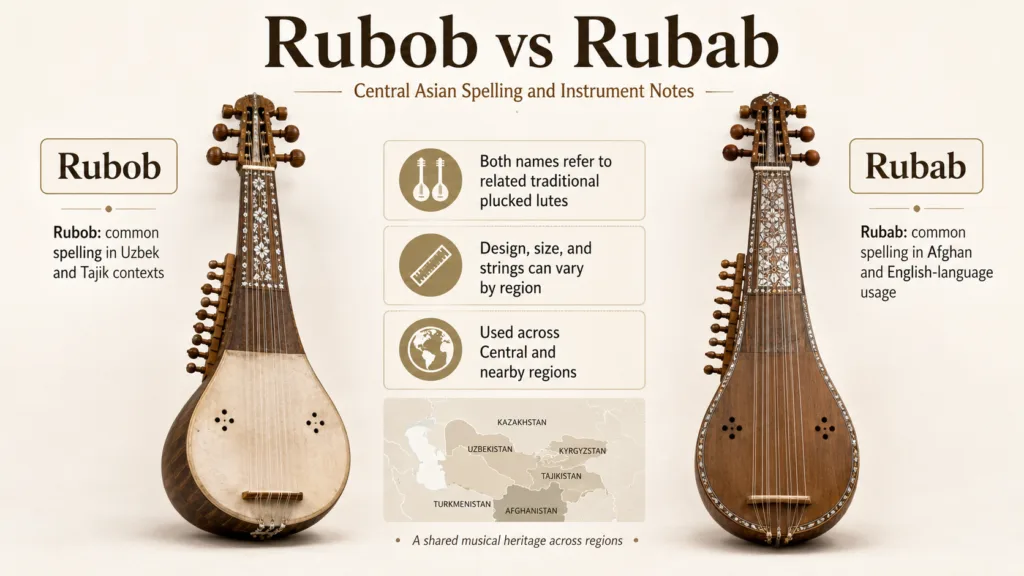
Rubob and rubab usually point to the same broad family of skin-topped lutes, but the spelling can signal region, language, and cataloging habit. Rubob is especially common in Central Asian contexts, including Uzbek usage, while rubab or rubāb is the wider English-facing form used for Afghan, Persian, Tajik, South Asian, and museum descriptions. The safest reading is not “two separate instruments,” but “one related name family with local instrument forms.”
Why the Spellings Differ
The difference between rubob and rubab is mostly a matter of transliteration. The name has moved through Arabic, Persian, Turkic, and Cyrillic writing systems, then back into Latin letters for English readers. Each step can change the vowel shown in the middle of the word.
In Uzbek and some Central Asian catalogues, rubob often reflects the local spelling and pronunciation. In wider English writing, rubab is more common because it has become the familiar spelling for Afghan and related lutes. A museum, musician, or teacher may choose one spelling over another without meaning a separate instrument species.
| Spelling | Where It Often Appears | What It Usually Suggests | Reading Caution |
|---|---|---|---|
| Rubob | Uzbek, Central Asian, and some museum descriptions | A local Central Asian spelling, often tied to plucked lute forms | Do not assume it is a different instrument only because of the vowel |
| Rubab | English-language music writing, Afghan instrument descriptions, South Asian contexts | A broad international spelling for the rebab/rabab/rubab family | It may refer to several different regional builds |
| Rubāb | Scholarly transliteration and Persian-influenced naming | A more formal transliteration that marks the long vowel | The diacritic helps spelling, not always instrument identification |
| Robāb | Iranian and some heritage descriptions | A Persian-facing spelling in Latin letters | It may overlap with rubāb in meaning |
| Rabab or Rebab | Arabic, North African, Indonesian, and broader historical contexts | A wider name family for bowed or plucked chordophones | These names can refer to instruments with very different bodies |
Regional Note: A spelling is a clue, not proof. The word rubob points the reader toward Central Asian usage, but the actual instrument still needs to be checked by body shape, neck length, frets, soundboard, strings, and playing method.
What Rubob Usually Means in Central Asian Use
In Central Asian settings, rubob commonly refers to a plucked lute rather than a bowed fiddle. Many documented Uzbek examples have a wooden body, a skin soundboard, a fretted neck, and strings sounded with a plectrum. Some examples are long-necked, with decorative inlay and a body shape that looks unlike the shorter Afghan rubab at first sight.
This is where spelling alone becomes weak. A reader may see rubob and expect the Afghan rubab, but a Central Asian rubob may instead resemble a regional long-necked lute used in ensemble music. The name connects the family. The build shows the local branch.
Common Central Asian Instrument Clues
- Skin soundboard: Many rubob forms use animal skin over part or all of the resonating table.
- Frets: Central Asian rubob examples may have fixed frets, unlike some bowed rebab types.
- Plectrum playing: The sound is often produced by plucking, not by bowing.
- Decorative body work: Inlay, carved details, and shaped shoulders may help identify a regional workshop style.
- Ensemble role: Rubob can appear beside instruments such as dutar, tanbur, gijjak, chang, nay, and doira in Central Asian music settings.
What Rubab Usually Means in Wider Use
Rubab is the spelling many English readers meet first because of the Afghan rubab. That instrument is usually described as a short-necked plucked lute with a skin-covered resonator. Depending on the regional and workshop form, it may include melody strings, drone strings, and sympathetic strings. The sound has a firm attack, a dry resonance, and a compact sustain shaped by the skin table and hollow body.
But rubab is not limited to Afghanistan. Related names appear across Central Asia, South Asia, Iran, North Africa, and other regions. In some traditions the named instrument is bowed. In others it is plucked. This is why “rubab” should be read as a family name unless the source gives a region or physical description.
Luthier’s Note: A skin table changes the playing feel. It can give the note a quick start and a slightly nasal edge, while the wooden body and neck shape help decide how much depth and sustain the instrument offers. These effects vary by build, stringing, and setup.
Rubob and Rubab Compared Without Over-Simplifying
The useful question is not “Which spelling is correct?” Both can be correct. The better question is: which regional instrument is being named?
| Point of Comparison | Rubob in Central Asian Contexts | Rubab in Wider English Contexts |
|---|---|---|
| Spelling Function | Often marks Uzbek or Central Asian naming practice | Often used as a broad English spelling for the instrument family |
| Typical Playing Method | Usually plucked in many Central Asian examples | Can be plucked or bowed, depending on region |
| Body Form | May be long-necked, fretted, and decorated with regional inlay | May refer to the short-necked Afghan rubab or other local forms |
| Best Identification Method | Check neck length, frets, soundboard, string layout, and country label | Check region first, then construction and playing technique |
Why the Middle Vowel Changes
The difference between -ob and -ab is not unusual when names travel between scripts. Uzbek, Tajik, Persian, Arabic, and English do not map sounds in exactly the same way. Cyrillic spellings can also be romanized in more than one style.
For English readers, this creates a practical issue: search results and catalogues may split related material under different spellings. A Central Asian source may write rubob, while an English museum entry may put rubab in parentheses. A heritage description may prefer rubāb or robāb. None of these choices should be treated as an automatic correction of the others.
How to Read the Name in a Catalogue
- Look for the country or region given with the object.
- Check whether the instrument is described as plucked or bowed.
- Note the body: short-necked, long-necked, bowl-shaped, boat-shaped, or barbed.
- Look for the soundboard material, especially skin or wood.
- Check string count only if the source is specific; numbers can vary by model and repair history.
Construction Details That Matter More Than Spelling
When identifying a rubob or rubab, construction gives better evidence than the word on the label. The same name family can cover instruments that differ in neck length, string layout, frets, bridge form, and playing position.
Body and Soundboard
Many rubob and rubab forms use a hollow wooden body with a skin-covered soundboard. The skin membrane helps shape the immediate attack of the note. It also gives the instrument a voice that differs from fully wooden lutes such as many tanbur or dutar forms.
Some rubob examples have a long neck and a clearly fretted fingerboard. Afghan rubab forms are often shorter in neck profile and can include sympathetic strings beneath or beside the main playing strings. Bowed rebab forms from other regions may have fewer strings and no frets.
Strings, Frets, and Playing Feel
Frets make a major difference in left-hand movement. A fretted rubob gives the player fixed pitch positions. A fretless bowed rebab requires a different ear and hand technique. Plucked forms also respond differently to attack: the plectrum can make the note speak sharply, while sympathetic strings, where present, add a faint halo around the main pitch.
Listening Note: A plucked Central Asian rubob may sound bright and articulate, especially in fast melodic passages. An Afghan rubab often feels rounder and more percussive, with a short bloom after the pluck. These are listening tendencies, not fixed rules for every instrument.
How Rubob Fits Beside Other Regional Names
The rebab/rabab/rubab name family is broad. That breadth is useful for history, but it can confuse instrument identification. Some names point to close relatives. Others share older terminology while looking and sounding quite different.
| Name | Usual Context | Relation to Rubob or Rubab |
|---|---|---|
| Kashgar Rubab | Uyghur and Central Asian contexts | A plucked long-necked lute form with its own regional identity |
| Afghan Rubab | Afghanistan and Afghan classical or folk music settings | A short-necked plucked lute often treated as the best-known rubab in English |
| Pamiri Rubab | Pamir region and Tajik cultural contexts | A related regional form; construction should be checked separately |
| Sarod | North Indian classical music | Historically linked to rabab development, but now a distinct concert instrument |
| Rebab or Rabāb | North Africa, the Middle East, Southeast Asia, and museum catalogues | A wider name that may refer to bowed or plucked chordophones |
Common Misreadings to Avoid
The spelling debate often becomes less useful than careful object reading. A few mistakes appear often when rubob and rubab are treated as plain synonyms or total opposites.
- Rubob is not merely a typo. It can be a normal Central Asian spelling in Latin letters.
- Rubab is not one single build. It can name several regional instruments.
- Not every rebab-family instrument is bowed. Many Central Asian and Afghan forms are plucked.
- Not every plucked form is Afghan. Central Asian rubob types may have their own neck, fret, and body design.
- String numbers are not universal. They may change by workshop, model, restoration, or orchestra adaptation.
Practical Identification Notes
For readers, collectors, students, and catalogue editors, the best practice is to write the spelling used by the source, then add a short region and construction note. This prevents the common problem of flattening every rubob or rubab into one generic instrument.
A Clear Labeling Pattern
A useful label might read: rubob, Uzbek plucked lute with skin soundboard and fretted neck. Another might read: rubab, Afghan short-necked plucked lute with skin-covered resonator. The spelling remains, but the object becomes clearer.
For online writing, the phrase rubob vs rubab should answer the spelling question first, then move quickly into instrument form. That order helps readers who arrive through a search engine and also protects the cultural detail from being reduced to a spelling correction.
FAQ
Is Rubob the Same as Rubab?
Rubob and rubab can refer to related instruments from the same name family, but they are not always identical in build. Rubob often points to Central Asian usage, while rubab is a wider English spelling used for Afghan and other regional forms.
Why Do Uzbek Sources Write Rubob?
Uzbek sources often use rubob because it reflects local spelling and pronunciation in Latin-letter usage. It can also reflect romanization from Cyrillic forms. The spelling is normal in Central Asian contexts.
Is a Rubob Played with a Bow?
Many Central Asian rubob forms are plucked with a plectrum. However, the wider rebab/rabab name family includes bowed instruments in other regions. The playing method should be checked from the regional form, not from the name alone.
Does Rubāb Mean a Tajik Instrument?
Rubāb can appear in Tajik, Persian, and scholarly contexts, but the spelling alone does not prove one national type. It marks a transliteration style. The region, body shape, and playing method provide better identification.
How Can You Identify a Central Asian Rubob?
Look for a Central Asian label, a plucked playing method, a skin soundboard, a fretted neck, and a body style linked to Uzbek, Tajik, Uyghur, or neighboring traditions. These clues are stronger than the spelling by itself.
Should English Articles Use Rubob or Rubab?
Use rubob when the topic is specifically Central Asian or Uzbek usage. Use rubab when discussing the broader instrument family or the Afghan form. If both spellings matter, give both once and then keep the article’s main spelling consistent.