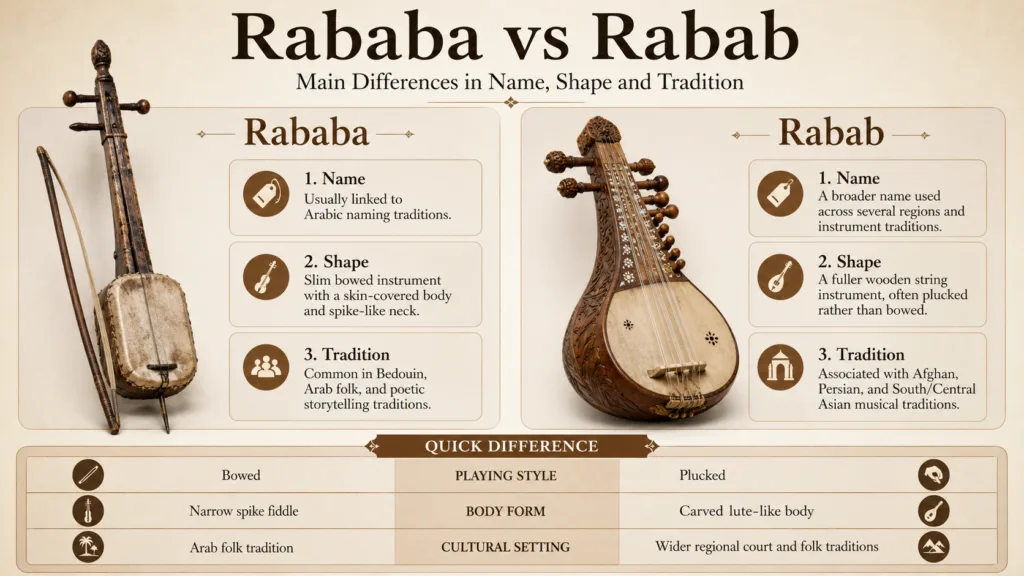
Rababa and rabab can point to related string-instrument traditions, but they should not be treated as one neat instrument name. In many Arabic-speaking contexts, rababa usually suggests a bowed fiddle with a skin-covered resonator and a direct link to vocal storytelling or folk performance. Rabab is broader: it may refer to a bowed North African lute, a medieval Arabic fiddle, or a plucked Central and South Asian rubab with a very different body, sound, and playing method.
Rababa vs Rabab: The Main Difference
The safest distinction is practical, not only linguistic. A rababa is most often understood as a bowed folk fiddle, while rabab can be either a bowed lute or a plucked lute, depending on the region.
This is why two instruments with similar names may look nothing alike. One may have a narrow spike, a simple skin belly, and one or two bowed strings. Another may have a carved wooden body, a skin soundboard, sympathetic strings, and be played with a plectrum.
| Feature | Rababa | Rabab |
|---|---|---|
| Common Meaning | Usually a bowed fiddle or spike fiddle in Arabic folk settings. | A wider name used for several bowed and plucked lute traditions. |
| Playing Method | Normally bowed. | May be bowed in Arab and North African forms, or plucked in Afghan and related rubab forms. |
| Typical Body | Skin-covered resonator; may be rectangular, round, coconut-shell, or otherwise regionally shaped. | Varies from short-necked bowed lutes to carved wooden plucked lutes with skin-covered tables. |
| Sound Character | Direct, nasal, speech-like, and well suited to sung narrative lines. | Can be bowed and reedy, or plucked, dry, bright, and percussive, depending on the regional type. |
| Main Identification Clue | Look for a bow, a spike-like neck, and a simple membrane resonator. | Check whether it is bowed or plucked, then examine the body, pegs, strings, and regional context. |
Regional Note: Spelling alone is not enough. Rabāb, rabab, rebab, rubab, rubāb, rababa, and rebap may appear in different languages and catalogs. The instrument’s construction gives the better answer.
Why the Names Overlap
The overlap comes from language, travel, and instrument classification. Rabāb and related spellings have long been used for bowed chordophones in Arabic and neighboring musical cultures. In some sources, rabābah appears as another form of the same name.
Over time, the name traveled into different regions and attached itself to instruments with local shapes. In North Africa, rabāb may describe a short-necked bowed lute used in traditional Arabic ensemble settings. In Afghanistan and nearby regions, rubab or rabab usually means a plucked short-necked lute with a carved body and skin top.
So the question is not only “Which spelling is right?” A better question is: which regional instrument is being described?
Common Spellings and What They Usually Suggest
- Rababa or rabābah: often used for Arabic bowed folk fiddles, especially simple spike-fiddle forms.
- Rabab or rabāb: a broad spelling used for bowed Arab and North African lutes, and sometimes as a general family name.
- Rubab or rubāb: often used for the Afghan plucked lute and related Central or South Asian forms.
- Rebab or rebap: common in some Turkish, Persian, Southeast Asian, and museum-catalog contexts, with meanings that vary by region.
Shape and Construction: Where the Difference Becomes Visible
Shape is the most reliable way to separate rababa and rabab in actual use. A rababa usually keeps the logic of a bowed fiddle: a resonator, a neck or spike, a small number of strings, and a bow. Many examples use a skin-covered soundboard because the stretched membrane gives the instrument a clear, focused response.
A rabab, however, may follow several construction paths. A North African rabāb may be a short-necked bowed lute with a rounded or boat-like lower body. An Afghan rubab is a plucked lute, often carved from mulberry wood, with a skin-covered resonating area and decorative inlay in finer examples.
Rababa Body Forms
Rababa forms are not fully standardized. Some documented examples use a rectangular or quadrangular body. Others use a round resonator, a coconut shell, or a small cylindrical form. The skin table is more than decoration; it helps produce a firm, vocal tone that carries well under singing.
Many rababa-type instruments are built for use rather than display. The workmanship can be plain, but the proportions still matter. The bridge height, skin tension, string angle, and bowing clearance all affect response.
Rabab Body Forms
Rabab forms need more care because the word covers more ground. A Maghrebi rabāb from Morocco, Algeria, or Tunisia may be a bowed lute with a compact body and a covered neck area. Some museum examples show brass, mother-of-pearl, bone, leather, or wood details, but regional workshop practice varies.
The Afghan rubab is different again. It is normally recognized by its carved wooden body, skin-covered face, short neck, multiple pegs, and plucked playing style. It may include main playing strings, drone strings, and sympathetic strings, but exact string layout varies by maker and regional school.
Luthier’s Note: A skin soundboard does not behave like a thin wooden guitar top. It can give a fast attack and a tight, slightly dry resonance. Wood choice can shape resonance, but the skin tension, bridge, body depth, and string setup also matter.
Bow, Plectrum, and Playing Feel
The clearest playing difference is simple: rababa is normally bowed. The player draws a bow across one or more strings, and the melody can lean close to the phrasing of speech or song. This supports its strong link with vocal accompaniment.
Rabab is less fixed. In Arab and North African traditions, it may also be bowed. In Afghan and related rubab traditions, it is plucked with a plectrum. That change alters almost everything: attack, sustain, ornament, rhythmic drive, and the way a melody sits with drums or voice.
How Bowing Shapes the Rababa Sound
A bowed rababa can hold a note, slide between tones, and follow the contour of a sung line. The tone is often lean rather than lush. Its strength is not volume alone, but clarity and directness.
Because many rababa forms have few strings and no modern fingerboard in the violin sense, the player’s left-hand touch is exposed. Small shifts of pressure and position change the pitch and color.
How Plucking Shapes the Afghan Rubab Sound
A plucked rubab gives a shorter, more percussive note. The skin table helps the attack speak quickly. When sympathetic strings are present, they can add shimmer around the main melody, though the amount of resonance depends on setup and playing style.
This is one reason the Afghan rubab is often heard as both melodic and rhythmic. It can outline a tune while also giving a firm pulse.
Tradition and Musical Setting
Rababa and rabab also differ by social setting. The rababa is often associated with folk singing, recitation, and regional storytelling traditions across Arabic-speaking areas. It can work as a close partner to the human voice, especially where the music values text, melodic contour, and direct expression.
North African rabāb forms are tied to ensemble traditions in Morocco, Algeria, and Tunisia. Their role is not the same as a solo folk fiddle in every setting; they may sit inside a trained ensemble practice with its own repertory and performance etiquette.
The Afghan rubab belongs to a different sound environment. It appears in art, regional, and popular music, and it may be played solo or with small ensembles. In many modern contexts, it is strongly identified with Afghanistan, while also having links to nearby regions such as Pakistan and northwest India.
Why the Same Name Can Mislead Buyers and Beginners
Online listings often use rabab, rubab, rebab, and rababa loosely. A beginner searching by name may find bowed spike fiddles, Afghan plucked lutes, tourist-market wall pieces, or unrelated instruments with similar silhouettes.
Before identifying an instrument, check these points:
- Is there a bow, or is the instrument clearly built for plucking?
- Does it have a spike-like neck passing through the resonator?
- Is the body a simple skin-covered box, shell, or round form?
- Does it have many pegs, sympathetic strings, or a carved lute body?
- Does the seller mention Egypt, the Arabian Peninsula, the Maghreb, Afghanistan, Pakistan, or another region?
Sound: Vocal Line or Plucked Resonance
The rababa is often valued for a sound that sits close to the human voice. It can be narrow, penetrating, and flexible. That makes sense for music where the instrument shadows a singer, supports recitation, or adds a melodic thread under poetry.
Rabab sound depends on the type. A bowed North African rabāb can have a reedy, focused tone. An Afghan rubab has a plucked attack, a skin-top snap, and a compact resonance. The two should not be described with the same sound vocabulary.
Listening Note: If the sound begins with a bowed swell and can sustain a note, the instrument is probably in the rababa or bowed rabab area. If the sound starts with a sharp plucked attack and fades quickly, it may be an Afghan-style rubab or another plucked lute.
Materials and Workshop Details
Rababa-type instruments often use practical materials: wood for the neck or frame, animal skin for the soundboard, horsehair for strings or bow hair in some examples, and simple pegs for tuning. Some forms use a coconut-shell resonator. Others use a rectangular body covered with hide.
Rabab materials vary with the regional form. North African bowed rabābs may include wood, skin, gut, leather, brass, bone, and mother-of-pearl. Afghan rubabs are often associated with carved mulberry bodies and skin-covered resonators, with inlay used on more ornate instruments.
Decoration should not be confused with function. Inlay can show craft pride and local taste, but the instrument’s musical behavior depends more on structure: body depth, membrane quality, bridge placement, string tension, neck angle, and the condition of the pegs.
How It Differs from Related Instruments
The rababa and rabab sit near several other string instruments, but the relationships should be handled carefully.
Rababa and Rebec
The medieval European rebec is often linked by name and history to forms of rabāb that reached Europe through Mediterranean contact. The resemblance matters, but a modern rababa should not be described as a rebec. The repertory, construction, and cultural setting are different.
Afghan Rubab and Sarod
The Afghan rubab is often mentioned in relation to the sarod. Some reference sources describe the rubab as a possible ancestor of the sarod. The practical difference is visible: the sarod developed its own metal fingerboard, sound ideal, and classical performance style, while the rubab keeps a distinct plucked-lute identity.
Rababa and Kamancheh
Both may be bowed, and both can use a spike-like playing position in some traditions. Still, the kamancheh has its own Persianate and neighboring regional histories, construction standards, and repertory. A skin-covered bowed instrument is not automatically a rababa.
Identification Method for a Real Instrument
For a museum object, inherited instrument, or marketplace listing, use a step-by-step identification method. Start with physical evidence before trusting the name tag.
- Check the playing method. Bow marks, bow hair, and string height may point to a bowed rababa or rabāb. A plectrum-worn playing area suggests a plucked rubab.
- Look at the resonator. A simple skin-covered shell or box often points toward rababa-type fiddles. A carved lute body may point toward Afghan or related rabab forms.
- Count the pegs, not only the strings. Extra pegs can reveal missing drone or sympathetic strings.
- Study the neck. A spike through the resonator differs from a carved short-necked lute structure.
- Use region as supporting evidence. Region helps, but it should confirm what the construction already suggests.
Collector’s Note: A decorative object sold as “rabab” may not be playable without repair. Check skin tension, cracks, peg fit, bridge condition, string path, and whether the instrument was built with correct clearance for bowing or plucking.
Common Mistakes in Naming
The most common mistake is treating rababa as the “incorrect” form and rabab as the “correct” one. That is too simple. Both forms appear in serious musical-instrument contexts, but they do not always point to the same physical object.
Another mistake is calling every skin-topped string instrument a rabab. Many regional lutes and fiddles use skin soundboards. The full structure matters.
A third mistake is assuming that every rabab is bowed. The Afghan rubab shows why this fails. It is a plucked lute and should be described through its own playing technique, not through the bowing logic of the rababa.
When to Use Each Name
Use rababa when the subject is an Arabic bowed folk fiddle, especially a spike-fiddle type with a skin-covered resonator and a strong link to singing or recitation.
Use rabab when the regional source uses that name, but add a qualifier whenever possible: North African rabāb, bowed rabab, Afghan rubab, plucked rubab, or Moroccan rabāb. The qualifier prevents confusion.
For reference pages, object labels, and educational writing, the best practice is to pair the name with visible details: “a bowed rababa with a skin-covered rectangular body” or “a plucked Afghan rubab with a carved wooden body and skin table.”
FAQ
Is Rababa the Same as Rabab?
Not always. Rababa often refers to a bowed Arabic folk fiddle, while rabab is a broader name used for several bowed and plucked instruments. In some texts the names overlap, so the instrument’s shape and playing method must be checked.
Why Do Some Sources Call the Same Instrument Rabab and Rababa?
Transliteration is one reason. Arabic and regional instrument names are written in Latin letters in several ways. Older cataloging habits, local speech, and museum terminology can also produce different spellings for related instruments.
Does Every Rabab Use a Bow?
No. Some rabab forms are bowed, especially in Arab and North African traditions. The Afghan rubab is normally plucked with a plectrum, so it should not be identified only by the broader bowed-instrument meaning of rabab.
How Can I Tell a Rababa from an Afghan Rubab?
A rababa usually has a simpler bowed-fiddle structure, often with a skin-covered resonator and few strings. An Afghan rubab usually has a carved wooden lute body, a skin-covered face, several pegs, and a plucked playing style.
Which Name Should Be Used in an Instrument Description?
Use the name that fits the regional form, then add a short physical description. A label such as “bowed rababa” or “plucked Afghan rubab” is much clearer than using rabab alone.