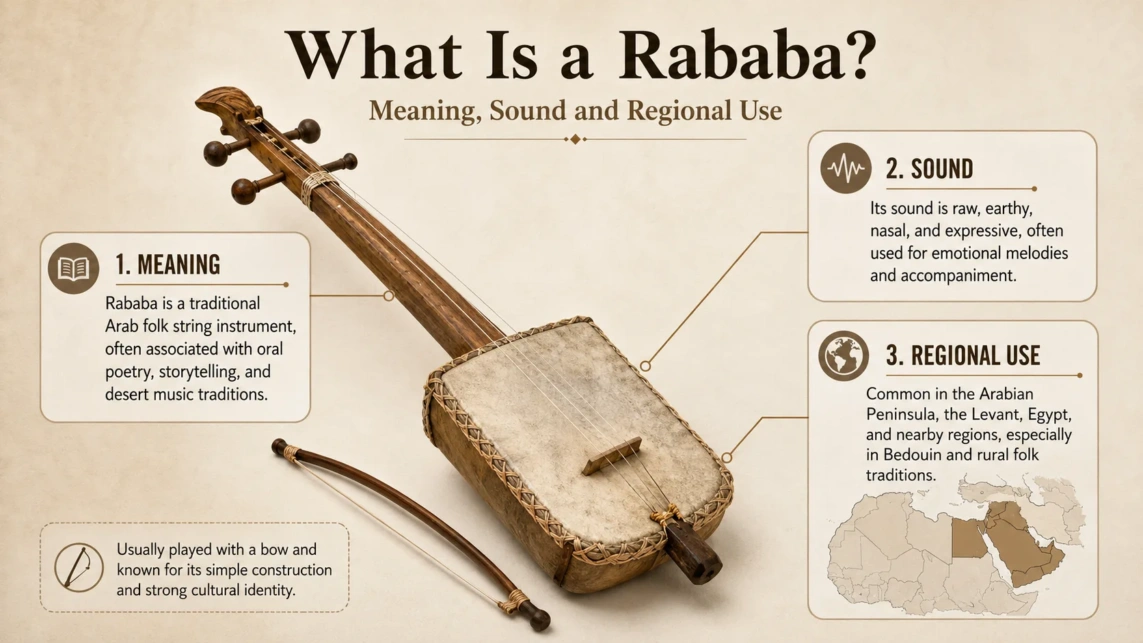
A rababa is usually a bowed spike fiddle of the Arab world, known for a direct, vocal sound and a body that can be square, bowl-shaped, coconut-shell based, or otherwise locally adapted. The name is not tied to one fixed factory pattern. It points to a family of related traditional instruments shaped by region, language, materials, and performance setting.
What the Name Rababa Means
The word rababa is closely related to rabāba, rabābah, rabab, and rebab. In many musical-instrument records, it describes a bowed spike fiddle: a small chordophone with a neck or spike passing through or into a resonating body.
The spelling changes because the name has moved through Arabic, Persianate, North African, Ottoman, South Asian, and European-language writing systems. A museum label may say rabāba. A performer may say rabab. A catalog may use rebab. These forms can overlap, but they do not always describe the same instrument.
| Name Form | Typical Use | What to Check |
|---|---|---|
| Rababa / Rabāba | Often used for Arab-world bowed spike fiddles, including square and bowl forms. | Look at the body shape, string count, and whether it is bowed. |
| Rabābah | A transliterated form often used in reference works for the Arabic name. | May describe the same family as rababa, not a separate modern model. |
| Rabab / Rabāb | A broader name that can refer to bowed fiddles or, in some regions, lute-like instruments. | Do not assume it is always the same as the one-string Arab rababa. |
| Rebab | Common in museum and Southeast Asian contexts, especially for bowed forms. | May refer to Javanese, North African, or other regional types. |
| Rubab / Rubāb | Often linked with plucked lutes in Central and South Asian contexts. | Usually needs a separate identification from the bowed rababa. |
Regional Note: The safest way to identify a rababa is not by spelling alone. Look for the physical form: a bowed instrument, a skin or membrane soundboard in many examples, a small resonator, and a playing position that often holds the instrument upright.
What a Rababa Usually Is
A rababa is best understood as a traditional bowed fiddle rather than a modern violin-family instrument. Many documented forms have a small body, a skin-covered sound table, one or two strings, and a bow strung with hair. Some have no separate fingerboard, so the player stops or touches the string directly.
The instrument’s simplicity can be misleading. A rababa may look plain beside a violin, yet its construction is highly purposeful. A light body, a membrane surface, and a small bridge help create a focused tone that can follow speech-like phrasing.
Body Shape and Resonator
Rababa bodies vary by region. Some are quadrangular, with a square or rectangular frame covered by hide. Others use a bowl, a coconut shell, or a carved wooden resonator. North African rabab forms may look more like short-necked bowed lutes, while some Egyptian examples use a coconut resonator with a skin covering.
The body is often small, but it does a demanding job. It must hold the string tension, support the bridge, and project the vibration from the bow. In many forms, the hide or parchment soundboard gives the tone a dry edge and fast response.
Strings, Bow, and Finger Contact
Some rababas have one string. Others have two. A few related instruments recorded under similar names have more strings, including sympathetic strings. Because the name covers several regional forms, a single universal string count would be misleading.
Traditional strings may be made from hair, gut, metal, or modern replacement materials, depending on the instrument and local practice. The bow is often simple, but the player’s control of pressure and angle matters greatly. Small changes can shift the tone from soft and breathy to sharp and penetrating.
Why It Is Called a Spike Fiddle
The term spike fiddle describes the way a narrow neck or spike relates to the body. In many examples, the spike passes through the resonator or continues below it. This allows the instrument to be held upright, with the lower end resting against the player, a knee, a cup, the ground, or another support.
This construction separates the rababa from a violin, which has a fully wooden hollow body, a fixed fingerboard, and a horizontal playing position under the chin.
Sound and Playing Feel
The rababa sound is often described as clear, reedy, nasal, and close to the human voice. Those words should be used carefully. The tone changes with the body shape, soundboard material, string type, bow hair, and local playing style.
In many bowed rababa forms, the sound has limited sustain compared with a violin. Notes speak quickly, then decay without much lingering resonance. This makes the instrument well suited to melodic lines that bend, lean, answer a singer, or support recitation.
Listening Note: A rababa may not sound “smooth” in the violin sense. Its character often comes from the bow’s grain, the membrane’s quick response, and the direct contact between hand, string, and resonator.
What Shapes the Tone
- Membrane soundboard: hide, parchment, or a similar skin surface can give the tone a tight and slightly percussive attack.
- Small resonator: a compact body often favors focus over long sustain.
- String material: hair, gut, steel, or replacement strings can change brightness, tension, and response.
- Bridge design: a simple bridge can make the instrument very sensitive to pressure and placement.
- Playing position: upright bowing allows subtle control, especially in vocal accompaniment.
Regional Use of the Rababa
The rababa is not tied to one nation or one single repertoire. It appears in Arab, North African, Egyptian, and neighboring traditions under related names. Its musical role is often intimate: it may accompany a singer, support poetic delivery, take part in folk performance, or appear in small traditional ensembles.
Regional use matters because the same name can point to different construction habits. A square one-string rababa and a two-string coconut-shell rabāba may share a family name, but their playing feel and visual profile are not identical.
| Region or Context | Common Form | Typical Musical Role |
|---|---|---|
| Arabian Peninsula and Bedouin Contexts | Often a square or rectangular spike fiddle, commonly associated with one string in many examples. | Used with sung poetry, narrative delivery, and solo accompaniment traditions. |
| Egypt | Rabāba forms may include a skin-covered resonator, sometimes made with a coconut shell, and one or two strings depending on the example. | Often linked with folk singers and local performance practice. |
| North Africa | Related rabab forms may be short-necked bowed lutes with skin soundboards and decorated bodies. | Used in traditional ensemble settings and regional art or folk music contexts. |
| Northeast Africa | The spelling rebaba can also appear for instruments outside the spike-fiddle type, including lyre forms in some collections. | The name must be checked against the instrument’s physical structure. |
| Broader Rebab Family | Related bowed instruments appear across parts of the Middle East, North Africa, and Southeast Asia. | Roles range from court and ensemble music to song accompaniment and local chamber settings. |
Arabian and Bedouin-Linked Rababa Forms
One of the clearest rababa images is the single-string bowed fiddle used with sung or recited poetry. The body may be square or rectangular, with hide stretched over a simple resonating frame. The string may be made from hair or another locally available material in traditional examples.
This form is valued less for volume and more for its ability to carry a flexible melodic line. It can shadow the voice, mark a tonal center, or give a performer a steady musical companion.
Egyptian Rabāba
Egyptian rabāba examples may use a small resonator covered with skin and played upright with a bow. Some museum examples describe two horsehair strings over a coconut resonator. The name kamānja agūz appears in some older Egyptian instrument labels for a related bowed-lute type.
In performance, the Egyptian rabāba is often connected with folk singers rather than formal violin-style concert playing. Its tone sits close to the voice, which helps explain why it remained useful in song accompaniment even as the violin became common in many urban ensembles.
North African Rabab Connections
North African rabab instruments can differ from the square rababa form. Some are short-necked bowed lutes with skin soundboards, decorated surfaces, and shaped wooden bodies. In museum examples from Algeria or Morocco, the instrument may appear more carved and lute-like than the simple one-string poet’s fiddle.
This is where spelling becomes especially important. A reader looking for “rababa” may find rabab, rebab, and rubab results that belong to different regional traditions. The body shape tells the better story.
When the Name Points Somewhere Else
Some collection records use rebaba for instruments that are not the Arab spike fiddle. In parts of Northeast Africa, related names may appear with lyres or other chordophones. That does not make the record wrong. It shows how names travel through language, collectors, and local usage.
For a reference page, the useful rule is simple: rababa usually means a bowed Arab-world spike fiddle, but the object must still be identified by form.
Materials and Construction Details
Traditional rababa construction often uses practical materials: wood for the neck or frame, hide or parchment for the soundboard, hair or gut for strings, and a small wooden bridge. Some examples use coconut shell, bone, mother-of-pearl, metal fittings, or painted decoration.
Decoration is not only visual. It can show regional taste, maker identity, repair history, and the social setting in which the instrument was used. A plain rababa may be a working singer’s instrument. A decorated rabab may belong to a different ensemble or collecting context.
Luthier’s Note: Wood choice can shape resonance, but the rababa’s sound also depends on the membrane, string tension, bridge height, bow hair, and how tightly the body is built. No single material explains the whole tone.
Membrane Soundboard
The skin-covered surface is one of the most recognizable details in many rababa forms. It behaves differently from a carved wooden soundboard. It can respond quickly to bow pressure and give the sound a lean, speech-like edge.
Humidity, age, and tension can affect the surface. Older museum instruments may not represent how the instrument sounded when new or actively played.
Neck, Pegs, and Tuning Setup
Many rababa-type instruments use simple pegs rather than geared tuners. The neck may be a plain spike, a carved piece of wood, or part of a larger body. Some instruments lack a separate fingerboard, so the string is stopped by finger contact rather than pressed against a hard board.
Tuning is regional and practical. A singer’s range, local mode, available strings, and the instrument’s build can all affect the pitch. It is safer to speak of local tunings than one universal rababa tuning.
How It Differs from Related Instruments
The rababa is often confused with other instruments because the names are close and the family history is tangled. A short comparison helps keep the main forms apart without turning every related instrument into the same object.
| Instrument | Main Difference | Useful Identification Clue |
|---|---|---|
| Rababa | Usually a bowed spike fiddle linked with Arab-world traditions. | Look for upright playing, a small resonator, and often a skin soundboard. |
| Afghan Rubab | A plucked lute, not a bowed spike fiddle. | It has a carved body, fretted neck area, plucked strings, and often sympathetic strings. |
| Rebec | A medieval European bowed instrument related historically in name and influence. | It is usually discussed in European medieval music contexts. |
| Kamancheh | A bowed spike fiddle from Persian, Caucasian, and neighboring traditions, with its own construction and repertoire. | Often has a rounded resonator and a more established art-music role in those traditions. |
| Violin | A European bowed instrument with a wooden body, fingerboard, four strings, and chin-held playing position. | The violin’s body and technique are standardized in a way the rababa family is not. |
How to Recognize a Rababa
A rababa can be recognized by a group of signs rather than one feature. The strongest signs are its bowed playing method, small resonator, upright position, and connection to regional vocal or folk practice.
- It is usually played with a bow, not a plectrum.
- It often has a skin or membrane soundboard.
- It may have one or two strings, though related forms can differ.
- The body may be square, bowl-shaped, coconut-shell based, or carved wood.
- It often supports singing, poetry, or small traditional ensemble music.
- Its spelling may appear as rababa, rabāba, rabābah, rabab, or rebab.
When identifying an old instrument, the safest question is not “What is the spelling?” but “How is it built, and how was it meant to be played?”
Common Misunderstandings About the Rababa
It Is Not Always the Same as a Rubab
Rubab often refers to plucked lute forms in Central and South Asian traditions. A rababa is usually bowed. The names share history, but the instruments can be very different in construction and technique.
It Is Not Always a One-String Instrument
Many well-known rababa forms use one string, especially in poet-fiddle contexts. Other examples have two strings, and related regional instruments may have more. String count alone should not decide the identification.
It Is Not a “Simple Violin”
The rababa is not a reduced violin. It belongs to a different design logic. Its membrane soundboard, upright posture, spike construction, and vocal performance role give it a separate identity.
The Name Can Cover More Than One Shape
A square rababa, a coconut-shell Egyptian rabāba, and a North African rabab may all sit near the same naming family. Their shape, sound, and setting can still differ.
FAQ About the Rababa
What Is a Rababa Instrument?
A rababa is usually a bowed spike fiddle associated with Arab and neighboring musical traditions. Many forms have a small resonator, a skin soundboard, one or two strings, and an upright playing position.
What Does a Rababa Sound Like?
A rababa often has a clear, dry, voice-like tone with a quick attack and modest sustain. The exact sound depends on the body, membrane, string material, bow, and regional playing style.
Is a Rababa the Same as a Rabab?
Sometimes the names overlap, but not always. Rabab can be a broad term for several chordophones, including bowed fiddles and some lute-like instruments. Rababa more often points to Arab-world bowed spike fiddle forms.
How Many Strings Does a Rababa Have?
Many rababas have one or two strings. Some related instruments recorded under similar names have different string setups. There is no single string count that fits every regional form.
Is the Rababa Played with a Bow?
Yes, the rababa is generally a bowed instrument. This separates it from many plucked rubab forms, even though the names can look related in English spelling.
Where Is the Rababa Used?
Rababa-type instruments are linked with Arab, Egyptian, North African, and neighboring traditions. They often appear in song accompaniment, poetic performance, folk music, and small traditional ensemble settings.