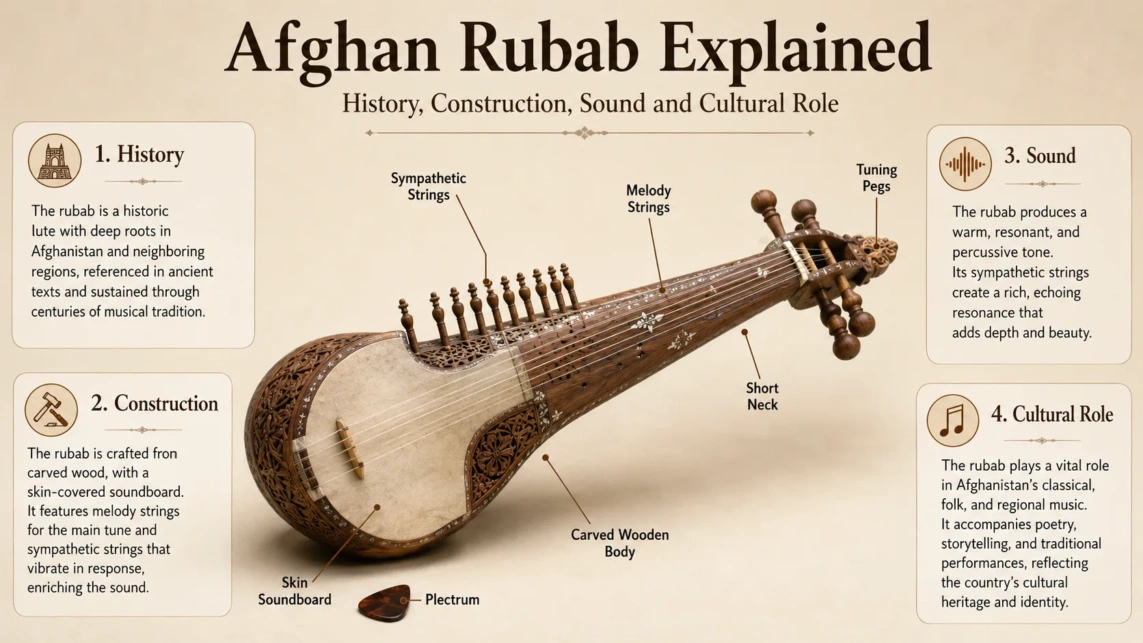
The Afghan rubab is a short-necked, plucked lute with a carved wooden body, a skin-covered resonating face, melody strings, drone strings and a set of sympathetic strings that add shimmer around the main note. It is often described as Afghanistan’s national instrument, but it is better understood as a carefully shaped member of a wider rubab family used across Central, South and Southwest Asia.
The instrument is also called rubāb, rabab, rebab, robab or Kabuli rubab depending on language, transliteration and regional context. In Afghanistan, the name usually points to the plucked lute form with a waisted body and skin soundboard, not to every instrument that carries a similar name elsewhere.
What the Afghan Rubab Is Known For
The Afghan rubab stands out because it combines a dry, percussive attack with a warm body resonance. The player strikes or plucks the strings with a small plectrum, so the first sound has a clear edge. After that, the skin head, wooden bowl and sympathetic strings shape the lingering tone.
This gives the instrument a voice that can cut through an ensemble without sounding metallic in the same way as a sarod or sitar. It can carry melody, support singing, answer a tabla pattern or give a short solo passage a firm rhythmic shape.
| Feature | Typical Description | Why It Matters |
|---|---|---|
| Instrument Type | Short-necked plucked lute | Places it within the wider chordophone and lute family rather than the bowed rebab family. |
| Body | Usually carved from a single block of wood, often mulberry in documented examples | The carved body and hollow chamber help shape a compact, resonant sound. |
| Soundboard | Skin-covered lower face, commonly described as goat skin in instrument records | The membrane gives the attack its dry, drum-like edge. |
| Strings | Melody strings, drone strings and sympathetic strings | The different string groups create melody, pitch support and ringing resonance. |
| Playing Method | Played with a small plectrum | The plectrum supports fast strokes, ornaments and clear rhythmic articulation. |
| Cultural Setting | Used in Afghan music and related regional traditions | It appears in solo playing, ensemble music, teaching lineages and heritage contexts. |
Names, Spelling and Regional Identity
The spelling varies because the name travels through Persian, Dari, Pashto, Uzbek, Tajik, Arabic-script sources and European transliteration. Rubab and rabab are common English spellings. Rubāb marks a long vowel in more formal transliteration. Rebab and robab may appear in catalogues, older writing or regional contexts.
The word can also refer to different instruments in different places. Some rebab-type instruments are bowed. Others are plucked. Some have long necks, while others have a short, carved body. This is why the phrase Afghan rubab is useful: it points to the Afghan plucked lute form rather than treating every similarly named instrument as the same object.
Regional Note: The Afghan rubab is closely associated with Afghanistan, especially with urban and professional music traditions, but related rubab, rawap, rubob and rewap forms appear across a much wider region. The shared names show family resemblance, not identical construction.
Historical Background without Overclaiming
The rubab name has a long history in Persianate and Central Asian musical writing, but the name did not always mean the same instrument. Older texts may use related words for bowed or plucked lutes, and the modern Afghan rubab should not be projected backward without care.
Many museum and research descriptions treat the contemporary Afghan or Kabuli rubab as a developed regional form, strongly associated with Afghanistan and nearby areas such as northwest India and Pakistan. Some accounts connect its present shape with the eighteenth century in cities such as Kabul, Kandahar and Peshawar. Other details are preserved through oral teaching lineages and instrument-making traditions, so exact historical claims should be handled with restraint.
What can be said with more confidence is practical: the Afghan rubab became one of the clearest musical symbols of Afghan instrumental music. It also helped shape later instruments and playing ideas in neighboring traditions. The sarod is often discussed in relation to the rubab, although the two instruments are not the same in build, surface, technique or sound.
Construction and Materials
The Afghan rubab is not built like a flat-backed guitar or oud. Its body is usually carved as a hollow form from wood, with a narrow waist that separates the upper and lower areas of the instrument. The lower chamber carries the skin face. The upper part continues into the neck and pegbox area.
Carved Body and Waisted Shape
Documented Afghan rubabs often use mulberry wood. Mulberry is valued in several Central and South Asian instrument traditions because it can be carved cleanly and can offer a responsive body when prepared well. Wood choice can shape resonance, but the final sound also depends on body thickness, skin tension, bridge placement, strings and the player’s touch.
The waist of the body is not just decorative. It divides the visual outline and helps define the lower resonating chamber. Many examples have a compact, almost sculptural profile, with ornament placed on the fingerboard, body edges or pegbox.
Skin Soundboard
The skin soundboard is one of the main reasons the Afghan rubab has its familiar attack. When the plectrum hits the string, the bridge sends energy into the membrane. The result is a quick, firm response with a slightly dry edge.
A wooden soundboard would not behave in the same way. The skin adds a sharper beginning to the tone, while the carved wooden body gives depth behind it. This balance is part of the instrument’s character.
Material Note: Skin soundboards react to humidity, temperature and age. A rubab that sounds bright in one room may feel tighter or softer in another. This is normal for membrane-faced lutes and should not be mistaken for a fixed flaw.
Fingerboard, Frets and Ornament
The Afghan rubab normally has a short fingerboard and tied or fixed frets depending on the form. Some museum records classify examples as fretted, while at least one recorded Afghan rubab is described as unfretted. This does not necessarily mean the sources are wrong. It shows that surviving instruments, restoration states and regional or maker choices can differ.
Mother-of-pearl, bone or similar light-colored inlay is common on decorated examples. The ornament is not always only surface display. It can also mark a craft lineage, workshop taste or the instrument’s intended status as a concert, teaching or presentation object.
Strings and Peg Arrangement
A typical Afghan rubab has several string groups rather than one simple set. The main melody strings are played directly. Drone strings provide pitch support. Sympathetic strings run along the side and vibrate in response to notes played on the main strings.
Many documented examples describe three main melody strings, two or three long drone strings and a set of sympathetic strings. The number of sympathetic strings may vary; museum and collection descriptions often show counts in the range of about eight to fifteen. Because makers, regions and restoration histories differ, a single exact number should not be treated as universal.
- Melody strings: used for the main line and ornaments.
- Drone strings: support the tonal center and rhythmic color.
- Sympathetic strings: add halo-like resonance when nearby pitches are played.
- Pegs: often placed in different areas for different string groups, which helps identify the instrument visually.
How the Afghan Rubab Produces Its Sound
The sound begins with the plectrum. A soft finger-plucked attack would change the instrument’s character. The rubab needs the small pick to produce its crisp leading edge, fast strokes and rhythmic bite.
After the attack, the skin head gives a short, percussive response. The carved body adds warmth. The sympathetic strings bring a faint, ringing layer that can make a single note feel larger than it looks on the fingerboard.
Timbre and Resonance
The Afghan rubab is often described as lively and percussive. That description fits many well-set-up examples, but the sound can still vary. A larger body, different skin tension, altered bridge height or different string material can change the balance between dryness, warmth and sustain.
The lower notes can feel rounded and woody. The upper register can become nasal, focused and bright. In skilled hands, the instrument can move between short rhythmic phrases and more singing melodic lines.
Listening Note: A rubab recording should not be judged only by sustain. Much of the instrument’s beauty sits in the first half-second of each note: the pick stroke, the skin response and the small after-ring from sympathetic strings.
Playing Style and Musical Function
The Afghan rubab is usually held across the body while seated. The player uses one hand to stop the melody strings and the other to strike with the plectrum. The playing hand does more than make sound; it controls pulse, accent and the density of repeated strokes.
In ensemble settings, the rubab can carry a melody, support a vocalist or converse with percussion. Tabla is a common partner in many modern performance settings, especially where Afghan, North Indian and regional classical ideas meet. The instrument can also appear in solo music, where the player uses drone and sympathetic resonance to keep the line full.
Learning Feel
Beginners often notice two things quickly. First, the rubab is physically compact, but it is not simple. Second, the extra strings make tuning and maintenance more demanding than on a basic three-string lute.
The left hand must learn the short scale and fret positions. The right hand must learn clean plectrum control. A player also needs patience with tuning, because the sympathetic strings can make the instrument sound alive only when they are set with care.
Tuning and Regional Variation
Rubab tuning is not best explained as one fixed global standard. In some Afghan and Kabuli contexts, the main melody strings are described as tuned in fourths, often with the tonal center adjusted to the singer, ensemble or harmonium reference. Other regional or teaching settings may use different practical choices.
This means a learner should avoid copying a random tuning chart without knowing the instrument type. An Afghan rubab, a Pamiri rubab, an Uzbek rubob and a Sikh rabab-style instrument may not share the same string layout, bridge setup or musical role.
- Identify the exact instrument form before tuning.
- Count the melody, drone and sympathetic strings separately.
- Check whether the frets and bridge are stable.
- Use teacher guidance or a reliable regional method when possible.
- Do not force old pegs, fragile strings or a dried skin head.
Decoration, Craft and Museum Context
A well-made Afghan rubab shows both musical and visual craft. The body may be plain and workmanlike, or it may carry inlay, carved detail and contrasting materials. Mother-of-pearl inlay is especially visible on many collected examples.
For museums, the Afghan rubab is not only a musical tool. It is also an object that records woodworking, carving, membrane preparation, peg fitting, string layout and regional taste. Dimensions, fret condition, string count and repair marks all help researchers understand how a particular example was made and used.
Collector’s Note: Old rubabs should be assessed carefully before playing. Missing sympathetic strings, loose pegs, cracked wood or a tired skin head can affect both sound and structure. Restoration should preserve the instrument’s regional character rather than forcing it into a modern generic setup.
Cultural Role in Afghanistan and Beyond
The Afghan rubab holds a respected place in Afghan musical life. It appears in professional performance, teaching lineages, social gatherings, recordings and heritage presentations. It is also recognized in broader rubab and rabab traditions across countries such as Afghanistan, Iran, Tajikistan and Uzbekistan.
Its role is not limited to one style. The instrument can appear in urban art music, regional folk settings, ensemble arrangements and modern cross-cultural performances. In each setting, the sound carries a recognizable profile: plucked attack, skin resonance and the fine shimmer of sympathetic strings.
The rubab also matters because it teaches listeners how instrument identity works. A name, a body shape, a string layout and a playing method all carry information. The Afghan rubab is not only “a lute from Afghanistan.” It is a specific craft tradition with its own sound logic.
How It Differs from Related Instruments
The Afghan rubab is often confused with other lutes because names and shapes overlap across regions. A short comparison helps keep the categories clear without turning every related instrument into the same thing.
| Instrument | Main Similarity | Main Difference |
|---|---|---|
| Sarod | Linked historically and musically to rubab-type lutes | The sarod usually has a metal fingerboard and a different modern concert technique. |
| Rebab or Rabab Fiddle | Shares a related name in some traditions | Many rebab forms are bowed, while the Afghan rubab is plucked with a plectrum. |
| Pamiri Rubab | Belongs to the wider rubab family | It has its own regional body form, stringing and playing context. |
| Rawap or Rewap | Related Central Asian lute family resemblance | Often has a different neck, body outline and regional performance setting. |
| Oud | Both are plucked lutes used in Asian musical cultures | The oud has a wooden soundboard and a different bowl-backed design, without the Afghan rubab’s skin head and sympathetic string layout. |
Common Misunderstandings
Every Rebab Is Not the Afghan Rubab
The shared name can mislead readers. Some rebabs are bowed spike fiddles. Some rubabs are long-necked lutes. The Afghan rubab is a plucked, short-necked lute with a carved body and skin-covered resonator.
The Extra Strings Are Not All Played as Melody Strings
The side strings are not used like a guitar’s main strings. Many of them are sympathetic strings. They vibrate when related notes are played, adding resonance rather than carrying the main melody.
The Instrument Is Not Just an Older Sarod
The sarod is often discussed in relation to the Afghan rubab, and the connection is useful. Still, the sarod has its own modern construction, metal fingerboard, technique and concert tradition. The Afghan rubab should be studied on its own terms.
Practical Identification Clues
An Afghan rubab can often be recognized by its compact carved body, narrow waist, skin-covered lower soundboard, short neck, peg arrangement and side sympathetic strings. Ornament is common but not required for identification.
- Look for a skin membrane on the lower body.
- Check for a short neck rather than a long tanbur-like neck.
- Notice the side pegs for sympathetic strings.
- Look for a carved wooden body rather than separate flat ribs.
- Do not rely only on decoration; plain examples can still be Afghan rubabs.
Condition also matters. A missing bridge, removed strings or repaired skin can make an instrument harder to identify. In that case, body shape and peg layout become more useful than the current string count.
FAQ
Is the Afghan rubab the same as the rebab?
No. The names are related, but they do not always refer to the same instrument. The Afghan rubab is a plucked short-necked lute with a skin soundboard. In other regions, rebab or rabab may refer to bowed instruments or different lute forms.
Does every Afghan rubab have the same number of strings?
No. Many examples have three main melody strings, drone strings and a group of sympathetic strings, but the exact number can vary by maker, region, age and restoration history.
What gives the Afghan rubab its sound?
The sound comes from the plectrum attack, the skin-covered resonating face, the carved wooden body and the sympathetic strings. The result is a tone that can feel dry, warm, bright and ringing at the same time.
Is the Afghan rubab hard to learn?
It can be challenging for beginners because it requires plectrum control, accurate tuning and care for several string groups. The short neck may look simple, but the musical style and maintenance need patient study.
Is the Afghan rubab related to the sarod?
Yes, many instrument histories discuss a relationship between the Afghan rubab and the sarod. The connection should not erase the differences: the sarod has a metal fingerboard, different playing technique and its own concert tradition.
Why is it sometimes called the Kabuli rubab?
The name Kabuli rubab points to the Afghan urban form associated with Kabul and related regional traditions. It helps distinguish this instrument from other rubab, rabab, robab or rawap forms found across Central and South Asia.