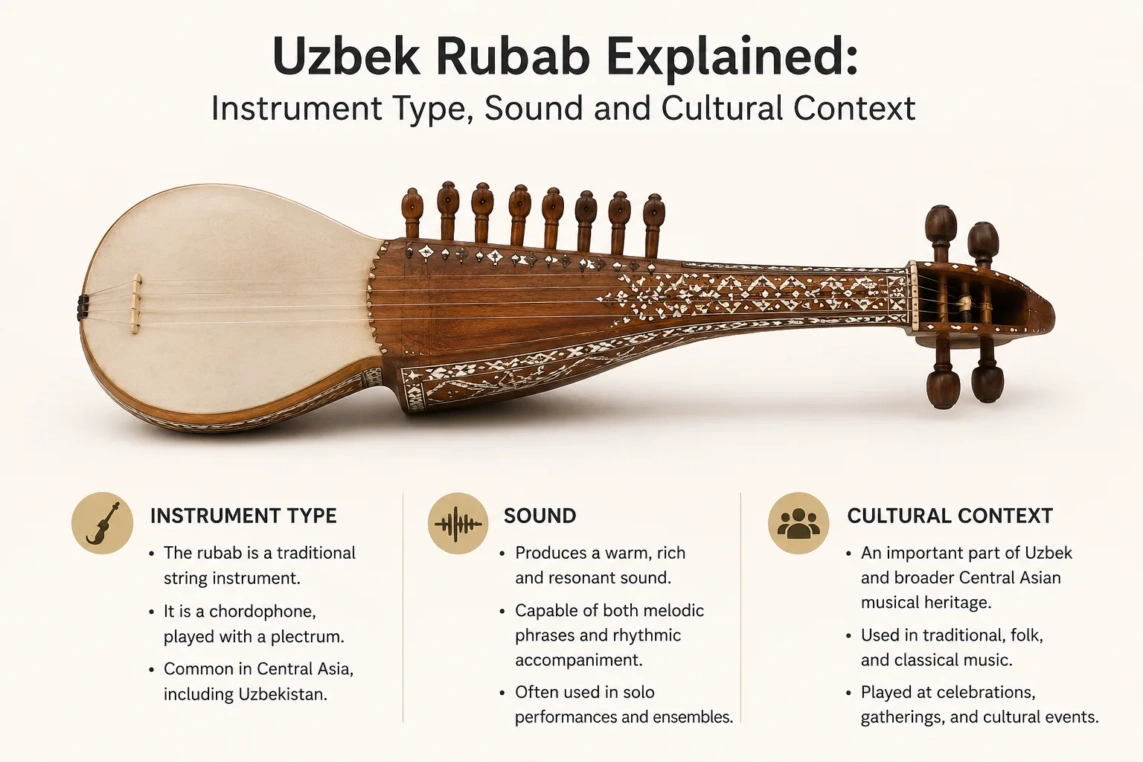
The Uzbek rubab is best understood as a family of plucked lutes rather than one fixed instrument. In Uzbekistan it is often called rubob, and the form many learners meet first is the Qashqar rubobi: a bright, fretted, plectrum-played instrument used in folk melodies, maqom-related performance, ensembles, and formal music education.
What Type of Instrument Is the Uzbek Rubab?
The Uzbek rubab belongs to the wider rubab, rabab and rubob family found across Central Asia and nearby musical cultures. In Uzbek use, the word usually points to a necked string instrument played with a plectrum. It is not the same as every instrument called rabab in Arabic, Persian, Afghan, South Asian or Southeast Asian contexts.
The main point is simple: an Uzbek rubab is usually a plucked lute, not a bowed spike fiddle. Some older uses of the word rabab in other regions can refer to bowed instruments, but the Uzbek rubob tradition is normally heard through a picked, fretted sound.
| Feature | Typical Uzbek Context |
|---|---|
| Common name | Rubob, rubab, Qashqar rubobi |
| Instrument type | Plucked necked lute |
| Playing method | Usually played with a plectrum |
| Neck | Fretted, allowing clear melodic fingering |
| Sound character | Bright, ringing, direct, and suited to melodic lines |
| Main settings | Solo pieces, ensembles, folk instrument orchestras, teaching studios |
| Related Uzbek instruments | Dutar, tanbur, gijjak, doira, chang, nay |
Names and Spellings
The spelling changes because the instrument name moves between languages, scripts and scholarly habits. Rubob is common in Uzbek transliteration. Rubab is widely used in English and in wider Central Asian writing. Rabab, robab and rubāb may appear in museum notes, academic sources or regional descriptions.
These spellings do not always name the same object. A Kabuli rubab, Pamiri rubab, Uyghur rawap and Uzbek Qashqar rubobi can share historical naming space while differing in body shape, stringing, tuning habits, repertory and playing feel.
Regional Note: In Uzbekistan, Qashqar rubobi is a specific and very familiar name. It points to a form associated by name with Kashgar, while its modern Uzbek use belongs strongly to Uzbek national instrument practice and music education.
The Qashqar Rubobi in Uzbek Music
The Qashqar rubobi is often described as one of the most widespread Uzbek national instruments. It is valued partly because it gives a clear melodic sound and can be learned more quickly than some long-necked instruments with more demanding left-hand technique.
Its role is practical as well as cultural. It can carry a tune in a small ensemble, support arranged pieces in a folk instrument orchestra, and serve as an entry instrument for students. The bright attack helps the melody stand out beside doira rhythms, dutar accompaniment or other plucked instruments.
Why It Is Common in Teaching
The fretted neck gives students visible pitch positions. The plectrum stroke also produces an immediate tone, which helps early learners hear rhythm and articulation clearly. This does not make the instrument simple in an artistic sense; advanced players still need fine control of ornament, timing, phrasing and tone.
- Clear frets help students map melodic movement.
- Strong attack supports rhythmic accuracy.
- Bright projection works well in ensemble texture.
- Adapted orchestra forms allow the rubob family to cover different ranges.
Body Shape and Construction
Uzbek rubab construction varies by regional form and by modern workshop practice. A Qashqar rubobi usually has a carved or built wooden body, a neck with frets, tuning pegs, a bridge and multiple strings arranged for plectrum playing. The outline is often easy to recognize because of its compact resonating body and long neck.
Documented Uzbek instrument descriptions also mention orchestra forms such as rubob prima, alto and tenor. These versions belong to organized ensemble practice and should not be confused with older regional rubab forms one-to-one. They are part of how traditional instruments were adapted for group performance, written arrangements and teaching systems.
Materials That Shape the Playing Feel
Wood choice, body depth, bridge fitting, string material and fret setup can shape the way a rubob responds under the hand. A well-set instrument gives a clean attack without feeling stiff. A poor bridge or uneven fretwork can make the same instrument sound thin or hard to tune.
Luthier’s Note: On a plucked rubob, the first sound is not only a matter of strings. The bridge, fret height, neck angle and body response all affect how quickly the note speaks after the plectrum touches the string.
Strings, Tuning and Range
String number and tuning should be described carefully because sources and modern instruments do not always agree. Some descriptions of rubab-type instruments mention four to six main strings, while specific Uzbek rubob forms may be set up differently depending on workshop, teaching system and ensemble role.
In practice, the player treats the instrument as a melody instrument. The tuning must support clear scalar movement, ornament and repeated plectrum strokes. In orchestra versions, range and tuning are adapted so different rubob sizes can sit in different registers.
Why One Fixed Tuning Is Not Enough
There is no safe single tuning statement for every Uzbek rubab. A student model, a Qashqar rubobi, an orchestra rubob prima and a regional rubob used outside formal teaching may not follow the same setup. The better approach is to identify the exact instrument type first, then describe its tuning.
What the Uzbek Rubab Sounds Like
The Uzbek rubab has a ringing, bright and articulate sound. Notes start clearly because the plectrum gives each tone a defined edge. The resonance is not usually as soft and woody as a dutar, and it is not as bowed or sustained as a gijjak.
The sound works well for ornamented melodic lines. Short repeated strokes, grace notes and quick turns can remain audible without becoming blurred. This is one reason the instrument fits both solo display and ensemble textures.
Listening Note: A Qashqar rubobi often sounds more pointed than a dutar. Listen for a clear plectrum attack, a bright upper register and a melody line that can cut through percussion and other plucked instruments.
Playing Style and Technique
The player usually holds the rubob across the body and plucks the strings with a plectrum. The left hand stops the strings against frets, while the right hand shapes rhythm, attack and repeated patterns.
Technique depends on clean coordination. The plectrum must be firm enough to produce a clear tone but not so heavy that the line becomes harsh. The left hand needs accurate placement because fast ornamentation can sound untidy if the frets are not approached cleanly.
Common Technique Areas
- Plectrum control: downstrokes, upstrokes, repeated strokes and rhythmic accents.
- Left-hand clarity: clean fingering on frets and controlled shifts along the neck.
- Ornament: short turns, slides or grace-note effects depending on style and teacher.
- Ensemble balance: playing brightly without overpowering singers or softer instruments.
Cultural Context in Uzbekistan
The Uzbek rubab sits inside a broader instrument culture that includes dutar, tanbur, gijjak, nay, chang and doira. It appears in folk repertory, staged ensembles, conservatory-linked teaching and arranged music for Uzbek folk instrument groups.
Its cultural role is not limited to one village style or one ceremonial use. Modern Uzbek rubob practice belongs to both everyday music education and public performance. It can appear in student concerts, professional ensembles and recordings of traditional or arranged repertory.
The wider craft and playing tradition of rubab and rabab instruments has also been recognized in a heritage context involving several countries, including Uzbekistan. That recognition reflects a shared regional instrument culture, not a claim that every rubab form is identical.
How It Differs from Related Instruments
The Uzbek rubab can be confused with other Central Asian and South Asian lutes because the names overlap. The differences are easier to hear and see when each instrument is treated as a regional form with its own construction and repertory.
| Instrument | Main Difference | Useful Identification Clue |
|---|---|---|
| Uzbek Qashqar Rubobi | Bright plucked lute common in Uzbek teaching and ensemble use | Fretted neck, plectrum attack, clear melodic projection |
| Afghan Rubab | Short-necked carved lute with a different body profile and playing tradition | Deeper carved body, skin soundboard area, sympathetic strings in many forms |
| Dutar | Long-necked two-string lute with a softer plucked voice | Long slim body and gentler tone |
| Tanbur | Long-necked lute used in maqom traditions with a different technique | Longer neck and a more specialized classical role |
| Gijjak | Bowed spike fiddle, not a plucked rubob | Played with a bow and produces sustained tones |
| Uyghur Rawap | Related naming and regional overlap, but a distinct Uyghur lute family | Often recognized by its own body shape, decorative style and repertory |
Afghan Rubab, Bukhara Rubobi and Uzbek Use
Some Uzbek sources use the name Afghan rubobi and also connect it with the name Bukhara rubobi. This form is usually described with a thicker and softer sound than the Qashqar rubobi. It belongs to a different rubab profile and should not be treated as the same instrument under a different spelling.
This distinction matters for readers, collectors and students. A Qashqar rubobi and an Afghan/Bukhara rubobi may both sit under the rubab-rubob naming umbrella, but they do not offer the same playing feel, tone or construction language.
What to Look for When Identifying an Uzbek Rubab
Start with the body and neck, then look at the playing method. A plucked fretted neck points toward the Uzbek rubob setting, while a short carved body with sympathetic strings may point toward an Afghan rubab form.
- Check whether the instrument is plucked or bowed.
- Look for frets on the neck.
- Notice the body shape and bridge position.
- Count the visible strings, but do not rely on string count alone.
- Ask whether the name used is Qashqar rubobi, Afghan rubobi, Bukhara rubobi or a general rubab label.
Collector’s Note: A label that says “rubab” is not enough for identification. The regional form, string layout, body shape and playing method give better evidence than the English spelling alone.
Modern Learning and Performance
The Uzbek rubab remains a practical instrument for learners because it gives quick feedback. A note either speaks cleanly or it does not. This helps students develop timing, left-hand placement and plectrum discipline.
More advanced study moves beyond note placement. Players work on phrasing, tone color, ornament, dynamic control and ensemble awareness. A strong rubob player does not simply play fast; the melody remains shaped and readable.
Beginner Points Worth Knowing
- The plectrum hand matters as much as the fretting hand.
- Tuning should be learned from the exact rubob type being used.
- Frets make pitch easier to locate, but they do not remove the need for careful listening.
- Uzbek rubab tone should be clear, not forced.
Common Misunderstandings
One common mistake is treating all rubab, rabab and rubob instruments as one object. The name travels widely, but the instruments do not all share one construction plan.
Another mistake is assuming the Uzbek rubab is always an ancient museum object. It has historical depth, but it is also a living teaching and performance instrument. Modern workshops, music schools and folk orchestras have shaped how many people now encounter it.
A third mistake is describing the sound only as “traditional.” That word is too broad. The more useful description is brighter and more percussive than many soft plucked lutes, with a clear melodic edge made by plectrum technique.
FAQ
Is the Uzbek rubab the same as the Afghan rubab?
No. They belong to the wider rubab family, but they differ in construction, sound and playing feel. The Uzbek Qashqar rubobi is usually a bright fretted plucked lute, while the Afghan rubab has its own short-necked carved body tradition and often a deeper tone.
Is rubob the same word as rubab?
Rubob is a common Uzbek form of the name. Rubab is more common in English and wider regional writing. The spelling alone does not identify the exact instrument type.
Does the Uzbek rubab use a bow?
In the usual Uzbek rubob context, it is played with a plectrum. Bowed instruments in nearby traditions may carry related names in older or regional usage, but the Uzbek rubob most learners meet is plucked.
What does the Qashqar rubobi sound like?
It has a bright, ringing and direct tone. The plectrum gives the note a clear attack, which helps the melody stand out in ensembles and solo playing.
Is the Uzbek rubab good for beginners?
It can be a suitable first traditional instrument because the fretted neck and clear attack help beginners hear their mistakes. Good instruction is still needed for tuning, plectrum control and ornament.
Why are there different rubab types in Uzbekistan?
Uzbek music includes regional forms, teaching instruments and orchestra-adapted versions. Names such as Qashqar rubobi, Afghan rubobi, Bukhara rubobi, rubob prima, alto and tenor can point to different roles rather than one single standard instrument.