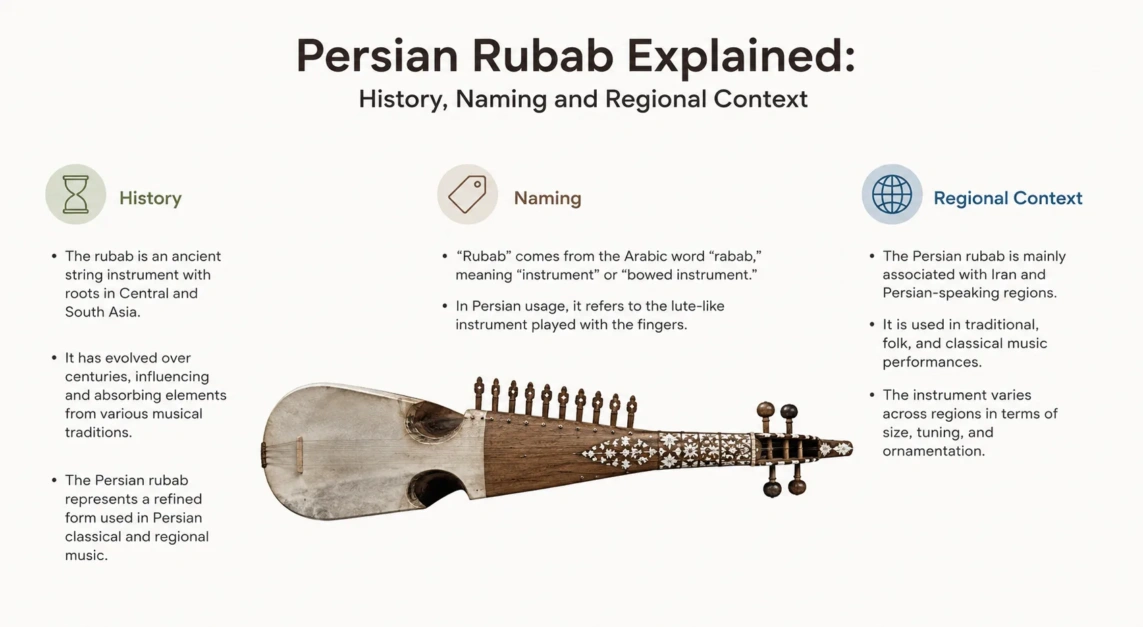
A Persian rubab is best understood as a rubab-family instrument seen through Persian-language naming, historical writing, and regional music practice. The phrase can point to more than one object: a plucked skin-top lute in the Khorasan and Central Asian sphere, an older rabab named in Persian and Arabic texts, or a local form linked to communities that use Persian, Dari, Tajik, or neighboring languages. That is why the name needs context before the instrument can be identified.
What the Name Usually Points To
The term Persian rubab does not describe one fixed modern model in the same way that “violin” or “classical guitar” does. It is a context-sensitive name. In some uses it points toward a plucked short-necked lute with a skin soundboard. In older writing, related forms of the word may refer to bowed instruments or to a wider class of string instruments.
This flexible naming is not a mistake. It reflects the long movement of the word rabab, rubab, and rebab across languages, scripts, makers, musicians, and museum catalogues.
Regional Note: In this context, “Persian” should not always be read as “made in present-day Iran.” It may mean Persianate: connected with Persian-language culture, the wider Khorasan region, and music traditions that cross modern borders.
| Name or Spelling | Where It Appears | What It Often Means | Careful Reading |
|---|---|---|---|
| Rubāb / Rubab | Persian, Dari, Central Asian, and South Asian writing in Latin transliteration | A plucked lute in many modern regional contexts | The macron in rubāb marks a long vowel; many pages omit it. |
| Rabāb / Rabab | Arabic and Persianate historical sources, museum labels, and music writing | A bowed or plucked string instrument, depending on period and region | The same spelling can point to different instrument forms. |
| Rebab | North African, Middle Eastern, Ottoman, Indonesian, and European-language contexts | Often a bowed spike fiddle or related bowed instrument | It should not be assumed to be the same as the Afghan-style plucked rubab. |
| Robab / Robāb | Iranian and Central Asian transliteration | A local spelling of the same name family | Pronunciation and spelling vary by language and transcription style. |
| Rubob / Rubob | Uzbek and Tajik contexts | Central Asian lute forms related by name and history | Construction may differ from Kabuli or Herati rubab models. |
Naming and Spelling in Persian Context
Rabab, Rubab and Rebab
The spelling changes because the name moved through scripts that do not map neatly into English letters. Arabic, Persian, Dari, Tajik, Uzbek, Turkish, and European-language catalogues may all choose different vowels. The consonant pattern stays recognizable, while the written vowels shift.
Rubāb is often used when writers want to show the long “a” sound. Rubab is the simpler web spelling. Rabab and rebab are also common, but they can lead the reader toward other regional instruments, especially bowed forms.
Persian or Persianate
The phrase Persian rubab works best when it is used for a cultural and language setting, not as a single national category. Persian-language poetry, courtly vocabulary, eastern Iranian regional culture, Afghan music, Tajik usage, and Central Asian lute traditions all sit near the name.
This is why a careful description should ask three questions before naming the instrument:
- Is the instrument bowed or plucked?
- Does it have a skin soundboard, a wooden soundboard, or another resonating surface?
- Which region, maker tradition, or catalogue source gives the name?
Historical Background
By the medieval period, rabab was already a known name in Arabic and Persianate music writing. It did not always mean one exact object. In some sources it described a bowed instrument. In other regional settings, especially farther east, related names became linked with plucked lutes.
This matters because modern readers often meet the rubab through Afghan or Central Asian examples and then project that shape backward onto every older reference. The historical name is older and broader than any one surviving model.
Khorasan and the Eastern Persian-Language Sphere
Khorasan is central to the rubab story because it connects Persian-language culture with present-day northeastern Iran, Afghanistan, parts of Central Asia, and older trade and craft routes. The word “Persian” in this setting often points toward that wider sphere rather than a narrow modern border.
In this region, instrument names travelled with poets, musicians, artisans, court repertories, and local performance settings. The rubab family sits beside other lutes and bowed instruments rather than replacing them.
Why the History Is Hard to Pin Down
Rubab history is difficult because the name and the object do not always move together. A word can survive in poetry while the instrument changes. A museum object can carry a regional label that reflects collection history rather than a maker’s own term. A local musician may use a practical name that differs from an academic label.
The safest historical reading is this: the Persian rubab belongs to a broad rubab/rabab name family, shaped by Persian-language culture and neighboring traditions, with both bowed and plucked meanings depending on source and region.
Construction Details That Help Identification
A Persian rubab description should begin with visible construction, not spelling alone. The plucked rubab-family lute is usually recognized by a carved wooden body, a membrane soundboard on part of the resonator, a short neck, lateral pegs, and a bridge that carries the string vibration into the skin top.
Many documented Afghan and Central Asian rubab-family instruments use mulberry wood, though makers may use other woods depending on region, supply, and repair history. Decorative inlay, carved pegboxes, and shaped fingerboards can help identify a regional school, but ornament alone is not a safe naming tool.
Body, Soundboard and Strings
The skin soundboard gives many rubab-family lutes their firm attack and vocal edge. A wooden body supports resonance behind that skin surface. The result is not the long ringing sustain of some metal-strung lutes. It is a more immediate sound: clear, dry at the front, and warm in the body.
String layouts vary. Some regional forms have melody strings, drone strings, and sympathetic strings. Others are simpler. The exact count should not be guessed from the word “rubab” alone.
Luthier’s Note: A skin-top lute responds to air and handling. Dry conditions can tighten the surface and sharpen the response, while damp conditions may soften the attack. This is one reason older rubabs in collections are often described through their materials and condition, not only through their musical name.
Plectrum or Bow?
A modern Persian or Afghan-style rubab is usually understood as a plucked lute. The player uses a plectrum, often with a strong downstroke feel and clear melodic articulation.
That does not mean every historical rabab was plucked. In many Arabic, North African, Middle Eastern, and Southeast Asian contexts, rebab-type instruments are bowed. The name alone is not enough.
Regional Context
Iran and Persian-Language Use
In present-day Iranian classical music, the rubab is not usually the central concert instrument in the way the tar, setar, santur, kamancheh, or ney may be. The word is still relevant through older Persian-language references, regional culture, and the broader eastern Iranian and Khorasan setting.
For that reason, “Persian rubab” is most useful when the page or catalogue is explaining language, history, and regional identity. For a current performance instrument, a more specific label is often better.
Afghanistan and the Kabuli or Herati Rubab
The Afghan rubab has the clearest modern public identity in the rubab family. It is a plucked short-necked lute used in art music, regional music, and small ensembles, and it is widely recognized as a national instrument of Afghanistan.
Kabuli and Herati associations are often used in discussion of Afghan rubab forms. These names point to regional making, repertory, and style, not just geography on a map.
Tajikistan, Uzbekistan and Central Asian Rubob Forms
Central Asian rubob and rubab names sit close to the Persian rubab context because Tajik and Uzbek music traditions share long histories with Persianate culture. Yet the instruments can look and behave differently from Afghan models.
Some Central Asian rubob forms have a longer neck or a different body outline. Some use frets. Some belong to modern ensemble settings shaped by local teaching systems. They should be described on their own terms.
South Asian Links
The sarod is often discussed near the Afghan rubab because of historical links in northern South Asia. It is not simply a rubab under another name. The sarod has its own construction, metal fingerboard, repertory, and classical music setting.
This link is useful for orientation, but it should not flatten the differences between instruments.
How It Differs from Related Instruments
| Instrument or Name | Main Connection | What Changes | Best Use of the Term |
|---|---|---|---|
| Persian Rubab | Persian-language and Persianate regional context | May refer to a plucked rubab-family lute or to older textual usage | Use when naming, history, and regional context are the focus. |
| Afghan Rubab | Strong modern instrument identity | Usually a plucked short-necked lute with skin soundboard and regional ornament | Use when discussing Kabuli, Herati, or Afghan performance practice. |
| Arabic Rabab / Rababa | Older Arabic bowed-instrument vocabulary | Often a bowed fiddle rather than a plucked lute | Use for Arab bowed forms and medieval rabab references. |
| Rebab | Wide regional name across the Middle East, North Africa, Turkey, and Southeast Asia | Often bowed, with many body shapes | Use with a region attached, such as Indonesian rebab or Turkish rebab. |
| Barbat | Persian short-necked lute history | Wooden soundboard and oud-like lineage, not a skin-top rubab form | Use for Persian lute history and oud-related discussion. |
| Kamancheh | Persian and regional bowed spike fiddle tradition | Bowed playing, spike support, different sound production | Use for bowed Persian classical and regional contexts. |
Sound and Musical Role
A plucked rubab-family instrument gives a compact, speech-like attack. The tone can feel bright at the start of the note and darker as the body responds. Sympathetic strings, where present, add a soft halo around the main melody.
The rubab works well for melodic lines, rhythmic figures, and ornamented phrases. In ensemble settings, it can carry a tune without needing the volume or sustain of a larger lute. Its voice is direct.
Listening Note: When comparing recordings, listen first to the attack. A skin-top plucked rubab often has a quick, percussive edge. A bowed rebab will sustain differently, with the bow shaping the note after it begins.
Museum and Collection Context
Museum labels can be helpful, but they need careful reading. A label may say rubāb, Afghani rubāb, rabab, or another spelling. It may record the place where the object was collected, the place where it was made, or a broad regional identity.
For a better reading, look at the object itself:
- A skin soundboard suggests a rubab-family lute or a membrane-bellied fiddle, depending on playing method.
- A bow, spike, or cylindrical body points away from the Afghan-style plucked rubab.
- A short carved body with plectrum wear points toward a plucked lute tradition.
- Inlay, pegbox shape, and bridge form can support identification but should not carry the whole answer.
Common Misunderstandings
“Persian Rubab” Does Not Always Mean an Iranian Concert Instrument
The word “Persian” can refer to language and cultural setting. It does not always mean the object belongs to the main classical instrument set of present-day Iran.
The Rubab Is Not Always Bowed
Older and western rebab/rabab traditions often include bowed instruments. Afghan and many eastern rubab-family lutes are plucked. Both facts can be true because the name family is broad.
Spelling Does Not Prove Instrument Type
Rubab, rabab, rebab, and robab may reflect language, transliteration, or catalogue habit. The build and playing method matter more than the spelling.
There Is No Single Safe Tuning to Assume
Tuning can vary by region, teacher, repertory, and instrument design. A page about general Persian rubab context should not give one tuning as universal unless it is discussing a named regional form.
FAQ
Is a Persian Rubab the Same as an Afghan Rubab?
Not always. The Afghan rubab is a clear modern regional instrument. “Persian rubab” is often a broader language and history term. It may overlap with Afghan, Khorasan, or Central Asian contexts, but it should be defined by the source and instrument form.
Is the Persian Rubab Bowed or Plucked?
In many modern eastern contexts, rubab-family lutes are plucked with a plectrum. Older rabab/rebab names can also refer to bowed instruments. The safest answer depends on the region and the physical construction.
Why Are There So Many Spellings of Rubab?
The name has passed through Arabic, Persian, Dari, Tajik, Uzbek, Turkish, and European-language writing. Latin spelling choices vary, especially for vowels. That is why rubāb, rubab, rabab, rebab, robab, and rubob can all appear.
What Region Is Most Connected with the Persian Rubab?
The strongest context is the wider Persianate and Khorasan sphere, including eastern Iran, Afghanistan, Tajikistan, and nearby Central Asian regions. Afghanistan has the most widely recognized modern rubab tradition.
How Can a Beginner Identify a Rubab-Family Instrument?
Look for a carved body, a skin soundboard, short-necked lute structure, plectrum use, and regional pegbox or inlay details. Then check the label for place, date, and playing method. Do not rely on spelling alone.
Does the Persian Rubab Have a Fixed Standard Tuning?
No single tuning should be assumed for the whole name. Tunings vary by regional form, teacher, repertory, and string layout. A specific tuning belongs better in an article about a named instrument type, such as Afghan rubab tuning.