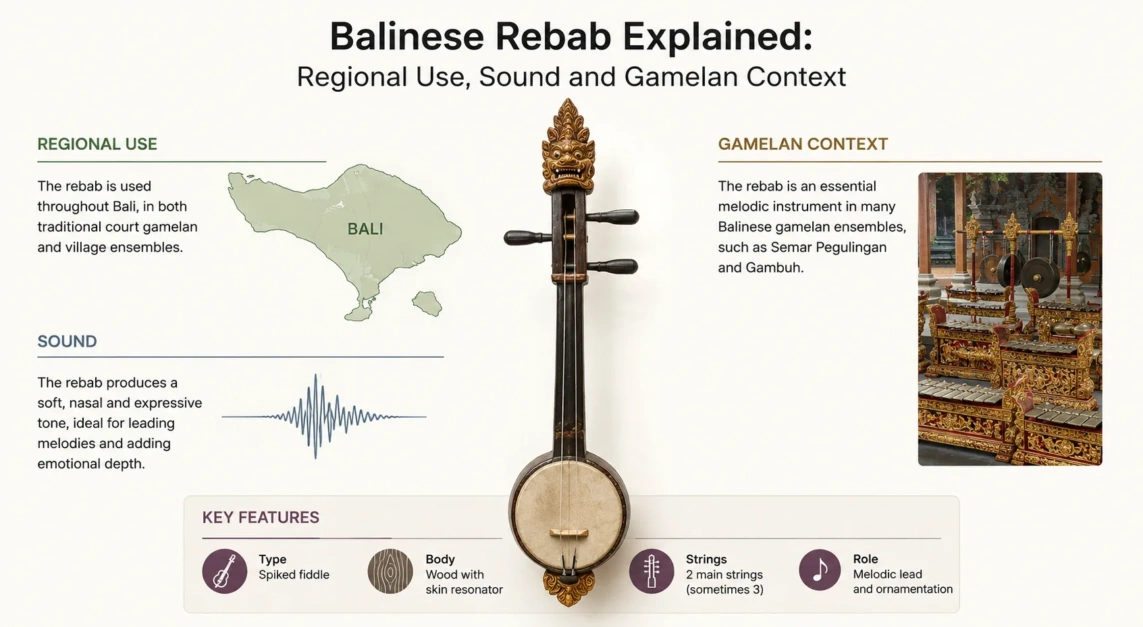
The Balinese rebab is a small two-string bowed lute used inside selected Balinese gamelan ensembles, where its soft line bends around the main melody rather than competing with the bronze instruments. It is not the plucked Afghan rubab, and it is not a general name for every bowed fiddle in Indonesia. In Bali, the rebab is a quiet but highly refined melodic voice, most closely tied to gamelan gambuh and also heard in ensembles such as palegongan, semar pagulingan, gong kebyar, and gong suling.
Main Details Worth Knowing
The Balinese rebab belongs to the chordophone family because its sound comes from vibrating strings. More specifically, it is a bowed lute: the player draws a bow across two strings while the instrument stands upright in front of the seated player.
Its role is easy to miss in a loud gamelan setting. Bronze keys, gongs, drums, cymbals, and flutes can fill the room, while the rebab sits in a narrower register with a softer tone. That quieter character is part of its function. It can add curved melodic motion, short ornaments, passing tones, and a human-like contour to a piece.
| Feature | Typical Balinese Rebab Detail | Why It Matters |
|---|---|---|
| Instrument Type | Two-string bowed lute, often described as an upright spike fiddle in gamelan contexts | Separates it from plucked rubab types found in Afghanistan and Central Asia |
| Main Region | Bali, Indonesia | The instrument belongs to Balinese karawitan and selected Balinese gamelan ensembles |
| Sound Production | Bow hair or nylon is drawn across metal strings | The tone is sustained, flexible, and suited to ornamented melody |
| Resonator | Small wooden or coconut-shell body covered with a thin animal membrane in many documented examples | The membrane gives the sound a focused, delicate edge rather than the long ring of bronze keys |
| Gamelan Role | Melodic guide, ornamenting voice, or softer color depending on the ensemble | Its status changes between gambuh and louder modern gamelan settings |
| Tuning | Adjusted to the gamelan and the piece rather than fixed to one universal pitch standard | Balinese gamelan sets can differ in tuning, so the rebab must match the local ensemble |
Names, Spellings, and Regional Identity
The spelling rebab is common in Balinese and Indonesian gamelan writing. Related names such as rabab, rubab, rebap, and rababa appear across other regions, but they do not always refer to the same instrument shape or playing method.
This matters because the Balinese rebab is a bowed instrument, while some instruments called rubab or rabab elsewhere are plucked. A reader looking at an Afghan rubab, for example, will see a larger plucked lute with a different body, string layout, and musical setting. The shared name points to a wider family of terms, not to one fixed instrument design.
Regional Note: In a Balinese context, the word rebab normally points to the bowed gamelan instrument. Outside Bali, the same word family can point to different bowed or plucked lutes, so the region and ensemble setting should always be checked before identifying the instrument.
Construction and Materials
The Balinese rebab has a slim vertical form. Its main parts include a small resonating body, a long neck or stem, tuning pegs, two strings, a supporting lower spike or foot, and a bow. Local terminology varies in written descriptions, but several Balinese terms are often used by makers and players.
Resonator and Membrane
The resonating body is often called pelawah in Balinese rebab descriptions. It may be oval, rounded, or heart-like, with oval forms often noted in Balinese examples. Makers may use selected woods or coconut shell for this part, depending on local practice, availability, and desired appearance.
Documented wood choices include materials such as sono keling, jackfruit wood, and other local woods used by Balinese makers. Wood choice can shape resonance and durability, but it should not be treated as a single formula. The maker’s carving, the thickness of the body, the membrane, the strings, and the bowing method all affect the final sound.
In many documented examples, the front of the resonator is covered with a thin animal membrane. This membrane is not just decoration. It helps turn string vibration into audible tone and gives the rebab its compact, slightly delicate sound.
Neck, Pegs, Strings, and Bow
The neck or vertical stem carries the strings and allows the player to stop pitches with the fingers. The instrument is not handled like a modern violin. It stands upright while the seated player bows across the strings.
The two main strings are commonly metal strings in modern documented practice. Some descriptions mention steel or guitar-type strings. The bow, known in Balinese sources as pengaradan or pengarad, may use horsehair or nylon. Rosin-like material is applied so the bow hair can grip the strings and produce a clear response.
Luthier’s Note: The rebab looks simple from a distance, but its small resonator, thin membrane, string tension, and bow grip leave little room for careless setup. A weak membrane or poorly matched string can make the tone thin, unstable, or hard to control.
Sound and Playing Feel
The Balinese rebab is usually described through its function as much as through its tone. It does not try to match the loud, bright attack of bronze instruments. Its sound is softer, more sustained, and more flexible. It can lean into a note, slide toward a pitch, or add short turns around the melody.
A Soft Line Inside a Loud Ensemble
In a full gamelan, the rebab may sit behind louder instruments. In smaller or older ensemble settings, especially where flutes carry much of the melodic work, it can be easier to hear the rebab’s bowed line. Its voice may trace the melody closely, then decorate it with small movements.
Short trills, light passing tones, and syncopated paraphrases are part of the instrument’s musical identity. These details can be subtle. A listener may first notice the bamboo flutes or bronze keys, then hear the rebab as a thinner bowed layer moving through them.
Tuning Is Tied to the Gamelan
Balinese rebab tuning is not best understood as a fixed concert pitch. It is adjusted to the gamelan set and the piece being played. In some descriptions, the two strings are aligned to named Balinese tones such as dong, dung, deng, or dang, depending on the ensemble and repertoire.
This is why a written tuning alone can mislead beginners. Balinese gamelan sets may have their own tuning character, and the rebab must work inside that local sound. The useful question is not only “What are the two notes?” but also “Which gamelan and which piece is the rebab serving?”
Listening Note: When trying to hear the Balinese rebab, listen for a sustained bowed thread rather than a struck tone. It often lives between flute melody and gamelan texture, adding curved motion where the bronze instruments speak with clearer attack.
Role in Balinese Gamelan
The Balinese rebab does not have one identical function in every ensemble. Its role changes with the barungan, the Balinese term often used for a gamelan ensemble type or instrumental grouping.
Gamelan Gambuh
Gamelan gambuh is the setting where the rebab has one of its clearest melodic roles. Gambuh is associated with older Balinese dance-drama practice and is known for deep bamboo flutes called suling gambuh. In this context, the rebab works with the flutes to carry and shape melodic material.
The rebab is still not a loud instrument here. Its authority comes from contour and placement rather than volume. It helps clarify melodic direction, adds bowed color, and supports the long line of the music.
Palegongan, Semar Pagulingan, Gong Kebyar, and Gong Suling
In ensembles such as palegongan, semar pagulingan, gong kebyar, and gong suling, the rebab may act more as an ornamenting or color-giving instrument. It can soften the melodic surface, add a bowed layer, or provide refined decoration around the main line.
In louder ensembles, especially those with strong bronze sonority, the rebab can recede into the background. That does not make it useless. It means its contribution is felt in texture, phrasing, and melodic shading rather than in sheer volume.
| Ensemble Setting | Typical Rebab Role | Listening Focus |
|---|---|---|
| Gamelan Gambuh | Melodic partner to the suling, with a more active melodic role | Long bowed line, close relation to flute melody |
| Palegongan | Ornamenting and melodic coloring role | Subtle decoration around established melodic patterns |
| Semar Pagulingan | Secondary melodic color in many contexts | Soft bowed layer within a refined ensemble texture |
| Gong Kebyar | Often accessory or supportive due to the loud, bright ensemble sound | Brief ornaments, background melodic shading |
| Gong Suling | Melodic support in a flute-centered sound setting | Interaction between bowed string tone and bamboo flute tone |
Playing Technique and Musical Control
The Balinese rebab asks for control that is different from struck gamelan instruments. Most gamelan instruments produce sound through a mallet, hand, or beater. The rebab depends on the meeting of bow pressure, string contact, finger placement, and resonator response.
Good bowing is balanced. Too much pressure can choke the sound. Too little pressure can fail to start the note cleanly. The player must also control pitch by placing the fingers accurately on the string, often while matching an ensemble tuning that may not follow Western equal temperament.
Descriptions of Balinese rebab technique often note that players do not simply bow both strings together all the time. The left and right strings can serve different pitch needs, and players select tones according to the piece. The result is a line that can move with the gamelan rather than sit outside it.
Why It Is Often Considered Hard to Learn
The rebab is not learned only by memorizing a finger chart. A player needs to hear the gamelan tuning, understand the piece, shape ornaments tastefully, and control a bow on a small responsive instrument. This makes it harder for many beginners than instruments with clearer visual key layouts.
Another challenge is social and practical. Since the rebab is not used in every Balinese gamelan setting, fewer students meet it early. Skilled players and makers may be less common than players of drums, metallophones, or flutes.
How It Differs from Related Instruments
The Balinese rebab shares a name family with many instruments, but its construction and musical use are specific. Comparing it with related instruments helps prevent common mistakes.
| Instrument | Playing Method | Typical Setting | Main Difference from Balinese Rebab |
|---|---|---|---|
| Balinese Rebab | Bowed | Selected Balinese gamelan ensembles | Soft bowed melodic color inside Balinese karawitan |
| Javanese Rebab | Bowed | Central Javanese gamelan | Often holds a more leading melodic status in Javanese court gamelan practice |
| Afghan Rubab | Plucked | Afghan and related regional music traditions | Larger plucked lute with a different string layout and sound body |
| Arabic Rababa | Usually bowed, with regional variation | Arabic-speaking regional traditions | Different body forms, performance settings, and local repertories |
| Kamancheh | Bowed spike fiddle | Persian and related art music traditions | Different playing tradition, sound ideal, and construction details |
The closest comparison is often the Javanese rebab, because both are bowed instruments used in gamelan. Even there, the musical hierarchy differs. In many Javanese contexts, the rebab has a more prominent guiding role. In Balinese gamelan, it may be central in gambuh but more secondary in other ensembles.
Regional Use in Bali
Regional use of the Balinese rebab should be understood through ensemble practice rather than through a single province-wide standard. Bali has many gamelan types, and not every ensemble uses the rebab in the same way.
In older or more specialized settings, the rebab can carry a stronger melodic responsibility. In louder and more modern ensemble settings, it may serve as a softening or ornamenting layer. Some documented makers and players have been associated with areas such as Gianyar and Denpasar, but the instrument’s identity is better defined by Balinese karawitan practice as a whole.
The rebab also appears in modern creative work, where composers may place it in more exposed roles or experiment with its tone. These uses do not erase its traditional gamelan functions. They show that the instrument can move between older ensemble duties and newer composition when a skilled player is available.
What to Notice When Identifying a Balinese Rebab
A Balinese rebab can be identified by several practical signs. No single feature should be used alone, but the group of details is helpful.
- Two strings: The Balinese rebab is normally discussed as a two-string bowed instrument.
- Upright playing position: The instrument stands vertically while the musician sits on the floor.
- Small resonator: The body is compact, often oval or heart-like in documented examples.
- Membrane face: Many examples use a thin animal membrane over the resonating body.
- Bow use: Sound comes from bowing, not plucking.
- Gamelan setting: The strongest identification clue is its use inside Balinese ensemble practice.
Collector’s Note: A rebab labeled “Balinese” should be checked against its construction and ensemble context. Decorative appearance alone is not enough. The number of strings, membrane body, bow, upright form, and relation to Balinese gamelan all matter.
Common Misunderstandings
The Balinese Rebab Is Not a Small Violin
It is bowed, but its body, posture, tuning logic, and musical role differ from the violin. The rebab does not use a Western violin body, bridge system, or standard violin tuning.
It Is Not the Same as the Afghan Rubab
The Afghan rubab is usually a plucked lute with a different body and string system. The Balinese rebab is a bowed gamelan instrument. The names are related, but the instruments are not interchangeable.
It Does Not Always Lead the Ensemble
In Balinese gamelan, the rebab may be primary, secondary, or ornamental depending on the ensemble. Its strongest melodic role is usually linked to gambuh, while in louder ensembles it may be more of a color and ornamenting voice.
Its Tuning Is Not Universal
The rebab is tuned in relation to the gamelan and repertoire. A single fixed tuning chart cannot describe every Balinese rebab situation accurately.
FAQ
Is the Balinese rebab bowed or plucked?
The Balinese rebab is bowed. The player draws a bow across two strings while the instrument stands upright. This separates it from plucked rubab types found in other regions.
Does every Balinese gamelan ensemble use a rebab?
No. The rebab appears in selected Balinese gamelan settings, including gambuh, palegongan, semar pagulingan, gong kebyar, and gong suling contexts. Its role and audibility vary by ensemble.
What does the Balinese rebab sound like?
It has a soft, sustained bowed tone. In ensemble use, it often adds melodic curves, ornaments, and passing tones rather than a loud front-line sound.
How is the Balinese rebab tuned?
It is tuned to fit the gamelan and the piece being performed. The two strings may be aligned to Balinese tone names according to the ensemble’s needs, so there is no single universal pitch setting.
Is the Balinese rebab the same as the Javanese rebab?
No. They are related bowed gamelan instruments, but their construction details, playing habits, and ensemble roles differ. The Javanese rebab often has a more leading melodic status in Central Javanese gamelan, while the Balinese rebab changes role by ensemble type.
Why is the Balinese rebab hard to learn?
It requires accurate listening, controlled bow pressure, flexible pitch placement, and knowledge of gamelan melody. Because it is not present in every ensemble, beginners may also have fewer chances to study it with a specialist player.