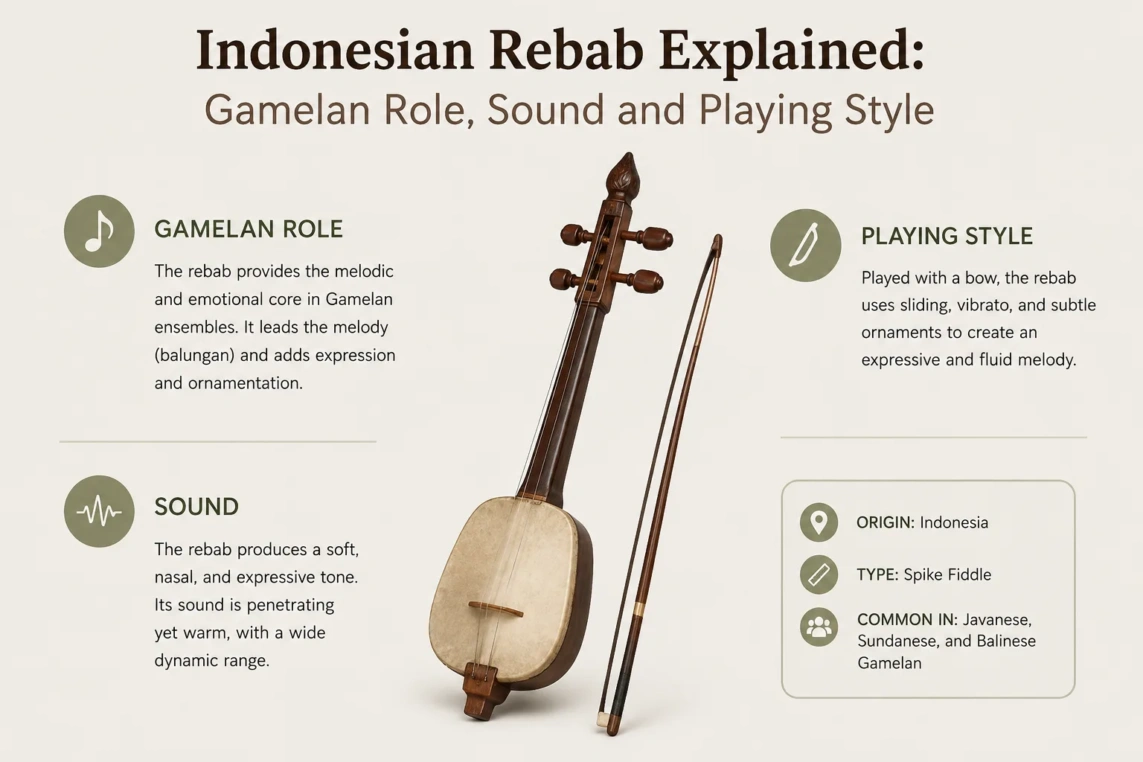
The Indonesian rebab is best understood as a group of related bowed instruments used in different Indonesian musical traditions rather than as one fixed national model. Central Javanese, Sundanese and Balinese rebab forms share an upright playing position, bowed strings and a compact membrane-covered resonator in many documented examples, yet their ensemble setting and musical function are not identical. The regional context is therefore part of the instrument’s identity.
What the Indonesian Rebab Refers To
The name Indonesian rebab commonly describes small bowed chordophones used in gamelan and related ensemble traditions in Indonesia. Many examples have two strings, a long unfretted neck, large lateral tuning pegs and a skin or vellum-covered resonator. The instrument is normally held upright while the musician sits on the floor.
These shared physical traits make Indonesian rebab forms recognizable as a family. They do not create a single playing system. A rebab from Central Java belongs to a different musical setting from a Sundanese example from West Java or a Balinese rebab used in selected gamelan ensembles.
| Regional Form | Main Setting | Typical Character | What Should Not Be Generalized |
|---|---|---|---|
| Central Javanese Rebab | Central Javanese gamelan, especially soft ensemble textures | Closely integrated with melodic elaboration, singers and other soft-playing parts | Its detailed melodic rules should not be treated as the standard for every Indonesian rebab |
| Sundanese Rebab | West Javanese or Sundanese musical settings | Bowed melodic instrument used within regional ensemble and vocal traditions | Sundanese playing should not be described simply as a copy of Central Javanese practice |
| Balinese Rebab | Selected Balinese gamelan traditions | Flexible bowed voice that may ornament or support the ensemble melody | The rebab is not present or equally prominent in every Balinese gamelan type |
Regional Note: “Indonesian rebab” works well as a national reference term, but regional identification remains necessary. Java, Sunda and Bali have their own repertoire, ensemble relationships and performance habits.
Shared Construction Across Indonesian Forms
Many Indonesian rebabs use a compact resonator connected to a long neck or spike. A membrane stretches across the front of the body, and a small bridge transfers vibration from the strings into that membrane. Two large pegs near the upper neck control string tension.
The body outline varies. Museum examples may appear rounded, heart-like, triangular or slightly bowl-shaped. Decorative cloth, turned wood, metal fittings and other surface details can also differ between instruments. Shape alone is therefore less useful than looking at several structural features together.
Body and Membrane
A thin animal membrane or material catalogued as vellum appears on many documented Indonesian rebabs. The membrane reacts differently from a carved wooden soundboard. It can give the instrument a direct attack and a focused tone with a dry or lightly nasal edge.
Terminology for the membrane varies between collections. Some records identify parchment-like material, bladder or another animal membrane more specifically. When the exact material of an instrument is unknown, describing it as a membrane-covered resonator is safer than assigning one material to every regional form.
Strings, Bridge and Pegs
Two metal strings are common in Indonesian rebab descriptions. Brass, copper and related wire materials appear in museum and instrument records, although surviving instruments and modern replacements are not uniform.
The strings pass across a small bridge resting on the membrane. Bridge position, membrane tension and string tension work together. A poor setup can weaken the response or make the bowed tone difficult to control.
Luthier’s Note: Wood choice can shape resonance, but the response of an Indonesian rebab also depends on membrane tension, bridge fit, string material and bow contact. These parts should be considered together when examining how an instrument sounds.
The Bow
The bow is generally light and simpler in construction than a modern violin bow. Horsehair appears in documented examples, while replacement or contemporary bows may use other suitable fibers. Some playing traditions use relatively loose bow hair that the musician can control with the bowing hand.
This setup allows a soft attack and small changes in pressure. It also requires a different right-hand feel from a fixed-tension Western orchestral bow.
Java, Sunda and Bali
The easiest way to understand the Indonesian rebab is to separate the main regional contexts before comparing their shared construction.
Central Java
In Central Java, the rebab belongs closely to gamelan traditions associated with areas such as Yogyakarta and Surakarta. It is especially characteristic of softer ensemble textures where bowed, plucked, blown and sung lines interact with the bronze instruments.
The Central Javanese form has a highly developed relationship with melodic direction and ensemble knowledge. Its detailed treatment of opening formulas, modal organization, repertoire structure and melodic leadership belongs specifically to Javanese rebab practice rather than to the Indonesian rebab family as a whole.
For a national overview, the main point is that the Central Javanese rebab can carry an ornamented melodic line and interact closely with singers and other soft-playing instruments. Its more specialized musical vocabulary should be understood within Central Javanese gamelan.
Sunda and West Java
Sundanese rebab traditions belong to West Java. Instruments identified as Sundanese rebabs commonly retain the upright bowed form, long neck and small membrane-covered body associated with Indonesian rebabs, but their musical surroundings are regional rather than simply Central Javanese.
Sundanese music has its own vocal habits, ensemble types, melodic vocabulary and performance conventions. The rebab can therefore occupy a different relationship with singers and accompanying instruments depending on the setting.
This distinction matters when identifying recordings or museum instruments. A label that says “Java” does not automatically mean Central Javanese gamelan. West Javanese or Sundanese provenance changes how the instrument should be described.
Bali
The Balinese rebab is another regional member of the Indonesian bowed-rebab family. It appears in selected Balinese gamelan traditions rather than functioning as a required instrument in every Balinese ensemble.
Balinese examples are generally small upright bowed instruments with two strings and a membrane-covered resonator. Their softer sustained tone provides a different kind of melodic motion from the struck bronze instruments around them.
The rebab’s exact prominence depends on the Balinese ensemble. In some settings it can contribute strongly to melodic shaping; elsewhere it functions more as an ornamenting or supporting voice. This variation makes it inaccurate to transfer the Central Javanese rebab’s musical responsibilities directly to Bali.
What These Regional Forms Share
Regional differences are easier to understand once the basic common traits are separated from local musical practice.
- Bowing: Indonesian rebab forms are played with a bow rather than a plectrum.
- Upright posture: The instrument is generally positioned vertically in front of a seated musician.
- Compact resonator: The body is small compared with long-necked plucked lutes.
- Membrane face: A skin or vellum-like soundboard occurs in many documented examples.
- Unfretted playing: Pitch is controlled directly by the left hand rather than by frets.
- Flexible pitch motion: Sliding, shading and ornamented connections between tones are available to the player.
- Ensemble dependence: Tuning and musical behavior are tied to the local ensemble rather than one national standard.
These traits describe the family without claiming that every instrument is built or played identically.
Sound and Timbre
Indonesian rebabs usually have a thin, focused bowed voice. Words such as nasal, reedy and vocal-like are often useful descriptions, although the exact color changes with the membrane, strings, bridge, bow and playing technique.
The instrument produces sustained and curved melodic movement beside instruments whose tones begin with a strike. This difference is easy to hear in ensemble music. The rebab can connect one pitch to another continuously instead of producing a separate attack for every note.
- Attack: generally soft and controlled by bow contact.
- Sustain: continuous while the bow remains active.
- Pitch Motion: capable of slides, turns and small pitch adjustments.
- Resonance: compact and focused rather than broad or bass-heavy.
- Dynamic Range: often suited to softer ensemble layers.
Listening Note: Listen for a sustained bowed line among the shorter attacks of bronze keys and gongs. The rebab often reveals itself through curved pitch movement and a tone closer to sung phrasing than struck metal.
Playing Position and Basic Technique
The musician normally sits on the floor with the rebab upright. A lower spike, foot or extension helps stabilize the instrument. The left hand reaches the long neck while the right hand draws the bow across the strings.
The neck does not work like a fretted guitar or a violin fingerboard. In many rebab techniques, the player stops the strings lightly without pressing them firmly against a hard board. Accurate pitch therefore depends heavily on listening and hand memory.
Left-Hand Control
The left hand selects pitch by touching different points along the strings. The absence of frets allows small slides and pitch shading, but it also removes fixed visual or physical markers.
Regional style determines how these movements are used. A gesture appropriate in one Indonesian repertoire should not automatically be applied to another.
Right-Hand Bowing
The bowing hand controls attack, continuity and pressure. When loose bow hair is used, the hand may also influence hair tension during playing.
A light instrument with a membrane soundboard can react quickly to bow pressure. Too much pressure may produce a rough response, while too little may prevent the string from speaking clearly.
Tuning Varies with the Ensemble
There is no single universal tuning for every Indonesian rebab. The instrument is adjusted to the musical system and pitch level of the ensemble with which it is played.
This is especially important with gamelan. Individual gamelan sets can have their own pitch relationships and overall tuning level. A rebab intended for one ensemble should therefore not be treated as if a fixed Western concert-pitch chart can describe every example.
Regional repertoire adds another layer. Central Javanese, Sundanese and Balinese musicians organize melody differently, so a national tuning formula would hide the musical distinctions that matter most.
Names, Spellings and Identification
The spelling rebab is common in Indonesian music writing. Related forms such as rabab, rubab, rebap, rabāb and rababa occur across a much wider geographic area.
These spellings do not identify one fixed instrument. A similarly named instrument may be bowed or plucked, have one string or several strings, and belong to a completely different musical tradition.
For an Indonesian example, construction and context provide better evidence than spelling alone.
| Instrument | Playing Method | Typical Context | Useful Distinction |
|---|---|---|---|
| Indonesian Rebab | Bowed | Indonesian gamelan and regional ensemble traditions | Usually an upright, membrane-faced instrument with a small resonator |
| Afghan Rubab | Plucked with a plectrum | Afghan and neighboring musical traditions | Short-necked carved lute with a very different string arrangement |
| North African Rababa or Rabab | Usually bowed | Regional North African and Middle Eastern traditions | Body form, string count and musical use vary separately from Indonesian practice |
| European Rebec | Bowed | European medieval and early-music contexts | Different body construction and repertory despite a broadly related name history |
How to Recognize an Indonesian Rebab
Several features should agree before an instrument is identified as an Indonesian rebab.
- It is played upright with a bow.
- It commonly has two strings.
- The resonating body is small.
- A membrane covers the front of many documented examples.
- The neck is long and unfretted.
- Large tuning pegs usually project from the upper neck.
- A lower spike or foot may help support the instrument.
- The provenance or performance setting points to Java, Sunda, Bali or another Indonesian context.
Decoration is less reliable. Cloth coverings, carved elements and fittings can vary with maker, period, regional taste and restoration history.
Museum and Collector Identification
Museum catalogues may classify Indonesian rebabs as bowed lutes, spike lutes, spike fiddles or chordophones. Different cataloguing systems can use different organological terms for closely related objects.
Recorded materials may include wood, animal membrane, metal wire, horsehair, cloth, horn and older decorative fittings. An individual catalogue description should not automatically be extended to all Indonesian rebabs.
Working details usually offer better identification clues than ornament. Check the membrane, bridge, string path, peg arrangement, lower spike and bow together with the recorded region.
Collector’s Note: Old membrane soundboards and pegs can be fragile. A museum or antique rebab should not be brought to playing tension simply to test its sound. Condition assessment should come before tuning.
Regional Variation in Materials and Appearance
No single decorative pattern identifies every Indonesian rebab. Some instruments have plain working surfaces. Others carry cloth covers, polished wooden parts, ornamental pegs or fittings associated with a particular maker or collection history.
The membrane itself may also look different after years of use. Age, humidity, previous repairs and storage can change its surface and tension. These condition differences should not be mistaken for separate instrument families without other evidence.
Body proportions vary as well. A compact heart-like resonator on one example and a more rounded outline on another can still belong within the Indonesian rebab family when the rest of the construction and regional context agree.
How Regional Context Changes the Musical Role
The same basic organological form can serve different musical purposes. This is one reason the national label must remain broad.
Central Javanese practice gives the rebab a particularly developed place inside soft gamelan texture and melodic organization. Those functions depend on Central Javanese repertoire and ensemble knowledge.
Sundanese practice places the instrument within West Javanese melodic and vocal traditions. The surrounding repertoire and phrasing expectations differ from Central Java.
Balinese practice uses the rebab in selected gamelan ensembles. Its prominence can change considerably between ensemble types, so a Balinese rebab should not automatically be described as the main melodic leader.
This regional separation gives a clearer picture than applying one Javanese description to the whole country.