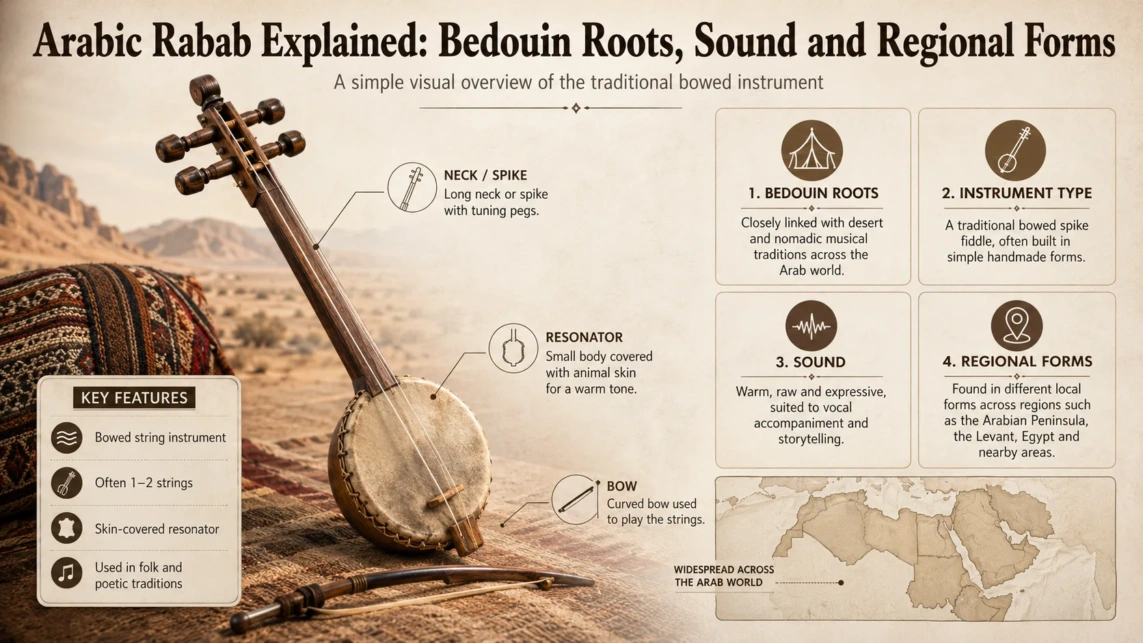
Arabic rabab usually points to a bowed folk fiddle of the Arab-speaking world, especially the Bedouin rababa: a lean instrument with a skin-covered body, a long neck, a bow, and often a single string. The name can also cover several regional fiddles, so the safest way to understand it is to look at form, playing method, and setting rather than spelling alone.
What the Arabic Rabab Is
The Arabic rabab, also written rabāb, rababa, rebab, or rebaba, belongs to the bowed chordophone family. In many Arab contexts it is a fiddle rather than a plucked lute. It is held upright, bowed across one or more strings, and used to support song, poetry, and regional folk repertory.
The Bedouin form is the best-known Arabic image of the instrument. It often has a rectangular or quadrilateral wooden soundbox covered with animal skin and a single horsehair string. The bow may also use horsehair. The sound is narrow, direct, and vocal in shape; it does not aim for the broad sustain of a violin.
The word rabab has never behaved like a modern product name. Medieval and later sources used related terms for different bowed instruments, and regional makers still build forms that differ in body shape, string count, and resonator material. This is why an Egyptian rababa, a Bedouin rababa, an Iraqi joza, and a Maghrebi rebab can share a name family without being the same instrument.
Names, Spellings and What They Hide
English spellings vary because the name moves between Arabic, Persian, Turkish, South Asian, North African, and European writing habits. Rabab and rabāb often appear in reference works. Rababa is common for Arab and Egyptian forms. Rebab appears often in older European writing and in some museum labels. Rubab is usually linked with plucked lutes of Afghanistan and nearby regions, not the Bedouin bowed fiddle.
The spelling alone cannot identify the instrument. A label must be read with region, structure, and playing method.
Regional Note: When an Arabic source says rababa, it may refer to a one-string Bedouin fiddle, a folk fiddle used with singing, or a local variant with two or more strings. The word is useful, but it needs context.
Main Details Worth Knowing
| Feature | Common Arabic Rabab Pattern | What May Vary |
|---|---|---|
| Instrument Type | Bowed string instrument, often a spike fiddle or upright folk fiddle | Some related rabab names in other regions refer to plucked lutes |
| Strings | Often one string in Bedouin forms | Egyptian examples may have two strings; Iraqi joza forms commonly use more |
| Soundbox | Wooden frame or small resonator with a skin sound table | Rectangular, coconut-shell, pear-like, or boat-like bodies appear by region |
| Playing Method | Played upright with a bow | Posture, bow curve, and left-hand contact differ by local practice |
| Musical Role | Supports singing, poetry, recitation, and folk melody | Some forms enter ensemble music or heritage performance settings |
| Tone | Focused, nasal, speech-like, and close to the human voice | Skin tension, string material, body size, and bow hair change the response |
Bedouin Roots and Social Use
The Bedouin rababa is strongly tied to portable music-making, oral poetry, and communal performance. It does not need a large body, a fixed stand, or a complex set of parts. A singer can carry it, tune it to a comfortable range, and use it to mark the contour of a poem.
In Bedouin settings, the instrument often works as a partner to the voice. It can support sung poetry, praise poetry, narrative song, and gathering music. The bow gives the player a continuous line, while the single string keeps attention on text, rhythm, and vocal delivery.
This practical design is part of its identity. The rababa is not “simple” because it lacks craft. It is focused. The instrument reduces the number of moving parts so the performer can shape melody, ornament, and text with direct control.
Why the One-String Form Works
A single string can do more than it appears to do. Without frets and without a fingerboard, the player can shade notes by touching the string directly. Small slides, ornaments, and pitch bends become part of the line.
- The bowed string allows sustained notes under the voice.
- The skin sound table gives a dry, immediate response.
- The limited range keeps the music close to speech and recitation.
- The upright posture lets the player control bow pressure with small movements.
Body, Skin and String Layout
Arabic rabab forms are usually built around a resonating body, a neck, one or more strings, a bridge, and a bow. That description sounds neat, but the details can differ a great deal. Museum examples and living instruments show rectangular wooden frames, coconut-shell bodies, skin-covered resonators, carved necks, and different spike arrangements.
Soundbox and Membrane
The Bedouin rababa is often described with a quadrilateral wooden soundbox. Animal skin may cover the front and back. In some examples, the skin is stitched or laced around the frame. This membrane is not just a cover; it is the vibrating sound table.
Skin responds differently from carved wood. It can give the instrument a dry attack, a tight resonance, and a voice-like edge. It may also react to weather. Heat, moisture, and dryness can change tension, which can change the playing feel.
String, Bow and Neck
Many Bedouin rababas use one horsehair string, though materials may vary by maker and period. The bow may be a curved stick strung with horsehair. The left hand does not press strings onto a fingerboard in the violin sense; it often stops or touches the string directly.
The neck may be plain or carved. Some instruments show decorative finials, shaped pegs, or incised patterns. Decoration matters, but it should not distract from construction. A lightly decorated working instrument can be as culturally clear as an ornate example.
Luthier’s Note: Wood choice can shape resonance, but the skin table, bridge fit, string material, and bow hair often have a more immediate effect on the Arabic rabab’s response. A small change in skin tension can make the instrument feel tighter, softer, brighter, or less stable.
Sound and Playing Feel
The Arabic rabab is valued for a narrow, human-scale voice. Its tone can be nasal, grainy, and flexible. That is not a flaw. The sound suits sung poetry because it can sit beside the voice without covering words.
The bow does not create the polished, wide projection associated with orchestral bowed strings. Instead, it gives a close line with a clear start to each note. On many forms, the sustain is modest. The player uses pressure, speed, and small pitch movement to keep the sound alive.
Bowed Line and Voice-Like Movement
Arabic rabab playing often favors contour over chordal harmony. One string is enough when the job is to trace melody, support recitation, and add emotional color to a line of text. The player can lean into a note, slide away, or return to a central pitch.
This is one reason the instrument can feel closer to a singing voice than to a fretted lute. Pitch is not locked into fixed frets. The hand can move between notes in small steps.
Listening Note: A good listening test is to follow the words first, then the bowed line. In many rababa performances, the instrument does not compete with the singer. It frames the phrase, reinforces pitch, and leaves space for the text.
Regional Forms of the Arabic Rabab
Regional names are not always tidy. The same family word can point to different instruments, while different names can point to related construction ideas. The table below keeps the focus on Arabic and North African forms that often appear in music, collections, and instrument labels.
| Form or Name | Region or Setting | Typical Features | Main Use |
|---|---|---|---|
| Bedouin Rababa | Arabian Peninsula, Jordan, Syria, desert and semi-desert communities, with local variation | Often one string, rectangular or quadrilateral skin-covered soundbox, horsehair bow | Poetry, song, gatherings, solo accompaniment |
| Egyptian Rababa | Egypt, including folk and Upper Egyptian contexts | Often a two-string spike fiddle; some examples use a coconut resonator covered with skin | Folk singing, epic narration, vocal ensemble support |
| Joza or Jawza | Iraq and related urban or folk settings | Coconut-shell resonator, skin sound table, spike construction; commonly more strings than the Bedouin form | Melodic playing in local music traditions |
| Maghrebi Rebab | North Africa and Andalusi music contexts | Short-necked bowed lute form in many descriptions, separate from the rectangular Bedouin rababa | Andalusi repertory and regional ensemble practice |
| General Rabab or Rebab | Arabic, Persianate, Ottoman, North African, and wider Islamicate contexts | A broad name family; may be bowed or, in some regions, plucked | Depends on the local instrument |
Bedouin Rababa
The Bedouin rababa is the form most closely linked with the phrase “Arabic rabab” in many English descriptions. It is often compact, upright, and made with a skin-covered wooden frame. The single string gives the performer a direct melodic line.
Its musical role is inseparable from the voice. The instrument supports sung text rather than replacing it. In this setting, a narrow range can be useful because the melody stays close to the singer’s phrase.
Egyptian Rababa
Egyptian rababa examples are often described as two-string spike fiddles. Some use a coconut-shell resonator covered with skin, and some are associated with folk singers and epic poets. The Egyptian form may be called kamānja agūz in certain museum and collection labels.
The two strings can add extra melodic support, but the instrument still keeps the close, bowed character of the rababa family. It is not simply a rustic violin. Its resonator, skin table, posture, and bowing style create another kind of sound.
Iraqi Joza
The Iraqi joza or jawza is related by construction idea rather than by identical form. The name is linked to the coconut shell used for the resonator. Many described examples have a skin sound table, a spike, and more strings than the Bedouin rababa.
This instrument can sit nearer to ensemble melody than to single-string poetry accompaniment. It shows how the rabab idea can move from portable folk accompaniment into more developed melodic roles.
Maghrebi Rebab
The Maghrebi rebab belongs to North African and Andalusi music contexts. It should not be confused with the rectangular Bedouin rababa. In many descriptions it is a short-necked bowed lute, and its role is tied to regional ensemble practice.
This is a good example of why the name rabab needs form-based reading. The same name family can refer to instruments with different bodies, different musical jobs, and different histories of use.
How It Differs from Related Instruments
Arabic rabab forms are often placed beside the violin, Afghan rubab, rebec, kamancheh, and oud. The comparisons are useful only when they stay specific.
| Instrument | Main Difference | Useful Identification Clue |
|---|---|---|
| Afghan Rubab | Usually a plucked lute, not a bowed Bedouin fiddle | Carved wooden body, sympathetic strings in many forms, plectrum use |
| Violin | Wooden soundbox, four strings, fingerboard, shoulder or chin position in common classical use | No skin membrane and no spike-fiddle posture |
| Rebec | Medieval European bowed instrument with historical links to rabab-type fiddles | Usually a small bowed instrument of European medieval context |
| Kamancheh | Spike fiddle of Persian and nearby traditions, usually with a rounded resonator and distinct repertory | Often more standardized in art-music settings than the Bedouin rababa |
| Oud | Plucked, fretless lute with a large wooden bowl body | No bow, no skin-covered spike-fiddle body |
The closest visual confusion often happens between rababa, joza, and kamancheh-type spike fiddles. The safest markers are body material, string count, neck design, region, and performance context.
Tuning and Range: What Can Safely Be Said
Arabic rabab tuning is not one fixed system across all regions. A one-string Bedouin rababa may be tuned to suit the singer’s voice or a local melodic habit. Egyptian two-string forms and Iraqi joza forms follow other practices. Modern performers may also adapt tuning to stage use, recordings, or ensemble needs.
Because the instrument often lacks a fingerboard and frets, tuning is only part of pitch control. The left hand shapes the line in performance. Small shifts of pressure and contact can change the pitch, color, and ornament.
Material Note: Claims about exact tuning should be treated with care unless the region, performer, and instrument type are named. A Bedouin one-string rababa, an Egyptian two-string rababa, and an Iraqi joza should not be forced into one tuning chart.
Craft, Repair and Museum Identification
A curator or collector should identify an Arabic rabab by structure before decoration. The most useful questions are plain: Is it bowed? Does it have a skin table? How many strings does it carry? Is the body rectangular, coconut-shaped, pear-like, or boat-like? Does it have a spike? Is it linked to Bedouin, Egyptian, Iraqi, Maghrebi, or another regional setting?
Wear marks can also help. A bridge mark on skin, polish near the neck, bow wear on the string, and old repairs around lacing or stitching can show how the instrument was handled. These marks should be read carefully. They do not always prove age, but they can show use.
Labels such as “Arab fiddle” or “rabab” are often too broad. A better label gives region, local name, string count, body material, and playing method.
What to Check on a Physical Instrument
- Membrane: Look for skin type, tension, repairs, and how it is fixed to the frame.
- Bridge: Check whether it floats on the skin or is fixed by another method.
- String Material: Horsehair, gut, metal, or modern replacements can change sound and dating clues.
- Neck and Pegs: Note carving, peg shape, wear, and whether the neck passes through the resonator.
- Bow: The bow may be as culturally informative as the instrument body.
Common Misunderstandings
The first common mistake is to treat all rabab, rubab, and rebab names as one instrument. They are a name family. Some are bowed fiddles. Some are plucked lutes. Some belong to court, folk, or ensemble traditions that use different construction rules.
The second mistake is to judge the Arabic rabab by violin standards. Its tone is not meant to copy a violin. The skin table, upright posture, direct bowing, and close range give it a different musical purpose.
The third mistake is to assume that a single-string instrument is musically limited in a simple way. In rababa playing, the detail often lives in pitch shading, bow pressure, timing, vocal response, and ornament. The instrument leaves room for the singer and for the poem.
FAQ
Is the Arabic Rabab the Same as the Afghan Rubab?
No. The Arabic rabab or rababa discussed here is usually a bowed fiddle, especially in Bedouin and Egyptian contexts. The Afghan rubab is usually a plucked lute with a carved wooden body and a different playing method. The names are related, but the instruments are not the same in use or construction.
Does Every Arabic Rabab Have Only One String?
No. The Bedouin rababa is often described as a one-string instrument, but Egyptian rababa examples may have two strings, and Iraqi joza forms commonly have more. String count depends on the regional form.
Why Does the Rababa Sound So Close to the Voice?
The close, vocal quality comes from several features working together: bowed sound, direct pitch control, a skin sound table, modest sustain, and a performance role tied to singing. The instrument often follows the shape of the text rather than filling the space with harmony.
Is the Arabic Rabab Hard to Learn?
It can be hard in a different way from fretted instruments. The player must control pitch by ear, manage bow pressure, and learn the melodic habits of the repertory. A one-string form may look spare, but accurate intonation and phrasing take careful listening.
How Can I Tell a Bedouin Rababa from an Egyptian Rababa?
A Bedouin rababa often has a rectangular or quadrilateral skin-covered body and one string. An Egyptian rababa is often described as a two-string spike fiddle, and some examples use a coconut-shell resonator with skin. Region, string count, body shape, and performance setting should be checked together.
Can the Arabic Rabab Be Used in Modern Music?
Yes, but it needs careful handling. The instrument works best when its natural tone is respected: close, flexible, and text-friendly. Amplification, ensemble tuning, and stage volume can change how the skin table and bow response are heard.