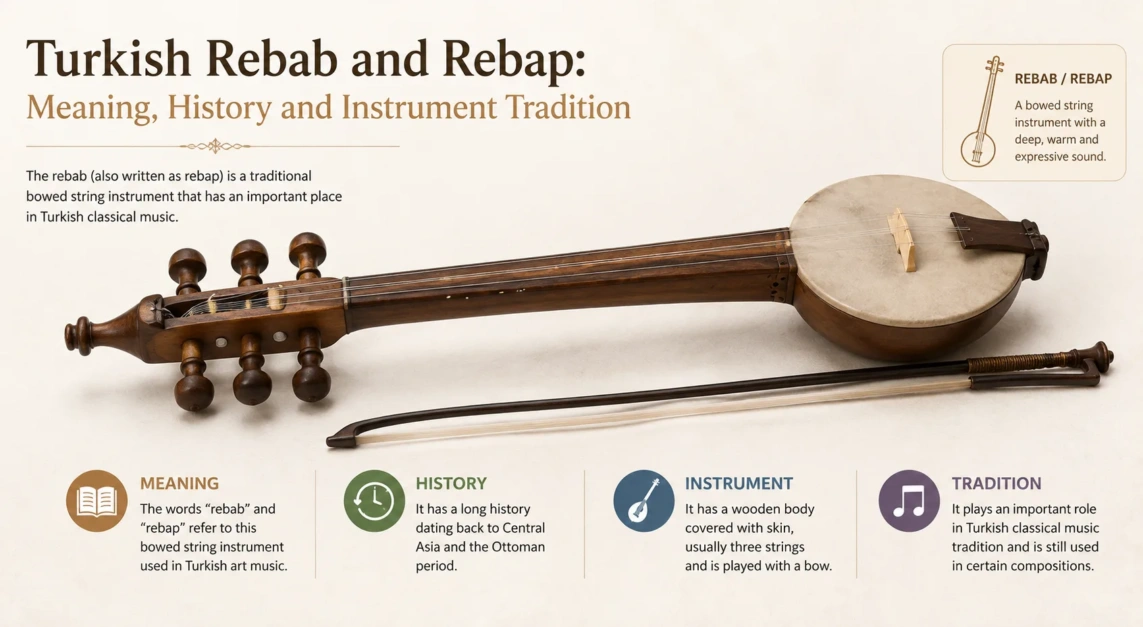
Turkish rebab, often written rebap in modern Turkish, names a bowed string instrument tied to Ottoman music, Mevlevi musical practice, and the wider rabāb family of the Middle East and Central Asia. The word can confuse readers because similar spellings also point to plucked rubabs, Arab rababah fiddles, Central Asian lutes, and the European rebec. In a Turkish instrument context, however, rebab or rebap usually refers to a vertical bowed spike fiddle with a small resonating body, a skin soundboard in many older forms, and a soft but focused tone suited to makam-based melody.
Meaning of Turkish Rebab and Rebap
Rebab, rebap, and rebâb are spelling forms connected to the same broad instrument name. The older Ottoman-Turkish form rebâb reflects Arabic and Persian written usage, while rebap fits modern Turkish spelling more naturally. English-language writing often keeps rebab because it matches common museum, musicology, and international instrument terminology.
The name does not always point to one fixed object. Across different regions, related forms of the word can mean a bowed fiddle, a spike fiddle, or a plucked lute. That is why the phrase Turkish rebab matters: it narrows the meaning to the Turkish and Ottoman bowed tradition, not to every instrument called rabab, rubab, or rubob.
| Spelling | Typical Context | Useful Note |
|---|---|---|
| Rebab | English writing, Turkish music writing, museum labels | Often used for the bowed Turkish form and for other rabāb-family instruments. |
| Rebap | Modern Turkish spelling | A Turkish spelling for the same historical instrument name. |
| Rebâb | Ottoman-Turkish and older scholarly style | The circumflex marks the long vowel in older transliteration. |
| Rabab / Rabāb | Arabic and broader Middle Eastern usage | May refer to bowed fiddles, and in some older sources to bowed instruments as a group. |
| Rubab / Rubāb | Afghan, Central Asian, and South Asian contexts | Often a plucked lute, especially in the Afghan rubab tradition. |
Regional Note: A Turkish rebab should not be identified only by spelling. Shape, playing method, soundboard type, strings, and performance setting give a safer identification than the written name alone.
What Kind of Instrument Is the Turkish Rebab?
The Turkish rebab belongs to the bowed lute and spike fiddle world. It is normally held upright rather than under the chin. The lower end, spike, or foot helps support the instrument while the player bows the strings. This vertical posture separates it from violin-family instruments and places it nearer to older bowed instruments such as the Arab rabābah, the kamancheh family, and several regional kemane forms.
Many Turkish rebab descriptions point to a small body, a neck without a modern violin-style fingerboard, and strings stopped directly by the player’s fingers. Body forms vary by period, maker, and reconstruction. Older examples and descriptions may include coconut shell, gourd, or carved wood bodies, with animal skin or membrane used for the resonating face. Later workshop instruments may show more regularized proportions and finer decorative work.
Bowed Form, Not the Afghan Rubab
The Turkish rebab is mainly discussed as a bowed instrument. The Afghan rubab, by contrast, is a plucked lute with a carved body, fretted neck area, sympathetic strings in many forms, and a different musical role. The similar name comes from a shared historical word family, not from identical construction.
This naming overlap is one of the main reasons rebab and rebap need careful explanation. A search for “rubab” may show Afghan instruments with short necks and plucked strings, while a search for “Turkish rebab” may show a vertical bowed instrument connected with Ottoman and Mevlevi settings.
Historical Place in Turkish and Ottoman Music
The wider rabāb name appears in medieval sources and is often linked with early bowed instruments. In Turkish and Ottoman music, the rebab became part of a local bowed-instrument vocabulary that also included names such as kemânçe, ıklığ, and later ayaklı keman. These names did not always stay fixed. They shifted as new instruments entered court, urban, and lodge settings.
Before the broad adoption of European bowed instruments in Ottoman musical life, the rebab or kemânçe-type spike fiddle filled a melodic bowed role in many descriptions of Turkish music. This statement needs one caution: regional folk bowed instruments also existed, so the claim is safest when speaking about the main urban and classical Ottoman repertoire rather than every local tradition in Anatolia.
By the eighteenth century, the musical landscape changed. Instruments such as the viola d’amore, violin, and later the Istanbul kemençe gained space in secular performance. As these instruments became more common, the older rebab lost much of its former public role. It did not disappear completely. It remained attached to Mevlevi musical memory and to later revival work by musicians, makers, and researchers.
A 2026 study by Emre Soylu places this history within a wider interpretation of the rebab name. The study argues that construction alone cannot account for every historical identity attached to rebab-related instruments. Ottoman usage, terminology, performance setting, and cultural meaning also need to be considered when identifying what the instrument represented in a particular period.
Kemânçe, Iklığ, and Ayaklı Keman
One reason the history feels confusing is that Turkish bowed instruments were not always named with the strict labels used by modern catalogs. Kemân could mean a bowed instrument more broadly. Kemânçe could point to a smaller bowed form. Iklığ appears in older Turkish instrument vocabulary. Ayaklı keman, literally “footed violin” or “violin with a foot,” describes a rebab-like instrument by its supporting spike or foot.
These names show a practical naming habit. Musicians and writers often named an instrument by how it looked, how it was held, or what newer instrument it had to be distinguished from. The rebab was not only an object; it was part of a changing vocabulary.
Mevlevi Musical Setting
The Turkish rebab is often remembered through Mevlevi music, where its bowed tone sat well beside ney, kudüm, tanbur, and voice. In that setting, the instrument’s quiet attack and flexible pitch could support long melodic lines. It did not need the volume of a large public-stage instrument.
The rebab’s place in Mevlevi culture also extends beyond construction and ensemble function. Soylu’s 2026 research notes that classical texts and Mevlevi contexts can give the rebab aesthetic, symbolic, and spiritual meanings alongside its role as a sound-producing instrument. This does not mean that every rebab performance carried the same symbolic interpretation. It means that the instrument could operate within a textual and cultural language that cannot be recovered from body shape, strings, or bowing technique alone.
This distinction helps keep Mevlevi descriptions grounded. Symbolic meaning belongs to documented cultural interpretation rather than to an assumed property of the instrument’s sound. Earlier scholarship on rebab imagery in Divân-ı Kebîr and writings on the rebab in Mevlânâ-related thought also show why textual evidence matters when discussing this side of the instrument.
Some Mevlevi circles treated the rebab with special respect because of its place in ceremony, teaching, literary memory, and inherited musical practice. Its survival in this setting therefore involved more than preserving an old instrument type. The name, musical use, and meanings attached to the rebab continued together even after the instrument lost much of its wider secular role.
Construction and Materials
The Turkish rebab is best understood as a maker’s instrument: small differences in body, skin, bridge, strings, bow, and setup can change how it responds. Older documentation does not give one universal standard. That variety is normal for instruments carried through oral teaching, workshop practice, and regional naming habits.
Body and Resonating Face
Many described Turkish rebabs use a small rounded or cut-spherical body. The resonating face may be covered with skin or another membrane rather than a carved wooden top. A skin soundboard gives a different response from a violin plate: it can speak with a dry, close, and slightly reedy color, especially in quiet rooms.
Some older descriptions mention coconut shell, gourd, or wood for the body. These materials should not be treated as a ranking of quality. A carefully fitted membrane, stable bridge, clean neck angle, and balanced string tension can matter more to the playing result than a simple material label.
Luthier’s Note: Wood choice can shape resonance, but the rebab’s voice also depends on membrane tension, bridge height, string material, bow hair, and the player’s touch. A small change in setup can make the instrument feel more open, nasal, soft, or resistant.
Strings, Neck, and Bow
Many Turkish rebab accounts describe two- or three-string forms, with later Ottoman descriptions often favoring three strings. Gut, silk, and other historical string materials appear in older instrument traditions, while modern players and makers may adapt available strings to suit pitch, tension, and stability.
The neck usually does not work like a fretted lute neck. The player stops the strings by touch, allowing small pitch shades that suit makam performance. The bow is also part of the instrument’s identity. A rebab bow does not need to behave like a modern violin bow; hair tension and bow weight may differ, and the player’s hand can shape a narrow range of tone colors with small changes in pressure.
Sound, Playing Feel, and Makam Expression
The Turkish rebab is valued for a tone that can sound close, vocal, and slightly grainy. It does not aim for the smooth projection of a modern violin. Its strength is a more intimate line: slides, gentle ornaments, soft attacks, and small pitch inflections can be heard clearly when the room and ensemble leave enough space.
Makam music needs pitch flexibility. A fretless bowed instrument helps the player approach notes by ear rather than by fixed frets. This does not mean the rebab is vague or imprecise. Skilled playing needs control, because every shift of finger pressure and bow angle can be heard.
Listening Note: A Turkish rebab line may feel less bright than a violin and less metallic than some modern kemençe recordings. Listen for a warm, narrow tone, soft bow noise, and ornaments that lean into the note rather than striking it sharply.
How It Differs from Related Instruments
The rebab family is broad, so comparison helps. The Turkish rebab sits near other bowed spike fiddles, but its historical setting and naming path are distinct. It should also be kept separate from plucked rubabs, even when the spellings look almost identical.
| Instrument | Main Playing Method | Main Difference |
|---|---|---|
| Turkish rebab / rebap | Bowed, held upright | Linked with Ottoman, Turkish classical, and Mevlevi contexts; often described as a spike fiddle. |
| Afghan rubab | Plucked with plectrum | A lute with a carved body and a different construction system; not a bowed Turkish rebab. |
| Arab rabābah | Bowed | Often simpler in body and string layout, with strong regional variety across Arab traditions. |
| Kamancheh | Bowed, held upright | Shares spike-fiddle features, but belongs to Persian, Azerbaijani, Armenian, and neighboring traditions with its own setup and repertoire. |
| Istanbul kemençe | Bowed, held upright or against the knee | Later urban Ottoman/Turkish role; pear-shaped body and fingernail stopping technique in classical practice. |
| Rebec | Bowed | Medieval European instrument often discussed as historically related to rabāb forms, but it belongs to a different performance context. |
Instrument Tradition and Cultural Role
The Turkish rebab tradition is not only about an old object kept in memory. It also includes how makers reconstruct the instrument, how players learn bow pressure and makam intonation, how historical texts describe it, and how the name is placed inside Turkish musical history.
Its cultural role is strongest in three areas:
- Historical Ottoman music: the rebab helps explain how bowed sound existed before violin-family instruments became common in many ensembles.
- Mevlevi musical and textual culture: the instrument is connected with lodge practice, teaching, literary representation, and documented aesthetic, symbolic, and spiritual meanings.
- Organology and museum study: it shows how one name can travel through Arabic, Persian, Ottoman, Turkish, European, and Central Asian contexts while changing shape and function.
The 2026 organological study makes this cultural layer especially useful when interpreting the Turkish rebab. Two instruments can share structural traits without carrying the same historical meaning, while one instrument name can persist even as form and function change. For the Turkish rebab, Mevlevi context is therefore part of identification when historical texts and cultural use are being discussed, not an ornamental story added to its construction history.
Craft, Ornament, and Workshop Identity
Surviving or reconstructed rebabs may show carved pegs, polished wooden necks, skin faces, simple bridges, and restrained decoration. Ornament can be meaningful, but it should not distract from setup. A rebab that looks plain may still speak well if its body, membrane, bridge, and strings are balanced.
Because older instruments are not always preserved in large numbers, modern makers often work from descriptions, miniatures, museum examples, and musician feedback. This can produce variation. One maker may favor historical reconstruction; another may build for stable concert use.
Modern Learning Context
Learning Turkish rebab is different from starting a standard school violin. The player usually has fewer method books, fewer teachers, and more need to listen closely to makam phrasing. Tuning and string choice may also depend on the teacher, ensemble, or instrument build.
Beginners should not expect one universal rebab setup. It is better to identify the exact instrument type first, then ask which tuning, string material, and bowing style match that form. A Turkish rebab used for Mevlevi repertoire may not be set up like a Central Asian rubab or a folk kemane.