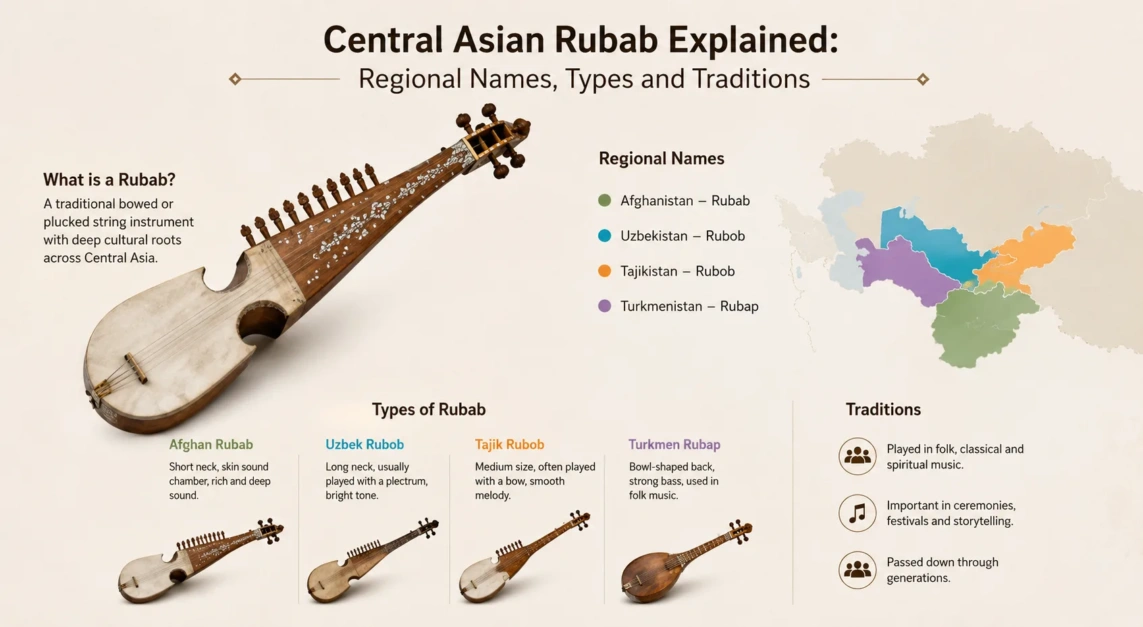
Central Asian rubab is not one single, fixed instrument. The name points to a family of plucked lutes whose forms move across Afghanistan, Tajikistan, Uzbekistan, Iran, the Pamir mountains, and nearby musical cultures. A Kabuli rubab, an Uzbek rubob, a Tajik rubāb, a Pamiri rubab, and a Uyghur rawap may share a name-history and a lute identity, yet they can differ in body depth, neck length, skin or wood soundboard, string layout, tuning practice, and musical role.
What Central Asian Rubab Means
The term Central Asian rubab usually refers to regional lute forms connected by the names rubab, rabab, robāb, rubāb, rubob, and related spellings. In museum and heritage writing, the instrument is normally treated as a chordophone: its sound comes from vibrating strings stretched over a resonant body.
Most Central Asian forms are plucked, not bowed. This is a useful point because the older word rebab or rabab can also appear in other regions for bowed spike fiddles or bowed lutes. In the Central Asian setting, the name often survives while the construction and playing method follow local lute traditions.
Regional Note: A rubab name does not always mean the same body shape. Before identifying an instrument, look at the neck length, soundboard material, presence of frets, string layout, and whether it has sympathetic strings.
Regional Names and Spellings
The spellings reflect several languages, scripts, and transcription habits. English pages often simplify them, but instrument catalogues and cultural records may preserve diacritics such as rubāb or robāb.
| Name or Spelling | Common Regional Link | What It Usually Signals |
|---|---|---|
| Rubab / Rabab | Afghanistan, Pakistan, northern India, broader Central and South Asian writing | A plucked lute form, often linked in English with the Afghan or Kabuli rubab. |
| Rubāb | Tajikistan, Persian-language and scholarly transcription | A more exact transliteration used in museum, music, or heritage contexts. |
| Robāb | Iran and Persian-language contexts | A related spelling for a regional short-necked instrument tradition. |
| Rubob | Uzbekistan | The Uzbek spelling used for rubab-family lutes in traditional and ensemble settings. |
| Rubab-i Pamir / Pamiri Rubab | Pamir Mountains and Badakhshan | A Pamir-region form with its own body, string, and performance identity. |
| Rawap / Rewap | Uyghur music of Xinjiang and nearby traditions | A related long-necked plucked lute, visually different from the Afghan short-necked rubab. |
Main Regional Types
The rubab family is easier to understand by comparing regional forms instead of forcing every instrument into one pattern. The Afghan rubab is the best-known form internationally, but it is not the only Central Asian reference point.
Afghan or Kabuli Rubab
The Afghan rubab is a short-necked plucked lute closely tied to Afghan art, popular, and regional music. It is widely described as Afghanistan’s national instrument. Documented museum examples show a body carved from mulberry wood, a skin-covered face, decorative inlay, and a bright, percussive attack.
Many modern Afghan rubabs have melody strings, drone strings, and sympathetic strings. The exact layout can vary by maker and school, but a common modern description includes three main melody strings, a small number of frets, two or three longer drone strings, and a set of sympathetic strings that vibrate along with the played notes.
The plectrum gives the Afghan rubab its firm attack. The skin soundboard helps create a dry, direct response, while sympathetic strings add shimmer after the plucked note. That mixture is one reason the instrument can carry both solo lines and ensemble textures.
Tajik Rubāb and Uzbek Rubob
In Tajikistan and Uzbekistan, the rubāb or rubob name is attached to short-necked string instruments used in traditional ensembles and community performance. Cultural records describe robāb/rubāb/rubob traditions using apricot, mulberry, or other woods, with shape varying within and across countries.
These instruments should not be reduced to a copy of the Afghan rubab. The name connection is real, but regional craft, repertory, and ensemble use shape the final instrument. Some forms are associated with professional ensembles; others remain closer to local community settings.
Pamiri Rubab
The Pamiri rubab, often called rubab-i Pamir, belongs to the Pamir and Badakhshan musical area. Museum descriptions of historic examples show a body, neck, and pegbox cut from one piece of fruit wood, with leather over part of the body and wood over another resonating area.
The Pamiri form is especially useful for comparison because it does not look or behave exactly like the Afghan rubab. Some documented Pamiri instruments are unfretted and use fewer active strings than the heavily ornamented Afghan form. Their musical role may lean toward accompaniment, drone, rhythm, and support for sung or spoken poetry.
Uyghur Rawap
The rawap sits near the rubab discussion because of shared lute ancestry and naming overlap in Central Asian writing. It is usually a long-necked plucked lute, not a short-necked Afghan rubab. A typical Uyghur rawap has a small bowl-shaped body, a skin sound table, a long fretted neck, and decorative horn-like extensions near the bowl.
Some rawap forms include sympathetic strings, while others are described by region or performance setting. The Kashgar rawap is one well-known form. For identification, the long neck and side horns often separate it visually from the short-necked rubab forms.
Construction Details That Shape the Instrument
Rubab-family instruments are often built around a carved wooden body rather than a flat guitar-like box. Mulberry appears often in Afghan and Central Asian examples, while apricot and other fruit woods are also documented in regional craft. Wood choice can shape resonance, weight, carving behavior, and repair choices, but it should not be treated as the only source of tone.
Body and Neck
Short-necked forms such as the Afghan rubab concentrate resonance in a compact body. The neck is not simply a handle for the strings; it also affects balance, hand position, and how ornamentation is fitted. Some historic examples show body, neck, and pegbox carved from one piece of wood, while other instruments include repaired or replaced parts.
Soundboard
The soundboard may be skin, wood, or a combination depending on the form. Afghan rubab descriptions often mention a skin face, commonly goatskin in modern descriptions. Pamiri examples may combine leather over the lower resonating area with wood over another hollowed section. Rawap examples often use reptile skin or other animal skin on the bowl opening, depending on region and maker.
Strings, Drones, and Sympathetic Strings
The string plan is one of the best ways to avoid confusion. A simple count can be misleading because some strings are played directly, some serve as drones, and others are sympathetic. Sympathetic strings are not normally plucked in ordinary melody playing; they vibrate in response to nearby pitches and add a light after-ring.
Luthier’s Note: On rubab-family instruments, small construction choices matter. Skin tension, bridge height, fret placement, string material, and the depth of the carved body can change the playing feel as much as the outside shape does.
Sound and Playing Feel
The Central Asian rubab family is known for a tactile plucked sound. On Afghan-style instruments, the note begins with a clear strike from the plectrum, then the skin-covered body gives a compact resonance. The sound can be bright without being thin, especially when sympathetic strings are present.
Pamiri and related regional forms may give a drier, more grounded accompaniment effect, depending on construction and stringing. Rawap forms, with their longer necks and metal strings, can support fast melodic passages and bright articulation in Uyghur performance settings.
Common Playing Features
- Plectrum use: Most Central Asian rubab-family instruments are plucked with a plectrum or pick-like tool.
- Drone support: Drone strings or repeated open tones help support modal melodies and vocal lines.
- Ornamented melody: Slides, quick turns, repeated notes, and rhythmic strokes help shape phrasing.
- Flexible tuning: Tuning may change by regional form, repertory, teacher, and ensemble need.
Traditions and Performance Settings
Rubab traditions are tied to social music as well as formal performance. In Afghanistan, the rubab can appear in solo playing, small ensembles, regional folk repertory, and art music connected with Kabul’s court and urban traditions. It also works with percussion such as tabla or dhol in some performance settings.
In Tajikistan, Uzbekistan, and Iran, robāb/rubāb/rubob traditions are described in cultural records as part of holidays, gatherings, rituals, mourning ceremonies, and traditional ensembles. These settings show why the instrument should be understood as craft, repertory, and community practice together, not just as an object with strings.
In the Pamirs, the rubab can support sung poetry and local repertory. In Uyghur contexts, the rawap is strongly tied to narrative singing, professional performance, and regional ensemble practice. The instrument’s role changes with the musical language around it.
How It Differs from Related Instruments
Several Central and South Asian lutes can look related at first. The safest comparison starts with construction and playing role, not just the name.
| Instrument | Main Visual Clue | Playing Method | Usual Point of Confusion |
|---|---|---|---|
| Afghan Rubab | Short neck, carved body, skin face, often ornate inlay | Plucked with plectrum | Sometimes confused with sarod because of historical and musical links. |
| Pamiri Rubab | Regional Pamir body form, often plainer and structurally distinct | Plucked | Often treated as if it were the same as the Kabuli rubab, though its role and build differ. |
| Uyghur Rawap | Long neck, small skin-covered bowl, horn-like side extensions | Plucked | Name and lute ancestry link it to the rubab discussion, but its profile is different. |
| Dutar | Long neck, pear-shaped body, usually two strings | Plucked | Shares Central Asian lute space but has a different string plan and body concept. |
| Sarod | Metal fingerboard, South Asian classical context | Plucked | Often discussed as related to or developed from Afghan rubab traditions. |
Common Misunderstandings
All Rubabs Are Not the Same Instrument
The name travels widely, but each regional form needs its own description. A short-necked Afghan rubab, an Uzbek rubob, a Pamiri rubab, and a Uyghur rawap should not be described with one fixed string count or one tuning.
Rubab Does Not Always Mean Bowed
Some older or neighboring uses of rabab/rebab refer to bowed instruments. Central Asian rubab-family instruments discussed here are mainly plucked. That difference changes the bridge, string response, attack, and musical technique.
String Count Is Not Enough for Identification
Counting pegs or strings can help, but it can also mislead. Restorations, missing strings, regional modifications, and sympathetic-string layouts can make two instruments of the same name look different.
How to Identify a Central Asian Rubab-Type Instrument
A careful identification starts with visible structure. The name on a label is useful, but the object itself gives better evidence.
- Check whether the neck is short or long.
- Look for a skin soundboard, wooden soundboard, or mixed face.
- Notice whether the body is carved from a block or assembled from thinner parts.
- Count visible melody, drone, and sympathetic strings separately when possible.
- Look for frets, fret material, and whether the fingerboard is plain or highly decorated.
- Read the regional label carefully: Afghan, Kabuli, Pamiri, Tajik, Uzbek, Iranian, Uyghur, or Kashgar may point to different forms.
Collector’s Note: Old rubab-family instruments often show repair history. A replaced bridge, added frets, missing inlay, changed strings, or a repaired pegbox does not automatically make the instrument inauthentic. It may show how a working instrument moved through use, storage, and restoration.
Place in Museum and Heritage Context
Rubab-family instruments appear in museum collections as musical objects, craft objects, and records of regional performance. A museum label may focus on date, material, and place of making. A player may focus on response, tuning, and repertory. Both views are needed.
The Afghan rubab is often represented through early twentieth-century museum examples with carved mulberry bodies, skin faces, and mother-of-pearl or other inlay. Pamiri examples can show much older dates and different construction choices. UNESCO heritage records also treat robāb/rubāb/rubob practice as craft and playing knowledge shared across communities in Iran, Tajikistan, and Uzbekistan.
This heritage view matters because the rubab is not only a preserved object. Its identity depends on makers who carve and fit the instrument, players who maintain repertory, and listeners who recognize its role in gatherings, ceremonies, and ensemble sound.
Learning and Listening Notes
For a beginner listener, the easiest entry point is to compare attack and resonance. Afghan rubab playing often has a crisp front edge, followed by a light ringing field from drones and sympathetic strings. Pamiri rubab performance may feel more direct and supportive, especially when accompanying voice. Rawap playing often highlights the long-necked lute character: bright notes, plectrum energy, and regional ornamentation.
For a beginning player, the challenge is not only tuning. It is learning how the right hand shapes the instrument. Plectrum angle, repeated strokes, drone control, and muting can make the difference between a plain plucked note and a phrase that belongs to the tradition.
FAQ
Is Central Asian rubab the same as Afghan rubab?
No. Afghan rubab is one major form, but Central Asian rubab can also refer to Tajik, Uzbek, Pamiri, Iranian, and related regional lute traditions. The Afghan form is the best-known internationally, yet it should not stand for every rubab-type instrument.
Why are there so many spellings: rabab, rubab, robāb, rubāb, and rubob?
The spellings come from different languages, scripts, and transliteration choices. English often uses rubab or rabab. Tajik and Persian-related writing may use rubāb or robāb. Uzbek commonly uses rubob.
Does every rubab use sympathetic strings?
No. Sympathetic strings are common in Afghan rubab descriptions and in some related lutes, but they are not a safe rule for every regional form. Always check the specific instrument type.
Is the rubab bowed or plucked?
The Central Asian rubab forms discussed here are mainly plucked. The wider rebab/rabab name can refer to bowed instruments in other regions, which is why naming alone can cause confusion.
What makes the Pamiri rubab different?
The Pamiri rubab belongs to the Pamir and Badakhshan musical area and has its own construction history. Documented examples show different body treatment, string layouts, and musical roles when compared with the Afghan rubab.
How can someone identify a rubab type without hearing it?
Start with the visible structure: neck length, body shape, soundboard material, frets, peg layout, and regional label. A long-necked rawap, a short-necked Afghan rubab, and a Pamiri rubab can usually be separated by these features before sound is considered.