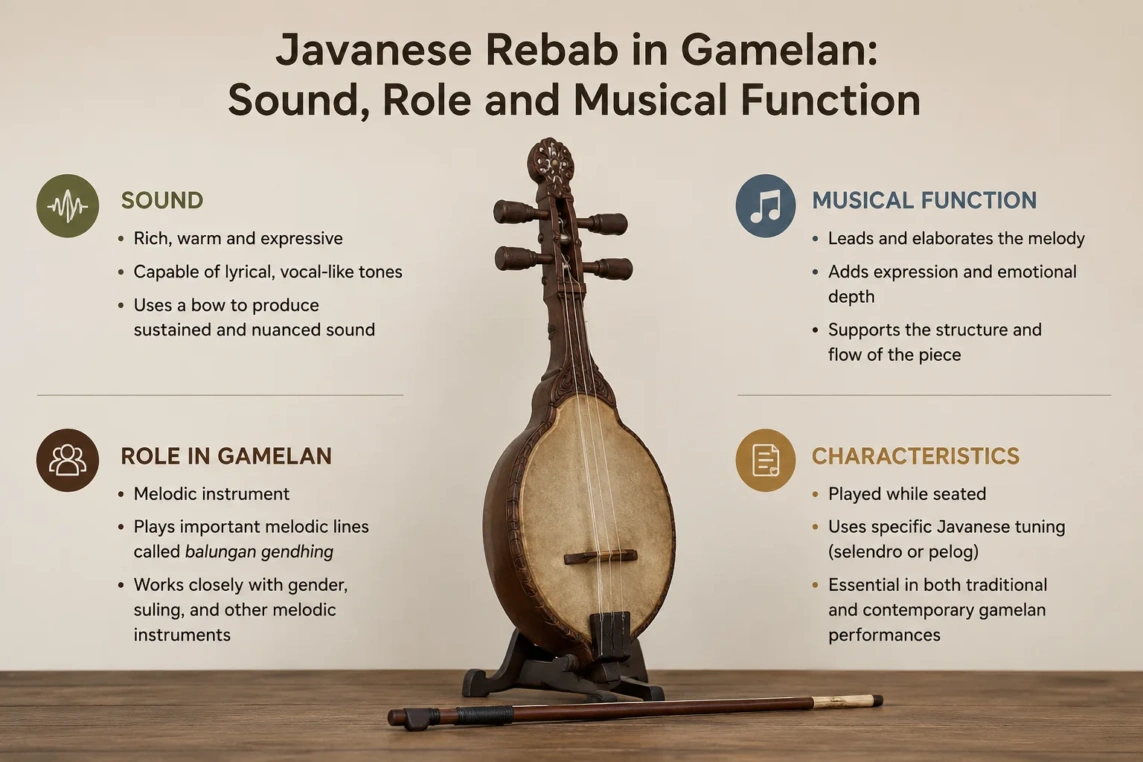
The Javanese rebab is a two-string bowed lute whose role in Central Javanese gamelan depends as much on musical knowledge as on bowing technique. In soft-style repertoire it can establish the opening of a piece, shape melodic direction, interact with singers and help other elaborating parts hear how the melody is moving through a particular laras and pathet.
What the Javanese Rebab Is
The Javanese rebab is a bowed spike lute used in Central Javanese gamelan, especially traditions associated with Yogyakarta and Surakarta. The player sits on the floor with the instrument upright and draws a loose-haired bow across two strings.
Its sustained line occupies a different acoustic space from struck bronze metallophones and gongs. The rebab can slide into tones, shade pitch and connect notes continuously, allowing it to carry melodic information that cannot be expressed in exactly the same way by fixed-pitch keys.
In many soft-style pieces, this line helps musicians hear the melodic path through the composition.
| Feature | Typical Javanese Rebab Detail | Musical Effect |
|---|---|---|
| Instrument Type | Two-string bowed spike lute or spike fiddle | Adds a sustained and flexible melodic line to the gamelan |
| Strings | Usually two metal strings; documented examples use materials such as brass, bronze or copper wire | Allows free-stopped melodic playing rather than chord-based technique |
| Body | Small wooden resonator with a membrane soundboard | Produces a focused, dry and slightly nasal bowed tone |
| Bridge | Small raised bridge, often described as srenten | Transfers vibration from the strings to the membrane |
| Playing Position | Held upright while the player sits cross-legged | Supports light left-hand stopping and controlled bow movement |
| Musical Role | Melodic guide and elaborating voice in many soft-style pieces | Helps communicate melodic direction, register and pathet |
Body, Neck and Materials
A Javanese rebab normally has a small wooden resonating body. The exact outline varies between surviving examples. Museum descriptions may call the body heart-shaped, triangular, rounded or bowl-like, depending on the instrument and the way its shape is interpreted.
The front is covered with a membrane rather than a carved wooden soundboard. Catalogues and teaching descriptions use terms such as parchment, bladder, skin or vellum for different examples. These records should be read as object-specific descriptions rather than one universal material specification.
A long spike passes through or continues from the resonator. Below the body it provides support. Above it, the structure forms the neck and reaches the two large lateral tuning pegs.
The neck has no fretted fingerboard. Pitch comes from light contact between the left hand and the strings.
Luthier’s Note: Membrane tension, bridge position, string material, bow-hair tension and left-hand contact all affect the response of a Javanese rebab. Small changes in setup can alter how quickly a note speaks and how stable the bowed tone feels.
The Bridge and Membrane
The bridge stands on the membrane and carries string vibration into the resonator. Because the membrane is thin, bridge pressure and placement have a direct effect on response.
A bridge that leans, sits badly or places unsuitable pressure on the membrane can make the tone weak or difficult to control. The condition of older membranes also matters; aged material may no longer tolerate normal playing tension.
The Bow
The Javanese rebab bow is commonly a light wooden bow fitted with horsehair, although modern replacements may use other fibers. Its hair is generally looser than the hair of a modern violin bow.
The player can influence the contact and tension of the hair with the bowing hand. This gives fine control over attack, continuity and pressure, especially at the low dynamic level common in soft gamelan textures.
The Sound of the Javanese Rebab
The Javanese rebab has a slender, dry and slightly nasal tone with a vocal quality. Its membrane-covered body responds quickly, while the bow allows tones to continue and change shape after the initial attack.
The rebab can slide into a pitch, leave it gradually or approach an arrival tone through a small ornament. These motions are especially useful beside instruments such as saron, slenthem, gender and gongs, whose individual pitches are fixed by their keys or bosses.
Free stopping also permits small pitch adjustments. The player listens continuously to the gamelan rather than relying on fixed finger positions copied from a standardized instrument.
- Attack: soft and adjustable through bow pressure.
- Sustain: continuous while the bow remains active.
- Pitch: freely stopped without frets.
- Ornament: shaped with slides, turns and short connecting gestures.
- Register: used flexibly according to the melodic path of the piece.
Listening Note: In soft gamelan, follow the sustained bowed line around the metallophones and singers. The rebab often reveals melodic direction through the way it approaches a tone rather than through volume.
Melodic Leadership in Javanese Gamelan
Central Javanese gamelan distributes musical responsibility among several performers. The kendhang is closely involved with tempo, transitions and rhythmic flow. The rebab contributes a different kind of guidance by shaping melodic movement.
The player signals direction through contour, register, phrase endings and familiar melodic formulas. Other musicians do not need a theatrical cue. They hear the information inside the rebab line and relate it to the form and repertoire they already know.
This role is especially clear in soft-style pieces, where the rebab interacts with gender, gambang, siter, suling and vocal parts.
Buka and the Opening of a Piece
A buka is the opening phrase that starts a composition or prepares the entry of the ensemble. In many pieces associated with the rebab, the bowed instrument performs this opening.
Before the buka, the rebab player may sound a short preparatory gesture commonly called senggrengang. This gives the other musicians information about the musical area in which the piece will begin and allows them to prepare for the opening.
The exact shape of a buka belongs to the composition and performance tradition. It is learned as musical material rather than improvised as a generic introductory flourish.
Gendhing Rebab
A piece whose opening responsibility belongs to the rebab may be described as gendhing rebab. The term identifies the rebab’s role in beginning the piece and points to its close connection with the subsequent melodic flow.
The designation does not mean that the composition becomes a rebab solo. Once the ensemble enters, the rebab works inside the larger texture while continuing to provide melodic information.
Guiding Elaborating Parts
The rebab belongs among the elaborating or melodic instruments that move around the simpler outline supplied by the balungan. Gender, gambang, siter, suling and vocal parts each have their own techniques and patterns, so they do not merely duplicate the same line.
The rebab can anticipate an arrival tone, connect one melodic area to another or suggest how a phrase should move through its register. Experienced players of the other elaborating parts recognize these cues within the shared repertoire.
Laras and the Rebab
Laras refers to the tuning system of Javanese gamelan. The two main systems are slendro and pelog. They should not be treated as Western equal-tempered scales transferred onto gamelan instruments.
Individual gamelan sets have their own tuning character and absolute pitch level. The rebab must therefore be tuned and played in relation to the set beside it.
Slendro is commonly described as a five-tone tuning system. Pelog contains a larger collection of pitches, with particular subsets and pitch relationships used according to the musical context. A rebab player learns these sounds through the actual gamelan rather than through a universal frequency chart.
Pathet and Melodic Function
Pathet organizes melodic behavior within Javanese gamelan. Translating it simply as “mode” can be useful as an initial comparison, but rebab playing requires more practical knowledge than that label supplies.
Pathet affects which tones receive emphasis, how melodies move through different registers, where phrases tend to settle and which melodic formulas fit a particular passage. The rebab is closely involved because its line can expose these relationships clearly.
A player therefore needs to know more than the sequence of balungan tones. The line must fit the pathet, the register of the passage, the vocal material and the expected melodic route through the gendhing.
Why Register Matters
The rebab can move above and below the immediate range suggested by a short section of balungan. This wider movement helps clarify how one phrase connects to another.
Register is part of the melodic information. Two gestures containing similar pitch classes can function differently when placed in different areas of the rebab’s range.
How the Rebab Relates to Gamelan Layers
| Musical Layer | Common Instruments or Parts | Relationship with the Rebab |
|---|---|---|
| Balungan | Saron, slenthem and related instruments | The rebab interprets the melodic outline and can approach its tones through elaborated movement |
| Structural Punctuation | Gong, kenong, kempul, kethuk and related gong instruments | The rebab shapes melodic motion toward structural arrival points |
| Rhythmic Direction | Kendhang | The rebab responds to tempo, irama and transitions shaped by the drummer |
| Elaborating Parts | Gender, gambang, siter, suling and related soft instruments | The rebab supplies melodic cues and participates in the same unfolding phrase structure |
| Vocal Parts | Pesindhen and gerong | The rebab can support, prepare or interact with sung melodic movement |
Soft-Style Gamelan and the Rebab
The rebab is most closely associated with the softer instrumental and vocal layer of Central Javanese gamelan. This texture gives sustained, plucked, blown and sung lines enough space to interact around the balungan.
The bowed line may begin the composition, prepare a phrase ending, move alongside a singer or signal an expected melodic turn. Its exact behavior changes with the gendhing, pathet, irama and the musicians involved.
Repertoire dominated by louder bronze sonorities may give the rebab less space or omit it. Its function should therefore be described in relation to the type of piece rather than as a permanent role in every gamelan performance.
Irama and Ensemble Movement
The rebab player also listens closely to irama, the changing relationship between the basic pulse and the density of elaborating parts. As the ensemble moves between irama levels, the amount of melodic space available to the rebab changes.
A slower surface does not simply invite random extra ornament. The player uses established melodic knowledge to fill the available time while remaining connected to the structural cycle and the other elaborating instruments.
The kendhang is particularly important during these changes. The drummer communicates transitions that affect the whole ensemble, while the rebab adjusts its melodic pacing to the new rhythmic setting.
Playing Technique and Musical Skill
The Javanese rebab has only two strings, but accurate playing requires close ear control. There are no frets to establish fixed positions, and the instrument is tuned in relation to a particular gamelan.
The player sits cross-legged with the rebab upright. The left hand touches the strings lightly to produce different pitches. The string is not normally pressed against a long hard fingerboard in the manner of a violin.
The right hand draws the bow while controlling its pressure and hair contact. Small adjustments change the attack and continuity of the tone.
Left-Hand Pitch Placement
Pitch positions become familiar through repetition and listening. The hand develops physical memory, but that memory remains tied to the tuning of the ensemble.
Slides and connecting movements are part of phrasing. They need controlled placement because excessive movement can blur the relationship between the rebab and the surrounding gamelan pitches.
Right-Hand Bow Control
The loose-haired bow rewards a light and responsive hand. Pressure, speed and contact determine whether a note begins clearly or develops an unwanted rough edge.
The player also has to plan bow direction over a phrase. Reversing the bow at an unsuitable point can interrupt melodic continuity even when the correct pitches are being played.
Why Written Notation Is Not Enough
Cipher notation can show useful pitch and structural information, especially for students learning a new gendhing. It cannot record every detail of bowing, timing, ornament, register choice and melodic emphasis.
A written balungan is even further removed from a complete rebab part. The rebab interprets the melodic structure through patterns learned from teachers, repertoire and repeated ensemble listening.
For this reason, a student who can read the notation may still be unsure which melodic path is appropriate. Rebab fluency develops through hearing how experienced players connect written structure with pathet and performance context.
Practice Note: Bowing an open string and locating a few pitches can be learned relatively early. Choosing the correct melodic path through a gendhing requires much more repertoire knowledge.
Relationship with the Voice
The Javanese rebab has a close relationship with vocal melody. Its sustained sound can slide, lean toward pitches and move through ornaments in ways that resemble possibilities available to a singer.
The relationship is musical rather than literal imitation. The rebab does not duplicate every vocal note. It can prepare a vocal entry, move alongside a pesindhen line, respond to gerong or connect instrumental phrases around sung material.
This interaction becomes especially useful when vocal melody supplies information that is less obvious in the balungan. The rebab can help carry that melodic direction into the instrumental layer.
Balungan and Rebab Melody
The balungan provides an important melodic reference, but a rebab part should not be understood as decorated balungan played one note at a time.
Rebab melody can approach balungan tones indirectly, anticipate important notes and move through patterns whose shape comes from pathet and established performance practice. The destination may correspond with the structural melody while the route taken by the rebab is more elaborate.
This distinction explains why two musicians looking at the same balungan notation may still need substantial repertory knowledge before producing an appropriate rebab line.
Central Javanese Regional Setting
The rebab is closely associated with Central Javanese gamelan traditions centered around Yogyakarta and Surakarta, alongside community, teaching and performance practices elsewhere in Java and beyond.
It can appear in palace-related repertoire, klenengan, dance accompaniment, wayang-related music and other gamelan settings where the required instrumentation and repertoire include it.
The exact musical responsibility changes from piece to piece. A rebab may have a clearly exposed opening in one composition and spend more of another performance blended with singers and other soft instruments.
Yogyakarta and Surakarta Traditions
Yogyakarta and Surakarta are both major centers of Central Javanese gamelan, but their repertories and performance habits should not be assumed to be identical in every detail.
Teachers and ensembles may preserve different versions of melodic formulas, pieces or stylistic preferences. A rebab part learned in one lineage may therefore contain details that are handled differently elsewhere.
These variations belong inside Javanese rebab practice itself and do not change the instrument’s broader role as an unfretted bowed melodic voice in gamelan.
Javanese Rebab and Related Instruments
The name rebab has relatives across many regions, including rabab, rubab, rabāb, rababa and rebap. The Javanese instrument should be identified through its Central Javanese context, bowed technique and construction rather than by name alone.
| Instrument | Playing Method | Main Context | Difference from the Javanese Rebab |
|---|---|---|---|
| Javanese Rebab | Bowed | Central Javanese gamelan | Closely tied to soft-style elaboration, buka, laras and pathet |
| Afghan Rubab | Plucked | Afghan and neighboring musical traditions | Short-necked carved lute played with a plectrum |
| Balinese Rebab | Bowed | Selected Balinese gamelan ensembles | Belongs to Balinese repertoire and does not carry the full Central Javanese musical function |
| North African Rababa or Rabab | Usually bowed | Regional North African and Middle Eastern traditions | Different construction, repertoire and ensemble relationships |
| European Rebec | Bowed | European medieval and early-music settings | Different historical construction and repertory |
How to Recognize a Javanese Rebab
A Javanese rebab is best identified through a combination of physical and musical evidence.
- It is a small upright bowed instrument.
- It usually has two metal strings.
- The resonator has a membrane-covered face.
- A long spike or neck extends above and below the body.
- Two large tuning pegs project from the upper neck.
- The strings are stopped without frets.
- The instrument appears in a Central Javanese gamelan setting.
- Its repertory can involve buka, gendhing rebab, pathet-based elaboration and interaction with soft-playing parts.
The final musical clue is especially useful. A visually similar regional rebab should not automatically be labelled Javanese if its repertoire and provenance point to Sunda, Bali or another tradition.
Museum and Instrument Identification
Museum descriptions may label a Javanese rebab as a bowed lute, spike lute, spike fiddle or unfretted chordophone. These terms reflect different classification habits and are not necessarily contradictions.
Documented materials include wood, membrane material, metal wire, horsehair, cloth and decorative fittings. Older examples may contain materials that are no longer commonly used. Such details should be recorded historically rather than treated as requirements for a working modern instrument.
For identification, inspect the string path, bridge, membrane, peg arrangement and spike together. Decorative cloth or carving can support provenance, but ornament alone cannot establish the musical tradition.
Collector’s Note: An old Javanese rebab with a dry membrane, stiff pegs or corroded strings should not be tuned simply to test whether it plays. Membrane instruments can suffer damage when aged components are brought suddenly under tension.
Common Misunderstandings
A Quiet Rebab Can Still Guide the Melody
Melodic guidance in gamelan does not depend on being the loudest instrument. Experienced musicians hear the rebab’s contour and phrase placement within the ensemble.
Two Strings Do Not Make the Music Simple
The physical string layout is small, while the musical vocabulary is extensive. Free stopping, register changes, bow control and repertory-specific melodic formulas give the instrument a wide range of possible lines.
The Rebab Does Not Use One Fixed Western Tuning
A Javanese rebab is adjusted to the gamelan with which it is played. Slendro and pelog practice cannot be reduced accurately to one universal set of equal-tempered Western notes.
Pathet Is More Than a Scale Choice
Pathet affects melodic movement, register, emphasized tones and phrase behavior. Selecting a collection of pitches without understanding those relationships does not reproduce Javanese rebab practice.
Rebab and Rubab Are Not Interchangeable Instrument Names
The Afghan rubab and Javanese rebab differ in construction, technique and musical setting. Similar spelling does not make them the same instrument.