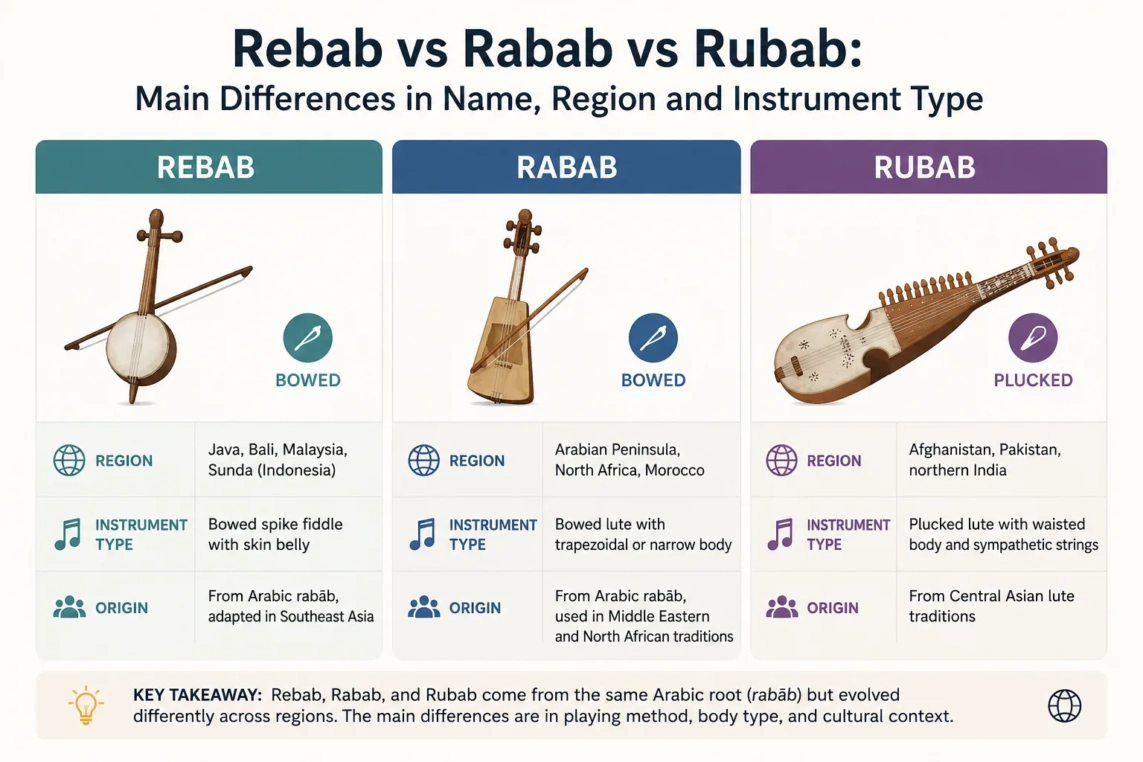
The three names — rebab, rabab, and rubab — trace back to a single Arabic root. They are not three separate instrument families. But they are not simply three spellings of one instrument either. Across the regions where these instruments appear, the name has attached itself to forms that differ in body shape, playing method, string count, and musical function. Understanding which name refers to which instrument requires knowing where the instrument comes from, not just how its name is spelled.
One Name, Multiple Instruments
The Arabic word rabāb (ربابة) is the common ancestor of all three spellings. From this root, several distinct regional instrument traditions developed over centuries. Some of these traditions produce bowed lutes. Others produce plucked lutes. The fact that both types can carry names like rebab, rabab, or rubab is what creates the most confusion.
Spelling alone is not a reliable guide to instrument type. A “rubab” in Afghanistan is a plucked instrument with a deep waisted body and gut or nylon frets. A “rebab” in Java is a bowed two-string spike fiddle with a skin belly. Both names come from the same source, but the instruments are structurally and sonically unrelated.
Where the Spelling Differences Come From
The variations in spelling reflect different transliteration practices across languages and regions — not fundamentally different words.
- Rebab — common in Southeast Asian contexts (Java, Bali, Malaysia, Sunda) and in some English-language musicology when referring to the Arabic bowed form.
- Rabab — found in Arabic, Turkish, and Persian sources; also used in English texts describing Middle Eastern bowed lute traditions.
- Rubab — the standard romanization for the Afghan plucked lute; also found in some Central Asian contexts, where a related form called the rubob exists in Tajikistan.
The vowel shift from “e” to “a” to “u” reflects how the root word is pronounced and romanized across Arabic, Persian, Dari, Uzbek, and various Southeast Asian languages. None of these spellings is universally correct — each is appropriate in its own regional or scholarly context.
| Name | Region | Playing Method | Body Type |
|---|---|---|---|
| Rebab | Java, Bali, Malaysia, Sunda | Bowed | Spike fiddle, skin belly |
| Rabab / Rababa | Arabian Peninsula, North Africa, Morocco | Bowed | Bowed lute, trapezoidal or narrow body |
| Rubab | Afghanistan, Pakistan, northern India | Plucked | Waisted lute, wooden upper soundboard |
| Rubob | Tajikistan, Uzbekistan | Plucked | Waisted lute, related to Afghan form |
| Rebap | Turkey, some Ottoman-era contexts | Bowed | Bowed lute, related to Arabic form |
Bowed or Plucked: The More Useful Distinction
If the spelling differences cause confusion, the bowed-versus-plucked distinction cuts through it quickly. The two main branches of the rebab/rubab family divide along this line, and the division is structural — not just a matter of playing preference.
The bowed forms appear across the Arab world, Morocco, and Southeast Asia. These instruments typically have a skin-covered soundboard (or occasionally a wooden one, depending on regional form), relatively simple construction, and a tone shaped by the resonance of that skin surface. The bow is not optional — it is how the instrument produces sound.
The plucked Afghan rubab is a categorically different construction. It has a carved wooden body, a skin-covered lower bout, a solid wooden upper soundboard, and a set of sympathetic strings that resonate without being directly plucked. The right hand uses a plectrum. The sound is fuller and carries a natural sustain from the sympathetics — something the bowed forms do not replicate.
Regional Note
The Tajik rubob and the Afghan rubab share structural features but differ in body proportions, string count, and playing repertoire. Both are plucked, and both descend from related Central Asian lute traditions — but they are distinct regional instruments, not interchangeable forms.
How Region Shapes the Name and the Instrument
The geography of this instrument family spans from West Africa and Morocco through the Arab Peninsula, into Persia and Central Asia, and east into South and Southeast Asia. No single instrument survived this entire journey unchanged. Each region adopted, modified, and in some cases reinvented what the name referred to.
The Arabic and North African Forms
In the Arab world, the rababa or rabab is a bowed instrument. Its body shape varies — some forms are trapezoidal, others more rectangular or slightly waisted. The soundboard is often skin. The string count is low, typically one or two strings. In performance, the rababa has historically accompanied oral poetry and song in both Bedouin and settled traditions across the Arabian Peninsula and the Levant.
The Moroccan rabab is sometimes called the rabab al-andalus in reference to its association with Andalusian musical traditions. It has a narrower, more elongated body with a skin soundboard and is played with a bow. Some musicologists treat it as a distinct instrument rather than simply a local variant, given its specific structural and contextual differences from the Arabian form.
The Afghan Rubab
The Afghan rubab is a plucked lute and the most widely recognized form outside its home region. It has three main playing strings (traditionally gut, now often nylon), two or three drone strings, and a row of sympathetic strings that run alongside the neck. The body is carved from a single block — typically mulberry wood, though this varies by maker. The upper soundboard is solid wood; the lower resonating chamber is covered with animal skin.
This is the instrument central to Pashtun and broader Afghan classical and folk traditions, and it is the structural ancestor of the North Indian sarod — a connection that musicologists have documented through both historical and organological evidence.
The Javanese and Malay Rebab
The Javanese rebab is a bowed spike fiddle used within gamelan ensembles. It has two strings, a skin belly, and a long spike that passes through the body and rests on the floor during performance. The player holds the instrument vertically and draws a horsehair bow across the strings. Its role in gamelan is melodic — the rebab often leads phrasing and signals transitions within the ensemble structure.
The Malay rebab is a related form used in wayang theater accompaniment and traditional ensemble settings. Regional construction and playing details vary between Peninsular Malaysia and other Malay-speaking areas.
Identifying Which Form You Are Looking At
When a name alone does not resolve the question, a few structural features help narrow it down.
- Bowed or plucked? A bow indicates the Arab, North African, or Southeast Asian traditions. A plectrum indicates the Afghan rubab or a Central Asian related form.
- Sympathetic strings present? The Afghan rubab and Tajik rubob include a row of sympathetic strings. The bowed forms in this family typically do not.
- What does the soundboard look like? A skin surface covering the full top of the body suggests the bowed family. A wooden upper surface with skin only on the lower bout is characteristic of the Afghan rubab.
- String count? Bowed forms commonly have one or two strings. The Afghan rubab has several — main strings, drone strings, and sympathetics — with totals that vary by maker and tradition but often reach fifteen or more.
- Is there a spike at the base? A spike passing through the bottom of the body is a feature of spike fiddles, including the Javanese rebab. The Afghan rubab has no spike.
- Ensemble role? The Javanese rebab leads melodic lines within gamelan. The Afghan rubab functions as a solo or lead instrument in classical and folk settings. The Arabic rababa has historically accompanied vocal poetry and narrative singing.
Luthier’s Note
The method of attaching the soundboard is one of the more telling construction details. On the Javanese rebab, skin is stretched across a thin rim at the top of the body. On the Afghan rubab, skin covers only the lower resonating chamber while the upper surface — where the strings rest over the bridge — is solid wood. These are not cosmetic differences. They shape how vibration travels through the body and produce entirely different acoustic behavior.
The Afghan Rubab and the Sarod
The link between the Afghan rubab and the North Indian sarod is worth noting here because it shows how far this instrument family’s influence reached. The sarod developed from Afghan rubab forms brought into the Indian subcontinent, most likely during the eighteenth and early nineteenth centuries.
Where the rubab uses gut or nylon strings and a plectrum made from wood or horn, the sarod uses steel strings and a plectrum made from polished coconut shell. The waisted body shape is carried over; the frets are removed entirely, giving the sarod its fretless playing surface and its characteristic sliding technique. The sarod belongs to its own distinct tradition now, but the rubab provided its starting point.
Shared Etymology, Different Instruments
The Arabic rababa is also one of the instruments that scholars have connected to the early history of European bowed string instruments — particularly the rebec, a medieval bowed lute that appeared in Europe during the period of sustained musical exchange between Arab and European cultures. The transmission routes and the degree of direct influence remain debated, but the structural resemblance between the Arab bowed forms and the European rebec has been noted in organological literature for well over a century.
That a single etymological root could produce the Afghan rubab, the Javanese spike fiddle, the Moroccan bowed lute, the Arabic rababa, and potentially contribute to the European rebec is not coincidence — it reflects centuries of movement, adaptation, and reinvention across a wide geographic range.
Frequently Asked Questions
Are rebab, rabab, and rubab the same instrument?
They share a common Arabic root word, but they are not the same instrument. Different regional forms developed over centuries, some bowed and some plucked, with different body shapes, string arrangements, and musical functions. The name reflects a shared etymology, not a single standardized instrument.
Which spelling is correct — rebab, rabab, or rubab?
All three are correct within their own regional and linguistic contexts. Rebab is standard in Southeast Asian usage and in some English-language musicology. Rabab appears in Arabic, Turkish, and Persian scholarship. Rubab is the accepted English romanization for the Afghan plucked lute. There is no single universal standard across all traditions.
Is the rubab always a plucked instrument?
The Afghan rubab is always plucked. However, instruments in other regions sometimes carry the rubab name or a close variant and are bowed. The name alone does not confirm the playing method — regional origin and construction details are more reliable indicators.
What is the main difference between the Afghan rubab and the Javanese rebab?
They are structurally and sonically different instruments. The Afghan rubab is a plucked lute with sympathetic strings, a wooden upper soundboard, and a skin-covered lower bout. The Javanese rebab is a bowed two-string spike fiddle with a skin belly, played vertically in gamelan ensemble settings. The two instruments share a name root and nothing else of structural significance.
Does the Arabic rababa have any connection to European instruments?
Scholars have associated the Arabic rababa with the early history of European bowed string instruments, including the medieval rebec. The exact transmission routes remain debated, but the structural similarities between the Arab bowed lute forms and the rebec have been noted in organological literature for a long time. The connection is plausible given the historical contact between Arab and European musical cultures, though direct lineage is difficult to establish conclusively.
How do I identify a rebab-family instrument in a museum or collection?
Look at the playing method (bowed or plucked), the soundboard material (skin or wood), whether sympathetic strings are present, and whether a spike runs through the base of the body. Regional labels and provenance records in collection notes are usually the most reliable guide. When labels are missing or unclear, construction details — particularly soundboard type and string arrangement — support identification.