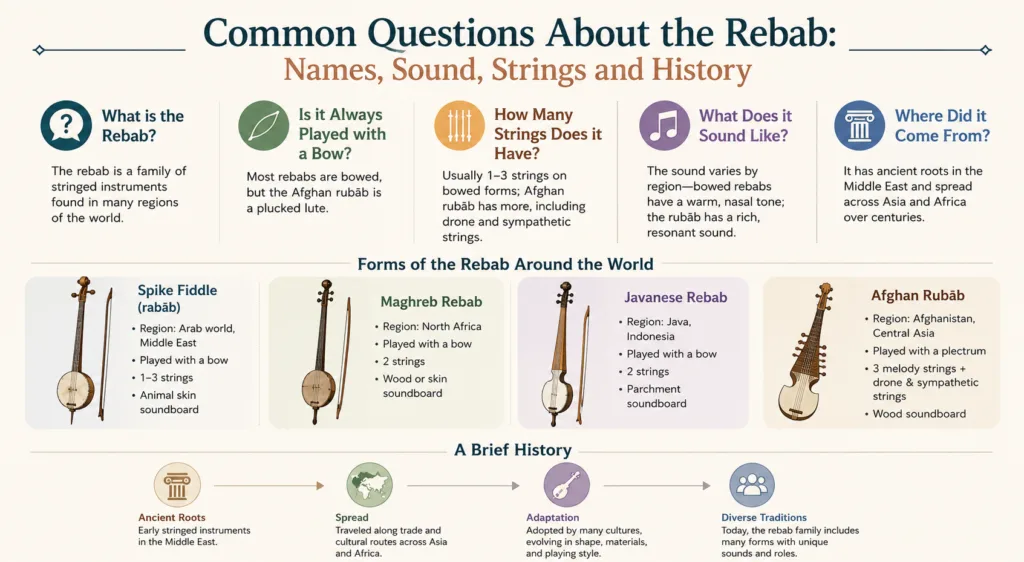
The word rebab does not name a single instrument. It names a family — a loosely connected group of stringed instruments that spread across North Africa, the Middle East, Central Asia, and Southeast Asia over many centuries, picking up new shapes, new materials, and new names along the way. That spread is why the same word appears spelled differently across different languages, and why a rebab in Morocco and a rebab in Java can look almost nothing alike.
The questions people ask about the rebab tend to cluster around the same handful of topics: What is it actually called? Is it always bowed? How many strings does it have? What does it sound like? And where did it come from? Those are the right questions to start with.
The Name and Its Many Spellings
Rebab, rabab, rubab, rubāb, rebap, rubob, rababa — these are not different instruments. They are different transliterations of the same Arabic root word, rendered into English (and sometimes other languages) through different regional phonetic systems and different historical periods.
The Arabic root carries a sound that does not map cleanly onto any single English spelling. The vowel in the first syllable shifts between e and a depending on dialect and transcription convention. The second syllable does the same. Persian and Urdu speakers tend toward rubāb or rubob; North African traditions more often produce rebab or rebeb; the Moroccan form is sometimes written rbeb. None of these is more correct than the others — they reflect actual spoken differences across regions.
There is also a historical dimension worth noting. In medieval Arabic writing, rabāb functioned at times as a generic term for bowed string instruments broadly, not just one specific form. This makes it harder to pin down early references to a single instrument type.
The spelling rebab is the most widely used in English-language organology and tends to be the default in museum and academic contexts. The spelling rubab or rubāb is most often reserved for the Afghan plucked lute — an instrument related by name and ancestry, but quite different in construction and playing technique.
One Name, Several Distinct Instruments
The table below outlines four of the most documented regional forms. The differences between them are not minor variations — in some cases, they amount to entirely different playing techniques and instrument structures.
| Regional Form | Primary Region | Playing Method | Typical String Count | Soundboard |
|---|---|---|---|---|
| Spike fiddle (rabāb) | Arab world, Middle East | Bow | 1–3 | Animal skin |
| Maghreb rebab | North Africa | Bow | 2 | Wood or skin |
| Javanese rebab | Java, Indonesia | Bow | 2 | Parchment |
| Afghan rubāb | Afghanistan, Central Asia | Plectrum | 3 melody + drone and sympathetic strings | Wood |
Is the Rebab Always Played with a Bow?
No — and this is probably the most common point of confusion.
The majority of instruments called rebab in their regional traditions are bowed. The spike fiddle forms found across the Arab world, North Africa, and Java are all played with a horsehair bow. But the Afghan rubāb is a plucked lute, played with a plectrum (or sometimes the fingers). It has a wooden soundbox rather than a skin soundboard, and it carries a different set of strings — melody strings, drone strings, and sympathetic strings that ring freely when adjacent notes are played.
When someone asks whether the rebab is bowed or plucked, the honest answer is: it depends on which form they mean. Regional context almost always determines the playing method.
How Many Strings Does a Rebab Have?
String count varies by form and region. There is no single standard.
Most bowed spike fiddle forms carry one to three strings. Two strings are common across many documented examples — enough for melodic playing alongside a drone. Some older or more simplified forms used a single string. Three-string bowed forms also exist and appear in several traditions.
The Afghan rubāb is a different case. It typically carries three main melody strings, alongside a set of drone strings and a further set of sympathetic strings. The sympathetic strings are not plucked directly — they vibrate in response to notes played on the melody strings, adding a layered resonance to the overall sound. The exact count of drone and sympathetic strings can vary between makers and players.
The Javanese rebab typically has two strings. Playing style on this instrument is specific: the player applies light finger pressure without fully pressing the strings against the neck, producing a softer, more fluid tone suited to the gamelan texture.
What a Rebab Actually Sounds Like
Bowed rebab forms are generally described as producing a voice-like, penetrating tone. The sound tends toward the nasal end of the spectrum — closer in character to a human singing voice than to the fuller projection of a modern violin. This is partly a result of the skin soundboard, which transmits vibration differently than a carved wooden top.
The Javanese rebab is particularly noted for its tonal closeness to the human voice. In gamelan performance it functions as a melodic lead instrument, and its sonic quality is said to approach the ornamental possibilities of Javanese singing more closely than any other instrument in the ensemble.
The Afghan rubāb produces a warmer, fuller sound. The wooden resonating chamber and the sympathetic strings give it a layered quality — a plucked note does not decay cleanly but continues to interact with the open sympathetics, creating a ringing sustain. This distinguishes it clearly from the bowed forms.
Origins and Early History
The rebab’s origins are traced to the Arabic and Persian-speaking world, with early written references appearing around the 10th century. By that point the instrument was already prominent in Arab musical culture, and the word rabāb was in wide use.
Some scholarship points toward older roots. Persian-language sources and archaeological finds suggest that instruments of similar structure may predate the 10th-century written record by several centuries, possibly with connections to Central Asian instrument traditions. Pear-shaped and boat-shaped body forms that characterize many early rabāb types have parallels in earlier Persian artifacts, though direct lineages are difficult to establish with certainty.
What is better documented is the spread. Beginning around the 8th century, instruments of the rebab family traveled along Islamic trade and pilgrimage routes — across North Africa, into Andalusian Spain, through Central Asia, and eventually to Southeast Asia. Each region absorbed the instrument into its own musical context and modified it accordingly.
How the Rebab Reached Europe
The pear-shaped bowed rabāb that entered medieval Europe through Andalusia became the rebec — a bowed instrument common in European music from the 11th century onward, eventually declining as the viol family became dominant in the 16th century. The rebec is generally considered a close relative or descendant of the bowed rabāb, shaped by the same basic construction principles: narrow neck, rounded body, and a tone that sat at the vocal end of the string-instrument spectrum.
The relationship between the rebab and the violin is sometimes overstated. The rebab’s structural features — particularly the skin soundboard and the absence of a fingerboard in many forms — do not appear in the violin’s design. The connection runs more clearly through the rebec than directly to the violin itself.
Frequently Asked Questions
Is the rebab the same instrument as the rubab?
The names come from the same Arabic root, but in practice they often refer to different instruments. Rebab most commonly refers to bowed spike fiddle forms across the Middle East, North Africa, and Southeast Asia. Rubab or rubāb most often refers to the Afghan plucked lute — a separate instrument in terms of construction, playing technique, and sound. The shared name reflects shared ancestry, not identical form.
Does every rebab use a bow?
No. Most regional forms called rebab are bowed instruments, but the Afghan rubāb is a plucked lute played with a plectrum. The original instruments of the rebab type were plucked; bowing was applied to them later. Both bowed and plucked forms are documented across the broader rebab family.
How many strings does a rebab have?
It depends on the regional form. Most bowed spike fiddle variants carry one to three strings, with two being common across many documented examples. The Afghan rubāb has three main melody strings alongside drone and sympathetic strings. The Javanese rebab typically has two strings. There is no single standard across the full rebab family.
What does a rebab sound like?
Bowed rebab forms produce a voice-like, somewhat nasal tone — penetrating rather than warm, often compared to human singing in its expressive quality. The Afghan rubāb has a fuller, warmer sound, with a sustained resonance produced by its sympathetic strings. The two sound quite different, which reflects how distinct these instruments are despite sharing a name.
Where did the rebab originate?
The earliest clear written references to the rabāb appear in Arabic sources around the 10th century. Some researchers point to earlier Persian or Central Asian roots, supported by archaeological parallels, though precise lineages remain debated. From its documented origins, the instrument spread widely along Islamic trade routes from the 8th century onward.
Is the rebab related to the European rebec?
Yes. The rebec, which appeared in Europe from around the 11th century, is generally considered a descendant or close relative of the pear-shaped bowed rabāb that entered Europe through Andalusia. Both share a similar body form and playing approach. The rebec eventually declined as the viol family became dominant, but the structural and sonic resemblance between the two instruments remains clear.