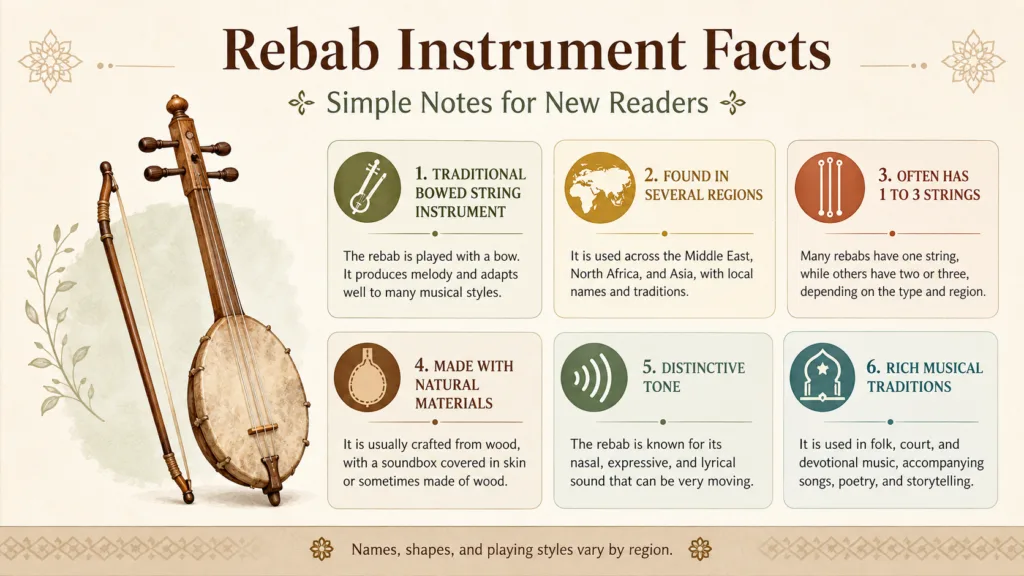
The word rebab does not name a single instrument. It names a family — one that includes bowed fiddles, plucked lutes, spike instruments, and membrane-topped resonators spread across a wide arc from North Africa through the Middle East, Central Asia, South Asia, and Southeast Asia. A new reader encountering the term for the first time will find that many of the facts cited about it online apply to only one branch of the family, not all of them.
That distinction matters from the start. Knowing the rebab as a family — rather than a fixed object — makes every other fact about it easier to hold in place.
Bowed or Plucked: the First Question to Ask
The most useful dividing line within the rebab family runs between instruments played with a bow and those plucked with the fingers or a plectrum. Most forms found in Arab, Persian, Javanese, and Moroccan traditions are bowed. The Afghan rubab — one of the best-known members of the family — is plucked.
This distinction shapes almost everything: body design, string choice, playing posture, and sound. A bowed rebab produces a sustained, vocal-like tone. A plucked rubab produces a sharp attack with a fast decay, closer in character to a lute or sitar.
Neither is more “authentic.” Both share the name because they share a lineage.
The Main Regional Forms
The table below outlines the most commonly documented forms. Construction details and string counts can vary within each regional tradition, so these entries describe typical rather than fixed configurations.
| Form | Region | Played With | Soundboard | Typical Strings |
|---|---|---|---|---|
| Arab rebab (rabābah) | Middle East, North Africa | Bow | Skin membrane | 1–2 |
| Moroccan rebab (rbeb) | Maghreb | Bow | Wooden belly | 2 |
| Javanese rebab | Java, Indonesia | Bow | Skin membrane (bull bladder) | 2 |
| Afghan rubab (robab) | Afghanistan, Pakistan | Plectrum | Skin membrane | 3 melody + sympathetics |
| Persian / Central Asian rebab | Iran, Central Asia | Bow (varies) | Skin or wooden (varies) | 2–3 |
The Moroccan form is worth noting separately: its carved wooden belly places it closer in construction to the European rebec than to the membrane-covered Arab forms. This is not a coincidence — the Moroccan form and the rebec share a common line of descent.
What the Spelling Variants Tell You
The same instrument family appears in English text under many names: rebab, rabab, rubab, rabābah, robab, rubob. These are not errors or interchangeable nicknames. Each spelling tends to reflect a regional language, transliteration convention, or local pronunciation.
Rebab is the most common English-language spelling and functions as a broad umbrella term. Rabab appears frequently in Arabic and South Asian contexts. Rubab and robab are associated specifically with the plucked Afghan form. Rubob is found in Tajik and Uzbek usage.
When a source uses one spelling consistently, it is often signaling — intentionally or not — which regional form it is describing. Paying attention to spelling can help a new reader identify which branch of the family is being discussed.
The Soundboard Question
One of the clearest structural differences across rebab forms is the soundboard material. Many bowed forms use a skin membrane — stretched animal skin or, in the Javanese tradition, bull bladder — over the resonating chamber. This gives the instrument a soft, slightly muted tone with a distinct mid-range presence.
The Moroccan rebab and certain Central Asian forms use a carved wooden belly instead. Wood transmits vibration differently: the tone tends to project more clearly and has a slightly brighter character.
Luthier’s Note
Skin soundboards are sensitive to humidity and temperature. In dry climates, they can tighten and raise pitch; in humid conditions, they may soften and lose resonance. Makers in arid regions often account for this when fitting the membrane. A wooden-bellied form generally handles environmental changes with more stability.
String Count and How the Strings Are Stopped
Most rebab forms carry between one and three melody strings. The Afghan rubab adds a set of sympathetic strings — thin metal strings that run beneath or alongside the main strings and vibrate in resonance, adding a shimmering sustain to the plucked notes.
A detail that surprises many new readers: most rebab forms have no fingerboard. The player stops the strings by pressing the fingertips — or the side of the finger — directly against the string, without any fretted or fretless board running beneath it. The string is pressed against the neck or simply pressed in the air at the correct position along its length.
This technique produces a highly responsive sound but also demands careful left-hand control. Small variations in pressure or position change the pitch significantly. It is one of the reasons the instrument takes time to learn well.
What a Rebab Sounds Like
Describing sound in text is always approximate, but a few observations hold across most documented bowed forms. The tone is relatively thin and nasal compared to a violin, with a clear vocal quality in the upper register. The skin soundboard contributes a softness that prevents the instrument from sounding bright or harsh.
The Afghan rubab sounds different — attack-heavy, warm in the low and mid range, with the sympathetic strings adding resonance that blurs into the note after the pluck.
Listening Note
When comparing recordings of different rebab forms, listen for whether the note sustains smoothly (bowed) or cuts off quickly (plucked). Also listen for whether there is a halo of overtone resonance around each note — that is the sympathetic string effect, specific to the rubab family.
The Spike and the Body Shape
Many bowed rebab forms are spike fiddles. A spike is a thin rod or extension at the base of the body that protrudes through the resonating chamber and rests on the floor or the player’s knee, supporting the instrument in a vertical position. The Javanese rebab uses this design, as do several Middle Eastern forms.
Body shapes vary considerably: pear-shaped, boat-shaped, figure-eight, rectangular, and trapezoidal bodies all appear in different traditions. The shape affects how the resonating chamber projects sound, though regional craft tradition often determines shape as much as acoustic logic does.
How the Rebab Connects to European Instruments
The bowed Arab rabāb reached Spain and Sicily via Islamic trade and cultural contact during the medieval period. The European rebec — a pear-shaped bowed fiddle widely used from the 11th to the 16th centuries — is generally understood to descend from it. The rebec in turn contributed to the development of later European bowed instruments.
This lineage is not always presented carefully in popular sources. The connection is real and well-documented at a broad level, but the rebab was not the only ancestor of the European violin — the path was long and involved many intermediary instruments and traditions. The relationship is better described as influential rather than direct.
Where the Rebab Appears Today
Bowed rebab forms remain active in Moroccan classical music (Andalusian malhun), Javanese and Sundanese gamelan, Arab folk and classical traditions, and certain Central Asian repertoires. The Afghan rubab is played across Afghanistan and Pakistan, and has attracted players internationally following increased global interest in Central and South Asian music.
Several regional forms are taught formally at music conservatories. Others are maintained primarily through oral transmission in ensemble or apprenticeship contexts.
What New Readers Often Misread
A few recurring misunderstandings are worth naming directly.
- The kamancheh is not a type of rebab. It is a related but distinct bowed instrument from Persian tradition. The two share structural similarities but are separate instruments with separate names.
- The erhu is sometimes mentioned alongside the rebab as a comparison instrument. The structural resemblance is loose. The erhu developed independently in Chinese tradition and is not a member of the rebab family.
- The Afghan rubab is not a bowed instrument. Referring to it as a “rebab fiddle” or assuming it is played with a bow is a common error in general-audience articles.
- Spelling variations do not indicate different instruments. Rebab and rabab can refer to the same regional form spelled two ways, or they can refer to different forms. Context — region, tradition, construction — is what determines which form is being described.
Frequently Asked Questions
Is the rebab always played with a bow?
No. Most forms in Arab, Javanese, and Moroccan traditions are bowed, but the Afghan rubab — one of the most widely known members of the family — is plucked with a plectrum. The bowed/plucked distinction is the most useful starting point when trying to understand which form a source is describing.
Why does the same instrument have so many different spellings?
The spelling differences reflect different regional languages, transliteration systems, and pronunciations. Rebab, rabab, rubab, robab, and rubob each signal a regional context. They are not errors — learning to read the spelling as a regional marker helps clarify which branch of the family is being discussed.
How many strings does a rebab have?
It depends on the form. Bowed forms typically carry one to three melody strings. The Afghan rubab adds a set of sympathetic strings alongside the main melody strings, bringing the total to a higher number depending on the individual instrument.
Does the rebab have a fingerboard?
Most forms do not. Players stop the strings with their fingertips directly against the string or neck, without a fingerboard running beneath. This is a significant technical difference from instruments like the violin or cello, and it requires a different left-hand technique.
Is the rebab related to the violin?
Indirectly, yes. The medieval Arab rabāb influenced the European rebec, which was one of the instruments that contributed to the broader development of bowed string instruments in Europe. The relationship is real but not a straight line — many instruments and traditions were involved across several centuries.
What is the difference between the rebab and the kamancheh?
Both are bowed spike fiddles with long histories in Middle Eastern and Central Asian music, and they share structural similarities. However, they are distinct instruments with separate names, separate regional traditions, and somewhat different construction. The kamancheh is not considered a subtype of the rebab.