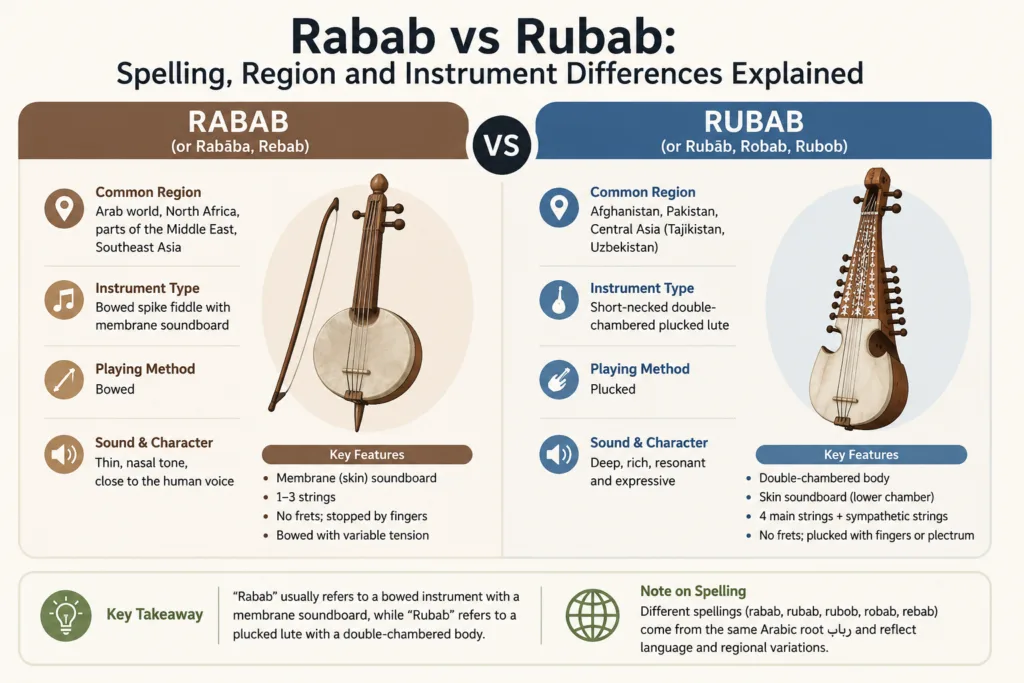
The difference between “rabab” and “rubab” is not always a matter of spelling alone. Both words come from the same root in Arabic script — رباب — but in practice they often point to different instruments, played differently, built differently, and rooted in different regional traditions. Understanding why requires looking at how the word traveled, and what happened to the instrument along the way.
One Word, Many Romanizations
Arabic script does not map neatly onto the Latin alphabet. The short vowel in the first syllable of رباب is represented differently depending on who is doing the transliteration — and from which language they are working. Arabic-language sources tend to romanize the word as rabab or rabāba. Persian and Dari sources lean toward rubāb. Pashto speakers often say and write rubab or robab. In Tajik and Uzbek contexts, rubob is common.
None of these are misspellings. They reflect genuine phonological differences across languages that all use, or once used, Arabic script. The vowel shift from “a” to “u” is not random — it follows real patterns in how Persian-influenced languages absorbed and adapted Arabic vocabulary.
The problem is that the two most common English spellings — rabab and rubab — have, over time, become loosely associated with two distinct instrument types. That association is not perfectly consistent across all sources, but it holds well enough to be useful as a starting point.
What the Spelling Often Signals
The table below shows how each spelling tends to be used across regions and instrument types. These are tendencies, not fixed rules — regional overlap and inconsistent transliteration mean exceptions exist.
| Spelling | Common Region of Use | Instrument Type Typically Described | Playing Method |
|---|---|---|---|
| Rabab / Rabāba | Arab world, North Africa, parts of the Middle East | Spike fiddle with membrane soundboard | Bowed |
| Rubab / Rubāb | Afghanistan, Pakistan, Central Asia | Short-necked double-chambered plucked lute | Plucked |
| Rubob | Tajikistan, Uzbekistan | Plucked lute, related to Afghan form | Plucked |
| Robab | Afghanistan, Pakistan (alternate romanization) | Same instrument as rubab | Plucked |
| Rebab | Southeast Asia, broader generic use | Bowed spike fiddle (Indonesian, Malay contexts); also used as a generic family name | Bowed |
The Bowed Form: What “Rabab” Usually Describes
In Arabic-speaking regions, the rabab (or rabāba) is a bowed instrument. Its body is typically small and rounded or boat-shaped, and its soundboard is a stretched membrane — parchment or animal skin — rather than a wooden plate. It has one, two, or three strings, and the neck is narrow, usually without a separate fingerboard. The player stops the strings with the fingertips directly against the neck or against the string itself.
The bow sits loosely against the strings, and the tension of the bow hair is often controlled partly by the player’s bow hand — a technique that takes time to develop. The result is a thin, nasal tone that sits close to the human voice in register and timbre. This quality made the rabab well suited to accompany singing and recitation across the Arab world.
In Iraq, a similar bowed instrument is known as the joza, traditionally made with a coconut shell body. In the Arabian Peninsula, the rabāba remains part of Bedouin musical practice. In North Africa, bowed rabab forms have existed alongside plucked ones, which adds a layer of regional complexity to the classification.
The rabab is considered one of the earliest documented bowed instruments in history. It was named in Arabic sources no later than the 8th century, and the 10th-century scholar Al-Farabi gave one of the earliest detailed accounts of an instrument called rabāb. From there, variations of the bowed form spread across trade and pilgrimage routes into Southeast Asia — where the rebab became an integral part of Javanese and Malay musical traditions — and into Europe, where it influenced the development of the rebec.
The Plucked Form: What “Rubab” Usually Describes
The instrument most commonly called the rubab in contemporary usage is a different animal altogether. It is a short-necked, double-chambered plucked lute associated primarily with Afghanistan, and to a significant extent with Pakistan’s Pashtun and Kashmiri communities.
The Afghan rubab’s body is carved from a single piece of wood — traditionally shah tut, a variety of mulberry — and has two distinct chambers. The lower chamber is larger and carries a soundboard made from animal skin (usually goat or sheep). The upper chamber, narrower and often called the “waist” section, has a wooden surface that also functions as part of the fingerboard area. This two-chamber design gives the instrument its characteristic silhouette and contributes to its layered resonance.
The string arrangement is one of the rubab’s most distinctive features. Three main strings — typically gut or nylon — run the full length and carry the melody. Two or three longer drone strings run alongside them. Then there are the sympathetic strings: up to fifteen additional strings that are not plucked directly but vibrate in response to the notes played. These are tuned to the notes of the melodic mode being performed, and they produce a sustained, shimmering wash of sound behind the main melody.
Luthier’s Note: The skin soundboard of the rubab’s lower chamber is sensitive to humidity changes. Players and makers in dry climates often manage this with careful storage. The skin affects how the instrument responds dynamically — and different skin weights and tensions produce noticeably different results, even between instruments made by the same maker.
The rubab is played with a plectrum, traditionally made from bone or horn. The right-hand technique places heavy emphasis on stroke patterns — combinations of downstrokes and upstrokes that carry rhythmic weight alongside melodic content. This percussive dimension is part of why the instrument works well in both solo and ensemble contexts.
Where the Names Overlap — and Cause Confusion
The spelling-to-instrument mapping above is useful, but it breaks down in several places worth knowing about.
First: the Kabuli rebab. This is a bowed instrument from Afghanistan — same country as the plucked rubab, but structurally and acoustically quite different. Its name includes “rebab” (a spelling associated with bowed forms), which is accurate in terms of playing method. But when someone says “Afghan rubab” without further qualification, they almost always mean the plucked double-chambered lute, not the Kabuli rebab. The two coexist in Afghan music but occupy very different roles.
Second: the Sikh rabab. This instrument, associated with the early Sikh tradition and the musician Bhai Mardana — companion of Guru Nanak — is a plucked instrument, not a bowed one. Its spelling follows the Arabic romanization pattern (“rabab”) but its playing method aligns with the plucked rubab tradition. Historically, a Punjabi variant sometimes called the “Firandia” rabab was part of this lineage, though there is ongoing scholarly discussion about its precise relationship to other regional forms.
Third: a broader issue of inconsistency in historical and academic writing. Older musicological texts, translations, and museum catalogues do not always use these terms consistently. An instrument labeled “rabab” in a 19th-century European catalogue might be a bowed Arabic form, a plucked Central Asian lute, or something else entirely depending on where the collector encountered it. The word has functioned at times as a generic family name rather than a precise instrument label.
Regional Note: In parts of Central Asia, “rubob” (the Tajik and Uzbek romanization) refers to the plucked lute form related to the Afghan rubab. The Pamiri rubab, played in Tajikistan’s Pamir region, is a related but distinct instrument with a shallower body and different string arrangement — including one string attached partway down the neck rather than running the full length.
A Distinction Scholars Have Tried to Formalize
The musicologist Henry George Farmer, writing in the early 20th century, proposed a distinction that many specialists have found useful: rabab as a generic term covering bowed lutes, and rubab as the term covering plucked lutes within the same broad family. This is a practical analytical framework, and it reflects real patterns in how the instruments developed across different regions.
The distinction is not universally accepted or consistently applied, but it does hold up reasonably well when comparing the Arabic bowed spike fiddle tradition with the Afghan and Central Asian plucked lute tradition. The two lines of instruments share a name and, at some historical point, likely a common ancestor. But by the time either instrument appears in documented history, they are already quite different in construction and playing method.
For anyone trying to identify a specific instrument — in a museum, a recording, or an educational resource — the clearest approach is to look at the playing method first, then the body shape and soundboard material, and only then use the spelling as a supporting clue. Spelling alone can mislead; construction and performance context usually do not.
The Instrument That Connects Both Traditions
Despite their differences, the bowed rabab and the plucked rubab share more than a name. Both use (or historically used) skin soundboards on at least part of the body. Both have been associated with court music, spiritual settings, and itinerant performance across overlapping regions. Both produced descendants that went on to shape music far beyond their regions of origin.
The bowed Arabic rabab influenced the European rebec, which in turn fed into the development of violin-family instruments. The plucked Afghan rubab, in the hands of musicians at the Lucknow court in the 19th century, was adapted into the sarod — now one of the leading instruments in Hindustani classical music. These are not small legacies.
What the name “rabab/rubab” points to, then, is less a single instrument and more a category of instruments that share certain structural ideas — membrane soundboards, deep body carving, string arrangements suited to modal melody — while diverging significantly in form, technique, and sound.
Frequently Asked Questions
Are rabab and rubab the same instrument?
Not always. Both words come from the same Arabic root, but they are often used to describe different instruments. “Rabab” most commonly refers to a bowed spike fiddle in Arabic-speaking regions, while “rubab” is more typically used for the plucked double-chambered lute from Afghanistan and Central Asia. In some historical and regional contexts, the same instrument is called by both names.
Which spelling is correct — rabab or rubab?
Both are correct as romanizations of the Arabic script word رباب. The difference reflects the phonology of the language being transliterated. Arabic sources favor “rabab” or “rabāba,” while Persian, Dari, and Pashto sources tend toward “rubab” or “rubāb.” Neither spelling is wrong; they each reflect a legitimate linguistic tradition.
Is the Afghan rubab a bowed or plucked instrument?
The Afghan rubab is a plucked instrument, played with a plectrum. It should not be confused with the Kabuli rebab, which is a separate, bowed instrument also used in Afghanistan.
What makes the Afghan rubab different from the Arabic rabab in terms of construction?
The Afghan rubab is a double-chambered plucked lute with a skin soundboard on its lower chamber, carved from a single piece of wood, and fitted with sympathetic strings that vibrate freely to enrich the sound. The Arabic rabab is a bowed spike fiddle with a smaller, rounded or boat-shaped body, a membrane belly, and typically one to three strings — without a fingerboard or sympathetic strings.
Why does “rebab” appear as a third spelling?
“Rebab” is another romanization of the same word, common in Southeast Asian contexts — particularly in Java and Malaysia — where a bowed version of the instrument became part of gamelan and other traditional ensembles. It is also used as a general family name for this group of instruments across musicological writing in English.
Can the word “rabab” refer to a plucked instrument?
Yes. Despite the general tendency to associate “rabab” with bowed forms, there are documented exceptions. The Sikh rabab is plucked. Some historical sources use “rabab” for plucked instruments in Central Asian and South Asian contexts. The spelling alone is not a reliable indicator of playing method — construction and context need to be considered alongside it.