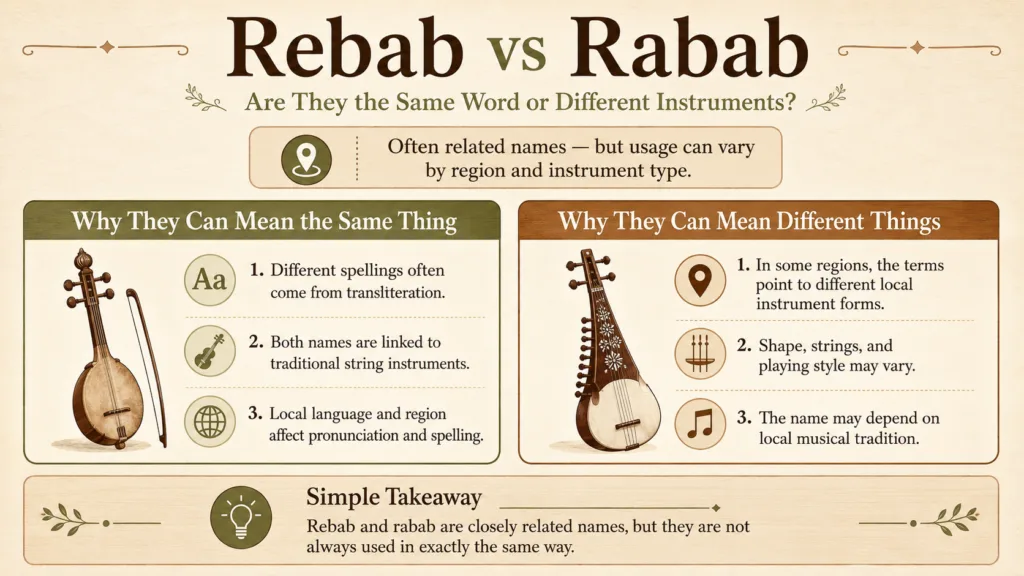
Both spellings — rebab and rabab — trace back to the same Arabic word: رباب, transcribed as rabāb in scholarly notation. The difference on the page is a transliteration choice, not a separate instrument name. In that sense, asking whether rebab and rabab are the same word has a clear answer: yes. But asking whether they always refer to the same instrument is more complicated. They often do. Sometimes they don’t.
The name has traveled far enough — across trade routes, languages, and centuries — that it now sits over a family of instruments rather than a single fixed design. Understanding the spelling difference is the easy part. Understanding what sits under each spelling takes a closer look at how the instrument changed as it moved.
One Root, Several Scripts
The Arabic word rabāb has no single agreed-upon spelling in Latin script. This is not unusual for Arabic musical terms. The first vowel in the word varies across Arabic dialects — in some, it sounds closer to “a,” in others closer to “e.” When speakers of Malay, Persian, Pashto, Turkish, or other languages absorbed the word, they brought their own phonological patterns with them.
The Oxford English Dictionary traces both forms to this single Arabic source, noting that the vowel variation in the first syllable reflects dialectal differences in Arabic itself. “Rebab” is not a corruption of “rabab,” nor is one form older or more authoritative than the other in Latin script. They are parallel renderings of the same source.
Regional languages and colonial-era transcription systems added further variety. Dutch documentation of Javanese instruments produced spellings that differ from those found in British accounts of Arab music from the same period. Arabic scholarly texts themselves use different vowel markings depending on the regional tradition being described.
| Spelling | Region or Context | Instrument Typically Referenced |
|---|---|---|
| Rabāb | Scholarly transliteration; classical Arabic texts | The Arabic bowed fiddle; historically used for bowed instruments broadly |
| Rabab | Middle East, North Africa; academic English | Bowed spike fiddle; Bedouin and Arab forms |
| Rebab | Southeast Asia (Java, Sunda, Malaysia); general English | Gamelan spike fiddle; broad family name in English |
| Rababa / Rababah | Egypt, Levant, Bedouin traditions | Egyptian spike fiddle; rectangular or boat-shaped Bedouin fiddle |
| Rubab / Rubāb | Afghanistan, Central Asia; Pashto and Persian sources | Afghan plucked lute; also the bowed Kabuli form |
| Robab / Rubob | Some Afghan, Pakistani, and Tajik transliterations | Variant spelling of rubab; same instrument |
What Most of These Instruments Share
Despite the range of spellings, the majority of instruments called rebab or rabab share a recognizable structural pattern. A membrane-covered soundboard — typically parchment or sheepskin — stretched over a wooden body. A narrow neck with no fingerboard, meaning the player stops the strings by pressing fingertips directly against the string rather than against a board. One, two, or three strings, drawn with a bow. A spike at the base that rests on the floor or the player’s lap during performance.
This is the spike fiddle form. It appears across Arabic-speaking regions, in Persian-influenced traditions, and in the gamelan ensembles of Java and Sunda. In each of these contexts, “rebab” or “rabab” is an accurate name for what is structurally the same broad type — even when local details differ.
The tonal character of these bowed forms is often described as voice-like: warm, relatively limited in range, and closely tied to melodic ornamentation rather than harmonic depth. In Javanese gamelan, the rebab typically plays an elaborating role, following and embellishing the core melody. In Bedouin contexts, the rababa (a rectangular-bodied variant) traditionally accompanied poets and storytellers. The instrument’s function shifted by setting, but its physical identity stayed consistent.
Where the Name Covers Different Instruments
The spelling begins to matter more when the instrument beneath it changes structurally. This happens most clearly with the Afghan form.
The instrument known as rubab (or rubāb) in Afghanistan and Central Asia is not a bowed spike fiddle. It is a plucked lute — shorter-necked, with a wooden body carved from a single piece of mulberry, a skin soundboard over the hollow bowl, and a set of sympathetic strings running alongside the main melody strings. It uses a plectrum, not a bow. Its playing technique, tuning, and tonal character differ from the bowed forms that carry the same word family.
Scholars distinguish these by using region as a qualifier: the Seni rebab of North India, the Kabuli rebab of Afghanistan, the Javanese rebab. Even within Afghanistan, “rebab” and “rubab” can point to different things — the Kabuli rebab was historically bowed, while the rubab that became dominant in Afghan classical music is plucked.
Regional Note
The Afghan rubab is sometimes written “rubab” or “robab” to distinguish it from the bowed forms that share the same name family. In 2024, UNESCO recognized the craft of making the rubab as Intangible Cultural Heritage in Afghanistan, Iran, Tajikistan, and Uzbekistan — a recognition that reflects how distinct this instrument’s tradition has become, even as its name connects it to the same Arabic root as all other rebab and rabab forms.
The Moroccan rabab is another case where the instrument under the name differs from the spike fiddle found in Egypt or Southeast Asia. It has a pear-shaped body, is bowed, and bears a closer structural resemblance to the rebec — the European descendant of the Arab instrument — than to the long-spiked fiddles found further east.
In Print and in Scholarship
In academic writing, “rebab” and “rabab” appear interchangeably, often within the same publication. Britannica uses “rabāb” as its primary headword while acknowledging that “rebab” and other derivative names are used across the Middle East, Africa, and Asia for instruments of this type. The Oxford English Dictionary treats both as valid renderings of the same source. Neither choice implies the other is wrong.
Older sources used the word in a still broader sense. Medieval Arab scholars, including Al-Farabi, applied rabāb to bowed instruments generally — making it almost a generic term at certain points in Arabic musical history, in the same way “lute” once covered a wide range of plucked instruments in European contexts. That broad use has since narrowed. Modern references are more likely to specify the regional form, letting the qualifier carry the precision that the spelling alone cannot provide.
How to Tell Which Instrument Is Meant
When reading about rebab or rabab without further context, the spelling alone rarely tells you which instrument is being discussed. Region is a more reliable guide.
- Southeast Asian sources (Java, Sunda, Malaysia) using “rebab” almost always mean the bowed spike fiddle used in gamelan or traditional court music.
- Arab and North African sources using “rabab” or “rababa” typically mean a bowed fiddle — rectangular, boat-shaped, or pear-shaped depending on the local form.
- Afghan and Central Asian sources using “rubab” or “rubāb” typically mean the plucked lute with sympathetic strings, unless the context specifies a bowed form.
- General English musicological texts may use “rebab” as a blanket term for the whole family.
String count can help narrow things down further. A reference to two strings usually points toward a bowed spike fiddle form. References to three melody strings alongside drone or sympathetic strings lean strongly toward the Afghan rubab type.
Playing technique — bow versus plectrum — is the clearest dividing line of all. When that detail is given, the spelling becomes secondary.
Frequently Asked Questions
Are rebab and rabab the same instrument?
They are different spellings of the same Arabic root word. In many contexts they describe the same type of instrument — a bowed fiddle with a membrane soundboard and no fingerboard. In other cases, the same word family covers structurally different instruments depending on region, particularly when comparing bowed spike fiddle forms with the plucked Afghan rubab.
Why does the spelling change depending on where you look?
The vowel variation reflects dialectal differences in Arabic and how each receiving language — Malay, Persian, Pashto, and others — absorbed the word phonologically. There is no single standardized Latin-script spelling for Arabic musical terms, and both “rebab” and “rabab” appear in authoritative academic and reference sources.
Is rubab a different instrument from rebab?
The Afghan rubab shares the same word origin but is structurally distinct. It is a plucked lute with a carved wooden body, drone strings, and sympathetic strings — different in construction, playing technique, and sound from the bowed membrane-covered spike fiddles more commonly called rebab or rabab in other regions.
Do all instruments called rebab use a bow?
No. Most regional forms are bowed, but plucked versions exist as well. The Afghan rubab is the most well-known plucked form. Some Moroccan forms are also plucked. The Kabuli rebab of Afghanistan was historically bowed before the plucked form became the dominant tradition in that region.
Which spelling is considered correct?
Neither is more correct than the other. Rabāb is the standard scholarly transliteration of the Arabic. “Rebab” appears widely in English-language sources and dominates in Southeast Asian contexts. Both are in regular use across academic and general references, and both accurately reflect the same source word.
Can the same source use both spellings?
Yes, and this happens often. Some publications alternate between “rebab” and “rabab” within the same article or book, either for stylistic variation or because they draw on sources from different regions. The intended instrument is usually clear from the surrounding context.