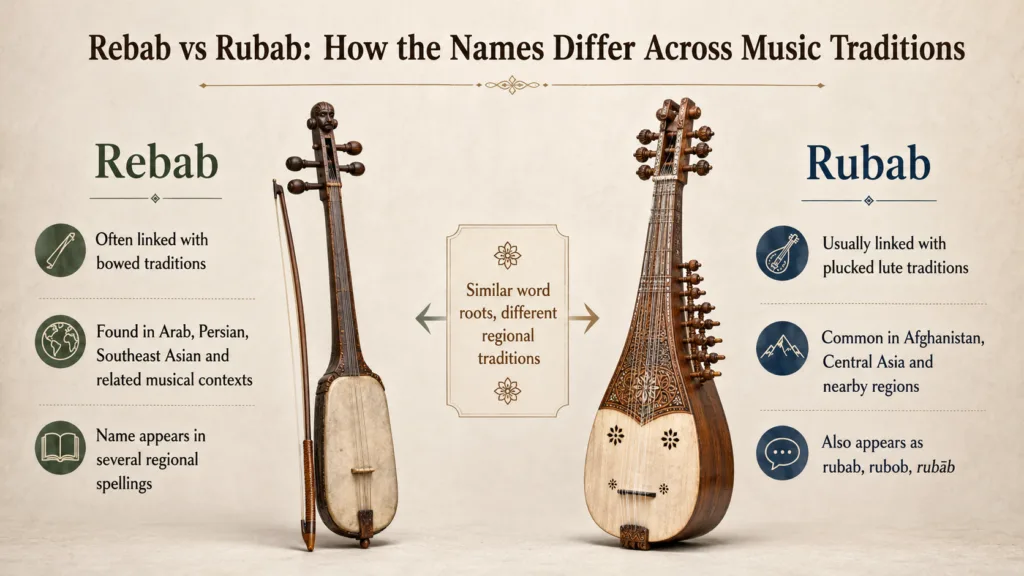
Rebab and rubab are not always two separate instruments. In many music traditions, they are different English spellings for related names that come from the same broad family of terms: rabāb, rabab, rubāb, rebab, rebap, rubob, and rababa. The real difference is usually not the spelling alone. It is the regional tradition, playing method, body form, and local language behind the name.
Rebab vs Rubab: The Short Answer
Rebab is often used in English for bowed spike fiddles and related bowed instruments found in Arab, Persianate, Turkish, Southeast Asian, and other regional traditions. Rubab is often used for plucked short-necked lutes, especially Afghan, Central Asian, and South Asian forms.
That rule is helpful, but it is not absolute. Some museum records, books, and performers use rabab, rubab, or rebab for instruments that differ in shape, strings, tuning, and technique. The safest reading is simple: the name tells you where to start, but the instrument’s construction tells you what it is.
Regional Note: A “rubab” in an Afghan music setting and a “rebab” in a Javanese gamelan setting should not be treated as the same object. The names are related, but the instruments serve different musical roles and are built for different techniques.
Main Name Differences
The spellings reflect several layers at once: transliteration from Arabic or Persian scripts, local pronunciation, colonial-era cataloging habits, and modern English writing. For readers, the most useful approach is to connect each spelling with its normal musical setting.
| Spelling | Common Context | Typical Instrument Type | Important Caution |
|---|---|---|---|
| Rebab | Arab, Turkish, Persianate, Indonesian, and other regional traditions | Often a bowed fiddle or spike fiddle | Can also appear as a broad historical or catalog name |
| Rabab | Arabic, North African, South Asian, and general English writing | May refer to bowed or plucked forms | One of the most flexible spellings |
| Rubab | Afghan, Central Asian, Pakistani, and North Indian contexts | Often a plucked short-necked lute | Does not always mean the same design in every region |
| Rubāb | Academic, museum, and transliterated writing | Usually a careful rendering of a local name | The macron marks vowel length, not a different instrument by itself |
| Rubob | Uzbek and some Central Asian contexts | Plucked lute forms, sometimes in several sizes | Often reflects local pronunciation and script conversion |
| Rebap | Turkish and related regional usage | Usually a bowed or historically related form | May appear in older or specialized music writing |
| Rababa | Arab and North African contexts | Often a bowed fiddle, sometimes simple in construction | Can refer to different local forms |
Why the Same Name Can Point to Different Instruments
The names travel more easily than the instruments themselves. A word can move across languages, courts, trade routes, religious settings, oral poetry, village ensembles, urban classical music, and museum catalogues. Over time, the local instrument may change while the old name remains.
This is why rebab vs rubab is not a clean “one instrument versus another” question. It is closer to a naming map. One spelling may point toward a bowed fiddle in one region and a plucked lute in another.
The Role of Transliteration
Arabic, Persian, Pashto, Urdu, Tajik, Uzbek, and other languages do not always move neatly into English letters. A single written form can become rabab, rubab, robab, or rebab depending on who is writing, which language is being represented, and whether the writer follows a formal transliteration system.
The marks in rubāb or rabāb are also useful. They show vowel length. They do not automatically prove that the object is a separate instrument from one written without marks.
The Role of Local Instrument Families
Names also shift because instrument families overlap. Some forms belong to the wider group of bowed fiddles. Others are better understood as plucked lutes. Both can carry related names because the name history is older than many modern categories.
- Bowed forms are often held upright and played with a bow.
- Plucked forms are played with fingers or a plectrum, depending on the tradition.
- Skin-covered bodies appear in several regional types, but the shape and string layout can vary.
- Wooden bodies may be carved from one piece or built from separate parts, depending on the local craft practice.
When “Rebab” Usually Makes More Sense
The spelling rebab often fits traditions where the instrument is a bowed fiddle or a spike fiddle. These instruments may have a small resonating body, a long neck, a skin or parchment soundboard, and one to several strings. Many lack a fingerboard, so the player stops the strings directly with the fingers.
In some Arab and North African settings, related names such as rabāb or rababa may refer to bowed instruments used with song, poetry, or local ensemble practice. In parts of Indonesia, the rebab is a refined bowed instrument associated with gamelan and other regional performance settings.
Listening Note: Bowed rebab-type instruments often have a vocal, flexible tone. The sound can feel direct and speech-like, especially when a skin soundboard and light bowing technique are part of the design. The exact tone depends on body shape, membrane tension, string material, bridge form, and playing style.
Common Features of Bowed Rebab Forms
Not every rebab has all of these traits, but they appear often enough to help with identification.
- A body covered partly or fully with skin, hide, or parchment
- A narrow neck, sometimes continuing through the body as a spike
- One, two, or three main strings in many documented forms
- A bow with hair, sometimes held and tensioned differently from a violin bow
- An upright playing position, often resting on the lap or held in front of the body
When “Rubab” Usually Makes More Sense
The spelling rubab is strongly associated with Afghan and Central Asian plucked lutes. The Afghan rubab is one of the best-known examples in English-language writing. It is usually described as a short-necked plucked lute with a carved wooden body, a skin-covered soundboard area, melody strings, drone strings, and sympathetic strings in many forms.
In Afghan contexts, the rubab has a deep link with instrumental music, song accompaniment, and later instrument development in South Asia. It is also often discussed in relation to the sarod, though the two instruments should not be treated as identical.
Common Features of Afghan and Central Asian Rubab Forms
- A short neck compared with long-necked lutes such as the dutar or tanbur
- A carved wooden body, often with a skin-covered resonating surface
- Plucked performance rather than bowed performance
- Main playing strings supported by drone or sympathetic strings in many examples
- Decorative inlay, carved surfaces, or regional ornament in some instruments
Luthier’s Note: Wood choice can shape resonance, weight, and playing feel, but it should not be treated as the only reason an instrument sounds a certain way. Body depth, skin tension, bridge placement, string layout, and the player’s attack all matter.
Rabab as the Middle Spelling
Rabab is often the most flexible spelling. It may appear in Arabic-related writing, museum catalogues, South Asian music writing, and general English descriptions. Because of that flexibility, it can be the least precise spelling unless the region and playing method are also given.
A record that says only “rabab” may need more detail before it can be identified. Is it bowed or plucked? Does it have a spike? Does it have frets? Is the body boat-shaped, round, rectangular, or double-chested? Does it have sympathetic strings? Those details carry more weight than the spelling.
How to Tell Which Instrument a Text Means
When the spelling is unclear, use the surrounding clues. A careful reader can usually identify the intended tradition without needing a photograph.
- Check the region first. Afghanistan, Uzbekistan, Tajikistan, Indonesia, Turkey, North Africa, and the Arab world can point to different forms.
- Look for the playing method. Bowed usually leans toward rebab, rabab, or rababa. Plucked often leans toward rubab, rubāb, or rubob in Central Asian contexts.
- Read the body description. A spike fiddle, boat-shaped body, short-necked lute, or skin-covered carved body gives a stronger clue than spelling.
- Check the strings. Sympathetic strings often suggest Afghan or Central Asian plucked rubab forms, though string counts vary.
- Notice the ensemble. Gamelan, Afghan classical and folk music, North African song traditions, and Central Asian ensembles use different instruments under related names.
Construction Clues That Matter More Than Spelling
Two instruments can share a name yet differ in every practical detail. For instrument identification, construction is the more reliable evidence.
Body Shape
Bowed rebab forms may have round, boat-shaped, rectangular, pear-shaped, or spike-supported bodies. Plucked rubab forms often have a carved body with a skin-covered section, though Central Asian forms may differ in outline, neck length, and decorative details.
Soundboard
A skin or hide soundboard is common across many related forms, but it does not prove the instrument is one type. It can appear on bowed fiddles and plucked lutes. A wooden soundboard or added fingerboard may point to another branch of the wider family.
Strings and Peg Layout
A simple bowed rababa may have one or two strings. A plucked Afghan rubab may include main strings, drone strings, and sympathetic strings. Some Central Asian rubob forms use metal strings and fretted fingerboards. The peg layout often reveals the instrument’s playing logic.
Bow, Plectrum, or Fingers
The tool used to sound the strings is one of the clearest dividing points. A rebab in a bowed tradition needs a bow. A rubab in an Afghan or Central Asian setting is normally plucked. If a source says the instrument is bowed, avoid assuming it is the Afghan rubab just because the spelling looks close.
Rebab, Rubab, and Regional Naming Habits
Regional naming habits are not mistakes. They reflect living traditions and the way musicians talk about their instruments. English spelling often tries to catch that sound after the fact.
Arab and North African Usage
In Arab and North African contexts, rabāb, rabab, or rababa often points toward bowed instruments. Some forms are simple in structure, with a skin resonator and one or more strings. Others are more elaborate. The name can also appear in older writing as a broad term for bowed instruments.
Afghan and South Asian Usage
In Afghan music, rubab or rubāb usually means the plucked Afghan rubab. In North Indian music history, related forms are sometimes discussed in connection with the seni rabab and the later sarod. This is an area where naming, design, and performance lineage need careful separation.
Central Asian Usage
In Central Asia, names such as rubāb, robāb, and rubob may refer to short-necked plucked instruments used in local ensemble and solo traditions. Uzbek, Tajik, and Iranian naming may differ in spelling even when the terms are related.
Southeast Asian Usage
In Indonesian contexts, rebab often refers to a bowed instrument used in gamelan and related performance traditions. Its role is not the same as the Afghan rubab. The name connection is real, but the musical function is different.
How It Differs from Related Instrument Names
Several instrument names sit near the rebab and rubab family, but they should not be merged too quickly.
| Name | Why It Gets Confused | Useful Difference |
|---|---|---|
| Rebec | The European rebec is historically linked to the rabāb family in many accounts. | It belongs to medieval European bowed instrument history and has its own construction path. |
| Sarod | The Afghan rubab is often discussed in relation to the sarod. | The sarod has a different playing surface, design language, and classical performance setting. |
| Rawap | The name and shape may overlap with Central Asian rubab-related lutes. | Uyghur and regional rawap types have their own local forms and playing systems. |
| Kamancheh | Both can be bowed spike-type instruments in broad classification. | The kamancheh has a distinct Persianate and regional identity, construction, and technique. |
| Kemenche | The name may appear in nearby bowed-instrument discussions. | Kemenche forms belong to different regional fiddle traditions and should be identified separately. |
Common Misunderstandings
“Rebab” Is Not Always the Older or More Correct English Form
No single English spelling wins in every context. Rebab, rabab, and rubab can all be correct when they match the tradition being described. A careful article, label, or catalogue should give the region and instrument type, not only the spelling.
“Rubab” Does Not Always Mean Afghan Rubab
The Afghan rubab is widely known, but the spelling rubab also appears in Central Asian and South Asian contexts. Some instruments under this name differ in scale length, fretting, strings, body shape, and ensemble role.
A Similar Name Does Not Prove a Similar Sound
A bowed rebab and a plucked rubab can share a naming root yet sound very different. Bow pressure, string material, skin tension, bridge design, and plucking attack all shape the result. The name alone cannot predict the tone.
Practical Identification Guide for Readers and Collectors
If an instrument is labeled “rebab,” “rabab,” or “rubab,” start with the object rather than the tag. A label may be old, translated loosely, or written for a general audience.
- If it has a bow: it is likely a bowed rebab, rabab, rababa, or related fiddle form.
- If it has many side pegs: it may have sympathetic strings, which often points toward Afghan or South Asian plucked rubab-type instruments.
- If it has a short neck and carved body: Afghan or Central Asian rubab identification becomes more likely.
- If it appears in a gamelan setting: the word rebab usually points to a bowed Indonesian instrument.
- If the record says only “rabab”: more region and construction data is needed.
Collector’s Note: Decorative inlay, a skin table, or an old-looking label should not be used alone for identification. Check the neck, bridge, peg arrangement, string paths, and signs of bow or plectrum use. Those details are harder to misread.
Best Way to Use the Names in Writing
For clear writing, pair the spelling with the tradition. Instead of writing only “rubab,” use “Afghan rubab” when that is what is meant. Instead of writing only “rebab,” use “Javanese rebab,” “Arab rabab,” or “bowed rebab” when the context needs precision.
This avoids a common problem: one article uses a spelling as if it were a universal label, while another uses the same spelling for a different instrument. Readers then assume the sources disagree, when they may simply be describing different regional forms.
Useful Phrases
- Afghan rubab
- Central Asian rubob
- Javanese rebab
- Arab rabab or rababa
- Bowed rebab-type fiddle
- Plucked rubab-type lute
- Short-necked rubab
- Spike fiddle rabab
FAQ
Are Rebab and Rubab the Same Instrument?
They can be related names, but they are not always the same instrument. In many contexts, rebab points to bowed fiddle forms, while rubab often points to plucked Afghan or Central Asian lute forms. Region and construction matter more than spelling alone.
Which Spelling Is Correct: Rebab, Rabab, or Rubab?
All three can be correct. The best spelling depends on the language, region, and instrument tradition. Rabab is often a flexible middle spelling, rebab is common for many bowed traditions, and rubab is common for Afghan and Central Asian plucked forms.
Does Every Rebab Use a Bow?
No. Many rebab-type instruments are bowed, but related names have also been used for plucked instruments in some regions. Always check the playing method before identifying the instrument.
Why Is the Afghan Rubab Usually Written with “u”?
English writers often use “rubab” or “rubāb” for the Afghan plucked instrument because that spelling reflects common transliteration habits for the local name. It also helps separate it from bowed rebab forms in many English texts.
Is the Rubab Related to the Sarod?
The Afghan rubab is often discussed as an important instrument in the background of the sarod. The relationship should be handled carefully, because the sarod has its own design, playing technique, and classical music setting.
How Can I Identify a Rebab or Rubab in a Museum Label?
Look beyond the label. Check the region, whether it is bowed or plucked, the body shape, the soundboard material, the number and layout of strings, and the presence of frets or sympathetic strings. Those clues usually give a better answer than the spelling alone.