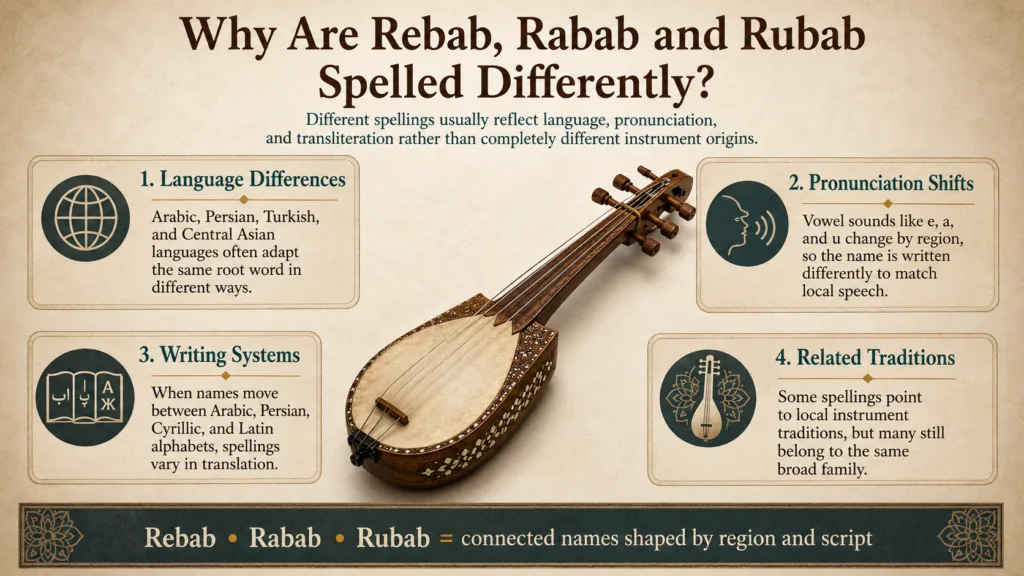
A reader can meet the same instrument family under several English spellings: rebab, rabab, rubab, rubāb, rabāb, robab, rebap, and rubob. These forms are not random mistakes. They come from the way Arabic, Persian, Pashto, Dari, Urdu, Tajik, Uzbek, Turkish, Malay, Indonesian, and other languages have carried related string instruments into English writing.
Why the Spelling Changes
The short answer is simple: English has no single official spelling for the whole rebab/rabab/rubab family. Writers choose different spellings because they are converting names from other scripts, following regional pronunciation, or using the spelling already common in a local music tradition.
The more careful answer is that one spelling does not always point to one exact instrument. In many regions, the name family refers to bowed fiddles. In other regions, especially around Afghanistan, parts of Iran, Pakistan, Central Asia, and North India, related names often refer to plucked lutes. That is why spelling, region, and instrument form need to be read together.
Name Note: A spelling such as rabab or rubab should not be treated as a full identification by itself. The body shape, soundboard, strings, playing method, and regional source matter just as much as the written name.
Main Spellings and What They Often Suggest
The table below shows common English forms and the contexts where a reader may meet them. These are helpful tendencies, not fixed rules.
| Spelling | Common Context | What It May Refer To | Useful Caution |
|---|---|---|---|
| Rebab | North African, Indonesian, Malay, museum, and general English usage | Often a bowed fiddle, but also used broadly for related chordophones | Do not assume it is always the same construction in every region. |
| Rabab | Arabic and South Asian English usage; also broad reference writing | Often linked to Arabic rabāb traditions or South Asian plucked forms | The same spelling can appear for both bowed and plucked instruments. |
| Rubab | Afghan, Central Asian, Iranian, Pakistani, and heritage contexts | Often a plucked lute with a skin-covered soundboard and sympathetic strings, depending on the regional type | Not every rubab has the same number of strings, tuning, or body details. |
| Rubāb / Rabāb | Academic, library, museum, and transliterated writing | A more marked spelling showing a long vowel | The macron helps with pronunciation, but many public-facing texts omit it. |
| Robab / Rubob | Persian, Tajik, Uzbek, and regional romanization contexts | Often a Central Asian or Iranian-family spelling for related lutes | Spelling follows local sound habits and romanization choices. |
| Rebap | Turkish-language usage | Usually a Turkish spelling linked to the same wider name family | The final letter reflects Turkish spelling practice, not a separate root. |
The Role of Transliteration
Many spellings come from transliteration: the attempt to write a word from one script in another script. Arabic and Persian-based scripts do not behave like English spelling. Short vowels may be unwritten or only marked in special contexts. Long vowels may be shown more clearly, but English writers do not always agree on how to represent them.
This is why one source may write rabāb, another rabab, another rebab, and another rubab. The underlying name may be close, but the English spelling reflects a decision made by a cataloguer, scholar, performer, maker, record label, teacher, or community.
Why a, e, o and u Shift
The middle vowel is the part that changes most often. English readers see rabab, rebab, robab, and rubab because different languages and dialects pronounce or hear the vowel differently.
- Rabab often keeps an a sound close to Arabic-style romanization.
- Rebab is common where English, French, Dutch, Malay, Indonesian, or museum traditions have favored that written form.
- Rubab is common for the Afghan and Central Asian plucked lute family in English-language writing.
- Robab can reflect Persian-influenced pronunciation and romanization habits.
- Rubob appears in some Central Asian romanization contexts, especially where the final vowel is heard or written closer to o.
No single vowel spelling can carry the full history of the name across all regions.
What the Macron Means in Rubāb and Rabāb
The line over the vowel in rubāb or rabāb is called a macron. It usually marks a long vowel. In reference writing, it helps show that the final vowel is not a short, casual vowel.
Public-facing English often drops the mark because many keyboards, search engines, and readers do not use macrons. So rubāb becomes rubab, and rabāb becomes rabab. The shorter spelling is easier to type, but it hides part of the pronunciation.
Curator’s Note: Museum labels may preserve macrons when they want a closer transliteration. Search boxes and general article titles often remove them. Both choices can be valid, but they serve different readers.
Spelling Does Not Always Equal Instrument Type
The name family is older and wider than any one modern instrument form. That creates confusion. A bowed North African rebab and an Afghan rubab can share a related name while looking and sounding very different.
A North African example may be a narrow, boat-shaped, bowed instrument with a skin or parchment soundboard. An Afghan rubab is usually a plucked lute, often carved from mulberry wood, with a skin-covered resonating area and several groups of strings. Both belong to the larger history of named string instruments, but they should not be described as identical.
Bowed and Plucked Forms
The word family has been used for both bowed and plucked chordophones. In Arabic and North African contexts, rabāb and rebab often point toward bowed fiddle traditions. In Afghan and nearby Central or South Asian contexts, rubab often points toward a plucked lute.
This is one reason spelling alone can mislead a beginner. The playing tool is a better clue:
- A bowed rebab/rabab is played with a bow and may have one, two, or more strings depending on the regional form.
- A plucked rubab/rabab is played with a plectrum or by plucking, depending on the tradition and instrument type.
- Some names in the family may act as broad cultural labels, not narrow technical labels.
Body Shape Gives Better Evidence
For identification, the body tells more than the spelling. A skin-topped, waisted Afghan rubab with side pegs for sympathetic strings is not the same object as a slender North African bowed rebab. A Javanese rebab, often used in gamelan contexts, has its own form and playing setting as well.
The name opens the door. The construction confirms the instrument.
Regional Language Habits Behind the Spellings
Different regions did not wait for English to standardize the name. They used their own scripts, sounds, and musical vocabulary. English spellings then followed those regional habits unevenly.
Arabic and North African Usage
In Arabic-related contexts, rabāb and rabābah are common transliterated forms. English writers may simplify these to rabab. In North African museum or catalog writing, rebab also appears often.
These names may refer to bowed instruments with skin soundboards, fretless necks, and regional body shapes such as boat-shaped, round, rectangular, or pear-like forms. The exact form depends on place and period.
Afghan, Iranian and Central Asian Usage
In Afghan and nearby regional contexts, rubab is widely used in English for the plucked lute associated with Afghan music and related traditions. Spellings such as robab and rubāb may also appear, especially in Persian-influenced or more formal transliteration.
Many documented Afghan rubabs have a skin-covered soundboard, a carved wooden body, melody strings, drone strings, and sympathetic strings. String counts, tuning habits, bridge setup, and decoration can vary by maker, region, and playing school.
Turkish, Malay and Indonesian Usage
In Turkish, the spelling rebap can appear because Turkish spelling handles final consonants in its own way. In Malay and Indonesian contexts, rebab is a familiar spelling for bowed instruments used in several traditional music settings.
These forms show how the name was absorbed into living languages. The English reader sees variation because the name did not travel through one route only.
Why Museums and Books Do Not Always Agree
Museums, libraries, dictionaries, and music books often make different naming choices. A museum may label an object by the name used when it was collected. A library catalog may follow a romanization table. A performer may use the spelling that their teacher, region, or audience already knows.
None of these choices is automatically wrong. They reflect different priorities.
- Museum labels often balance object history, donor records, regional naming, and modern catalog access.
- Academic writing may prefer marked forms such as rabāb or rubāb.
- Performer pages often use the spelling most familiar to their audience.
- Search-friendly English usually drops diacritics and chooses a simpler spelling.
Luthier’s Note: For instrument making or repair, the spelling on a label is only a starting point. A maker will look at the soundboard, peg layout, bridge, neck angle, string path, skin tension, and body carving before deciding what kind of instrument is actually present.
How to Choose the Right Spelling
The best spelling depends on what the page, label, or discussion is trying to describe. A broad reference page may use several spellings together. A regional instrument profile should usually choose the spelling most common for that exact form.
Use Rebab for Broad or Southeast Asian and North African Contexts
Rebab works well when discussing broad English usage, museum examples labeled that way, or regional traditions where this spelling is already common. It is also useful when explaining the wider family to readers who may have seen the term in Indonesian, Malay, or North African settings.
Use Rabab for Arabic-Linked or General Reference Contexts
Rabab is useful when the discussion leans toward Arabic transliteration or a broad Middle Eastern and South Asian naming context. It can also work as a plain English spelling when the article is not focused on one exact regional instrument.
Use Rubab for Afghan and Central Asian Plucked Forms
Rubab is the clearest choice for many English pages about the Afghan plucked lute and related regional forms. It matches common public usage and helps readers distinguish the instrument from many bowed rebab traditions.
Use Rubāb or Rabāb When Pronunciation Detail Matters
Marked forms such as rubāb and rabāb are useful in scholarly, museum, or language-focused settings. They show the long vowel more clearly. For general readers, the unmarked spelling is often easier to read and type.
Common Misunderstandings
Spelling variation causes several repeated mistakes. The most common one is treating every spelling as a separate instrument. Another is treating every form as the same instrument.
“Rebab” and “Rubab” Are Not Always Interchangeable
They can be related names, but they should not be swapped without context. If a text describes a plucked Afghan lute with sympathetic strings, rubab is usually clearer. If it describes a bowed North African or Southeast Asian instrument, rebab may be more natural.
“Rabab” Can Be a Middle Form
Rabab often sits between traditions in English usage. It may appear in Arabic-related discussion, South Asian writing, and general reference pages. That flexibility is useful, but it also means the object needs more description.
The Spelling Does Not Prove the Date or Origin
A spelling may reflect a modern catalog choice rather than the original local name used by a maker or player. Older collection records may also preserve spellings that are no longer the preferred form in current writing.
How to Identify the Instrument Beyond the Name
When a label says rebab, rabab, or rubab, look for physical details before drawing a firm conclusion.
- Check the playing method. Bowed instruments and plucked lutes belong to different performance habits.
- Look at the soundboard. Skin, parchment, or wood can point toward different regional forms.
- Count the visible string groups carefully. Melody, drone, and sympathetic strings may be separate.
- Notice the body shape. Boat-shaped, pear-shaped, waisted, round, and box-like bodies carry different clues.
- Read the regional label. Afghanistan, North Africa, Java, Morocco, Algeria, Iran, Tajikistan, Uzbekistan, Pakistan, India, and Turkey may all lead to different expectations.
This method is slower than relying on spelling, but it is more accurate.
How the Spellings Relate to Similar Instrument Names
The rebab/rabab/rubab family also connects to other instrument names through history, borrowing, and regional vocabulary. These links should be handled with care.
Rebab and Rebec
The European rebec is often discussed alongside the Arabic rabāb because historical writing links the rebec to bowed instruments that moved through Mediterranean contact zones. The names are related in many reference traditions, but the European rebec developed its own construction, playing position, and musical role.
Rubab and Sarod
The Afghan rubab is often mentioned in discussions of the sarod. The link is useful because the sarod shares part of the broader lute history of the region. Still, a rubab and a sarod are not the same instrument. The sarod has its own body design, metal fingerboard, stringing layout, and performance practice.
Rubab, Rawap and Regional Lutes
Names such as rawap, rubob, and related regional lute terms can appear in Central Asian and neighboring contexts. Some are close relatives in name or design; others need separate treatment. Similar spelling should not replace instrument-level evidence.
Practical Spelling Advice for Readers
For reading and research, use more than one spelling. A search for only rebab may miss Afghan rubab material. A search for only rubab may miss North African or Southeast Asian rebab examples. A search for rabāb may find formal reference material, but it may miss public pages without diacritics.
For writing, choose the spelling that fits the main subject:
- Use rebab when discussing a broad instrument family or traditions where that spelling is standard.
- Use rabab when following Arabic-linked or general reference usage.
- Use rubab when the subject is the Afghan or related Central and South Asian plucked lute.
- Use rubāb or rabāb when the article needs careful transliteration.
- Mention alternate spellings once near the start if readers are likely to search for them.
Listening Note: The spelling does not tell the whole sound story. A bowed rebab may have a nasal, direct, voice-like tone, while an Afghan rubab often has a plucked attack with a warm skin-head response and sympathetic shimmer. Regional form shapes the sound more than English spelling does.
FAQ
Are Rebab, Rabab and Rubab the Same Word?
They are related spellings from the same wider name family, but they are not always used for the same exact instrument. The region and construction decide the meaning more clearly than the English spelling alone.
Which Spelling Is Correct: Rebab, Rabab or Rubab?
All three can be correct in the right context. Rebab is common in broad and some regional English usage, rabab often follows Arabic-linked spelling, and rubab is widely used for Afghan and related plucked lute forms.
Why Do Some Sources Write Rubāb or Rabāb?
The line over the vowel marks a long vowel in transliteration. Many academic, museum, and library contexts use it for accuracy. General English pages often omit it for readability and easier typing.
Does Rubab Always Mean the Afghan Instrument?
No. In English, rubab often points to the Afghan plucked lute, but related forms and spellings also appear in Iran, Central Asia, Pakistan, India, and nearby regions. The body, strings, and playing method should be checked.
Can a Bowed Instrument Be Called Rabab?
Yes. In many Arabic and North African contexts, rabab or rabāb can refer to bowed fiddle traditions. This is one reason the name family should not be reduced to one modern instrument type.
What Spelling Should Beginners Search For?
Beginners should search several forms: rebab, rabab, rubab, rabāb, and rubāb. Adding a region such as Afghan, North African, Javanese, Moroccan, Algerian, Tajik, Uzbek, or Persian will make the results far more useful.