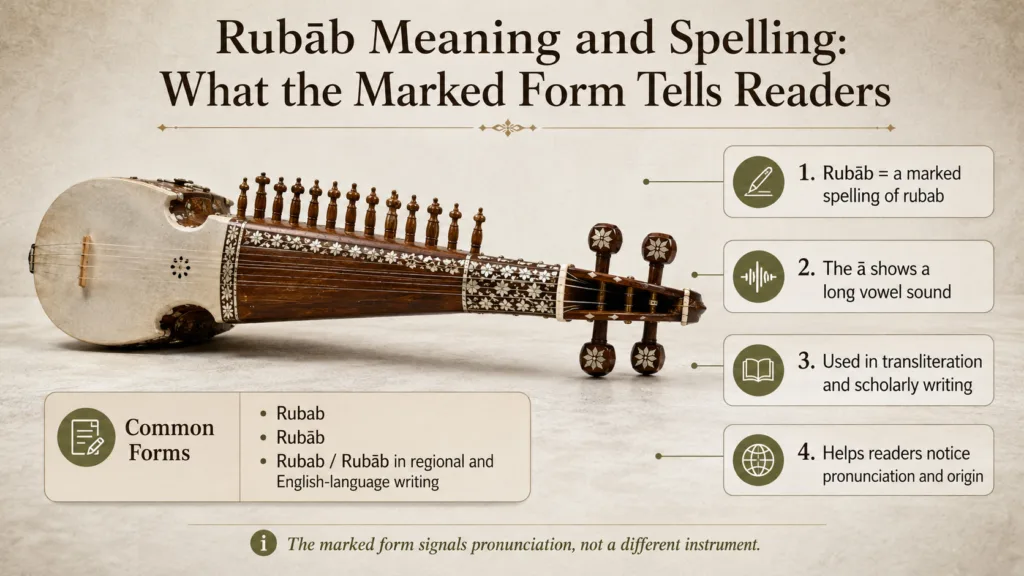
Rubāb is not a decorative spelling of rubab. The mark over the letter a is a macron, and it tells the reader that the vowel is being shown as long in a careful transliteration. For instrument readers, that small line matters: it separates a reference-style spelling from a plain English search spelling, without creating a new instrument category.
What Rubāb Means in Instrument Writing
Rubāb is a marked romanized form of a word used for several related string instruments across Arabic, Persian, Central Asian, South Asian, and neighboring musical settings. In English-language writing, the unmarked spelling rubab is easier to type and search. The marked form rubāb is more precise.
The word does not behave like a simple English label with one fixed object behind it. Depending on region and source, it may point to a plucked lute, a bowed lute, a spike fiddle, or a local member of a wider rebab-rabab-rubab naming family. That is why the spelling alone should not be used as proof of construction, tuning, playing method, or origin.
Language Note: The macron in rubāb marks a long vowel. It helps with reading and cataloging, but it does not mean that every player in every region says the word in exactly the same way.
What the Macron in Rubāb Tells Readers
The macron is the horizontal line above the vowel: ā. In many scholarly and library-style romanization systems for Arabic and Persian-related terms, it shows a long a sound. In practical English terms, rubāb signals that the second vowel is not just a casual short vowel in spelling. It carries length in the source-language reading.
This is useful when a page, museum record, academic article, or instrument catalog wants to show a closer romanization of the original word. It is less common in casual writing because many keyboards do not make ā easy to type.
| Spelling | What It Usually Signals | Best Use |
|---|---|---|
| rubāb | A marked transliteration that shows a long vowel. | Reference pages, museum-style descriptions, academic writing, and careful terminology notes. |
| rubab | A plain English spelling without diacritics. | General search use, article titles, beginner explanations, and filenames. |
| rabab | A related spelling often tied to Arabic forms and bowed traditions in many sources. | Arabic-language contexts, North African and Middle Eastern instrument references, and broad historical discussion. |
| rebab | A common English spelling linked to several regional forms, including bowed instruments. | General instrument writing, comparative pages, and historical discussions of related names. |
| rubob | A spelling often seen in Central Asian contexts, especially where local language forms influence English rendering. | Regional pages on Uzbek, Tajik, and neighboring instrument traditions. |
Rubāb, Rubab, Rabab, and Rebab Are Not Always the Same Label
The spellings overlap, but they do not always point to the same instrument form. A reader may see rubāb used for a lute-like plucked instrument in one source and rabāb used for a bowed instrument in another. Both can be correct inside their own regional and historical context.
The safer way to read the word is to ask what the source is describing:
- Is the instrument plucked with a plectrum, or bowed?
- Does it have a skin soundboard, a wooden soundboard, or a mixed body surface?
- Is the body deep, waisted, boat-shaped, pear-shaped, rectangular, or round?
- Does the neck look short and broad, or long and narrow?
- Is the source discussing Afghanistan, Iran, Baluchistan, North Africa, Central Asia, South Asia, or another region?
These details tell more than the spelling by itself.
Why Marked Spelling Appears in Museums and Reference Works
Marked forms such as rubāb and rabāb often appear in museum collections, library records, academic notes, and instrument catalogs. These settings need stable naming. A catalog entry may have to show the instrument name, region, material, period, and classification without turning the title into a long explanation.
The macron helps that work. It gives the reader a clue about pronunciation and source-language form. It also helps separate a careful transliteration from a simplified English spelling.
Collector’s Note: A label that says rubāb is not enough to identify an instrument with certainty. Body form, string layout, soundboard material, bridge type, pegs, frets, and playing wear all need attention.
Does Rubāb Have a Literal Meaning?
For instrument writing, rubāb is best treated as a historical instrument name rather than a neat English phrase. Some dictionaries and language sources attach other meanings to related Arabic or Persian forms, and some popular explanations give poetic meanings. These should be handled with care.
The most useful meaning for readers is practical: rubāb names a member of a wider family of traditional string instruments. In many English contexts, it often points toward plucked lute forms connected with Persianate, Afghan, Central Asian, or South Asian musical settings. In other contexts, related spellings point toward bowed rabab or rebab forms.
A spelling note should not turn into an etymology claim unless the source is clear. Instrument names travel through languages, scripts, and local musical systems. The spelling carries traces of that movement, but it does not solve every historical question.
How to Read Rubāb in a Sentence
When rubāb appears in an English sentence, it usually tells the reader that the writer is using a more exact transliteration. It does not require the rest of the sentence to use heavy academic language.
A clear sentence might say: The rubāb is a short-necked plucked lute in many Afghan instrument descriptions. Another might say: The spelling rubāb shows the long vowel more clearly than the simplified form rubab.
Both are readable. The marked form works well when the page is explaining names, catalog terms, pronunciation, or regional variants. For general beginner searches, rubab may still be easier for readers to recognize.
When to Use Rubāb Instead of Rubab
Use rubāb when precision matters. Use rubab when access and search simplicity matter more. A reference page can use both by introducing the marked form first, then explaining that the unmarked spelling is common in English.
| Writing Situation | Better Choice | Reason |
|---|---|---|
| Instrument terminology page | rubāb | The marked form supports pronunciation and language clarity. |
| Beginner article title | rubab | The plain spelling is easier to type and search. |
| Museum-style object description | rubāb or rabāb | Marked forms fit catalog and collection language. |
| Regional instrument profile | Depends on the region | Local usage, source language, and instrument type should guide the spelling. |
| Comparison of spellings | Both forms | The reader needs to see the difference directly. |
What the Marked Form Does Not Tell You
The spelling rubāb is helpful, but it has limits. It does not tell the reader the number of strings. It does not tell whether the instrument has sympathetic strings. It does not prove that the instrument is Afghan, Persian, Baluchi, Tajik, Uzbek, Kashgarian, or North African. It also does not tell whether the instrument is bowed or plucked.
Those details belong to the instrument description, not the spelling alone.
- It does not prove construction: body shape and soundboard material must be described separately.
- It does not prove tuning: tuning varies by regional form, player, ensemble, and teaching tradition.
- It does not prove playing method: related names cover both bowed and plucked instruments.
- It does not replace local names: regional spellings such as rubob, rabab, rebab, and related forms may be more natural in certain contexts.
Why Readers Often Confuse the Spellings
The confusion comes from three things: different scripts, different languages, and different instrument types sharing related names. Arabic script, Persian usage, local pronunciation, colonial-era spellings, museum cataloging, and modern search habits all shape what readers see in English.
A plain spelling like rubab removes the macron so it works on normal keyboards. A marked spelling like rubāb keeps a pronunciation clue. A related spelling like rabab may fit Arabic-language contexts better. A spelling like rebab may be familiar from wider historical writing on bowed instruments.
Regional Note: The safest wording is often regional: Afghan rubab, North African rabāb, Central Asian rubob, or bowed rebab. The regional label reduces confusion without forcing one spelling to carry too much meaning.
Rubāb and Related Instrument Names
The marked spelling belongs to a larger naming field. This is where a careful reader should slow down. Rubāb, rabāb, rebab, rubob, and rababa may appear close on the page, but the instruments behind them can differ in body, strings, and playing technique.
Rubāb and Afghan Rubab
In many modern English contexts, rubab or rubāb brings readers to the Afghan rubab: a plucked, short-necked lute with a carved body and a strong link to Afghan music. This is one common reading, but it is not the only possible reading of the name.
Rabāb and Bowed Traditions
Rabāb often appears in discussions of bowed instruments in Arabic-speaking, North African, Middle Eastern, and related historical settings. Some forms have skin soundboards, simple string layouts, and playing positions unlike the Afghan rubab.
Rubob and Central Asian Usage
Rubob is often seen in Central Asian contexts. It may refer to local lute forms shaped by regional craft, ensemble practice, and language. The spelling points toward a local naming path rather than a typing mistake.
Rebab and Wider Historical Writing
Rebab is a broad English spelling used for several related instruments. It often appears when writers discuss the long movement of bowed string instruments, related lutes, and the naming links that connect parts of the Middle East, North Africa, Europe, and Asia.
How the Marked Form Helps Without Overcomplicating the Page
The marked form is most useful when it is explained once and then used with restraint. A page can say rubāb for precision and also mention rubab for search familiarity. That gives both kinds of reader what they need.
For a reference-style instrument page, the best practice is simple: define the marked spelling, explain the macron, name the related spellings, and then return to the instrument context. The spelling is a tool. It should help the reader identify terms, not distract from the instrument.
Mini FAQ
Is Rubāb the Same as Rubab?
Yes, in many English contexts rubāb and rubab refer to the same word. The difference is that rubāb marks the long vowel with a macron, while rubab leaves the mark out for simpler typing and searching.
What Does the Line over the A in Rubāb Mean?
The line is a macron. It shows that the vowel is long in a careful transliteration. It is a pronunciation and cataloging aid, not a decorative mark.
Should I Search for Rubāb or Rubab?
Search for both if the topic is narrow. Rubab often finds more general English results, while rubāb may find museum records, academic writing, and careful terminology pages.
Does Rubāb Always Mean the Afghan Rubab?
No. The spelling can appear in wider instrument writing. Many readers associate rubab with the Afghan plucked lute, but related spellings also appear for bowed and plucked instruments in other regions.
Is Rabāb a Wrong Spelling of Rubāb?
No. Rabāb is not simply wrong. It is a related marked spelling often used in Arabic and bowed-instrument contexts. The right spelling depends on the region, language, source, and instrument form being described.
Does the Spelling Tell the Tuning or Number of Strings?
No. Spelling does not prove tuning, string count, soundboard material, or playing method. Those details must come from a clear description of the specific regional instrument.