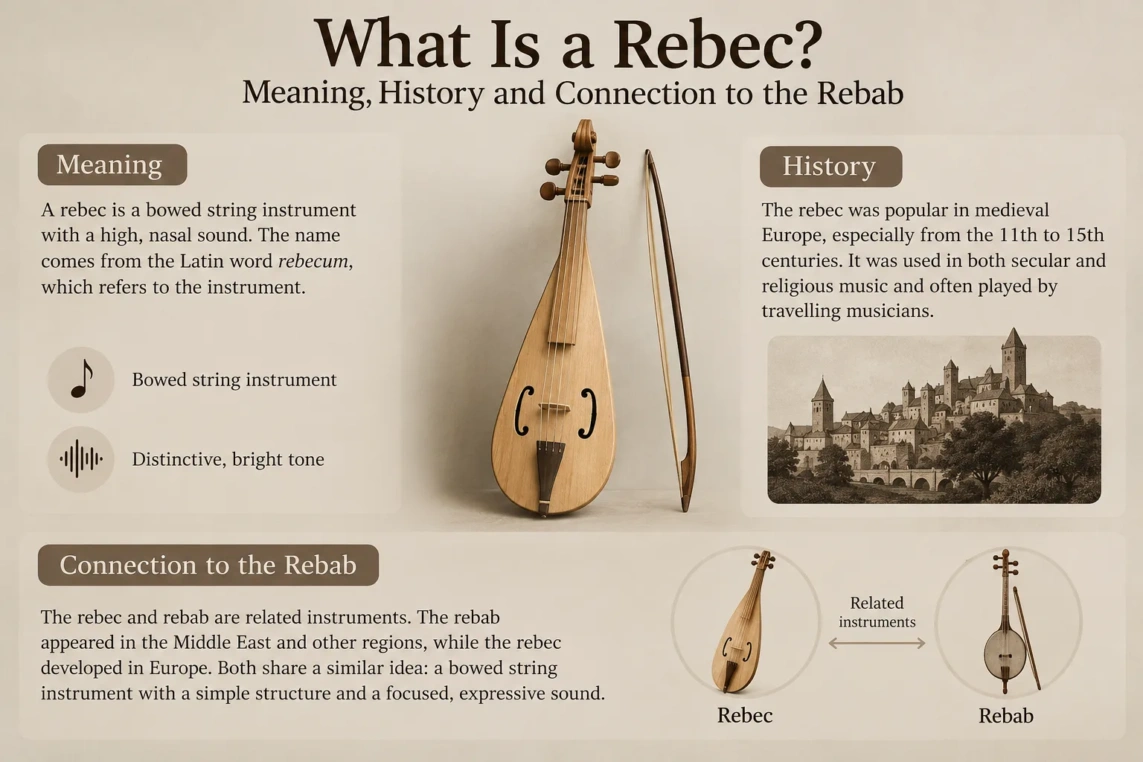
A rebec is a small bowed string instrument associated mainly with medieval and Renaissance Europe. Its compact, rounded or pear-shaped body, short neck and bowing technique make it look like an early relative of the violin, but the rebec belongs to an older instrument tradition. Its name also preserves an important clue to that history: rebec is etymologically connected with the Arabic rabāb.
The connection is real, but it needs careful wording. A rebec is not simply a European rebab under another name, and modern instruments called rebab, rabāb or rababa should not all be treated as direct versions of the medieval rebec. The strongest relationship lies in the history of the name, the movement of bowed-lute traditions around the Mediterranean, and several shared features seen in early European forms.
What Is a Rebec?
The rebec is a bowed necked string instrument whose most recognizable historical form has a narrow, rounded body flowing directly into the neck. Instead of the pronounced upper and lower bouts of a violin, the outline usually resembles an elongated pear or teardrop.
Many rebecs were built so that the back, neck and sometimes the pegbox formed a continuous carved structure. This construction method gives the instrument a different physical character from a violin and from many medieval fiddles assembled from flatter wooden plates.
Rebecs are often described as three-string instruments, and three strings are strongly associated with the familiar medieval and reconstructed form. That description should not be turned into a fixed rule. Surviving objects and historical representations show enough variation that string count alone cannot define a rebec.
A particularly useful example is an Italian instrument known as a rebecchino, dated to about 1420 and preserved by The Metropolitan Museum of Art. It was made for five gut strings. Its surviving condition even leaves open whether it was originally bowed or plucked, showing why individual museum objects must be interpreted rather than forced into a modern standardized definition.
Where the Word “Rebec” Comes From
The name provides one of the clearest links between the European rebec and the broader rabāb tradition. English rebec developed through medieval European forms related to Old French rebec and earlier ribabe. Related names include forms such as Italian ribeca and Spanish rabel. These forms are ultimately connected with Arabic rabāb.
Name history: rabāb → ribabe and related medieval forms → rebec. This linguistic relationship is strong evidence of cultural transmission, but it does not mean that every instrument carrying one of these names had identical construction.
Medieval instrument terminology was rarely as fixed as modern catalog labels suggest. Names changed between languages and regions, while instrument designs also changed. The history of the word therefore tells part of the story, not every detail of the instrument’s physical development.
The Rebec’s Body and Construction
The Carved, Pear-Shaped Resonator
The rebec is usually recognized by its rounded bowl-like back and narrowing upper body. In historical construction, the resonator could be hollowed from a solid piece of wood rather than assembled from multiple curved ribs in the manner of a lute or from separate back and side plates in the manner of a violin.
This produces an outline in which body and neck can appear almost continuous. The pronounced corners and narrow waist of the later violin are absent.
Surviving examples also warn against expecting every rebec to follow one workshop formula. The circa-1420 Italian rebecchino was hollowed from a block of boxwood and includes a sickle-shaped pegbox. Some of its present components are later replacements, which further complicates attempts to reconstruct an exact medieval standard from one object.
Fingerboard, Bridge and Pegbox
A typical rebec has a fingerboard running from the neck toward the soundboard, a bridge supporting the strings above the body, and tuning pegs mounted near the upper end of the neck. Many historical forms were unfretted, allowing the player to stop the strings directly with the fingers.
Pegboxes vary in shape. Curved, hooked and carved forms appear in surviving instruments and visual sources. Decorative heads can also occur, especially on elaborate courtly instruments. These details are useful for dating and comparing individual examples, but they are not required features of every rebec.
How Many Strings Did a Rebec Have?
Three strings are common enough that the rebec is frequently defined that way, yet historical evidence is less tidy. Different string counts appear across surviving objects, written descriptions and iconography.
The safer description is that medieval and Renaissance rebecs often had a small number of strings, commonly three, but the number was not universal. The five-string rebecchino in New York is a physical reminder that the historical category was broader than the familiar three-string reconstruction.
How the Rebec Was Played
The rebec was normally sounded with a bow. The bow set the strings into continuous vibration while the left hand changed pitch along the fingerboard. Because the instrument had no modern standardized setup, bow shape, string arrangement and playing technique could differ by place and period.
There Was No Single Playing Position
Calling the rebec an early violin can create the false impression that it was always placed under the chin. Medieval and Renaissance images show bowed instruments in several positions.
- Some were held against the chest or upper torso.
- Some appear near the shoulder.
- Others were supported lower on the body.
- Early rebec-related forms could be supported with the rounded end near the lap.
Iconographic evidence must be read cautiously because artists did not always reproduce proportions or construction details with technical accuracy. Even so, the repeated variety of postures makes it clear that modern violin position should not be projected backward onto every rebec player. Grinnell College’s musical instrument collection likewise notes varied historical designs and the limitations of reconstructing rebecs from surviving imagery.
Tuning Was Not One Fixed Medieval Standard
The rebec is associated with strings tuned in fifths, a feature that later became central to the violin family. The Metropolitan Museum of Art identifies fifths tuning as one of the rebec features incorporated into early violin development.
That does not justify assigning one universal tuning to every rebec across several centuries. Instrument size, string number, musical setting and regional practice could change. Modern replicas often require performers to select a practical tuning suitable for the repertoire being reconstructed.
The Rebec in Medieval and Renaissance Europe
By the later Middle Ages, the rebec had become a recognizable European bowed instrument. It appears in visual sources and in contexts involving singing, dancing, religious music and mixed instrumental performance. Surviving written evidence does not leave a large repertory composed exclusively for rebec, so much of its historical use has to be reconstructed from images, descriptions and broader performance practice.
The instrument was not limited to one social setting. Evidence summarized by the Grinnell College collection places rebec-type instruments in religious events, dance accompaniment, vocal accompaniment and ensembles with other medieval instruments.
Physical survivors from the medieval period are rare. That matters. Modern makers often work from a combination of the few surviving instruments, paintings, sculpture and later descriptions rather than copying a large body of intact medieval rebecs.
How Is the Rebec Connected to the Rebab?
The rebec–rebab connection has several layers. The linguistic connection is clear. The historical movement of bowed instruments between Arabic-speaking regions, Iberia and western Europe also provides a strong context. Physical similarities support comparison, but they do not prove that every rebec descended unchanged from one specific rabāb design.
The Rabāb Name Reached Medieval Europe
Historical rabāb traditions were already established in areas connected through Mediterranean travel and musical exchange. The Metropolitan Museum of Art describes the North African rabāb as an instrument that reached Spain and states that from about 1300 its name was applied to the early European rebec. The museum also notes a playing relationship: an early rebec could be supported with its rounded end on the lap, resembling the posture used for certain rabāb forms.
This is more useful than treating the history as a simple name change. Once instruments entered different musical and craft environments, their shapes, playing positions and construction could develop in new directions.
Iberia Was an Important Contact Zone
Medieval Iberia is especially relevant because European and Arabic musical traditions met there over long periods. Historical studies of bowed instruments identify the rabāb among instruments used in medieval Spain, while later European forms developed alongside different fiddle traditions.
The Met’s study of the early viol describes a rabab played in twelfth- and thirteenth-century Aragon and proposes that the rabab continued in Spain while a related rebec form developed elsewhere in western Europe. It also records rebec playing in late-fifteenth- and early-sixteenth-century Castilian art.
Historical caution: the safest interpretation is not “the rabāb became the rebec at one exact moment.” Names, bowed-lute designs and playing practices moved through several regions, while European makers adapted instruments to local musical needs.
Rebec and Rebab Are Related, Not Identical
The distinction becomes easier to see when a medieval European rebec is compared with documented bowed rabāb forms from North Africa. The instruments share a broader bowed-lute context, yet their construction and playing practice can differ markedly.
| Feature | Rebec | Bowed Rabāb / Rebab |
|---|---|---|
| Main historical setting | Medieval and Renaissance Europe | Several Arabic and North African traditions, depending on the form |
| Sounding method | Normally bowed | Bowed in the forms relevant to the rebec comparison |
| Body | Often narrow, rounded or pear-shaped, with a carved bowl-like back | Highly variable; North African examples include boat-shaped bodies |
| Strings | Often three, but historical variation exists | Varies by regional type; two-string forms are documented in North Africa |
| Frets | Generally unfretted | Many relevant bowed forms are unfretted |
| Soundboard materials | Wooden construction is characteristic of European rebecs | Wood and skin or parchment occur in documented regional forms |
| Playing position | Chest, shoulder, torso or lower support positions appear in historical evidence | Depends on type; some North African forms are supported across the body or near the lap |
| Historical identity | A European medieval and Renaissance instrument tradition | A group of regional instrument traditions sharing related terminology |
A late-nineteenth-century Algerian or Moroccan rebab preserved by The Met illustrates the difference clearly. It is described as a boat-shaped, two-string, unfretted fiddle held across the player’s body. That construction should not be used as a template for every historical rabāb, but it shows why rebab and rebec cannot be treated as interchangeable instrument names.
Rebec, Vielle and Early Violin
Medieval pictures often contain several bowed instruments whose identities can be difficult to separate. The rebec is especially easy to confuse with the vielle or to label retrospectively as a primitive violin.
Rebec Versus Vielle
The rebec commonly has a narrow pear-like profile with a rounded back. The medieval vielle generally belongs to a broader fiddle tradition and can have a flatter, wider body. Historical vielles also occur with more strings than a typical rebec.
The distinction is not always visually perfect. Medieval artists simplified instruments, terminology overlapped, and designs changed. Body outline, construction, string arrangement, playing posture and context therefore need to be considered together.
The Met distinguishes the vielle from rebec/rabab forms partly through construction, describing the vielle as a related bowed instrument made with flatter wooden elements and often equipped with more strings.
Why a Rebec Is Not Simply a Small Violin
A violin has a strongly waisted body with projecting corners, separate ribs, a carved top and back, and a standardized four-string arrangement. The rebec’s rounded bowl and flowing body-to-neck transition belong to a different construction tradition.
The resemblance comes from their shared status as bowed fingered string instruments and from real historical influence, not from identical anatomy.
Was the Rebec an Ancestor of the Violin?
Yes, but not as the violin’s single direct parent. Early violins drew features from several older bowed instruments. The rebec was one of them, alongside the Renaissance fiddle and the lira da braccio.
One inheritance is particularly clear: the rebec’s use of tuning in fifths is associated with the tuning system adopted by the violin. Body shape followed a different path. The hourglass outline of the violin is more closely connected with larger fiddle and lira da braccio forms, whose waisted bodies also gave the bow better access to individual strings.
The modern four-string violin took recognizable form in northern Italy around the middle of the sixteenth century. By then, European makers and musicians had several established bowed-instrument traditions available to draw upon. The rebec was part of that ancestry, not a violin waiting to acquire its final outline.
What Did a Rebec Sound Like?
No recording can reveal the exact sound of a medieval rebec. Modern performances use reconstructions based on surviving instruments, iconography, historical construction methods and period performance research.
A small wooden resonator, gut strings and bowing can produce a direct, focused tone suited to melody and rhythmic accompaniment. Depending on string arrangement and technique, a performer may also sustain one pitch while articulating another. Historical descriptions of the instrument’s use with singing, dancing and mixed ensembles fit this practical role.
Claims about a single authentic “rebec sound” should therefore be treated carefully. Body size, wood, string diameter, bow, setup, tuning and reconstruction choices all affect the result.
How to Recognize a Rebec in Medieval Art
A rebec in a painting, manuscript illumination or sculpture is best identified from several features together rather than from one detail.
- Look for a narrow pear or teardrop outline. A rebec often lacks the sharp waist and corners of a violin.
- Check the body-to-neck transition. The profile may flow continuously upward rather than forming pronounced shoulders.
- Look for a bow. This separates the usual rebec context from superficially similar plucked instruments.
- Notice the pegbox. Curved, hooked or carved forms occur in historical examples.
- Do not rely only on string count. Artists may omit strings, and historical rebecs were not limited to one arrangement.
- Observe the playing position. Chest, shoulder and lower positions can all occur.
Artwork is evidence of instrument use, shape and posture, but it is not an engineering drawing. A painter may compress the proportions, simplify pegs or reduce the visible number of strings. Identification is strongest when several structural clues agree.
Why Surviving Rebecs Need Careful Interpretation
Very few early rebecs survive compared with later violins. Some preserved instruments have also been repaired, altered or fitted with replacement components. A museum label therefore describes a physical object with its own history, not necessarily an untouched model of every rebec from that period.
The circa-1420 Italian rebecchino demonstrates this problem well. Its body preserves elaborate carved construction and evidence for five gut strings, yet some components are replacements and its original method of sounding remains uncertain.
An eighteenth-century instrument cataloged by The Met as probably Spanish gives another kind of evidence. Its fingerboard was made from part of a viol, while the museum associates the object with the unusually long survival of the medieval rebec tradition in rural Extremadura.
Such objects show why labels like rebec, rebecchino and Spanish rabel should be read together with date, region, construction and condition.
The Rebec Did Not Disappear as Soon as the Violin Appeared
The rise of the violin during the sixteenth century reduced the rebec’s role in many professional and courtly musical settings. Larger bowed instruments offered different projection, range and ensemble possibilities, while the violin family developed a more standardized construction and technique.
Replacement was gradual. Rebec-like instruments remained in use after the Renaissance and survived particularly well in some regional traditions. Grinnell’s collection notes continued rebec use into the seventeenth century, while the Spanish example preserved by The Met shows the persistence of the tradition into the eighteenth century.
What the Rebec Reveals About the Rebab Tradition
The rebec is best understood as a European instrument with a history connected to the wider rabāb family of names and bowed-instrument traditions. Its name points clearly toward Arabic rabāb, and medieval Iberia provides an important setting in which related instruments, musicians and terminology could circulate between musical cultures.
European makers then developed forms with their own construction, playing practice and visual identity. By the Renaissance, the rebec was recognizably part of European bowed-instrument culture, while instruments still called rabāb continued along several regional paths elsewhere.
This is why the sequence rabāb → rebec → violin is useful only as a very simplified orientation. The historical record is better represented as several connected bowed-instrument traditions influencing one another. The rebec occupies an especially clear place in that network because its name, construction and later influence on violin practice preserve different parts of the connection.