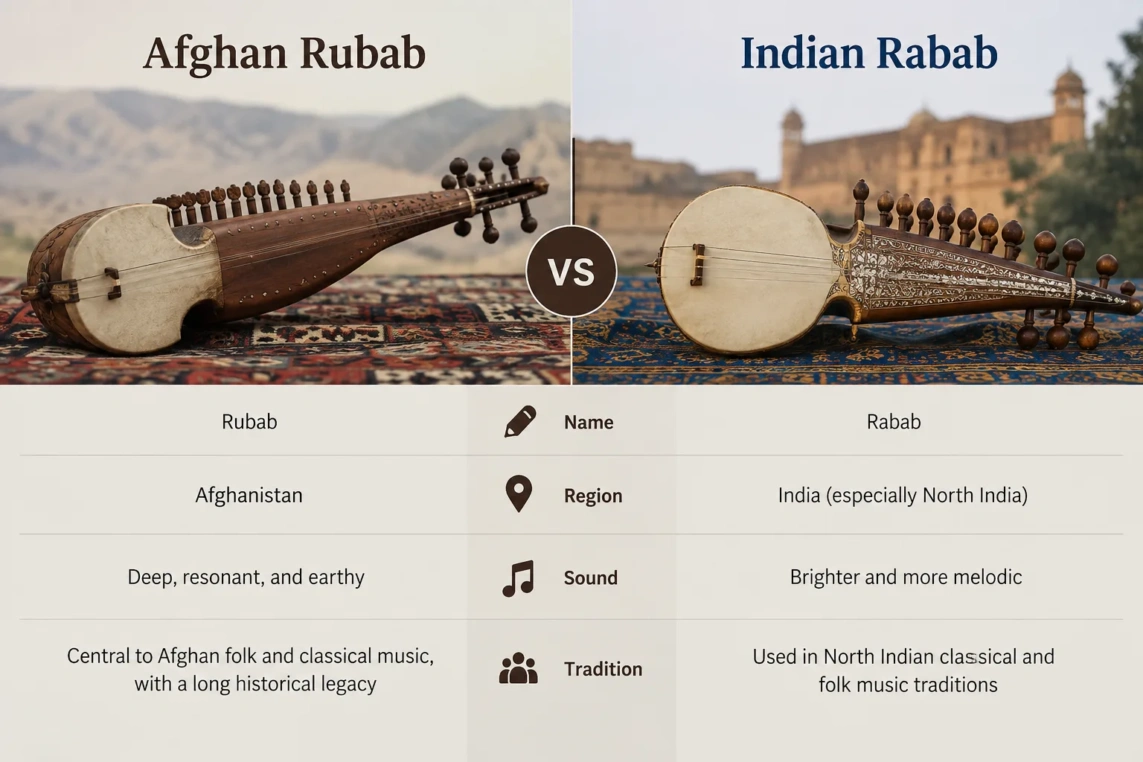
Afghan rubab and Indian rabab are not simply two national names for the same instrument. The Afghan or Kabuli rubab is a short-necked, fretted plucked lute with a layered string system that commonly includes melody, drone and sympathetic strings. The North Indian rabab compared here is the Seni rabab, also called Seniya, Dhrupad or Tanseni rabab in modern descriptions: a related plucked lute built around a fretless wooden fingerboard and a different traditional string arrangement.
The distinction matters because the word rabab covers several instruments across Central and South Asia. An instrument called a rabab in Punjab, Kashmir or a Sikh musical context should not automatically be identified as either the Afghan rubab or the historical Seni rabab.
Terminology used here: “Afghan rubab” refers primarily to the Afghan/Kabuli plucked rubab tradition. “Indian rabab” refers specifically to the North Indian Seni/Dhrupad rabab. Punjabi and Sikh rabab traditions are related subjects, but they are not treated as alternate names for the Seni instrument.
What “Indian Rabab” Means in This Comparison
Indian rabab is an imprecise label. India has encountered more than one rabab form, and historical sources do not present a single instrument that can safely be called the universal “Indian rabab.” For a comparison with the Afghan rubab, the most useful counterpart is the Seni rabab, the plucked rabab associated with North Indian court music and Dhrupad.
The names Seni rabab, Seniya rabab, Dhrupad rabab and Tanseni rabab are often used for closely related descriptions of this tradition. Their historical use is not perfectly uniform, so they should not be treated as four precisely standardized instrument classifications.
The Seni name is closely associated with Miyan Tansen, the celebrated musician of the Mughal court under Akbar. Later accounts often credit Tansen with modifying, developing or establishing the form used in North Indian art music. That association is strong; the stronger claim that Tansen personally invented the rabab cannot be treated as equally certain.
Afghan Rubab vs Indian Seni Rabab
| Feature | Afghan Rubab | Indian Seni Rabab |
|---|---|---|
| Regional identity | Afghanistan, with closely related traditions extending into neighboring regions | North Indian Hindustani and Dhrupad tradition |
| Other common names | Kabuli rubab, Afghan rabab | Seni rabab, Seniya rabab, Dhrupad rabab, Tanseni rabab |
| Playing method | Plucked with a plectrum | Plucked with a plectrum |
| Fingerboard | Wooden playing surface with tied frets on many traditional forms | Fretless wooden fingerboard |
| Main string system | Melody strings plus separate drone and sympathetic strings on many modern examples | Traditionally about six main strings, with lower strings able to serve a drone role |
| Sympathetic strings | A characteristic feature of many present-day Afghan rubabs | Not part of the traditional basic design; some modern reconstructions add them |
| Soundboard | Skin covers the lower resonating section | Skin-covered resonator |
| Traditional string material | Gut was historically common for principal strings; modern materials vary | Soft gut strings were traditional; nylon may appear on modern examples |
| Main musical setting | Afghan art music, regional traditions, solo and ensemble performance | Historical North Indian court music and Dhrupad-related performance |
| Present position | Living instrument with active performance and craft traditions | Rare historical instrument represented today partly through reconstruction and revival |
The Body Shows That These Are Different Instruments
The Compact Afghan Form
The Afghan rubab has a recognizable short-necked, deep-bodied profile. Its body is traditionally carved from wood rather than assembled like a flat-backed guitar. The lower resonating area is covered with skin, while the upper portion provides the wooden surface over which the strings run.
Many instruments show a pronounced waist around the transition between the resonator and neck. The peg arrangement can also be visually busy because the main strings, drones and numerous sympathetic strings need separate tuning points.
Mulberry is strongly associated with rubab making, especially in regional craft traditions, but material descriptions should not be turned into a rule that every surviving or modern Afghan rubab uses exactly the same wood, skin or string material.
The Seni Rabab Has a Different Proportion
The North Indian Seni rabab is usually described with a larger resonating body and a longer playing surface than the compact Kabuli type. A skin-covered resonator remains part of the design, preserving an obvious family resemblance, but the neck and fingerboard lead to a very different playing system.
A traditional description gives the Seni rabab six strings, six wooden tuning pegs and no frets. The fingerboard is wood rather than a polished metal plate. Historically, this favored softer strings such as gut; nylon can be used on modern instruments. Traditional descriptions also distinguish the instrument by the absence of the large sympathetic-string array now associated with the Afghan rubab.
Frets Change How the Two Instruments Behave
The most useful physical distinction is not the decorative carving or the shape of the pegbox. It is the playing surface beneath the melody strings.
Afghan Rubab: A Fretted Playing System
Afghan rubabs commonly use tied frets on the neck. Their exact number, material and placement can vary with the instrument and setup. These frets give the player defined stopping positions while retaining a construction very different from the fixed metal frets of a modern guitar.
This has a direct musical effect. A note can be struck firmly with the plectrum and stopped against a known fret position, producing the clear attack strongly associated with rubab playing. Ornamentation still depends on the player, tuning and regional style; describing the instrument as fretted does not mean its melodic language behaves like Western fretted-lute music.
Seni Rabab: A Fretless Wooden Fingerboard
The Seni rabab removes that fret structure. Its strings run across a plain wooden fingerboard, leaving pitch placement to the player’s left hand.
This is also why the wooden surface must be distinguished from the metal fingerboard of the modern sarod. A traditional Seni rabab with soft strings and a wooden board belongs to a different mechanical system. Historical playing descriptions and modern reconstructions may also involve nail contact when stopping or articulating a string, although technique is not identical across every reconstruction.
Calling both instruments “rabab” therefore hides one of their largest practical differences: one is normally organized around tied frets, while the other historical form is fretless.
The String Layout Creates Two Different Resonance Systems
Afghan Rubab: Melody, Drone and Sympathetic Strings
A typical modern Afghan rubab is not best understood by asking for one fixed total string count. Instruments differ. The useful distinction is what the strings do.
- Principal melody strings carry the notes directly struck by the plectrum.
- Drone strings reinforce a tonal center or supporting pitch.
- Sympathetic strings are tuned to respond acoustically when related frequencies are played.
Three principal melody strings are common in descriptions of the Afghan rubab. Additional drone strings and a bank of sympathetic metal strings can raise the total well beyond the number the player normally strikes as melody strings. The exact arrangement depends on the maker, regional practice and instrument.
The sympathetic strings are especially important to its acoustic identity. They are not merely extra strings for decoration and are not normally picked as part of the main melodic line. They respond to vibration from the played notes and add a faint layer of resonance around them.
Seni Rabab: A Leaner Traditional Layout
The traditional Seni rabab has a different logic. Descriptions commonly give it six principal strings. Its lower strings can support the tonal center in a drone-like role, but the traditional form does not depend on a separate bank of numerous sympathetic strings.
That detail is useful because some modern reconstructed Seni or Tanseni rababs do include sympathetic strings. A newly made revival instrument should not automatically be treated as evidence that every historical Seni rabab had the same feature. Modern builders may adapt string materials, sympathetic strings and construction details to make a rare instrument practical for present-day performance.
Why They Do Not Sound the Same
Words such as “warm,” “deep” or “bright” are too loose to explain the difference. The more useful comparison follows what happens after a string is struck.
Afghan Rubab: Defined Attack Followed by Resonant After-Ring
The Afghan rubab combines a plectrum strike, a skin-covered resonator and a layered string system. The principal note begins with a clear, percussive attack. Its directly played string does not sustain like the bowed string of a fiddle, but sympathetic strings can continue responding around the note.
The result is two acoustic events heard together: the immediate plucked note and a softer surrounding resonance. How obvious that second layer becomes depends on tuning, string number, setup, room acoustics and playing technique.
Seni Rabab: A More Direct String-to-Resonator Response
A traditional six-string Seni rabab lacks the large sympathetic-string bank of the common Afghan form. Its response therefore depends more directly on the plucked gut or soft string, the wooden fingerboard, bridge, skin and hollow body.
This does not mean it has no resonance. It means the resonance is produced by a different mechanical arrangement. The lower strings can reinforce tonal stability, while the fretless surface gives the player’s left hand a different relationship with pitch and melodic movement.
For Dhrupad-oriented performance, that distinction matters more than a simple description such as “Afghan rubab is brighter and Indian rabab is deeper.” Instrument size, string material, tuning and reconstruction choices can change perceived tone too much for such a formula to be reliable.
Afghan Rubab Belongs to a Living Regional Tradition
The Afghan rubab remains strongly identified with Afghan musical culture. It appears in solo playing, ensemble settings and regional repertoire, and its craft survives as a working tradition rather than only through museum instruments.
Its geographic story also extends beyond a modern national border. Closely related rubab traditions occur through parts of Central and South Asia, and Afghan/Kabuli-type instruments have long circulated into areas including present-day Pakistan and Kashmir. Regional movement is one reason the label on an old instrument cannot always be inferred from the country in which it was collected.
The modern phrase Afghan rubab is itself useful partly because it distinguishes this plucked lute from other instruments carrying forms of the name rabab, rebab or rubab.
The Seni Rabab Belongs to the Dhrupad and Court-Music Line
The Seni rabab is associated with a different musical setting: North Indian art music, Dhrupad and the Mughal court tradition. Tansen, who served at Akbar’s court in the sixteenth century, became so closely linked with the instrument that later terminology preserved the connection in names such as Seni and Tanseni rabab.
This association should be separated from a literal invention story. Instrument families change through makers, musicians and regional contact over long periods. Tansen may be described as a central figure in the development or establishment of the North Indian form without turning a traditional attribution into a proven single-inventor account.
The instrument’s fretless fingerboard, soft strings and relatively spare traditional string layout also place it in a different performance lineage from today’s Kabuli rubab. It eventually became rare in mainstream Hindustani performance, while related and descendant instruments took on larger roles.
The Sarod and Sursingar Do Not Form One Simple Rabab Family Tree
Rabab history in India is sometimes compressed into a straight sequence in which one “rabab” simply becomes another instrument. The surviving evidence supports a more branched picture.
Instrument scholarship distinguishes the Dhrupad rabab from the Afghan-type rabab when discussing later North Indian lutes. One influential historical reconstruction treats the Dhrupad rabab as the main ancestor of the sursingar, while linking the modern sarod more closely with the rubab form used in Afghanistan, Pakistan and Kashmir.
The mechanical contrast helps explain why this distinction is useful. The modern sarod has a smooth metal fingerboard and metal strings, allowing techniques that differ sharply from those of a gut-strung rabab on wood. Historical accounts place the appearance of the term sarod in the nineteenth century and describe a period in which Afghan-rubab-derived forms were being modified rather than replaced in one sudden step.
Sursingar followed another experimental path, enlarging and modifying rabab-related construction for the demands of North Indian art music. The two later instruments therefore should not be used as proof that Afghan rubab and Seni rabab were identical before diverging.
Punjabi and Sikh Rabab Need a Separate Identification
The word rabab also carries an important Punjabi and Sikh musical association, especially through traditions concerning Bhai Mardana and Guru Nanak. That context creates a common identification problem: “Indian rabab,” “Seni rabab” and “Sikh rabab” are sometimes treated as interchangeable labels.
They should not be merged automatically.
Descriptions and modern reconstructions of the Punjabi or Sikh rabab do not establish one universally preserved historical specification that can simply be equated with the Seni instrument. The cultural association is well established, but the exact physical form represented by every modern reconstruction is a separate question.
A museum catalogue, painting, modern workshop instrument or religious-performance instrument should therefore be identified from construction and context together, not from the word rabab alone.
How to Tell an Afghan Rubab from a Seni Rabab
When a photograph provides no reliable label, a few physical features are more useful than decorative carving.
- Look at the fingerboard first. Tied frets favor identification as an Afghan/Kabuli-type rubab. A long plain wooden fingerboard with no frets is consistent with a Seni rabab.
- Count peg systems, not just visible strings. Numerous small pegs serving a bank of thin sympathetic strings are strongly associated with the modern Afghan rubab.
- Check the main string layout. A relatively simple traditional six-string arrangement without a separate sympathetic bank fits descriptions of the Seni rabab more closely.
- Compare the proportions. The Afghan form is characteristically compact and short-necked. Seni instruments and reconstructions tend to present a longer playing surface and a different body-to-neck proportion.
- Confirm the musical context. Afghan repertoire, Kabuli terminology or a living Afghan craft setting favors the Afghan identification. Dhrupad, Tansen, Seniya or historical North Indian court context favors the Seni identification.
- Do not identify by spelling alone. Rubab, rabab and rebab spellings overlap across languages and transliteration systems.
A useful warning for collectors and readers: a sympathetic-string bank does not prove that an instrument is centuries old in that exact form. Modern makers sometimes add sympathetic strings to reconstructed Seni or Tanseni rababs. Construction details must be considered together.
The 2024 UNESCO Rubab Inscription Covers a Specific Multinational Tradition
In 2024, UNESCO inscribed “Art of crafting and playing rubab/rabab” on the Representative List of the Intangible Cultural Heritage of Humanity. The multinational nomination was submitted by Afghanistan, Iran, Tajikistan and Uzbekistan. It recognizes both rubab making and performance as transmitted cultural practices.
India is not one of the submitting states in that inscription. The UNESCO listing therefore should not be presented as an inscription of the Indian Seni rabab or as proof that every instrument called rabab belongs to one standardized tradition. It concerns a named living heritage practice shared by the four participating countries.
That modern heritage status also highlights the clearest difference between the two instruments today. The Afghan rubab remains part of an active craft-and-performance continuum, while the historical Seni rabab survives in a much narrower space shaped by archival evidence, museum examples, Dhrupad history and modern reconstruction. Their names are related, and their construction histories intersect, but their frets, string systems, sound behavior and musical traditions identify them as distinct branches of the broader rabab family.