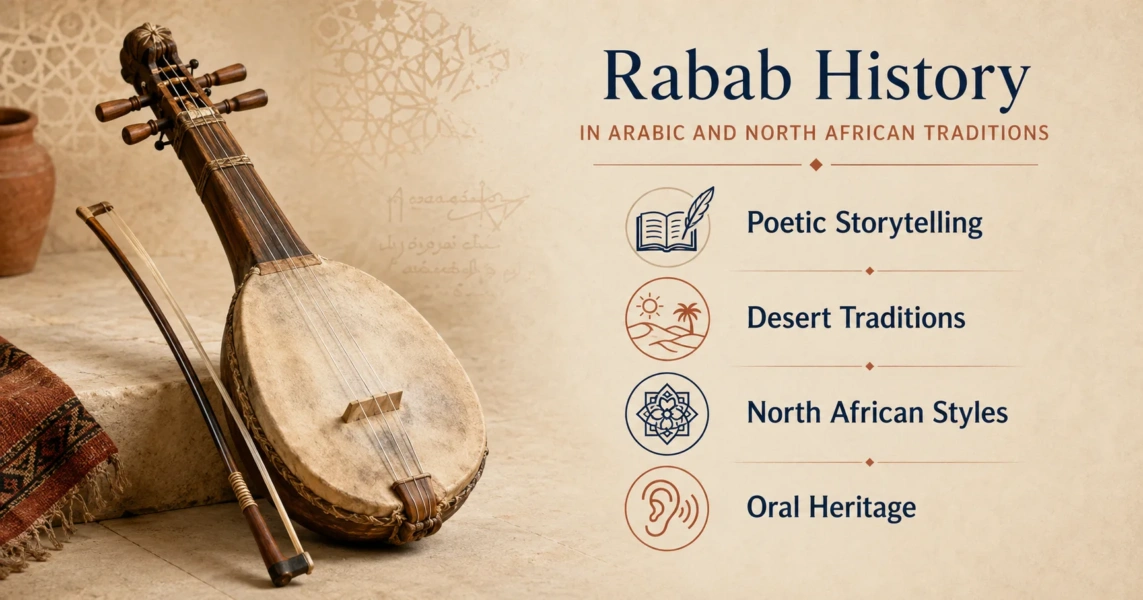
Rabab history in Arabic and North African traditions is not the story of one fixed instrument. The name moved across languages, courts, village settings, poetic performance, and museum catalogues. In Arabic usage, rabāb and rababa have referred mainly to bowed string instruments, while related spellings can also point to different regional lutes outside the Arab world. That shifting use is exactly why the instrument needs careful handling.
What Rabab History Means in Arabic Traditions
The Arabic term rabāb is one of the older names attached to bowed chordophones in the Arabic-speaking world. Medieval writers used the word for instruments sounded with a bow, but the physical forms were not always identical. Some had a boat-shaped body. Some used a spike-like neck. Others had a small resonator covered with skin.
This is the first point to keep clear: rabab history is a history of related forms, not a single standard model. The name can describe an Arab bowed fiddle, a North African two-string rebab, an Egyptian rababa, or, in other regions, a plucked lute with a different structure.
Regional Note: In North African Arabic and local usage, spellings such as rebab, rbab, rabab, and rabāb may appear for related instruments. The spelling alone is not enough to identify the instrument. Body shape, playing method, string layout, and performance setting matter more.
| Region or Setting | Common Name | Typical Form | Usual Role |
|---|---|---|---|
| Arabic literary and courtly contexts | Rabāb | Bowed chordophone with regional variation | Melody, song support, and ensemble use |
| Egyptian folk and epic performance | Rababa | Spike fiddle, often with skin-covered resonator | Accompaniment for singers, poets, and narrative performance |
| Morocco, Algeria, and Tunisia | Rebab, rbab, rabāb | Short-necked bowed lute, often boat-shaped and two-stringed | Vocal and ensemble support, including Andalusi-linked traditions |
| Wider Islamic and adjacent regions | Rabab, rubab, rebab | May refer to bowed or plucked instruments | Depends on local tradition and instrument family |
Early Arabic Context: A Bowed Voice for Melody and Recitation
The rabāb appears in Arabic musical history as part of a broader family of bowed instruments. Its early value was not only technical. It offered a sustained melodic line close to the human voice. A plucked lute can mark rhythm and outline melody, but a bow can hold a tone, bend into pitch, and follow vocal phrasing with more fluid motion.
That feature helps explain why the rabāb and rababa became linked with singing, poetic recitation, and narrative performance. The instrument could support a voice without covering it. It could also answer the singer with short melodic phrases.
Why the Bow Changed the Instrument’s Role
A bowed string allows the player to continue a note as long as the bow keeps moving. This made the rabāb useful for modal music, sung poetry, and ornamented melodic lines. It also made small instruments sound more expressive than their size might suggest.
Many documented rabāb forms do not use a long fingerboard like a modern violin. The player may stop or touch the strings directly with the fingers. This gives the sound a flexible pitch surface rather than a fixed fretted layout.
Poets, Singers, and Storytellers
In Arabic folk settings, especially in Egypt and nearby traditions, the rababa is strongly tied to singers and epic poets. It is often described as an accompaniment instrument rather than a solo concert instrument. The bow supplies a narrow but expressive melodic range, enough to support sung narrative and improvised openings.
Older Egyptian examples are often described with skin-covered resonators, wooden necks, and one to three strings depending on the form. Some use a coconut shell or a simple box-like body. The exact construction can vary, especially in folk instruments made by local craftsmen rather than workshop makers.
North African Rebab: The Maghrebi Line
In North Africa, the rebab developed a very recognizable profile. Museum examples from Algeria and Morocco often show a short-necked bowed lute with a skin or parchment soundboard, two strings, and a body that may be described as boat-shaped. Some examples include decorative inlay, pierced brass, bone, mother-of-pearl, or carved wood.
This North African rebab should not be confused with the Afghan rubab. The Afghan instrument is usually plucked and has a very different body, neck, and string system. The Maghrebi rebab belongs to the bowed side of the family.
Morocco, Algeria, and Tunisia
In Morocco, Algeria, and Tunisia, the rebab appears in traditional Arabic ensembles and in music linked with Andalusi heritage. It is often connected with vocal performance rather than detached solo display. The instrument’s line can reinforce the melody, shadow the voice, and add a nasal, focused color to the ensemble.
North African examples may be held across the body, with the instrument resting against the player rather than under the chin like a violin. This playing posture is one reason older descriptions compare the rabāb and the European rebec, while still keeping the two instruments separate.
Andalusi Links Without Overstatement
The rabāb is often discussed in relation to al-Andalus and the medieval Mediterranean. North African bowed rabāb forms are also linked to the history of the European rebec. The connection is real enough to appear in museum and music history writing, but it should be phrased carefully.
The rebec did not simply copy one single rabāb model. It belongs to a wider movement of bowed instruments, names, techniques, and shapes across Arabic, North African, Iberian, and European settings.
Collector’s Note: A North African rebab in a museum label may be listed as Algerian, Moroccan, or Algerian or Moroccan. This is not unusual. Similar construction habits, trade routes, and collection histories can make exact attribution difficult, especially for 19th-century instruments gathered outside their original performance setting.
Egyptian Rababa and Narrative Tradition
The Egyptian rababa has a different historical feel from the Maghrebi two-string rebab. It is commonly described as a spike fiddle used by folk singers, epic performers, and storytellers. The instrument may have a skin-covered resonator and a simple neck that continues through or beyond the body.
Some Egyptian examples use two horsehair strings. Other folk examples may have one string or show later repairs and substitutions. In practical use, the rababa is valued less for wide range and more for vocal closeness. It can bend, hover, and answer sung lines with a raw but controlled tone.
Epic Singing and the Rababa
In Egyptian epic performance, the rababa often supports the singer’s authority. The instrument gives pitch, opens the performance space, and marks shifts in delivery. It does not need a large range to do this work. Its job is to hold the voice in a modal space and help the narrative move.
That close link with oral performance explains why the rababa remained present even as larger urban ensembles adopted the violin, oud, qanun, and other instruments for broader melodic and harmonic needs.
Construction Details That Shape the History
Rabab history is easier to understand when the instrument is read through its materials. A skin soundboard, short neck, limited string count, and bowing method all point to specific musical uses.
Body and Soundboard
Many Arabic and North African rabab forms use a resonator covered with skin, hide, parchment, or a similar membrane. This material choice helps create a direct, slightly dry attack and a focused tone. It does not behave like a carved wooden violin top.
Wood choice can shape resonance, but the effect depends on the whole instrument: body size, membrane tension, bridge position, string material, and the bow. A simple wood label cannot explain the sound by itself.
Strings and Neck
Documented North African rebabs often have two strings. Egyptian rababa examples may show one, two, or sometimes more depending on the local type and later condition of the object. Gut, horsehair, and later replacement strings may all appear in historical or folk examples.
The absence of frets is normal in many rabab forms. This allows flexible intonation and vocal-style movement. It also means that learning the instrument depends heavily on listening, hand placement, and tradition rather than a fixed fingerboard map.
Bow and Playing Position
The bow is central to the Arabic rabāb identity. Some bows are simple, with horsehair or similar hair stretched on a light stick. The player may sit with the instrument in front of the body, across the lap, against the knee, or held in another regional posture.
Luthier’s Note: A skin-covered rabab is sensitive to humidity and tension. Changes in the membrane can alter response, brightness, and tuning stability. This is one reason old instruments may sound and behave differently after restoration, storage, or travel.
Names and Spellings in Historical Sources
The word appears in many spellings because it moved through Arabic, Persian, Turkish, European, and local North African writing systems. English writing also adds variation because long vowels and Arabic consonants are not always marked.
| Spelling | Common Context | Care Needed |
|---|---|---|
| Rabāb | Scholarly transliteration of Arabic ربابة or related forms | May refer broadly to bowed instruments in Arabic history |
| Rabab | Common English spelling | Can refer to bowed Arab forms or plucked regional lutes |
| Rababa | Arabic folk and Egyptian usage in English writing | Often points to a spike fiddle, but local forms vary |
| Rebab | North African, Turkish, Indonesian, and European-language usage | Needs regional context before identification |
| Rbab or Rbeb | Maghrebi spelling variants | Often linked with Morocco, Algeria, or Tunisia |
| Rubab | Central and South Asian contexts | Often plucked, especially in Afghan usage |
How the Arabic Rabab Differs from Related Instruments
The rabab family is often compared with the rebec, violin, oud, kamanja, and Afghan rubab. These comparisons are useful only when the differences stay clear.
Rabab and Rebec
The rebec is a medieval European bowed instrument whose name is often linked with the Arabic rabāb. Both belong to the broader history of bowed strings around the Mediterranean. The rebec, however, developed in European musical settings and should not be treated as the same instrument under another name.
Rabab and Violin
The violin eventually replaced or reduced the role of some older bowed instruments in urban Arabic ensembles. It offers a wider range, louder projection, and a different construction system. The rabab and rababa kept a place in folk, regional, and heritage settings because their tone and playing habits serve different musical needs.
Rabab and Afghan Rubab
The Afghan rubab is usually plucked with a plectrum and has a carved body, sympathetic strings in many forms, and a role in Afghan and related regional music. The Arabic and North African rabab forms discussed here are mainly bowed. The shared name reflects historical language movement, not identical construction.
Rabab and Oud
The oud is a plucked lute with a wooden soundboard and no bow. It can carry melody, rhythm, and modal development in a wide range of ensemble settings. The rabab is narrower in range but more voice-like in sustained pitch. Their musical roles can overlap, but their playing logic is different.
Sound, Range, and Musical Function
The rabab’s sound is often described as nasal, direct, and close to the singing voice. That description fits many bowed skin-covered forms, though not every instrument sounds the same. Body shape, membrane tension, string material, and bow pressure all matter.
Its range may be modest compared with violin or oud. That does not make it a lesser instrument. In song accompaniment, poetic recitation, and some ensemble roles, a narrow range can be enough. The instrument’s value sits in phrasing, tone color, and its ability to lean into the voice.
Listening Note: When hearing a rabab or rababa recording, listen for how the bow follows speech-like timing. The line may not behave like a violin melody in Western notation. It often bends around the singer’s phrase and supports the mode rather than displaying long solo passages.
What Museum Objects Reveal
Museum examples from North Africa often show how refined the rebab could be. Some 19th-century instruments include mother-of-pearl, brass, bone, ivory-like inlay, carved backs, and carefully shaped wooden parts. These objects show that the rebab was not only a simple folk tool. It also existed as a crafted object within formal musical culture.
At the same time, museum objects can mislead if read alone. A decorated rebab in a collection may not show the full range of everyday instruments. A plain rababa used by a singer may carry more performance history than a heavily ornamented object kept behind glass.
Why Labels May Be Broad
Older collection records may list a rebab as Algerian or Moroccan, or as possibly Algerian. That does not mean the label is careless. It often reflects the reality of 19th-century collecting, regional overlap, and limited information about the maker or original player.
For identification, the best evidence comes from several details together: body outline, membrane type, string count, pegbox, decoration, playing position, and the musical tradition attached to the object.
Common Misunderstandings About Rabab History
- The rabab is not always the Afghan rubab. In Arabic and North African history, the name often points to bowed instruments.
- The rababa is not simply an early violin. It belongs to bowed string history, but its construction and musical use are different.
- North African rebab forms are not all identical. Moroccan, Algerian, and Tunisian examples can differ in decoration, neck covering, and local use.
- A simple body does not mean simple music. The instrument can carry subtle pitch movement and vocal phrasing.
- Spelling does not settle the matter. Context is needed before deciding what instrument a source means.
Historical Place in Arabic and North African Music
The rabab holds a practical historical place: it connects bowed technique, Arabic naming, North African ensemble practice, and folk narrative performance. In one setting, it belongs beside singers in Egyptian storytelling. In another, it supports Maghrebi and Andalusi-linked ensemble music. In another, it appears in museum collections as a finely worked short-necked bowed lute.
This range is the reason rabab history should be read through regions rather than forced into one definition. The Arabic rabāb, the Egyptian rababa, and the North African rebab share a name family and a bowed-string identity, but each form has its own construction, posture, and musical setting.
FAQ
Is the rabab an Arabic instrument?
Yes, the rabāb is strongly tied to Arabic musical history, especially as a bowed string instrument. The name also spread into other regions, where it sometimes refers to different instruments.
Is the North African rebab the same as the Egyptian rababa?
No. They are related through name and bowed-string practice, but they are not the same form. The North African rebab is often a short-necked, two-string bowed lute, while the Egyptian rababa is commonly a spike fiddle used with singers and storytellers.
How old is the rabab in Arabic history?
The rabāb is documented in early medieval Arabic musical writing. Exact origins are difficult to state with certainty because the name covered more than one bowed form over time.
Did the rabab influence the European rebec?
Many music history and museum sources connect the Arabic rabāb with the medieval European rebec. The safest reading is that the rebec developed within a wider Mediterranean exchange of bowed instruments, names, and playing practices.
Does every rabab use a bow?
No. In Arabic and North African contexts, the rabab forms discussed here are mainly bowed. In Central and South Asian contexts, related names such as rubab often refer to plucked lutes.
Why is the rabab often linked with singing?
The bow allows sustained notes and flexible pitch movement, which helps the instrument follow the human voice. This made the rabab and rababa useful for song accompaniment, poetic recitation, and narrative performance.