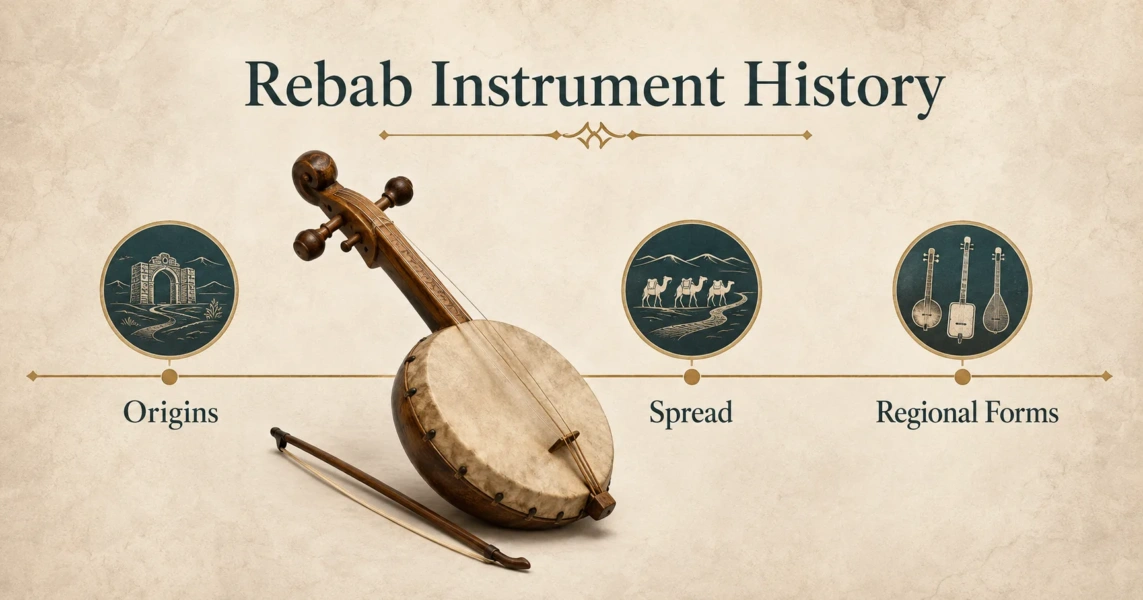
Rebab instrument history is best read as the history of a name that traveled with several related string instruments, not as the story of one fixed design. In one region, rebab may mean a bowed spike fiddle with a skin soundboard. In another, rubab may mean a plucked lute carved from mulberry wood. In North Africa, Java, Afghanistan, Central Asia, South Asia, and parts of the Middle East, the name changed shape because local makers, court musicians, singers, and ensemble traditions needed different tools.
The shared thread is not a single body shape or tuning. It is a family resemblance: a string instrument, often with a skin or parchment soundboard, often tied to oral musical traditions, and often built with regional materials rather than a universal workshop pattern.
Why the Rebab Has More Than One History
The word rebab and its related spellings point to a wide group of chordophones. Some are bowed. Some are plucked. Some have a short neck, while others use a spike-like neck that passes through the body. This makes the history of the instrument layered.
A North African rabāb, a Javanese rebab, and an Afghan rubāb can all belong to the same broad naming family while looking and sounding quite different. A careful history must hold these differences in place instead of forcing them into one neat origin story.
A July 31, 2026 research article by Emre Soylu in Online Journal of Music Sciences supports this reading. Comparing historical terminology with Ottoman, Arab, Iranian, Central Asian, North African, Southeast Asian, and European examples, Soylu finds that rebab did not keep one stable organological identity. Depending on period and place, the same name could refer to bowed instruments or to plucked forms played with a plectrum or the fingers.
Regional Note: The spelling often gives a clue, but it is not a rule. Rebab is common in English discussions of bowed forms and Indonesian gamelan. Rabab and rabāb often appear in Arabic, Persian, and museum contexts. Rubab, rubāb, and rubob are often used for plucked lutes in Afghanistan, Central Asia, Pakistan, and nearby regions.
Names, Spellings and Early Meanings
The name appears in several languages and scripts, so English spelling varies. Readers may meet rebab, rabab, rabāb, rababa, rubab, rubāb, rebap, rubob, and related forms. These spellings do not always separate instruments cleanly, because collectors, translators, colonial records, museum catalogues, and musicians used different systems.
In many historical references, rabāb became a broad term for string instruments connected with Islamic and Islamic-influenced musical cultures. That broad use helps explain why the same name can appear on a bowed lute in North Africa and a plucked lute in Afghanistan.
This is why spelling alone cannot settle an instrument’s identity. Soylu’s 2026 study treats rebab-related names as historical terms whose referents shifted with language, geography, period, performance practice, and cultural setting. Continuity in a name does not guarantee continuity in body shape or playing method.
| Name or Spelling | Common Context | Typical Instrument Type | Caution |
|---|---|---|---|
| Rebab | Indonesia, North Africa, English-language museum records | Often bowed, especially spike fiddle or short bowed lute | May also be used as a broad family name |
| Rabab / Rabāb | Arabic, Persian, North African, Middle Eastern and scholarly contexts | Often bowed, but not always | Historical texts may not describe the exact construction |
| Rubab / Rubāb | Afghanistan, Pakistan, Kashmir, Central Asia | Often plucked lute with skin soundboard | String count and tuning vary by regional form |
| Rubob / Robab | Uzbek, Tajik and wider Central Asian contexts | Usually plucked lute | Modern versions may use frets, nylon strings or metal strings |
| Rababa | Arab folk and Bedouin-related traditions | Often bowed fiddle, sometimes one or two strings | Local names and body forms vary widely |
Early Roots and Medieval Spread
The earliest history of the rebab family cannot be reduced to a single workshop, date, or inventor. Historical writing usually places rebab-related instruments within the wider movement of bowed and plucked lutes across the Middle East, North Africa, Central Asia, and later Europe and Southeast Asia.
By the medieval period, forms of the rabāb were known in Arabic and Persian cultural settings. Some sources treat the rebab as one of the early bowed instruments in the Islamic world. Others focus on plucked rubab-type lutes in Central Asia and Afghanistan. Both lines matter, because the name developed along more than one path.
Two Main Historical Lines
For clarity, the history can be separated into two broad lines, while remembering that real musical life is messier than any chart.
- Bowed rabāb and rebab forms: These include North African short-necked fiddles, Arab rababa forms, and Southeast Asian spike fiddles used in ensembles such as Javanese gamelan.
- Plucked rubab and rubob forms: These include Afghan rubab, Central Asian rubob types, and related lutes with skin soundboards and plectrum playing.
This split explains a common confusion. A reader searching for rebab history may expect a bowed instrument, then find an Afghan rubab played with a plectrum. Both can be historically related through name, region, and instrument family, but they are not the same object.
Routes of Spread
The rebab spread through musical contact, court patronage, trade routes, religious and poetic performance settings, migration, and ensemble practice. The process was not a single movement from one center to the rest of the map. It was a set of regional adoptions.
As the instrument moved, makers adjusted the body, soundboard, strings, bridge, and playing method. Local materials mattered. So did the music around it. A bowed instrument that supports a singer needs different behavior from a plucked lute that carries melodic phrases in an Afghan or Central Asian ensemble.
North Africa and al-Andalus
In North Africa, the rabāb developed as a bowed instrument used in traditional Arabic ensemble settings, especially in parts of Morocco, Algeria, and Tunisia. Museum examples often show a boat-shaped or short lute-like body, a skin or parchment face, gut strings in older forms, and decorative work such as inlay or metal fittings.
Historical accounts often connect North African rabāb forms with al-Andalus and the early European rebec. The relationship should be stated carefully. The rabāb appears to have influenced the naming and some features of medieval bowed instruments in Europe, especially the rebec, but the European violin family developed through several later design steps. The rebab did not simply turn into the violin.
Arab Rababa Traditions
The rababa is often associated with Arab vocal and poetic traditions. Many forms are simple in construction compared with court instruments: a small resonating body, skin top, one or two strings in some regional examples, and a bow. The player may use the instrument to support recitation, song, or narrative performance.
This line of history shows how the rebab family could serve speech-like melody. The instrument did not need a wide pitch range to be useful. It needed a direct tone, a flexible pitch center, and a voice-like way of shaping notes.
Central Asia and Afghanistan
In Afghanistan and parts of Central Asia, the rubab became a plucked lute with a very different profile from the bowed North African rabāb. The Afghan rubab is widely recognized for its carved wooden body, skin soundboard, short neck, plectrum technique, and sets of melody, drone, and sympathetic strings in many modern examples.
Mulberry wood is strongly associated with Afghan rubab making, though museum examples and regional relatives may include walnut, apricot, or other woods. The skin face gives the instrument a crisp attack. Sympathetic strings, where present, add a halo of resonance around the main melody.
Luthier’s Note: A skin soundboard reacts to humidity and tension in ways that differ from a wooden soundboard. It can give a plucked rubab a dry, bright attack, but the exact sound depends on body depth, bridge position, string material, skin thickness, and setup.
South Asia and the Sarod Connection
The Afghan rubab is often discussed as an ancestor or close relative of the sarod of Hindustani classical music. This connection is useful, but it needs care. The sarod developed with its own playing surface, metal strings, fretless technique, and classical repertoire. It should not be described as merely a renamed rubab.
The relationship shows how instrument ideas travel. A skin-faced lute with a strong melodic role entered new musical settings, then makers and players reshaped it for different tone, sustain, and ornamentation. The result was a new instrument with a memory of the older one.
Southeast Asia and Gamelan
In Java and nearby Indonesian contexts, the rebab became a bowed spike lute used in gamelan. It is usually a two-string instrument with a small resonator, a skin or membrane face, a long neck or spike, and a light bow. It is played upright by a seated musician.
The Javanese rebab does not function like a loud solo fiddle. In many gamelan settings it guides, ornaments, and shades the melodic line. It can sit close to the vocal style, shaping phrases with slides and delicate pitch movement. That role explains why its history belongs as much to ensemble practice as to instrument construction.
Regional Development by Instrument Form
The clearest way to understand rebab history is to compare the main regional forms by construction and use. The table below keeps the focus on historical development rather than exact tuning, since tuning changes by teacher, repertoire, region, and instrument type.
Body form remains useful for identification, but it cannot settle identification by itself. The 2026 study compares structure with historical terminology, region, playing method, performance setting, and cultural meaning. This helps explain why instruments carrying related rebab names can belong to different organological lines.
| Region or Tradition | Main Form | Playing Method | Historical Role |
|---|---|---|---|
| North Africa | Short bowed rabāb, often boat-shaped or lute-like | Bow | Used in Arabic ensemble and vocal accompaniment traditions |
| Arab Rababa Traditions | Simple bowed fiddle, often with skin soundboard | Bow | Supports song, recitation, and regional poetic performance |
| Afghanistan | Carved plucked rubab with skin face | Plectrum | Used in Afghan music and linked to wider Central and South Asian practice |
| Central Asia | Rubob and related lute forms | Plectrum | Adapted into local ensemble and craft traditions; modern forms may use frets |
| Java and Sunda | Bowed spike-lute rebab | Bow | Melodic ornament and vocal-like guide in gamelan settings |
| Medieval Europe | Rebec and related bowed instruments | Bow | Shows naming and design influence from rabāb-type instruments, later developing separately |
Construction Changes Across Regions
Rebab history is visible in the workshop. Body shape, soundboard material, string layout, and playing tools changed as the instrument entered new musical settings.
Body Shape
North African rabāb examples may have a boat-like or hollowed wooden body. Javanese rebab forms often use a small resonator with a spike-like neck. Afghan rubabs usually have a carved body with a skin-covered lower chamber and a carved upper section that supports strings and pegs.
These forms are not decorative variations only. They affect balance, playing posture, projection, and how the instrument sits in an ensemble.
Skin and Parchment Soundboards
A skin soundboard appears in many rebab-related instruments. It gives a direct response and helps the instrument speak clearly without needing a large wooden soundbox. In bowed forms, it can support a nasal, focused tone. In plucked rubab forms, it can give a percussive edge to the attack.
The material may be described as skin, parchment, vellum, hide, bladder, or membrane depending on the region and source. Exact terms vary, so a museum description may not match a maker’s local vocabulary.
Strings and Resonance
Older examples may use gut, silk, hair, or other organic materials depending on the region. Modern instruments may use nylon, steel, bronze, or mixed string sets. Afghan rubabs often include sympathetic strings in addition to main strings and drone strings, though the number is not universal.
Sympathetic strings changed the listening experience. They do not simply make the instrument louder. They add shimmer around selected pitches and help the instrument respond to modal playing.
Bow, Plectrum and Hand Technique
The bowed branch of the rebab family uses pressure, slides, and flexible intonation. The plucked branch depends on attack, rhythmic clarity, and left-hand ornament. This difference shaped regional history more than name alone.
A Javanese rebab player does not approach the instrument like an Afghan rubab player. A North African rabāb does not behave like a sarod. The shared name can invite comparison, but technique separates the traditions.
How Sound Shaped Its Development
The rebab family often sits close to the human voice. Bowed forms can bend pitch and follow sung lines. Plucked forms can mark rhythm while still carrying melody. This vocal closeness helped the instrument fit into poetry, court music, devotional settings, folk performance, and ensemble music.
Listening Note: A bowed rebab may sound narrow, reedy, and speech-like. A plucked Afghan rubab may sound dry, warm, and percussive, with extra resonance from sympathetic strings when present. These are family traits, not fixed rules.
The instrument also had practical strengths. Skin-faced bodies could be built with local materials. Smaller bowed forms were portable. Plucked rubabs could carry melody in social and ensemble settings. These features helped the name survive even as the instrument changed.
Rebab, Rebec and the European Question
The rebec is often mentioned in rebab instrument history because medieval European sources and later scholarship connect the name and some design features to rabāb-type instruments. The link is reasonable, especially through contact across the Mediterranean and al-Andalus.
Still, the connection should not be overstated. The rebec belongs to medieval European music, while the rabāb belongs to a broader set of North African, Middle Eastern, and Islamic-influenced traditions. The violin family later developed with ribs, a separate neck, a wooden soundboard, and other design features that differ from many rabāb constructions.
The better view is this: rabāb-related instruments helped shape the early bowed-instrument vocabulary of Europe, but European bowed instruments did not follow one straight line from rebab to violin.
What Changed in Modern Use
Modern rebab and rubab traditions continue in different ways. Some forms remain tied to regional ensembles and teacher lineages. Others appear in concert halls, diaspora music, museum demonstrations, academic collections, and online teaching spaces.
Materials have also changed. Synthetic strings, metal strings, machine-made fittings, and export-market decoration can appear beside older craft methods. These changes do not make an instrument false by themselves. They do mean that a modern rubab or rebab should be identified by construction, region, and playing tradition rather than by name alone.
Museum Labels and Living Practice
Museum labels are useful because they preserve dates, materials, places, and older collection histories. They can also be limited. A label may say “rebab” without explaining local tuning, repertoire, maker lineage, or performance setting.
Living practice fills that gap. Musicians know how the instrument behaves in real music: how the bow grips the string, how a skin face reacts, how ornaments fit a melody, and how the instrument balances with voice, drum, lute, gong, or drone.
Common Misunderstandings About Rebab History
Several mistakes appear often when the rebab is described too quickly.
- It is not one standardized instrument. The name covers several regional forms with different construction and technique.
- Not every rebab is bowed. Afghan rubab and Central Asian rubob forms are usually plucked.
- Not every rubab is Afghan. Afghanistan has a highly recognized rubab tradition, but related names and forms exist across Central and South Asia.
- The rebab is not simply an early violin. It helped shape bowed-instrument history, but the violin developed through other structural changes.
- Spelling does not prove identity. Transliteration varies, and the same spelling may appear in different catalogues for different instruments.
Historical Timeline Without Forcing a Single Origin
A cautious timeline can show the broad movement of the rebab family without pretending that every regional form came from one identical prototype. Soylu’s 2026 study supports the same caution: the name moved across different structures, functions, and musical settings rather than remaining attached to one unchanged instrument.
- Early and medieval West Asian contexts: Names related to rabāb appear in Arabic and Persian cultural settings, referring to string instruments in more than one form.
- Medieval Islamic and Mediterranean contact: Bowed rabāb-type instruments circulate through North Africa and al-Andalus, helping shape the vocabulary around European bowed instruments such as the rebec.
- Central Asian and Afghan development: Plucked rubab and rubob lutes develop strong regional identities, with skin soundboards, carved bodies, and plectrum technique.
- South Asian adaptation: Rubab-related ideas contribute to later instrument development, including the sarod connection, while new repertoire and construction choices create separate instruments.
- Southeast Asian adoption: The rebab becomes part of Indonesian gamelan, especially in Java and Sunda, where it takes on a refined melodic role within ensemble music.
- Modern museum and concert life: Rebab and rubab forms are documented, collected, restored, taught, and performed across local and diaspora settings.
How to Identify the Historical Branch You Are Looking At
When a label says rebab, rabab, or rubab, start with the structure rather than the spelling.
- If it has a small resonator, long spike-like neck, two strings, and a bow, it may belong to a Southeast Asian rebab or another bowed spike-fiddle tradition.
- If it has a boat-shaped or short lute-like body, skin face, and bow, it may be a North African rabāb form.
- If it has a carved wooden body, skin soundboard, plectrum playing, and sympathetic strings, it may be an Afghan rubab or a related Central Asian form.
- If it has a metal fingerboard and belongs to Hindustani classical music, it is more likely a sarod, even if its ancestry is discussed alongside the rubab.