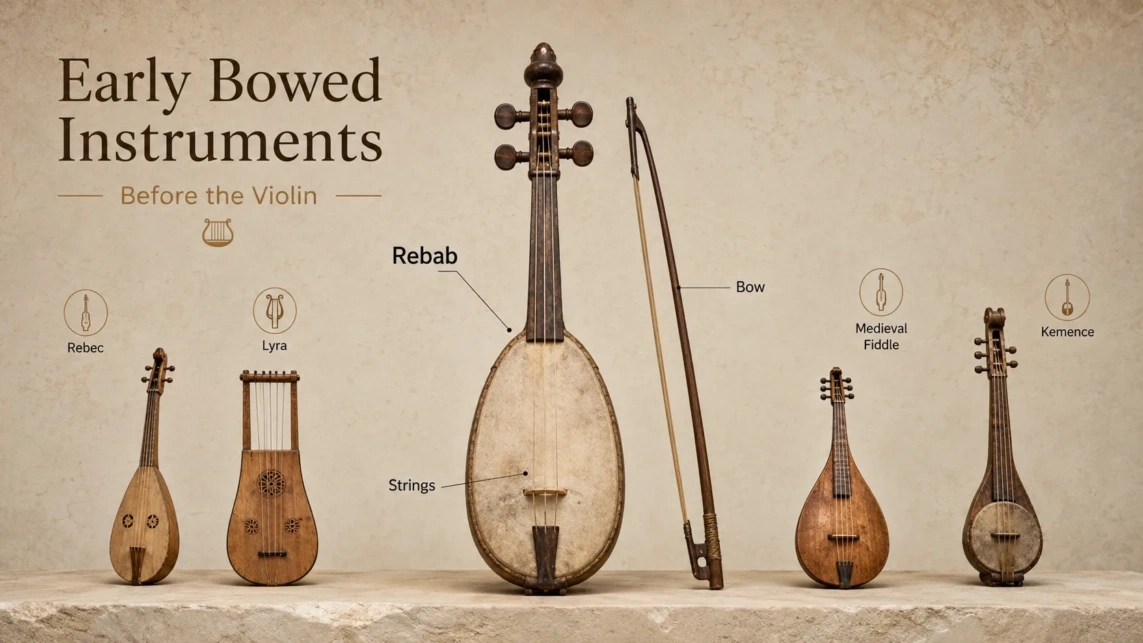
The rebab belongs to the older layer of bowed string instruments that existed before the violin became a settled European form in the sixteenth century. It should not be treated as a simple “early violin,” yet it helps explain how bowed playing, skin-covered resonators, short necks, gut strings, and regional fiddle traditions moved across North Africa, the Middle East, Iberia, Europe, and parts of Asia.
The violin did not appear from one single ancestor. It emerged after centuries of experiment with bowed lutes, fiddles, lyres, rebecs, vielles, and lira-type instruments. The rebab fits into that history as one of the older and more widely named bowed chordophones, especially in Islamic and Islamic-influenced musical regions.
Why the Rebab Comes Before the Violin
The modern violin is usually linked to northern Italy around the sixteenth century. By that time, many bowed instruments were already in use: the rebec, medieval fiddle, vielle, lira da braccio, Byzantine lyra, and several regional forms of rabab or rebab.
The rebab matters because it shows that bowing was already a mature musical technique long before the violin family became dominant. In many documented examples, the rebab had a small resonating body, one to three strings, no frets, and a bow made with horsehair. Some forms had a skin or parchment soundboard rather than a carved wooden top.
This makes the rebab different from the violin in construction, but close to it in playing principle: a stretched string is set into motion by a bow, and the body shapes the sound.
Important Distinction: The rebab is best understood as a family name, not a single fixed instrument. A North African boat-shaped rebab, an Indonesian spike fiddle called rebab, and a Central Asian rubab may share a name history, but they do not all have the same body, playing method, or musical role.
A Bowed Instrument Family, Not One Fixed Shape
The word rebab appears in several spellings, including rabab, rabāb, rubab, rebap, and related regional forms. In some contexts it refers to bowed instruments. In others, especially in Central and South Asian usage, related names may refer to plucked lutes.
For early bowed instrument history, the most relevant forms are the bowed rabāb or rebab types found in Arabic, North African, Iberian, and Southeast Asian contexts.
| Instrument | Usual Period or Context | Typical Structure | Connection to the Violin Story |
|---|---|---|---|
| Rebab / Rabāb | Medieval Islamic, North African, Iberian, and later regional traditions | Often a small bowed lute or fiddle; may have a skin soundboard, short neck, and few strings | Helped transmit bowed-lute ideas into Europe and gave its name to the rebec in many accounts |
| Rebec | Medieval Europe | Pear-shaped or boat-shaped bowed instrument, usually small and portable | One of the direct pre-violin bowed instruments in European iconography and courtly music |
| Vielle | Medieval Europe | Wooden body with ribs or box-like construction; often more strings than the rebec | Contributed to the larger body concept and broader fiddle tradition before the violin |
| Byzantine Lyra | Byzantine and post-Byzantine regions | Pear-shaped bowed lute, often held upright | Part of the eastern Mediterranean bowed tradition that shaped later regional fiddles |
| Lira da Braccio | Renaissance Italy | Arm-held bowed instrument with violin-like outline in some forms | One of the closer European relatives near the birth of the violin |
Where the Rebab Fits in the Bowed Instrument Timeline
The rebab belongs near the beginning of the written and visual history of bowed instruments, but the exact origin of bowing is not simple. Early bowed instruments appear in several connected regions across Asia, the Middle East, the Byzantine sphere, North Africa, and Europe.
By the medieval period, the rebab was already part of a broad musical exchange zone. Its movement into Iberia is especially important for European instrument history, because the medieval rebec is often linked to the rabāb by both name and form.
Evidence from fourteenth- and fifteenth-century Italy shows that rabab-related bowed instruments were not confined to an earlier Iberian stage of this history. Thilo Hirsch’s 2025 study of Italian sources brings together manuscript and pictorial evidence with written and ethnomusicological material. One of its most useful references comes from Simone de’ Prodenzani’s Saporetto, written around 1415/25, which names “rubebe, rubechette e rubecone” in connection with the performance of vocal works.
The three related terms suggest instruments of different sizes or registers. Read together with Italian depictions of rabab-type instruments, Hirsch argues that a three-part bowed-string ensemble may have been possible in Italy during the first half of the fifteenth century. This is not evidence that such an ensemble was standardized throughout Italy, but it places rabab-related bowed instruments inside Italian musical practice well before the violin acquired its later form.
The path was not a straight line. The violin was not made by adding parts to a rebab. Makers and players across different regions developed bowed instruments with different bodies, bridges, tunings, sizes, and playing positions. Over time, some European forms moved toward the arched wooden body, waisted outline, four strings, and fifths tuning associated with the violin.
Shared Features with Later European Fiddles
The rebab shares several features with early European bowed instruments, especially the rebec and some medieval fiddles.
- Few strings: Many rebab and rebec forms used a small number of strings, often one to three depending on region and period.
- Unfretted neck: Several forms were played without frets, allowing flexible intonation and ornament.
- Compact body: Many rebabs were small enough for mobile performance and vocal accompaniment.
- Bow use: The bow created sustained tone, unlike plucked lutes whose sound decays more quickly.
- Regional tuning: There was no single universal rebab tuning; tuning depended on local repertory and ensemble role.
These shared traits do not make the rebab a violin. They show that rebab-type instruments belonged to the long history of makers adapting resonating bodies, strings, bridges, and bows to different kinds of music.
How the Rebab Differs from the Violin
The violin has a carved wooden belly and back, ribs, a soundpost, bass bar, f-holes, four strings, and a strongly standardized shape. The rebab is more variable.
Many rebab forms use a skin or parchment soundboard. Some have a boat-shaped or pear-shaped body. Some are spike fiddles, where a long neck or spike passes through the resonator. Others are short-necked bowed lutes. The bridge can be simpler than a violin bridge, and the playing position may place the instrument on the lap, against the body, upright, or across the player depending on the regional form.
Luthier’s Note: A skin soundboard can give a rebab a direct, nasal, and speech-like attack. A carved wooden violin top supports a different kind of projection and sustain. The difference is not only volume; it changes how the instrument speaks under the bow.
The Rebab and the Rebec
The rebec is one of the clearest European links in the rebab story. Medieval and Renaissance sources often connect the rebec with the rabāb, and museum descriptions commonly note that the rebab or rabāb entered Spain and influenced the naming and form of the rebec.
The rebec was usually a small bowed instrument with a rounded or pear-shaped body. It became common in medieval Europe and survived in several regional forms. Compared with the later violin, it had a narrower sound world and a less standardized structure.
The Italian evidence adds another layer to this relationship. The rubebe, rubechette, and rubecone named by Simone de’ Prodenzani around 1415/25 indicate that related bowed-instrument terminology was present in Italy itself. Hirsch’s comparison with fourteenth- and fifteenth-century Italian images suggests that rabab-type instruments should be considered part of the Italian bowed-string landscape before the violin, rather than only as instruments that passed through Iberia on the way to later European forms.
This evidence also argues against a neat sequence in which one named instrument simply replaced another. Rabab-related forms, rebecs, vielles, and other bowed instruments could exist within overlapping periods and musical settings.
The Rebab and the Vielle
The vielle was another pre-violin bowed instrument, but it followed a different construction path. Where many rebab and rebec forms were carved from a single piece or used a small resonator, the vielle often had a larger wooden body built more like a box or early fiddle.
That difference matters. The vielle points toward the larger, louder, more body-driven European fiddle tradition. The rebab points toward the older bowed-lute and skin-topped fiddle tradition. Both belong in the story before the violin, but they do not occupy the same place.
The Rebab and the Byzantine Lyra
The Byzantine lyra is another early bowed instrument often discussed beside the rebab. It was a pear-shaped bowed lute associated with the Byzantine world and later regional traditions around the eastern Mediterranean and Balkans.
The lyra and the rebab show that bowed instruments developed through contact, borrowing, and local adaptation. A name may move in one direction while a body shape moves in another. A bowing technique may spread even when the instrument itself changes form.
This is why the history of early bowed instruments is better read as a network than a family tree with one trunk.
Regional Rebab Forms Before and After the Violin
The rebab did not disappear when the violin appeared. In some places, it stayed central to older musical systems. In others, violin-family instruments became more common, but local rebab forms remained in ritual, court, rural, classical, or folk settings.
North African Rebab
North African rebab forms are often described as boat-shaped, short-necked, and bowed. Some examples have two strings and decorative inlay. In Morocco, Algeria, and Tunisia, related rabāb forms have been used in traditional Arabic and Andalusi-influenced ensembles.
These instruments are important for understanding how bowed-lute forms survived outside the violin’s standard European path.
Arabic Rabāb
Arabic rabāb traditions include bowed instruments with skin soundboards and few strings. In medieval usage, the word could also function as a broader term for bowed instruments. This makes historical reading tricky, because the name does not always identify one exact body type.
When older texts mention rabāb, the safest reading depends on region, date, and musical setting.
Southeast Asian Rebab
In Indonesia and nearby regions, the rebab became a bowed spike fiddle associated with ensemble traditions such as gamelan. This form is different from the shorter North African rebab, yet it keeps the same broad identity as a bowed chordophone within a local musical system.
Its role often includes ornamenting melody and shaping expressive lines rather than carrying a violin-like solo function.
Sound and Musical Role
The rebab’s sound is often described as penetrating, vocal, and flexible. That character comes from several elements working together: a small resonator, skin or thin soundboard in many forms, light strings, and direct bow contact.
It is not built for the same polished projection as a concert violin. Its strength lies in line, ornament, and voice-like expression.
Listening Note: A rebab line may feel closer to sung speech than to modern violin melody. Slides, ornaments, and subtle pitch movement are part of the instrument’s identity in many traditions.
Why “Ancestor of the Violin” Needs Care
Calling the rebab “the ancestor of the violin” is attractive, but too simple. It is more accurate to say that rebab and rabāb traditions are part of the pre-violin bowed instrument history that helped shape European bowed instruments, especially through the rebec and related medieval fiddles.
The Italian evidence examined in recent research reinforces this caution. Rabab-type bowed instruments were already documented in Italian sources during the fourteenth and fifteenth centuries, while other fiddle families were also developing. The possible rubebe–rubechette–rubecone ensemble of the early fifteenth century shows overlapping bowed traditions rather than a single succession from rabab to rebec and then violin.
The violin also drew from other sources: the Renaissance fiddle, the lira da braccio, the vielle, and northern Italian making practices. Its final form depended on local workshop knowledge, wood carving, ensemble needs, dance music, and courtly performance.
The rebab belongs to the earlier current of bowed instruments that made the later European bowed-string tradition possible, but it was not replaced by the violin everywhere and should not be reduced to a stepping stone.
Modern Research on Skin-Covered Bowed Instruments
The 2025 volume Rabab, Rubeba, Rubāb: Fellbespannte Streichinstrumente im historischen und kulturellen Kontext, edited by Thilo Hirsch, Marina Haiduk, and Thomas Gartmann, brings together results from a Bern University of the Arts research project carried out from 2019 to 2023 along with related studies.
The research approaches skin-covered bowed instruments through Arabic studies, Islamic history, art history, musicology, ethnomusicology, instrument reconstruction, and physics. For pre-violin history, this wider evidence is useful because medieval names, images, surviving regional instruments, construction methods, and performance experiments do not always point to one identical object. The Italian rabab study is one example of how several source types can produce a more precise historical picture than a simple rebab-to-rebec lineage.
Common Confusions
Rebab and Rubab
In some regions, rubab refers to a plucked lute rather than a bowed fiddle. The Afghan rubab is a well-known example of a plucked instrument. That form belongs to a related naming history, but it should not be confused with bowed rebab instruments.
Rebab and Rebec
The rebec is a European medieval bowed instrument closely tied to the rebab by name and historical influence. It is not simply the same instrument under another spelling. Its shape, stringing, and European use developed in its own direction.
Rebab and Violin
The violin is a later, standardized European instrument. The rebab is older in name and broader in form. The two share bowed-string principles, but their bodies, soundboards, bridges, playing roles, and musical settings differ.
How to Recognize a Bowed Rebab in a Museum or Collection
A bowed rebab can often be recognized by a small resonator, a short or narrow neck, few strings, and a bow. Many examples have a skin, parchment, or vellum soundboard. Others may have decorative wood, bone, metal, mother-of-pearl, or textile details depending on region and period.
Look for these features:
- A body that may be boat-shaped, pear-shaped, round, or spike-fiddle-like
- One, two, or three main playing strings in many traditional examples
- A bridge positioned on a skin or thin soundboard in some forms
- No frets on many bowed types
- A playing position that may differ from violin posture
- Regional labels such as rabāb, rebab, rbab, rebap, or related spellings
Identification should always leave room for regional variation. A label alone is not enough.
The Rebab’s Place in Pre-Violin History
The rebab fits into pre-violin history as an early and influential bowed chordophone name, especially in Arabic, North African, Iberian, Italian, and later Asian contexts. It connects to the rebec, overlaps with the wider medieval fiddle tradition, and helps explain how bowing was already established before the violin family rose to prominence.
Fifteenth-century Italian evidence makes that position more concrete. Rabab-related instruments were present in Italy while other bowed forms were developing, and the Saporetto terminology suggests that related instruments may even have been used in different registers within an ensemble. The evidence supports a history of overlapping instrument families rather than one uninterrupted line of descent.