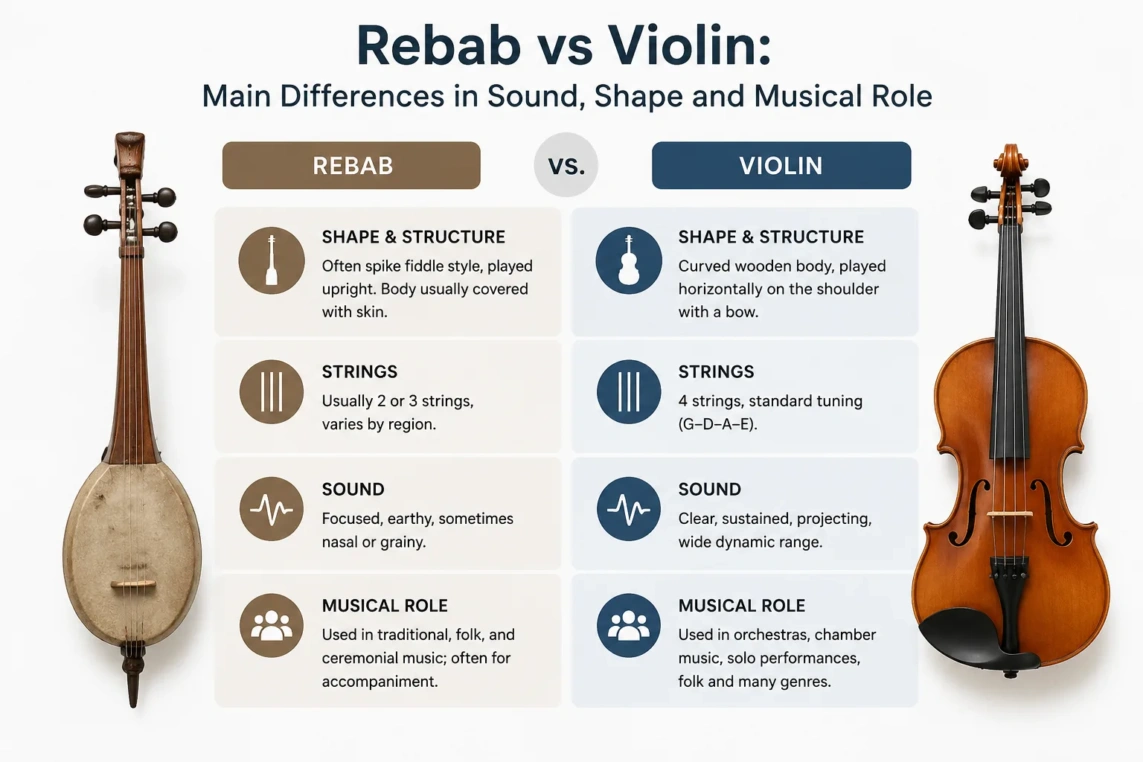
The rebab and violin are both bowed string instruments, yet they differ sharply in construction, playing position, tonal character, and musical purpose. A violin has a standardized four-string design with a fully wooden resonating body and is usually held at the shoulder. Rebab is a broader name applied to several regional bowed instruments, many of which use a skin-covered resonator, fewer strings, and an upright playing position.
This distinction matters because there is no single rebab design that can be placed beside the violin as an exact equivalent. Indonesian, Malay, Arab, Turkish, and other rebab or rababa traditions have developed their own forms. The comparison therefore works best between the common characteristics of bowed rebabs and the much more standardized modern violin.
Rebab vs Violin Comparison
| Feature | Rebab | Violin |
|---|---|---|
| Instrument type | Regional family of bowed instruments; many forms are spike fiddles | Standardized member of the violin family |
| Body | Often a small bowl, shell, or carved resonator with a skin membrane | Hollow wooden body with arched top and back |
| Strings | Varies by regional form; two or three strings are found in many documented bowed examples | Four strings |
| Standard tuning | No universal rebab tuning | G3–D4–A4–E5, in fifths |
| Playing position | Frequently held upright, resting on the lap, leg, floor, or another support | Normally held between the shoulder and jaw |
| Sounding surface | Often animal skin or another membrane | Wooden soundboard |
| Typical tonal impression | Focused, textured, sometimes nasal or grainy depending on the form | Clear, sustained, projecting, with a broad dynamic range |
| Musical setting | Traditional ensembles, vocal accompaniment, ceremonial music, theatre, and regional art music | Orchestras, chamber music, solo repertory, folk traditions, and many modern styles |
| Construction standardization | Highly regional | Relatively standardized |
The Biggest Structural Difference Is the Resonating Body
The two instruments create bowed sound by the same basic principle: bow hair causes a string to vibrate, and those vibrations are transferred through a bridge to a resonating body. What happens after that point is quite different.
Rebab Bodies Often Combine Wood and Skin
Many bowed rebabs use a skin-covered resonator rather than the carved wooden soundboard associated with a violin. The resonator may be made from carved wood or, in some traditions, a natural shell such as coconut. A thin membrane is stretched across its open face, with the bridge standing on the membrane.
Museum examples show how much this design can vary. Some rebabs have compact rounded bodies, while others are elongated. Certain Arab rababa forms use a more box-like skin-covered frame. Indonesian examples can take the form of slender spike fiddles, meaning that a structural spike or neck passes through or beyond the resonator.
The membrane is more than a visual difference. It gives the instrument a different resonating system from the violin’s carved wooden plates and helps produce the rebab’s distinctive attack and tonal texture.
The Violin Uses an Arched Wooden Sound Box
The violin body follows a far more consistent pattern. A traditional acoustic violin normally combines a spruce top with maple used for the back, ribs, and neck. Its outline has upper and lower bouts, a narrow waist, and two f-shaped sound holes.
The strings cross a curved bridge that transfers vibration into the body. Internal parts, including the soundpost and bass bar, help the wooden structure respond to the vibrating strings.
This construction supports both sustained playing and changes in volume and tone. It also allows a violin section to project clearly as a group in a large ensemble.
Shape and Playing Position Make Them Easy to Tell Apart
A violin is played horizontally. The instrument rests near the shoulder, with its neck extending to the player’s left. Modern players commonly use a chin rest and may also use a shoulder rest.
Many bowed rebabs are played vertically or at a steep angle. Depending on the local design, the lower part of the instrument may rest on the player’s lap, knee, chair, or another supporting point. Spike-fiddle forms are especially suited to this upright posture.
The visual proportions differ as well. A violin has a wide resonating body in relation to its neck. Many rebabs have a narrower profile, a relatively long neck, prominent tuning pegs, and a compact resonator concentrated near the lower end of the instrument.
There are exceptions because rebab is a regional name rather than a single construction specification. Shape alone should therefore be used together with the soundboard, strings, posture, and cultural setting when identifying an instrument.
Rebab and Violin Strings Are Organized Differently
The modern violin has four strings tuned in fifths: G, D, A, and E. This arrangement is established across orchestral and classical violin practice, even though alternative tunings appear in some folk and experimental traditions.
Bowed rebabs do not share one comparable universal system. String number, materials, pitch relationships, and tuning practice depend on the particular regional instrument.
Two-string rebabs are well documented. Three-string forms also exist, including the rebab used in the Malay Mak Yong theatre tradition. Historical and museum instruments can differ again.
String material also shows the contrast between regional construction traditions. Rebab examples have been documented with horsehair, gut-like materials, and metal strings. Modern violin strings may use steel or synthetic cores, while gut strings remain part of historical and specialist violin practice.
For that reason, a statement such as “the rebab has two strings” describes certain forms accurately but should not be treated as a definition of every rebab.
Why a Rebab Does Not Sound Like a Violin
The most noticeable difference is not simply pitch. It is the character of the resonance.
Rebab Sound
A skin-covered bowed rebab often produces a tone that listeners describe as focused, dry, textured, nasal, or slightly grainy. These qualities vary with membrane tension, string material, bowing, resonator shape, bridge design, and the individual instrument.
The tone can respond strongly to small changes in bow pressure and left-hand movement. In melodic traditions that use ornamentation and flexible pitch, this can make the rebab particularly effective for shaping a line rather than merely sustaining fixed notes.
Its sound does not need to match the volume or brilliance expected from a modern orchestral string section. Many rebab traditions developed around smaller ensembles, singers, percussion instruments, or other instruments with which the rebab occupies a particular melodic space.
Violin Sound
The violin usually offers a more projecting and sustained tone, with considerable control over volume, articulation, vibrato, and register. Its four strings cover contrasting tonal areas, from the darker G string to the bright upper E string.
A violin can produce long legato phrases, rapid articulated passages, double stops, harmonics, tremolo, pizzicato, and many other established techniques. Its construction and repertory have also been shaped by centuries of ensemble and solo performance in which projection and tonal flexibility are heavily used.
This does not mean that one instrument is more expressive than the other. They provide musicians with different acoustic materials. A rebab phrase may depend heavily on inflection and ornamentation, while violin writing can make use of a much larger standardized technical and orchestral vocabulary.
Bowing and Fingering Feel Different
Both instruments are fretless in many of their familiar forms, so pitch depends on the placement of the player’s fingers rather than fixed metal frets. The physical relationship between hand and string, however, can differ.
On a violin, the player normally presses the string against an ebony fingerboard. Changing finger position shortens the vibrating length of the string and raises its pitch. The violin’s curved bridge also helps the bow select individual strings while allowing controlled movement between them.
Rebab fingering depends more strongly on the particular design. Some forms do not use the same long, solid fingerboard arrangement found on a violin. The way the fingers contact or stop the strings can therefore differ from standard violin technique.
The bows differ too. The modern violin bow is a highly developed tensioned bow with a stick, horsehair ribbon, and adjustable frog. Traditional rebab bows may be simpler in construction and can vary substantially from one region to another.
A trained violinist can understand the general logic of drawing a bow across a rebab string, but that does not make rebab technique identical to violin technique. Posture, bow angle, string response, ornamentation, and left-hand movement belong to the instrument’s own playing tradition.
The Rebab Often Carries a Regional Melodic Role
The musical role of the rebab cannot be reduced to one function because regional traditions use it differently.
In Javanese and Sundanese gamelan, the bowed rebab can elaborate and ornament the melodic material rather than behave like a Western orchestral violin section. Its fluid line contrasts with the struck bronze instruments that form much of the ensemble’s sound.
In Egypt, forms of the rabāba have been used to accompany folk singers. Here the bowed instrument can work closely with the human voice rather than as one member of a large homogeneous string section.
In the Malay Mak Yong theatre tradition, a three-stringed rebab forms part of the accompanying instrumental ensemble. Other rebab traditions appear in different forms of art music, devotional repertoire, theatre, storytelling, and local ensemble practice.
These uses explain why judging a rebab according to orchestral violin expectations can be misleading. Its musical purpose is often tied to a particular melodic system, performance setting, and ensemble texture.
The Violin Has a Much Broader Standardized Ensemble Role
The violin developed into one of the principal voices of European bowed-string music and later spread far beyond that setting. Its standardized construction allows instruments made by different workshops and played in different countries to perform the same written repertory with broadly compatible tuning and technique.
In a symphony orchestra, violins are normally divided into first and second violin sections. They may carry melodies, inner lines, rhythmic figures, harmonies, repeated patterns, or dense ensemble textures.
The violin is also central to the string quartet, where two violins perform alongside viola and cello. A large solo repertory developed for the instrument as well.
Outside classical music, the same basic instrument appears as a fiddle in numerous folk traditions. Playing style, tuning, bowing patterns, repertoire, and terminology may change while the physical instrument remains recognizably violin-based.
The contrast is useful: violin identity is relatively stable even when musical style changes, while rebab identity can involve substantial changes in the instrument itself from one region to another.
Are the Rebab and Violin Historically Related?
The rebab belongs to a much older and wider history of bowed string instruments, but a simple statement that “the rebab became the violin” goes too far.
Bowed rabab-type instruments were known across parts of the Middle East and reached medieval Europe. The rebec, a bowed European instrument with a rounded or pear-shaped body, is often discussed within this wider history of cultural and instrumental exchange.
The violin itself appeared in essentially recognizable form in northern Italy around the middle of the sixteenth century. Its design combined features associated with several earlier European bowed instruments, including the rebec, Renaissance fiddle, and lira da braccio.
The rabab also appears in discussions of the ancestry of the European viol. These connections show that rebab-related instruments belong to the broader history from which European bowed traditions developed, but the path involves multiple instrument types and regional developments rather than a single direct transformation.
Rebab, Rababa, and Rubab Do Not Always Mean the Same Instrument
Spelling is especially important in this comparison. Rebab, rabab, rabāba, rebap, and related names can refer to different instruments depending on language and region.
Many of the instruments most naturally compared with the violin are bowed rebabs or rababas. These include spike fiddles and other membrane-bodied bowed forms.
The Afghan rubab, by contrast, is normally a plucked short-necked lute. It has a very different body, string arrangement, playing method, and sound-production technique. Despite the closely related name, comparing an Afghan rubab with a violin as though both were bowed fiddles would mix two different instrument categories.
This naming overlap is one reason descriptions of “the rebab” sometimes appear to contradict each other. A source may describe two strings and a bow, while another discusses sympathetic strings and plucking. They may simply be describing different instruments that share related names.
How to Recognize a Rebab Beside a Violin
A conventional violin is usually easy to identify from its waisted wooden body, four strings, f-holes, projecting fingerboard, scroll, and horizontal playing position.
For a bowed rebab, look first for a smaller membrane-covered resonator, an upright posture, fewer melody strings in many forms, long tuning pegs, and a body that may continue into a spike. Exact details depend on the regional tradition.
The ear provides another clue. A violin usually has the sustained resonance and projection associated with a wooden orchestral string instrument. A skin-bodied rebab often gives the bowed note a more concentrated and textured edge.
The strongest identification comes from combining construction, posture, sound, and musical setting. With an instrument name as geographically broad as rebab, no single visual feature can identify every form accurately.