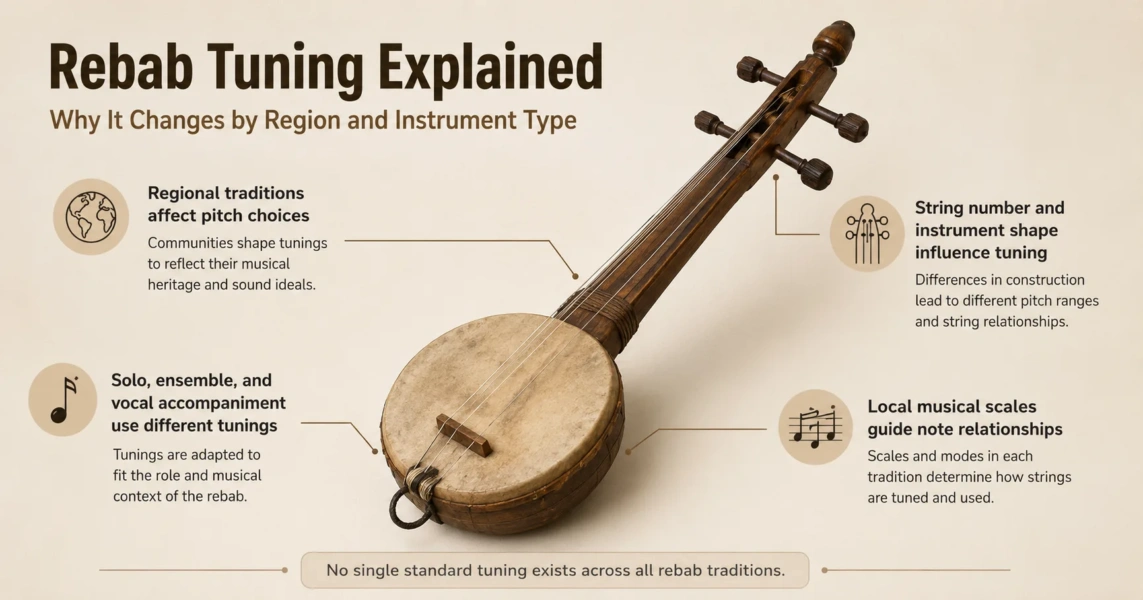
Rebab tuning is not one fixed chart. The word rebab, along with spellings such as rabab, rubab, rubāb, rababa, rebap and rubob, names a family of related string instruments rather than a single standardized model. Some are bowed spike fiddles with one or two strings. Others are plucked lutes with melody strings, drone strings and sympathetic strings. Because the instruments differ in body shape, string layout, playing method and musical setting, their tuning changes by region and instrument type.
Why Rebab Tuning Is So Variable
The main reason is simple: a Bedouin rababah, a Javanese rebab and an Afghan rubab do not solve the same musical problem. They may share a historical name family, but they are built for different repertoires.
A bowed rebab often supports a vocal line, poetic recitation or ensemble melody. Its tuning must allow slides, ornaments and flexible intonation. A plucked rubab needs a different setup because it uses struck strings, drones and resonance. A court or classical ensemble may tune the instrument to match a local pitch system, while a solo player may tune around the singer’s range or the main melodic mode.
Luthier’s Note: Rebab tuning begins with the instrument’s construction. String length, bridge height, skin tension, peg strength, string material and body size all limit how high or low the strings can safely and musically be tuned.
The Name Does Not Tell the Tuning
One common mistake is treating “rebab tuning” as if the spelling gives a direct answer. It does not. In English writing, rebab often points to bowed forms, while rubab often points to Afghan and Central Asian plucked lutes. But usage is not perfectly fixed. Museum labels, regional languages and older sources may use overlapping spellings.
For tuning, the more useful question is not only “Is it called a rebab?” but:
- Is the instrument bowed or plucked?
- How many main strings does it have?
- Does it have drones or sympathetic strings?
- Is it fretted or unfretted?
- Does it play alone, with voice, or inside an ensemble?
- Which regional scale or mode is being used?
Regional and Instrument-Type Differences
The table below shows why a single universal tuning chart cannot cover the whole rebab family.
| Instrument Type | Typical Playing Method | Tuning Logic | Why It Changes |
|---|---|---|---|
| Bedouin rababah | Bowed | Often centered on one main string or a very small string set | Used for vocal, poetic and melodic support; pitch may follow the performer’s voice |
| Javanese or Sundanese rebab | Bowed | Tuned to fit the local gamelan system and ensemble practice | Slendro, pelog, salendro and related systems vary by ensemble and region |
| Afghan rubab | Plucked | Melody strings, drones and sympathetic strings are tuned around the tonal center and scale | Setup changes with repertoire, teacher lineage, scale and instrument design |
| Central Asian rubob or rubab forms | Usually plucked | Frets and string courses guide a more lute-like tuning approach | Local music systems, string count and modern performance needs shape the setup |
| North African or Middle Eastern bowed rabab forms | Bowed | Often tuned to serve modal melody rather than Western chord harmony | Regional maqam practice, voice range and ensemble role affect pitch choices |
Bowed Rebab Tuning
Bowed rebab types usually depend on relative tuning more than fixed concert pitch. The instrument is adjusted so it can sing clearly in the range needed for the performer, singer or ensemble.
On a one-string rababah, “tuning” is not about matching several strings to each other. The single string provides a melodic line, and the player shapes pitch with finger pressure, slides and bow control. This allows expressive flexibility, but it also means written Western-style tuning charts are often too rigid for the tradition.
Two-string bowed rebabs add another layer. The strings may be tuned in a relationship that supports a central pitch, a fifth-like distance or another practical interval used in the local style. In some Southeast Asian forms, the instrument must fit the tuning identity of the ensemble, not an outside standard such as equal temperament.
Why Bowed Rebab Tuning Feels Flexible
An unfretted bowed rebab allows the player to shade notes while performing. This matters because many rebab traditions do not treat pitch as a row of fixed piano keys. Notes may lean, slide or settle differently depending on the phrase.
The bow also affects perceived tuning. A strong bow stroke can sharpen the attack slightly. A softer stroke can let the note settle more gently. Skilled players adjust by ear while playing, especially when accompanying voice.
Plucked Rubab Tuning
The Afghan rubab and related plucked forms need a different explanation. These instruments often have main playing strings, drone strings and sympathetic strings. The tuning must organize all three.
The main strings carry the melody. Drone strings reinforce a tonal center or important scale tones. Sympathetic strings are not usually stopped like melody strings; they vibrate in response when matching or related pitches are played. This gives the rubab its ringing aftersound.
Because of that structure, rubab tuning is not only “what note is each string?” It is also “what scale is the instrument prepared for?” A rubab player may tune sympathetic strings to the notes of the mode or scale used in a piece. When the music changes, those strings may need adjustment.
Listening Note: On a plucked rubab, tuning can be heard after the note is struck. If the sympathetic strings are well matched to the scale, the instrument gives a fine halo of resonance. If they are not matched, the sound can feel dry, uneven or restless.
Why Drones Matter
Drone strings are one reason rebab and rubab tuning often follows musical function rather than a fixed international pitch list. A drone may sit on the tonic, a fifth, a lower support note or another stable tone used by the tradition.
The drone helps the player and listener feel the tonal center. It also colors the instrument. A melody string may play many notes, but the drone keeps pulling the ear back to a home pitch.
This is especially important in music that is modal rather than chord-based. The instrument does not need to support Western-style chord progressions. It needs to support a melodic pathway.
Sympathetic Strings and Scale-Based Tuning
Sympathetic strings are common in several South and Central Asian instruments, including many Afghan rubab examples. They make tuning more delicate because they must be close enough to the intended scale tones to respond cleanly.
If a rubab has many sympathetic strings, the player may tune them across a scale or mode. Some may repeat important notes in more than one octave. This does not mean every rubab is tuned the same way. It means the instrument is being prepared for a musical environment.
That is why rubab tuning can change between lessons, recordings, regions and performers. A beginner may learn one practical default setup. A working musician may adapt the instrument to the singer, composition or ensemble.
Javanese and Sundanese Rebab Tuning
In Java and Sunda, the rebab belongs to a different musical setting. It is a bowed instrument used with gamelan and related ensemble traditions. Here, tuning must respect local scale systems such as slendro, pelog, salendro and regional variants.
These systems are not identical from one ensemble to another. A gamelan is often tuned as a set, and its pitch relationships may not match Western equal temperament. The rebab player listens into that sound and adjusts the instrument and finger placement accordingly.
This is one reason a Western note-name tuning chart can mislead readers. It may offer a rough approximation, but it cannot fully describe how the instrument fits a particular gamelan.
Why One Gamelan Rebab May Not Match Another
Two ensembles can both use slendro or pelog and still differ in pitch. The rebab is not tuned in isolation like a modern guitar taken from one band to another. It belongs to the pitch character of the ensemble around it.
For this reason, “correct” tuning in this context means correct for that ensemble, that repertoire and that local practice.
Bedouin Rababah Tuning
The Bedouin rababah is often described as a single-string bowed spike fiddle with a skin-covered soundbox. Its tuning is closely tied to voice, recitation and melodic delivery.
With one main string, the instrument does not build harmony through several open strings. Instead, the player uses a tuned string as a flexible melodic source. The bow, finger contact and vocal style shape the final pitch more than a fixed fretboard would.
This type of tuning can appear simple from the outside, but it demands a precise ear. The player must place pitches by hand and keep the sound connected to the vocal or poetic line.
Afghan Rubab Tuning
The Afghan rubab is a short-necked plucked lute, usually with a carved wooden body and a skin-covered resonating area. Many examples include melody strings, drone strings and sympathetic strings, though exact layouts can vary.
Its tuning is often taught through relative pitch names such as tonic and fifth rather than only through Western note names. In South Asian-influenced teaching contexts, scale-degree names may also be used. This makes sense because the instrument often serves modal melody, not fixed chord accompaniment.
The tuning must balance three things:
- the main strings must feel playable under the plectrum;
- the drones must support the tonal center without overpowering the melody;
- the sympathetic strings must respond cleanly to the chosen scale.
A rubab that is tuned well does not only sound “in tune” string by string. It speaks as a whole body.
String Material and Tension
Traditional and modern rebab-family instruments may use gut, hair, nylon, steel or other metal strings, depending on region and instrument type. String material affects how tuning behaves.
Hair and gut can respond differently from metal. Nylon may stretch more when first installed. Metal strings can hold pitch firmly but may put more stress on older pegs or delicate bodies if used without care. On skin-covered instruments, humidity can also change the response of the soundboard, which may affect how stable the tuning feels.
Material Note: Older or museum-style instruments should not be forced into a modern pitch standard without checking structure, string type and peg condition. A safe musical pitch is sometimes lower than a tuner app might suggest.
Why Fixed Western Pitch Is Often the Wrong Starting Point
Modern players may ask for rebab tuning in notes such as C, G, D or A. That can be useful for teaching, recording or playing with Western instruments. But many rebab traditions were not built around A=440 or piano-based equal temperament.
In practice, the tuning may be set by:
- the singer’s comfortable range;
- the main mode or scale of the piece;
- the pitch level of an ensemble;
- the tension the instrument can safely hold;
- the sound the player wants from the skin, bridge and strings.
This does not make the tuning vague. It makes it contextual.
Frets, No Frets and Intonation
Frets change how tuning works. A fretted rubob or rubab form gives the player fixed pitch points along the neck. This can make certain scales easier to repeat, though fret placement itself reflects a chosen musical system.
An unfretted rebab gives more freedom. The player can adjust every note by ear. This is useful for modal music, vocal imitation and ornaments, but it also means the performer must control intonation continuously.
Neither system is more advanced by itself. They answer different musical needs.
How Players Usually Approach Rebab Tuning
A practical tuning process often starts with the musical setting rather than the instrument alone.
- Choose the tonal center or main pitch needed for the piece.
- Tune the principal melody string or strings to a comfortable tension.
- Set drone strings to support the tonal center or important stable tones.
- Adjust sympathetic strings, if present, to the scale or mode.
- Check tuning against the voice, ensemble or teacher’s reference.
- Play phrases, not only open strings, to hear whether the setup works musically.
The last step matters. A rebab can seem correct on open strings but feel wrong when ornaments, slides and resonances are added.
Common Misunderstandings About Rebab Tuning
“All Rebabs Use the Same Tuning”
They do not. The rebab family includes instruments with different string counts, bodies and musical roles. A one-string rababah and a many-string Afghan rubab need different tuning logic.
“Rubab Tuning Is Just Guitar Tuning with Different Notes”
A rubab is not tuned like a guitar. Drones and sympathetic strings change the purpose of tuning. The instrument is prepared for resonance and modal melody, not standard chord shapes.
“A Tuner App Gives the Whole Answer”
A tuner app can help with pitch stability, especially for beginners. It cannot fully judge regional intonation, sympathetic response, ensemble blend or modal color.
“If It Sounds Slightly Nasal, It Is Out of Tune”
Not necessarily. Many bowed rebab forms have a focused, nasal or voice-like tone by design. Tuning should be judged by pitch relationship and musical function, not by expecting violin-like smoothness.
Rebab Tuning by Musical Role
The instrument’s job in performance often explains its tuning better than its name.
| Musical Role | Tuning Priority | Resulting Sound |
|---|---|---|
| Voice accompaniment | Match the singer’s range and phrasing | Flexible, speech-like or vocal tone |
| Solo plucked performance | Balance melody, drones and sympathetic strings | Clear attack with ringing resonance |
| Gamelan ensemble | Fit local scale and ensemble pitch | Expressive melodic line inside a tuned group sound |
| Poetic recitation | Support a narrow melodic field | Direct, intimate and rhythmically responsive |
| Modern cross-cultural performance | Negotiate with fixed-pitch instruments | Often adapted toward practical note-name tunings |
Why Regional Tuning Should Be Treated Carefully
Regional labels are helpful, but they can become too neat. “Afghan rubab tuning” does not mean every Afghan rubab player uses one identical setup. “Javanese rebab tuning” does not mean every Javanese ensemble shares the same pitch level. “Rababah tuning” does not mean every single-string bowed instrument is tuned to the same note.
The safer way to describe rebab tuning is by layers: instrument construction, string layout, regional scale system, repertoire and performer practice. Those layers explain why one name can carry many tunings.
FAQ About Rebab Tuning
Is There a Standard Rebab Tuning?
There is no single standard tuning for the whole rebab family. Tuning changes according to region, instrument type, string count, playing method and musical setting.
Why Does Afghan Rubab Tuning Include So Many Strings?
Many Afghan rubab examples include melody strings, drone strings and sympathetic strings. The extra strings help support the tonal center and create resonance around the chosen scale or mode.
Can a Rebab Be Tuned with a Guitar Tuner?
A tuner can help set reference pitches, but it should not be treated as the full answer. Many rebab traditions use flexible intonation, modal pitch relationships or ensemble-specific tuning.
Do Bowed and Plucked Rebabs Use the Same Tuning?
No. Bowed rebabs and plucked rubabs are built and played differently. Bowed forms often focus on melodic flexibility, while plucked forms may need drones and sympathetic strings tuned to the scale.
Why Does Rebab Tuning Change by Region?
Each region uses the instrument in a different musical system. Local scales, vocal practice, ensemble pitch, construction style and teaching lineage all shape how the instrument is tuned.