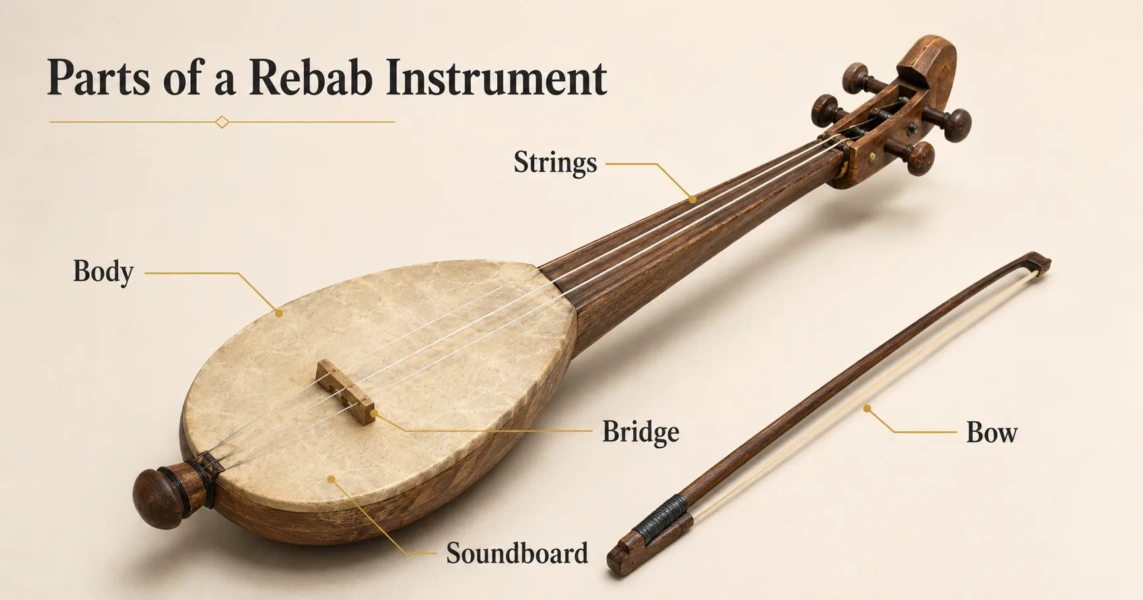
A rebab is best understood through the way its parts share tension: the strings pull across a small bridge, the bridge presses into a skin or wooden soundboard, and the body turns that pressure into tone. In bowed forms, the bow adds friction and vocal grain. In plucked rubab forms, the hand or plectrum gives the instrument a sharper attack.
The word rebab can point to more than one regional instrument. It may appear as rabab, rabāb, rubab, rubāb, rebap, rubob, or rababa. Some forms are bowed spike fiddles. Some are boat-shaped fiddles. Some are plucked lutes with sympathetic strings. Because of that, the parts of a rebab instrument should be read as a family pattern rather than a single fixed blueprint.
Rebab Instrument Parts and Their Main Functions
Most rebab-family instruments use the same basic acoustic idea: a resonating body, a vibrating surface, strings under tension, and a bridge that carries string energy into the soundboard. The visible shape changes by region, but these parts explain how the instrument works.
| Part | What It Does | Common Variation |
|---|---|---|
| Body | Holds the resonating air space and supports the neck, soundboard, strings, and fittings. | Boat-shaped, bowl-shaped, box-like, carved wooden, coconut-shell, or skin-covered frame forms. |
| Strings | Create the vibrating source of the sound. | One to several main strings; some rubab forms also include drone or sympathetic strings. |
| Bow | Sets bowed strings into motion through controlled friction. | Used on bowed rebabs; plucked rubabs use a plectrum or fingers instead. |
| Bridge | Transfers string vibration into the soundboard and helps set string height. | Small wooden pressure bridge, higher carved bridge, or a bridge adapted to skin tension. |
| Soundboard | Receives vibration from the bridge and helps shape volume, attack, and tone color. | Often skin, parchment, vellum, or membrane; some related lutes use wood. |
Terminology Note: A bowed North African rebab, a Javanese gamelan rebab, a Bedouin rababa, and an Afghan rubab do not share identical construction. The shared name marks a broad chordophone family, not one universal instrument plan.
The Body: Resonator, Shape, and Balance
The body is the part that gives the rebab its physical identity. It may be a compact resonator attached to a spike neck, a boat-shaped wooden shell, a skin-covered frame, or a carved lute-like chamber. Its job is not only to hold the parts together. It also controls how much air moves when the strings vibrate.
In many bowed rebabs, the body is small compared with violin-family instruments. This helps explain the close, direct tone. The sound often has a narrow center rather than a broad orchestral spread.
Body Shapes in Different Rebab Forms
The body shape changes with local playing practice and available materials.
- Spike fiddle bodies often have a neck or spike that passes through or attaches to a small resonator.
- Boat-shaped bodies are associated with some North African rebab forms and are often used with two strings and a bow.
- Box or frame bodies appear in some rababa traditions, where skin may cover one or both sides.
- Carved wooden bodies are common in plucked rubab traditions, especially where the instrument carries several strings.
Materials Used for the Body
Wood is common, but the exact material varies. Museum examples and regional instruments show wood, skin, metal fittings, horn, ivory in older high-status pieces, mother-of-pearl inlay, and other decorative or practical materials. Some Javanese rebab examples use a small resonator associated with coconut shell construction, while other forms use carved or framed wooden bodies.
Wood choice can shape resonance, weight, and response, but it should not be treated as a simple formula. The body works with the soundboard, bridge, strings, neck angle, and player technique.
The Strings: Main Strings, Drones, and Sympathetic Strings
The strings are the vibrating source of the rebab’s sound. On bowed rebabs, they are activated by the bow. On plucked rubabs, they are struck or plucked. String count is one of the easiest details to misread because the family includes both very simple and highly strung forms.
Many bowed rababa and rebab forms use one, two, or three main strings. A North African rebab may have two strings. Some Bedouin rababa examples use a single string. A Javanese rebab commonly belongs to the bowed, unfretted spike-fiddle type. Plucked rubab and rubob forms may use more strings, including melody, drone, and sympathetic strings.
Main Strings
Main strings are the strings the player directly stops or plucks for melody. In bowed forms, the player may stop the string with fingertips rather than pressing it against a fretted fingerboard. Some rebabs do not have frets at all, so pitch depends on ear, hand position, and the pressure of the left hand.
Materials vary. Older and regional instruments may use gut, horsehair, metal, silk-like materials, nylon, or modern replacements. A single-string rababa with horsehair behaves very differently from a plucked rubab with metal or nylon strings.
Drone and Sympathetic Strings
Some rubab forms add drone or sympathetic strings. Drone strings provide a repeated pitch or tonal base. Sympathetic strings vibrate in response to nearby pitches and can add a light after-sound beneath the played note.
This makes the instrument richer in resonance but also harder to tune. A small change in bridge pressure, membrane tension, or humidity can affect several strings at once.
Luthier’s Note: String count alone does not define the sound. A two-string bowed rebab with a responsive skin soundboard can sound more vocal and flexible than a larger instrument with many strings but a stiffer setup.
The Bow: How Bowed Rebabs Speak
The bow is central to many rebab traditions, but not to every instrument using the rebab or rubab name. Bowed rebabs use friction: the bow hair catches and releases the string in rapid motion. That motion is passed through the bridge into the soundboard.
Many traditional bows are simple in outline compared with modern violin bows. They may use wood and horsehair, though surviving museum examples may have missing or replaced hair. The bow does not only start the sound; it also shapes the note after it begins.
Bow Pressure and Tone
Light pressure can produce a thin, flexible line. More pressure can bring out grain, bite, or a tighter nasal color. On a small skin-topped resonator, the difference can be easy to hear.
This is one reason bowed rebabs often sound close to the human voice. The player can lean into a note, loosen it, bend it, or let the bow texture remain audible.
When a Rebab Does Not Use a Bow
Afghan rubab and some Central Asian rubob forms are plucked rather than bowed. They may still share naming history with the rebab family, but the playing mechanics change. A plectrum creates a quicker attack and a more percussive edge. The bridge and soundboard still matter, but the string is set in motion differently.
The Bridge: Small Part, Large Acoustic Role
The bridge is the small part that stands between the strings and the soundboard. It holds the strings above the surface and transfers their vibration downward. On many rebabs, the bridge is not a decorative afterthought. It is one of the most sensitive parts of the instrument.
On a skin soundboard, the bridge presses into a flexible membrane. If the bridge is too heavy, too tall, badly seated, or placed poorly, the instrument may lose response. If it is too light or unstable, the sound can become thin or uneven.
Bridge Placement
Bridge placement affects string length, playing feel, and soundboard pressure. On traditional instruments, this is often adjusted by makers and experienced players rather than treated as a fixed factory measurement.
A small movement can change tone. It may also affect tuning stability, especially on skin-topped instruments where tension changes with temperature, humidity, and age.
Bridge Shape and Height
The bridge shape depends on the instrument type. A bowed rebab needs a string layout that allows the bow to reach the strings cleanly. A plucked rubab may use a bridge shape suited to courses, drones, or sympathetic strings.
The height also changes the left-hand feel. Higher strings can allow clear vibration but may demand more finger pressure. Lower strings can feel easier but may buzz or lose clarity if the setup is poor.
The Soundboard: Skin, Wood, and Response
The soundboard is the vibrating face of the instrument. In many rebab-family instruments, this part is skin, parchment, vellum, or another membrane rather than a carved wooden top. That detail strongly affects the attack and the way the tone decays.
A skin soundboard can react quickly. It often gives a dry, direct, speaking quality. It can also make the instrument sensitive to weather and room conditions. When the membrane tightens or loosens, the bridge pressure and tuning may shift.
Skin Soundboards
Skin soundboards appear in many bowed rebab and rababa forms, as well as in plucked rubab forms. The skin may be stretched over a frame, bowl, box, or carved resonator. Some examples use animal skin on one side; others use skin on both front and back.
The surface is not passive. It behaves like a flexible drumhead under string pressure. That is why the bridge fit and membrane tension matter so much.
Wooden Soundboards
Some related lutes use wooden soundboards, and certain regional instruments near the rebab naming field may be built with wood tops. A wooden soundboard usually behaves differently from skin. It can give a more stable surface, but the exact tone depends on thickness, bracing, body shape, and string tension.
For the rebab family, it is safer to identify the actual instrument type before assuming the soundboard material.
Material Note: A skin soundboard is one reason many rebabs have a focused, immediate voice. The same material can also make the instrument more sensitive to humidity, storage conditions, and bridge pressure.
How the Parts Work Together
The rebab’s tone comes from a chain of contact. The string vibrates. The bridge receives that motion. The soundboard spreads it across a larger surface. The body adds air resonance and projection. The player controls the result with bow pressure, plucking force, left-hand pressure, and tuning.
Changing one part can change the whole instrument. A different bridge may alter response. A new string material may brighten the sound. A tighter membrane may raise tension and sharpen the attack. A heavier body may feel steadier but respond differently under the hand.
The Sound Path
- The player bows or plucks the string.
- The string vibrates at a pitch shaped by length, tension, and thickness.
- The bridge carries that vibration into the soundboard.
- The soundboard moves air and activates the resonating body.
- The body and setup shape volume, sustain, and tone color.
Regional Differences in Rebab Construction
Regional use changes the anatomy. A Javanese rebab used in gamelan, a North African rebab used with singing, a Bedouin rababa used with poetry, and an Afghan rubab used as a plucked lute all show different solutions to the same acoustic task.
Bowed Rebab Forms
Bowed forms often use fewer strings and rely on line, ornament, and vocal inflection. The body may be small, the soundboard may be skin or vellum, and the bridge may be a delicate pressure point between string and membrane.
These instruments are often fretless. The player finds pitches by ear and hand memory, which allows slides, subtle pitch movement, and flexible ornament.
Plucked Rubab and Rubob Forms
Plucked rubab and rubob forms may have more strings, frets in some regional examples, a carved body, and a skin-covered soundboard. They do not use the bow as their main sound source. Their anatomy serves attack, resonance, and rhythmic clarity.
Some decorated examples use inlay, multiple woods, and modern string materials. These details may show craft identity as much as acoustic design.
Common Misunderstandings About Rebab Parts
Several mistakes appear often when people first identify a rebab instrument. The first is assuming every rebab is bowed. The second is assuming every rubab is the Afghan plucked form. The third is judging the instrument only by string count.
- Not every rebab has the same body. The family includes spike fiddles, boat-shaped fiddles, and plucked lutes.
- Not every rebab uses a bow. Bowed rebabs and plucked rubabs share a naming field but use different playing methods.
- Not every soundboard is wood. Many rebab-family instruments use skin, parchment, or vellum.
- Not every bridge is fixed in the same way. Bridge placement and pressure can be part of the setup.
- Not every string count means the same thing. Main strings, drones, and sympathetic strings should be counted separately when possible.
How to Identify the Parts on a Rebab
Start with the body and soundboard. If the face looks like stretched skin or parchment, the instrument likely uses a membrane soundboard. Then look for the bridge: it is the small raised part where the strings cross the vibrating surface.
Next, count only the strings that are played directly. After that, look for shorter or thinner strings that may be drones or sympathetic strings. If the instrument has a bow, it belongs to a bowed setup. If it has a plectrum or a wide plucking area, it may be a rubab or rubob type rather than a bowed rebab.
Inspection Order
- Look at the body shape: bowl, boat, box, spike-fiddle, or carved lute form.
- Identify the soundboard material: skin, parchment, vellum, or wood.
- Find the bridge and note how it meets the soundboard.
- Count main strings separately from drone or sympathetic strings.
- Check whether the instrument is bowed or plucked.
- Look for frets, tuning pegs, tailpiece, spike, and decoration only after the main structure is clear.
FAQ
What are the main parts of a rebab instrument?
The main parts are the body, strings, bridge, soundboard, neck, tuning pegs, and, in bowed forms, the bow. Some rubab forms also include drone strings, sympathetic strings, frets, a plectrum, and decorative inlay.
Does every rebab have a bow?
No. Many rebabs are bowed, including several North African, Middle Eastern, and Southeast Asian forms. Afghan rubab and some Central Asian rubob forms are plucked, so they use a plectrum or fingers rather than a bow.
What is the soundboard on a rebab made from?
Many rebab-family instruments use skin, parchment, vellum, or another membrane as the soundboard. Some related lutes use wood, but it is not safe to assume a wooden top without identifying the regional form.
Why is the bridge so important on a rebab?
The bridge transfers string vibration into the soundboard. On skin-topped rebabs, bridge pressure can strongly affect tone, tuning stability, and response. A small bridge can have a large effect on the instrument’s voice.
How many strings does a rebab have?
There is no single number. Some rababa forms have one string, many bowed rebabs have two or three, and some plucked rubab forms have more because they may include melody, drone, and sympathetic strings.
How can someone tell a bowed rebab from a plucked rubab?
A bowed rebab is normally identified by its bowing setup, fewer main strings, and a bridge arranged for bow access. A plucked rubab usually has a lute-like body, a plectrum-based playing method, and may include extra strings for resonance.