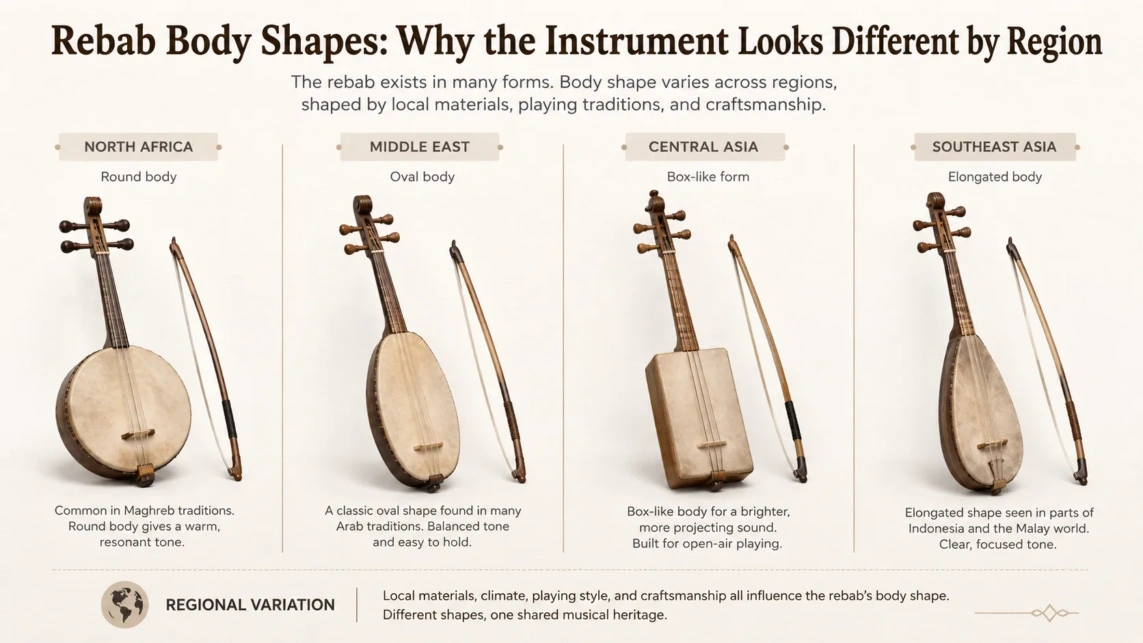
Rebab body shapes vary because the name rebab does not point to one fixed object everywhere. It describes a family of related string instruments whose bodies were adapted to local materials, playing positions, sound ideals, and craft traditions. A spike fiddle with a skin-covered bowl, a carved wooden rubab with a waisted body, and a simple one-string rababa can all belong to the wider rebab story, even when they look very different on a table or in a museum case.
Why Rebab Body Shapes Change by Region
The body of a rebab is not only a visual feature. It affects how the instrument is held, how the strings are supported, how the soundboard vibrates, and how the instrument fits into a musical setting. Regional makers shaped the body around practical needs first: available wood, animal skin, gourd, coconut shell, carving tools, transport, climate, and the role of the instrument in poetry, court music, folk performance, devotional settings, or ensemble playing.
That is why a rebab should not be judged by one standard outline. Some regional forms are narrow and portable. Others are deeper, rounded, boat-like, or carved from a larger block of wood. Some use a skin soundboard, while others use wood or a mixed construction. These differences are part of the instrument’s identity, not deviations from it.
| Regional Form | Typical Body Shape | Soundboard Type | Playing Method | Main Reason for the Shape |
|---|---|---|---|---|
| Arab Rababa | Rectangular, box-like, or simple frame body in many examples | Often skin-covered | Bowed | Portability, vocal support, and clear direct tone |
| North African Rebab | Small rounded, boat-like, or elongated body depending on local type | Often skin or mixed construction | Bowed | Flexible use in regional song and ensemble settings |
| Persian and Central Asian Related Forms | Carved wooden bodies, sometimes rounded or waisted | Wood, skin, or combined surfaces depending on type | Bowed or plucked, depending on instrument | Local craft methods and tonal balance |
| Afghan Rubab | Deep carved wooden body with a waisted outline | Skin-covered resonating area on many examples | Plucked | Strong resonance, sympathetic strings, and solo melodic use |
| Southeast Asian Rebab | Small rounded or pear-like body in several traditions | Often skin-covered | Bowed | Bright response for ensemble textures and ornamented melody |
Body Shape Is Linked to Instrument Type
The first reason rebabs look different is simple: not every regional rebab belongs to the same construction type. Some are bowed spike fiddles, with a neck passing through or into a resonator. Others are plucked lutes, especially in the rubab family of Central and South Asian music. A bowed spike fiddle needs a body that responds well to continuous bow pressure. A plucked rubab needs a body that can carry attack, decay, and resonance after the string is struck.
This difference changes the body from the beginning. A bowed rebab can work with a small resonator because the bow keeps the string vibrating. A plucked rubab often benefits from a deeper wooden body and a broader resonating area because each note must bloom after a single stroke.
Luthier’s Note: Body size alone does not decide quality. A smaller skin-covered rebab may produce a focused, vocal tone, while a larger carved rubab may offer more sustain and lower resonance. The body must be judged together with the bridge, strings, soundboard, neck angle, and playing style.
Skin-Covered Bodies and Wooden Bodies
Many rebab-family instruments use a stretched skin soundboard. Skin is light, responsive, and well suited to instruments that need a nasal, direct, speech-like tone. It can make a small body feel alive under the bow or plectrum. The exact result depends on thickness, tension, bridge pressure, humidity, and the shape of the resonator beneath it.
Wooden soundboards behave differently. They can support a more rounded resonance, especially when paired with a carved body. In some instruments, wood and skin appear together: the body may be carved from wood, while the main vibrating membrane is skin. This mixed approach is common in several rubab and rebab-related traditions.
Why Skin Was Common in Many Regions
Skin-covered construction was practical. Animal skin was available in many pastoral and rural settings, and it allowed makers to create responsive instruments without needing thin, carefully graduated wooden plates. It also worked well for compact instruments used with voice, poetry, and mobile performance.
Why Carved Wood Became Important Elsewhere
Carved wooden bodies appear where woodworking traditions, instrument workshops, and musical demands supported them. A carved body can provide more internal volume, a stronger neck-body connection, and room for extra strings or decorative shaping. The Afghan rubab is one of the clearest examples of this approach, with its deep body, carved form, and complex string layout.
Round, Bowl, Box, and Waisted Bodies
Rebab body shapes often fall into a few broad visual families, though local examples can blur the lines.
- Round or bowl-like bodies help create a compact resonating chamber and are common in many bowed spike fiddle traditions.
- Box-like bodies can be easier to build with flat materials and may suit simple, portable instruments.
- Boat-like bodies appear in some regional bowed forms where a narrow resonator supports a focused tone.
- Waisted carved bodies are associated with plucked rubab types, especially where the body must support more strings and a stronger bridge area.
- Pear-shaped bodies appear in several related bowed instruments where the body narrows toward the neck and widens near the resonating chamber.
The outline is only part of the story. Depth matters. A shallow body can sound immediate and dry. A deeper body may support more resonance, though this depends on construction. A rounded back, a flat back, and a hollowed wooden block will not respond in exactly the same way.
How Materials Shape Regional Forms
Regional rebab construction often follows the materials close at hand. Makers may use hardwood, softer local woods, coconut shell, gourd, animal skin, gut, silk, metal strings, bone, horn, or modern substitutes. The material choice can shape resonance and durability, but it should be described with care. A wood species does not guarantee one sound by itself.
In many older and rural traditions, the maker worked with what could be repaired, replaced, and understood locally. That practical logic explains why some rebabs look plain while others are heavily carved or decorated. Decoration often reflects the instrument’s social setting, not just the maker’s skill.
Playing Position Also Changes the Body
A rebab held vertically can have a very different body from one held across the lap. Bowed spike fiddles often rest against the player’s body, the floor, or the lap, with the neck rising upward. This favors a narrow body, a spike or lower extension, and a bridge position suited to bowing.
A plucked rubab is usually built for a different hand position. The body must sit securely, support the picking hand, and allow access to melody strings and sometimes sympathetic strings. This helps explain the stronger carved body and broader face seen in Afghan and related rubab forms.
Regional Examples of Rebab Body Design
Arab Rababa: Simple Body, Direct Voice
The Arab rababa is often known for a simple body, a limited number of strings, and close connection to sung poetry and narrative performance. Many examples use a skin-covered resonator with a plain outline. The body does not need to be large to do its job. It supports a clear bowed line that follows the human voice closely.
The simplicity is functional. A light body is easy to carry, repair, and tune to the needs of the performer. Its visual restraint also fits traditions where the instrument accompanies text rather than competing with it.
North African Rebab: Regional Bowed Forms
North African rebab types vary across local traditions. Some have narrow or boat-like bodies; others are more rounded. The body shape often reflects ensemble use, regional song style, and the balance needed between voice, percussion, and other melodic instruments.
In these traditions, the rebab may not be built for long sustain. A focused, textured sound can be more useful than a wide resonant tone, especially when the instrument carries ornamented lines within a dense musical setting.
Afghan Rubab: Deep Carved Body and Strong Resonance
The Afghan rubab looks different from many bowed rebabs because it is a plucked lute rather than a bowed spike fiddle. Its body is usually carved from wood, with a deep resonating chamber and a distinctive waisted outline. Many examples include a skin-covered soundboard area, melody strings, drone strings, and sympathetic strings.
The body must do more than hold strings. It supports a complex bridge system, strong attack from the plectrum, and a resonant response suited to melodic performance. Its shape also leaves room for regional ornament, carved details, and a recognizable profile.
Southeast Asian Rebab: Compact Body for Ensemble Color
Several Southeast Asian traditions use rebab forms with small rounded or pear-like bodies. These instruments often appear in ensemble music where the bowed line adds color, ornament, and melodic guidance. A compact body can produce a bright, responsive tone that cuts through without needing great volume.
The shape also suits the seated playing positions common in these settings. The instrument can be held close to the body while the bow creates flexible melodic curves.
Why Some Rebabs Have Long Necks
Many rebabs have long, narrow necks because the body is not designed like a modern violin or guitar. The neck may pass into the body, connect to a spike, or continue through the resonator. This structure helps keep the instrument light and stable while allowing the body to remain small.
A long neck also gives visual balance to a compact resonator. In bowed forms, it helps place the strings at a workable angle for the bow. In plucked forms, neck length and fingerboard design depend on the scale length, string tension, and regional playing technique.
Body Shape and Timbre
Different body shapes can guide the listener toward different tone qualities. A small skin body may sound dry, nasal, and immediate. A deeper carved body may sound fuller and more resonant. A narrow body can create a focused tone; a wider body may offer more air and warmth.
These are general tendencies, not fixed rules. The bridge, string material, soundboard tension, and player’s technique can change the sound as much as the outline of the body.
Listening Note: When comparing rebabs from different regions, listen for attack and decay. Bowed skin-bodied forms often speak quickly and sustain through the bow. Plucked rubabs create a stronger initial attack, then rely on body depth and string layout for resonance.
Decoration, Identity, and Craft Tradition
Body shape also carries cultural identity. A plain rababa body may reflect a portable oral tradition. A carved rubab body may show workshop lineage and regional aesthetics. Painted, inlaid, or carved details can mark a local style, but decoration should not be confused with the instrument’s basic type.
Museum labels sometimes group instruments under broad names such as rebab, rabab, rubab, or rebap. These names are useful, but they can hide important differences. The body shape often gives the best first clue: bowed spike fiddle, plucked lute, skin resonator, carved chamber, or local hybrid.
Why the Same Name Can Mean Different Shapes
The spellings rebab, rabab, rubab, rubāb, rababa, rebap, and rubob moved across languages and regions. Over time, related names attached to different but connected instruments. Some remained bowed. Some became plucked. Some kept skin soundboards. Others developed carved wooden bodies and extra strings.
This is why body shape matters when identifying the instrument. The name gives a family connection, but the body explains the regional form.
How to Identify a Rebab by Body Shape
- Look at the soundboard. Skin suggests many bowed rebab and rubab-related traditions, though it is not limited to one region.
- Check whether the instrument is bowed or plucked. Bowed forms often have smaller bodies and simpler string layouts.
- Notice the body depth. A deep carved body often points toward plucked rubab traditions.
- Look for a spike or lower extension. This can suggest a spike fiddle structure.
- Count the visible string groups carefully. Sympathetic strings, drones, and melody strings can help separate rubab types from simpler rebab forms.
- Study the bridge placement. A bridge sitting on skin behaves differently from one on a wooden table.
Common Misunderstandings About Rebab Body Shapes
One common mistake is to treat the violin-like bowed rebab as the only “real” rebab. Another is to assume the Afghan rubab is unrelated because it is plucked and more heavily built. The better approach is to see these instruments as regional members of a broad historical family, with different body solutions for different musical tasks.
Another mistake is to identify a rebab only by decoration. Ornament may help locate a workshop style, but the construction tells more: resonator shape, soundboard material, neck design, string layout, and playing method.
Body Shape as a Map of Use
The body of a rebab records how the instrument was meant to live. A portable rababa body suits singers, poets, and mobile performance. A compact Southeast Asian rebab body suits ensemble color and melodic ornament. A deep Afghan rubab body suits plucked resonance, sympathetic strings, and a stronger solo presence.
These regional shapes are not random. They show how makers solved the same basic problem in different ways: how to stretch strings over a resonating body and make that body speak in the music around it.