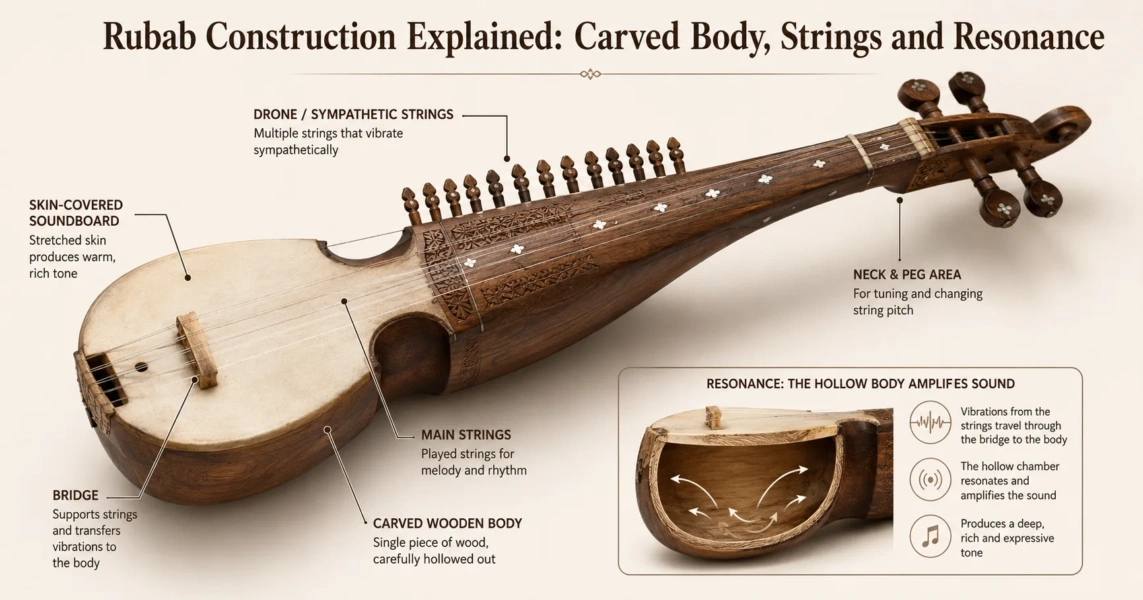
The rubab is built around a simple but demanding idea: a carved wooden body, a skin-covered resonating face, and several groups of strings that do different musical jobs. In Afghan, Kabuli, Central Asian and related South Asian forms, the instrument is usually a plucked short-necked lute rather than a bowed rebab. Its sound comes from the way wood, skin, bridge pressure and string tension work together.
What Makes Rubab Construction Different
A rubab does not behave like a guitar, oud, violin or long-necked tanbur. The body is commonly carved and hollowed from wood, often mulberry in Afghan examples, instead of being built from many thin ribs. The lower resonating area is covered with skin or parchment, and the bridge sits on that membrane.
This matters because the first attack of the note is shaped by the plectrum and the skin top. The carved chamber then adds body to the sound, while drone and sympathetic strings can add a ringing layer around the main melody.
| Part | Usual Form | Effect on Sound or Playing |
|---|---|---|
| Carved Body | Hollowed wooden body, often made from mulberry in Afghan rubab traditions | Supports a compact, warm resonance with a firm physical feel |
| Skin Soundboard | Animal skin or parchment stretched over the lower bowl | Gives a dry, quick attack and reacts strongly to bridge pressure |
| Bridge | Placed on the skin-covered resonating face | Transfers string vibration into the membrane and body |
| Melody Strings | Often three main strings, though setups vary | Carry the played melody and most visible finger movement |
| Drone Strings | Usually two or three longer supporting strings on many Afghan rubabs | Add a tonal floor and rhythmic emphasis when brushed or struck |
| Sympathetic Strings | Thin strings that are not normally fingered for melody | Respond to matching pitches and add a fine after-ring |
The Carved Wooden Body
The rubab body is one of its clearest identifying features. On many Afghan rubabs, the body and short neck are carved from a single block or trunk section. The maker hollows the lower body to form the sound chamber, leaving enough mass for strength while removing enough wood for response.
Mulberry is strongly associated with Afghan rubab making, but regional instruments and workshop examples may use other suitable woods. Wood choice can shape weight, response and resonance, yet it should not be treated as a fixed formula. The maker’s carving, chamber depth, skin tension and setup are just as important.
The carved form also affects how the instrument feels in the hands. A rubab has a compact center of gravity. It is not a long, open-necked lute made for wide chord shapes. It is built for plucked melody, rhythmic articulation, drone support and resonant color.
Luthier’s Note: A carved rubab body should not be judged only by decoration or surface polish. The inner hollow, the thickness left around the bowl, the neck angle, the bridge position and the skin tension all affect how the instrument speaks.
The Skin-Covered Resonating Face
Many plucked rubabs use a skin soundboard rather than a flat wooden top. This is one reason the instrument has a crisp, percussive front edge. When the plectrum strikes a string, the bridge presses energy into the skin, and the membrane answers quickly.
The skin top can make the rubab feel lively under the hand, but it also makes setup sensitive. Humidity, age and tension can change the response. A tight skin may give a sharper attack. A looser or tired membrane may reduce clarity or make the bridge area feel unstable.
The bridge is not just a support for string height. It is the meeting point between string tension and the skin-covered body. Small changes in bridge shape, placement or pressure can alter attack, sustain and balance between the main strings and the resonating body.
String Groups on the Rubab
The rubab is often misunderstood because its strings do not all have the same function. On many Afghan-style instruments, there are main melody strings, drone strings and sympathetic strings. Counting them without naming their role creates confusion.
Main Melody Strings
The main strings are the strings the player uses most directly for melody. Many descriptions of the Afghan rubab refer to three melody strings, often tuned in fourths, but exact practice can vary by region, teacher, maker and instrument size.
These strings are plucked with a plectrum. Their sound is direct and articulate. The note begins quickly, then the body and sympathetic strings add color around it.
Drone Strings
Drone strings support the tonal center. They may be struck, brushed or used as part of rhythmic phrasing rather than fingered like the main melody strings. Their role is not the same as bass strings on a guitar.
On a well-set rubab, drones help the instrument sound larger than its short neck suggests. They give the player a stable tonal ground while the melody moves above it.
Sympathetic Strings
Sympathetic strings are thin strings that vibrate in response to related pitches. The player usually does not stop them with the fingers during normal melody playing. Instead, they answer when the main strings produce nearby notes.
This response can be subtle. It may sound like a fine shimmer after the plucked note, especially in a quiet room or close recording. If the sympathetic strings are poorly tuned or the skin and bridge are unstable, the effect can become weak or blurred.
Listening Note: The rubab’s resonance is not only sustain. A note can decay quickly and still feel resonant because the body, drones and sympathetic strings leave a short after-sound around the pitch.
How the Body and Strings Create Resonance
Rubab resonance comes from a chain of contact. The plectrum starts the string. The string moves the bridge. The bridge loads the skin. The skin excites the carved wooden chamber. Other strings may answer if their tuning and tension relate to the note being played.
This chain explains why the rubab can sound both dry and ringing. The skin gives the attack a firm edge. The wooden body adds depth. The extra strings add a halo, but not in the same way as a reverb effect. It is mechanical resonance inside the instrument.
The best examples have balance. If the skin is too dull, the sound may lose bite. If the sympathetic strings are too loud, the melody can lose definition. If the bridge is badly fitted, the instrument may sound thin even when the wood and decoration look good.
Materials and Their Practical Roles
Traditional and modern rubabs may combine natural and modern materials. Older or historically styled instruments may use gut, skin, wood, bone or mother-of-pearl decoration. Modern instruments may use nylon, steel and other available materials, especially for durability and tuning convenience.
Material choice should be described carefully. A named wood does not guarantee a good instrument. A decorated fingerboard does not prove fine tone. Construction quality depends on how the maker brings the materials together.
- Wood provides the carved structure, chamber shape and physical mass.
- Skin or parchment forms the responsive membrane under the bridge.
- Main strings carry melody and direct articulation.
- Drone strings support tonal grounding and rhythmic color.
- Sympathetic strings add response around matching or related pitches.
- Pegs and bridge control tension, height and transfer of vibration.
Decoration, Inlay and Craft Detail
Many rubabs show carved ornament, inlay, patterned fingerboards or decorative borders. Mother-of-pearl, bone-like materials and carved motifs may appear on Afghan and related instruments. These details can show workshop style, regional taste or the status of a particular instrument.
Decoration should not be confused with construction quality. It may help identify a maker’s style or a regional design habit, but tone depends more on the body, skin, bridge, strings and setup.
For collectors and museums, decoration still matters. Inlay, carving and wear patterns can help describe an object’s age, use and cultural setting. For players, the more urgent questions are playability, stable tuning, skin condition and string response.
Regional Variation in Rubab Construction
The spelling rubab may refer to several related instruments across Afghanistan, Central Asia, Pakistan, northern India and nearby traditions. Rubab, rabab, rubāb, robab and rubob are not always used in the same way. Some names point to plucked short-necked lutes; others may be used more broadly in regional speech.
This article focuses on the plucked carved rubab associated especially with Afghan and Kabuli forms. That distinction is useful because the word rebab or rabab can also refer to bowed instruments in Arab, Malay, Javanese, North African and other traditions. Those instruments may share a historical name family, but their construction and playing method can be very different.
Afghan and Kabuli Forms
Afghan and Kabuli rubabs are often described with a carved wooden body, skin face, short neck, main strings, drone strings and sympathetic strings. The instrument is plucked with a plectrum and has a strong rhythmic character.
Central Asian Rubob and Related Forms
Central Asian rubob forms may share the plucked lute identity, but construction details can differ. Body outline, string count, neck shape and local tuning practice should be checked instrument by instrument.
Why One Standard Description Is Risky
Rubab-family instruments were shaped by local makers, performers and available materials. A single fixed specification can hide real variation. The safest description names the exact regional form whenever possible.
How to Read a Rubab Visually
A rubab can often be identified by looking at a few construction clues rather than by relying only on the label.
- Look for a carved, hollowed wooden body rather than a rib-built bowl.
- Check whether the lower face is covered with skin or parchment.
- Notice whether the bridge sits on the skin-covered area.
- Separate the main melody strings from drone and sympathetic strings.
- Look for a short neck and compact body rather than a long-necked lute outline.
- Check for side pegs or extra string paths that suggest sympathetic strings.
These signs help separate a plucked rubab from bowed rebabs, sarods, tanburs, ouds and other lutes that may share some visual features.
Common Construction Problems
Old or poorly stored rubabs often show problems around the skin, bridge and pegs. A cracked decorative area may look dramatic, but a weak membrane or unstable bridge can affect the sound more directly.
| Visible Issue | Possible Meaning | Why It Matters |
|---|---|---|
| Loose or sunken skin | The membrane may have lost tension or reacted to humidity | Can reduce attack, volume and tuning stability |
| Bridge leaning or slipping | String pressure may not be balanced across the skin | Can cause poor tone, buzzing or uneven response |
| Stiff or slipping pegs | Pegs may be worn, dry or badly fitted | Makes tuning difficult, especially with many strings |
| Missing sympathetic strings | The instrument may still play, but with less after-ring | Changes the expected rubab resonance |
| Body cracks near the bowl | Wood movement, impact or age may have weakened the structure | Can affect strength and sound transfer |
Collector’s Note: A rubab with missing strings is not always incomplete in the same way. Missing main strings stop normal playing. Missing sympathetic strings may still allow melody, but the instrument will not show its full resonant character.
Rubab Construction Compared with Similar Instruments
The rubab is close enough to several lutes that confusion is common. Construction details usually solve the problem.
| Instrument | Construction Clue | Main Difference from the Rubab Focused on Here |
|---|---|---|
| Sarod | Metal fingerboard, smooth playing surface and a different modern concert setup | Related in discussion, but built and played with a different classical design language |
| Oud | Ribbed bowl body and wooden soundboard | No skin membrane under the bridge in the usual oud form |
| Tanbur | Long neck with a different body-to-neck proportion | Built for another playing layout and regional role |
| Bowed Rebab | Often spike-like or bowed construction, depending on region | Played with a bow rather than a plectrum and usually has a different body system |
Why the Rubab Sounds Percussive and Warm
The rubab’s sound is often described as percussive because each note has a clear start. The plectrum gives the string a firm strike, and the skin-covered bridge area responds quickly. The note does not bloom in the same way as many long-sustain wooden-top lutes.
Warmth comes from the carved body and the lower resonance of the chamber. Ring comes from sympathetic strings when they are present and tuned well. The result is a tone that can feel dry at the front and glowing at the edge.
This is why rubab construction is best understood as a system. The carved body alone does not explain the tone. Neither do the strings alone. The instrument’s voice comes from the contact between wood, membrane, bridge, strings and hand.
Why Construction Knowledge Helps Listeners and Players
Knowing how a rubab is built makes the sound easier to understand. The short neck explains why the instrument does not behave like a guitar. The skin top explains the crisp attack. The sympathetic strings explain the light after-ring. The carved body explains the compact depth beneath the note.
For players, this knowledge helps with tuning, setup and care. For listeners, it helps separate the main melody from the resonant layer around it. For collectors, it gives a practical way to read an instrument beyond decoration or name labels.
A well-made rubab is not only a carved object with strings. It is a carefully balanced plucked lute in which the body, skin and string system share the work of producing tone.