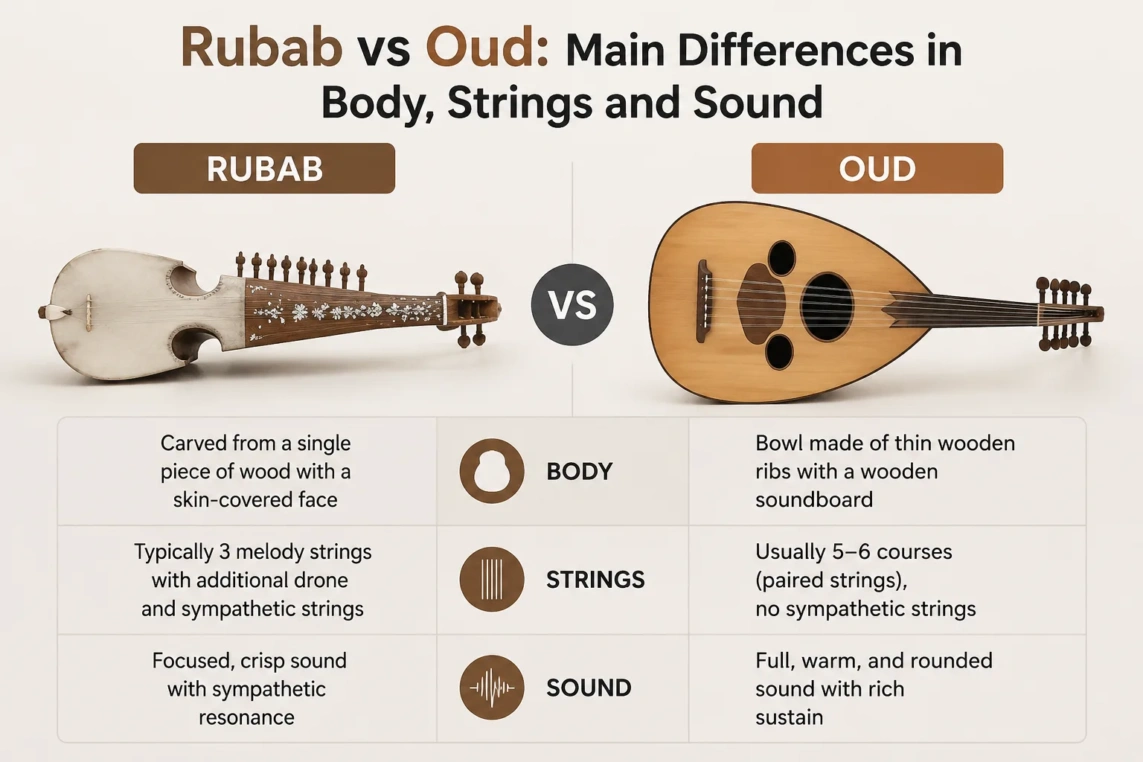
The rubab and oud are both short-necked plucked lutes, but they produce their voices in very different ways. An Afghan rubab typically combines a carved wooden body, a skin-covered resonating face, a small set of melody strings, drone strings, and a separate bank of sympathetic strings. The oud uses a deep rib-built wooden bowl, a thin wooden soundboard, an unfretted fingerboard, and strings arranged mainly in paired courses. The result is easy to hear: the rubab tends toward a firm, articulate attack followed by sympathetic resonance, while the oud gives a broader, rounded sound shaped by its paired strings and large wooden resonator.
Rubab vs Oud: The Main Physical Differences
| Feature | Rubab | Oud |
|---|---|---|
| Instrument Type | Short-necked plucked lute | Short-necked plucked lute |
| Body Construction | Body commonly carved from a solid piece of wood | Bowl assembled from multiple thin wooden ribs |
| Sound-Producing Face | Skin membrane forms an important part of the resonating face | Thin wooden soundboard |
| Fingerboard | Afghan rubab normally has a small number of frets | Unfretted |
| Melody Strings | Typically three main melody strings in the Afghan form | Usually several courses, most of them paired |
| Drone Strings | Present on many Afghan rubabs | No separate drone-string system as a defining feature |
| Sympathetic Strings | Characteristic of the Afghan rubab | Normally absent |
| Typical Plectrum Approach | Firm plectrum articulation | Played with a long flexible plectrum commonly called a risha or mizrab |
| General Sound Character | Focused, crisp, resonant, with a distinct sympathetic after-ring | Full, rounded, fluid, with paired-string richness |
| Main Musical Associations | Afghanistan and neighboring Central and South Asian traditions | Arab, Turkish and other Middle Eastern and North African traditions |
The Rubab Has a Carved, Skin-Faced Body
The body is one of the clearest ways to tell an Afghan rubab from an oud. A traditional Afghan rubab is commonly fashioned from a single piece of wood, with mulberry particularly associated with its construction. The maker hollows the wood to create the resonating chambers rather than assembling the back from numerous separate ribs.
The rubab is often described organologically as a double-chambered lute. Its body has pronounced changes in width rather than the uninterrupted pear-like outline of an oud. The carved form also provides the characteristic shoulders and constricted central area seen on many Afghan instruments.
A skin membrane, traditionally goatskin in documented examples, covers the resonating face of the lower part of the instrument. This is not merely decorative. The bridge transfers the strings’ vibration into this skin surface, making the membrane part of the rubab’s acoustic identity.
This combination of solid carved wood and stretched skin helps explain why the rubab does not respond exactly like a wooden-topped lute. Plucked notes can have a clear initial impact, while the instrument’s additional strings continue resonating around that attack.
The Oud Uses a Deep Wooden Bowl and Wooden Soundboard
The oud follows a different construction principle. Its large rounded back is normally assembled from thin curved ribs of wood joined edge to edge. Viewed from the side, these ribs create the deep vaulted bowl that is one of the oud’s most recognizable features.
The front is a comparatively thin wooden soundboard. One or more decorative soundholes or roses are normally cut into this face, depending on the regional style and maker.
The difference is therefore more than body shape. The vibrating surface beneath the bridge is different:
- Rubab: a skin membrane forms an important part of the resonator.
- Oud: the bridge works with a wooden soundboard over a large rib-built bowl.
Wood species, soundboard thickness, bracing, bridge design, dimensions and individual craftsmanship can all shape the response of an oud. There is no single acoustic formula shared by every Arabic, Turkish or other regional oud.
Their Necks Look Similar in Length but Work Differently
Both instruments belong to the broad category of short-necked lutes, so photographs can make them seem more closely matched than they really are.
The Afghan rubab traditionally carries a small number of frets. Four frets are documented on standard Afghan forms, allowing the player to stop the main melody strings at defined positions while also using open strings and characteristic ornaments.
The oud is fretless. Its fingerboard offers no raised fret divisions beneath the strings. The player’s finger therefore determines the exact stopping point of each note.
This difference matters musically. Oud technique allows very fine control of pitch placement, slides and ornaments without a fret interrupting the movement of the finger. Rubab technique develops around its own combination of fretted positions, open strings, plectrum strokes, drones and resonance.
Rubab Strings Are Divided into Different Jobs
The string system is probably the biggest practical difference between the two instruments.
On a well-documented Afghan rubab configuration, there are three main melody strings. Historically these could be gut; nylon is common on modern instruments. The instrument may also have two or three longer drone strings, while a larger group of thin metal strings serves a completely different function.
These are the sympathetic strings.
They are not normally plucked one by one as the primary melody voice. Instead, they respond acoustically when played notes match or excite frequencies to which the sympathetic strings are tuned. This creates the rubab’s characteristic secondary layer of resonance.
Documented Afghan instruments can have up to around fifteen sympathetic strings, although string layouts differ between instruments, makers and playing traditions. Some individual rubabs use other totals. For that reason, a single total string count should not be treated as a universal specification for every rubab.
Three Different String Functions Can Exist on One Rubab
- Melody strings carry most of the actively fingered musical line.
- Drone strings provide sustained tonal reference and rhythmic or melodic support.
- Sympathetic strings resonate in response to other notes.
This division of labor gives the rubab a more layered string architecture than its three main melody strings might initially suggest.
Oud Strings Are Organized into Courses
The oud takes another approach. Instead of surrounding a few melody strings with a large sympathetic bank, it arranges most of its playable strings into courses.
A course is a pair of strings that the player normally strikes together as a single musical unit. A widespread modern configuration uses five double courses and one single lower string, producing eleven strings in total. Ten-, twelve-, thirteen-string and other arrangements also exist, so eleven should be understood as a common setup rather than a rule for every oud.
The paired strings add density to each stroke. Tiny differences in the vibration of two strings sounding the same course can give the note a broader texture than one isolated string.
The important distinction is that an oud does not normally depend on a separate bank of sympathetic strings. The strings being heard are primarily the strings being directly played.
Why the Rubab Sounds More Percussive
A rubab note tends to announce itself quickly. The combination of plectrum attack, comparatively firm main strings, bridge placement and skin-faced resonator can produce a clear, compact and slightly percussive beginning to the note.
That initial attack does not mean the instrument sounds dry overall. Its sympathetic strings can continue vibrating after the main stroke, creating a fine metallic or shimmering resonance around the played pitch.
The listener therefore hears two related events: a strong direct note and a softer field of response around it.
This becomes especially noticeable when melodic passages repeatedly excite sympathetic strings tuned to notes used in the piece. The instrument can sound larger than the number of actively played melody strings would suggest.
Why the Oud Sounds Broader and More Rounded
The oud develops its sound without that sympathetic-string layer. Much of its character comes instead from the interaction between its paired courses, wooden soundboard and deep bowl.
A well-balanced oud can produce a full lower register, a rounded middle range and clear upper notes while retaining a recognizable plucked attack. Paired strings add body to the sound, and the wooden face and enclosed bowl support resonance after each stroke.
Its attack can still be crisp, especially under a strong risha stroke, but the overall impression is usually different from the rubab’s skin-driven response. The oud tends to place more of the audible mass directly in the played courses rather than surrounding the melody with separate sympathetic vibration.
Neither description should be treated as a fixed tone setting. String material, string tension, plectrum choice, body dimensions, setup and player technique can noticeably alter either instrument.
Rubab Resonance and Oud Sustain Are Not the Same Thing
The word resonant can describe both instruments, but the source of that resonance differs.
On the rubab, part of the effect comes from strings that were never struck directly. A melody note can activate sympathetic strings and leave a delicate continuation behind the main sound.
On the oud, resonance comes mainly from the vibrating course itself interacting with the bridge, soundboard, enclosed air and wooden bowl. When two strings form a course, both are deliberately sounded together.
This distinction helps explain why comparing the instruments only with terms such as “warm” or “bright” misses an important acoustic difference. Their sound is produced by different systems of vibration.
The Plectrums Encourage Different Playing Responses
Both instruments are plucked, yet the picking tools and right-hand traditions are different.
Rubab players use a plectrum suited to the instrument’s firm attack and string arrangement. Fast alternating strokes, repeated notes, rhythmic figures and interaction with open or drone strings are important parts of rubab technique.
The oud is normally played with a relatively long plectrum commonly called a risha in Arabic terminology. Its flexibility allows the player to move across the paired courses with both delicate and forceful strokes.
Because the oud has no frets, the two hands work together differently. The right hand controls articulation across the courses while the left hand has continuous control over where each pitch is stopped. On the rubab, fretted positions and the resonance-string system create another set of physical and musical possibilities.
The Oud Has a Wider Continuous Fingerboard
The oud’s neck flows into a broad fingerboard extending toward or onto the soundboard. With no frets dividing that surface, the player can move smoothly between pitches.
The rubab presents a different visual arrangement. Its short fretted neck leads into the distinctive carved body, while sympathetic strings often run along the side of the neck or body to their own tuning pegs. Those extra pegs can make an Afghan rubab appear mechanically busier than an oud.
The oud instead concentrates most of its tuning pegs in its characteristic backward-bent pegbox. The large number of pegs reflects its multiple courses rather than a division between melody, drone and sympathetic systems.
Tuning the Two Instruments Serves Different Purposes
There is no single tuning that represents every rubab or every oud. Regional practice, repertoire, instrument size and player preference all matter.
For the Afghan rubab, tuning involves more than establishing the pitches of the main strings. Drone and sympathetic strings must also be coordinated with the tonal material being played. The resonance strings may be prepared around the scale or pitch collection needed for a performance.
Oud tuning focuses on the relationships among its playable courses. Arabic and Turkish traditions do not necessarily use identical tunings, pitch levels or string gauges. Additional bass or upper courses also change the layout on some modern instruments.
This is why simple diagrams claiming one permanent “rubab tuning” or “oud tuning” can be misleading unless they identify the instrument type and musical tradition.
They Belong to Different Musical Geographies
The Afghan rubab is closely associated with Afghanistan and is also found in musical traditions extending into neighboring areas of Central and South Asia. It appears in Afghan folk repertories as well as art-music settings influenced by musical exchange with northern South Asia.
Rubab or rabab names also occur across a much wider geographical area, but the name does not always identify the same instrument. Bowed rabāb forms, Central Asian rubob types and South Asian rabab traditions can differ markedly from the Afghan instrument described here.
The oud belongs primarily to the musical cultures of the Middle East and North Africa, with established regional forms in Arab and Turkish traditions and related practice elsewhere. It is strongly associated with melodic systems in which the fretless fingerboard is particularly useful for precise pitch placement and ornamentation.
The comparison therefore works best when rubab means the Afghan or Kabuli-type plucked rubab. Comparing an oud with every instrument called rabab, rebab, rubab or rubob would combine several separate instrument traditions.
Are the Rubab and Oud the Same Kind of Lute?
They can both be classified broadly as necked plucked lutes, and both have relatively short necks compared with instruments such as the tanbur or sitar. That broad similarity does not make one a regional version of the other.
Their construction separates them immediately. The oud has a rib-built bowl, wooden soundboard and unfretted neck. The Afghan rubab uses a carved body, skin resonator, frets and multiple classes of strings.
Their string logic is even more different. Oud courses are directly played; rubab sympathetic strings are designed to respond.
For identification, that is often more useful than comparing decorative details. Ornament, inlay and wood color vary from maker to maker, while the underlying body and string systems reveal what the instrument actually is.
Which Instrument Has More Strings?
The answer depends on whether individual strings or actively played courses are being counted.
An oud with five paired courses and a single bass has eleven physical strings, all intended for direct playing. Other ouds can have different totals.
An Afghan rubab may have only three primary melody strings, yet drones and a substantial sympathetic-string bank can raise its total far beyond three. A documented configuration of three melody strings, two or three long drones and up to fifteen sympathetic strings illustrates how quickly the number grows.
So the rubab can have more individual strings while offering fewer primary melody strings. The oud normally gives the player’s right hand direct access to a larger set of pitched courses.
Which Is Easier to Recognize by Sound?
Listen first to the attack and what remains after it.
A rubab often gives a firm plucked note followed by fine sympathetic ringing. Repeated notes can sound sharply articulated while the resonance strings form a quieter halo beneath the melody.
An oud usually sounds more continuous across its courses. Paired strings give individual notes extra width, while the wooden body supports a rounded resonance without the rubab’s separate sympathetic response.
Visually, the distinction is even faster: a deep pear-shaped ribbed bowl and fretless neck point toward the oud; a carved waisted body, skin face, frets and numerous auxiliary strings point toward the Afghan rubab.