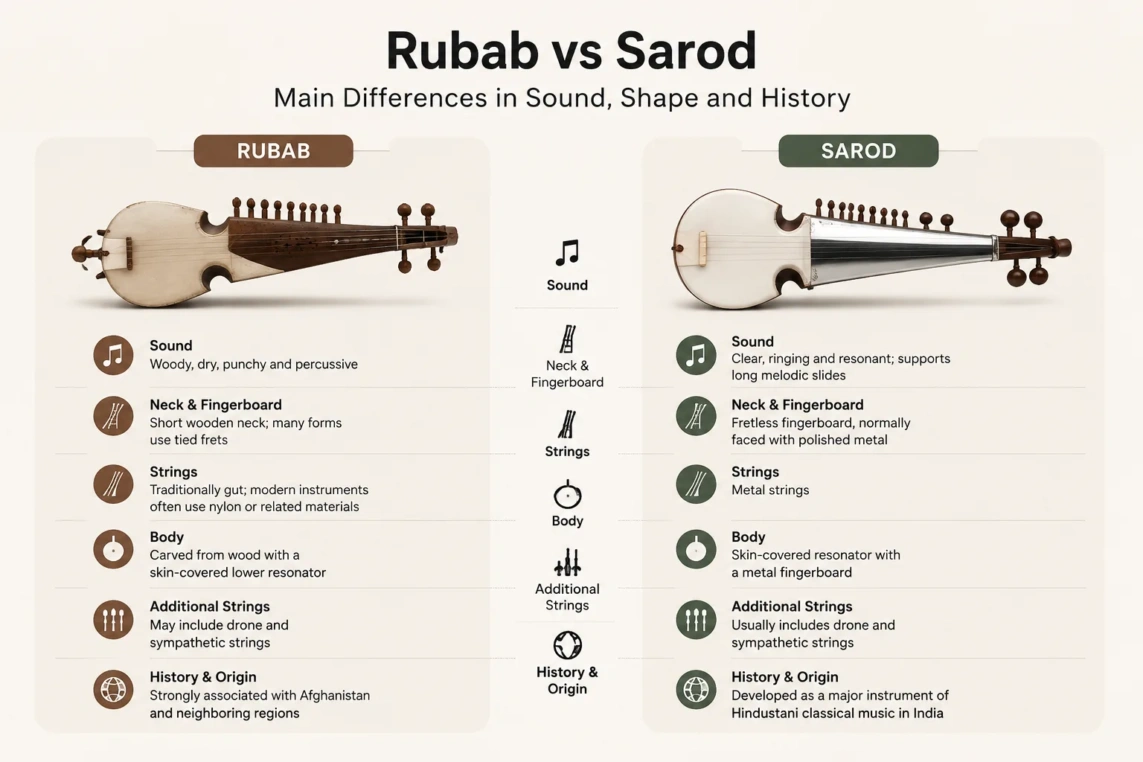
The rubab and sarod are related plucked lutes, but they are not two names for the same instrument. The Afghan rubab has a compact, deeply carved body, a skin-covered lower resonator and a distinctly woody, percussive attack. The sarod developed in North India into a fretless classical instrument with metal strings and, in its modern form, a smooth metal fingerboard that supports long slides between pitches.
The connection between them is historical as well as visual. The Afghan rubab is widely regarded as one of the main ancestors of the sarod, although the change did not happen through a single documented redesign. Different North Indian musical lineages took part in reshaping rubab-related instruments during the nineteenth century, and surviving early sarods show that features now considered standard appeared gradually.
Rubab vs Sarod: The Main Differences
| Feature | Rubab | Sarod |
|---|---|---|
| Primary Musical Context | Afghan and neighboring regional traditions | North Indian Hindustani classical music |
| Neck and Fingerboard | Short wooden neck; many Afghan forms use a small number of tied frets | Fretless fingerboard, normally faced with polished metal |
| Main Strings | Traditionally gut and, on modern instruments, often nylon or related materials | Metal strings |
| Additional Strings | May include drone and sympathetic strings | Usually includes drone and sympathetic strings |
| Sound | Woody, dry, punchy and strongly articulated | Clear, ringing and resonant, with strong capacity for sustained melodic slides |
| Pitch Technique | Frets on many forms help define part of the melodic range | Notes are stopped directly against a smooth fretless surface |
| Historical Center | Strongly associated with Afghanistan and adjoining regions | Developed as a major instrument of Hindustani music in India |
Why the Rubab Sounds More Woody and Percussive
A typical Afghan rubab gives each plucked note a firm initial attack followed by a relatively compact decay. Its sound is often described as lively or percussive rather than continuously ringing. The effect is especially noticeable in rhythmic passages where individual strokes remain clearly separated.
Construction helps shape this response. A traditional Afghan-style instrument may be carved substantially from one block of mulberry wood. Its lower resonating chamber is covered by skin, while the upper portion forms a hollow wooden structure beneath the fingerboard. The body has pronounced inward curves between its upper and lower chambers, giving the instrument its recognizable double-chambered outline.
The main strings also differ from those of the modern sarod. Historical rubabs used gut, while present-day players may use nylon or other materials according to instrument type and individual practice. These strings do not produce the same metallic attack as the sarod’s principal steel strings.
Many Afghan rubabs also carry sympathetic strings. These are not normally fingered to create the melody. Instead, they respond to matching or related frequencies from the played strings, adding a resonant layer beneath the sharper initial pluck.
Frets Change the Character of Rubab Phrasing
Many contemporary Afghan rubabs have a small set of tied frets on the upper fingerboard. Historical instruments are not completely uniform, so the rubab should not be treated as having one fixed construction across every period and region.
Where frets are present, they give the left hand physical pitch positions. Melodic ornament remains possible, but the tactile relationship between hand and string differs strongly from playing a modern sarod, whose melody strings are stopped against an uninterrupted metal plate.
Why the Sarod Has a More Metallic, Singing Response
The modern sarod combines a skin-covered resonator with metal strings and a smooth fretless fingerboard. This combination produces one of its most recognizable qualities: a clear attack followed by a ringing tone that can be shaped through continuous movement of the left hand.
Instead of pressing the melody strings behind raised frets, a sarod player stops them directly against the fingerboard. Fingernail technique is especially associated with modern sarod playing, although techniques differ between traditions and players. The hard contact between string and fingerboard gives notes a focused, bright edge.
The absence of frets also allows the player to move continuously between pitches. Meend, the controlled glide from one note toward another, can therefore extend smoothly across the metal surface. This makes the sarod particularly well suited to the detailed pitch movement and ornamentation used in Hindustani raga performance.
The sarod’s sympathetic strings add another layer of resonance. Their number and arrangement vary with instrument design and musical lineage, so a single string count should not be treated as universal. Modern sarods normally combine melody strings, rhythmic or drone strings and a separate group of sympathetic strings.
The Shapes Reveal Both Kinship and Separation
Viewed side by side, the relationship is easier to understand. Both instruments belong to the lute family and both can have skin stretched across the main resonating area. Both may also have deeply indented wooden bodies and side-mounted tuning pegs for sympathetic strings.
The rubab, however, retains a particularly compact double-chambered form. Its upper chamber and short neck create a visibly stepped profile, and decorative bone or mother-of-pearl inlay is common on many surviving Afghan examples. The lower skin-covered chamber sits beneath the bridge.
The sarod stretches this basic visual idea into a different playing surface. Its neck area becomes broader and smoother, eventually developing into the long fretless metal fingerboard associated with the modern instrument. The transition from resonator to neck therefore looks more continuous than on many rubabs.
The Metal Fingerboard Was Not Present on Every Early Sarod
One detail is especially useful when comparing their histories: the metal fingerboard did not appear fully formed at the beginning of the sarod’s development.
A North Indian sarod dated to about 1885 in the Metropolitan Museum of Art has an unfretted fingerboard but had not yet received the metal plate now associated with the instrument. Its materials include wood, parchment, wire and gut. This surviving instrument shows a stage between older rubab-related construction and the standardized modern sarod.
Modern definitions can therefore hide the development process. Saying simply that “rubab has wood and sarod has metal” describes many present-day instruments, but it does not describe every nineteenth-century example.
How the Rubab Is Connected to the Sarod Historically
The strongest historical connection involves the Afghan rubab and musical communities moving between Afghanistan and northern India. Museum and musical-history sources commonly identify the Afghan instrument as an ancestor or precursor of the North Indian sarod.
The precise transformation is harder to assign to one inventor. Several hereditary musician lineages preserve accounts of ancestors who modified the Afghan rubab after establishing themselves in India. Historical narratives differ over the people, places and exact sequence of those changes.
What can be followed more securely is the change in the instrument itself. During the nineteenth century, rubab-derived forms used in North India moved toward features that expanded their usefulness for classical raga performance. These developments included removing or abandoning frets, adopting metal strings, developing the smooth fingerboard and expanding the sympathetic-string system.
The Metropolitan Museum of Art describes the sarod as an instrument that had been evolving since around 1820, when it began gaining popularity. A modern historical presentation at SOAS similarly connects its development with musicians of Afghan origin in North India and describes traditions that replaced rubab frets with a smooth plate and metal strings.
This makes “the sarod came from the rubab” useful as a short description, but incomplete as an instrument history. The sarod became a separate instrument through repeated adaptation to a different musical environment rather than through a simple renaming of the Afghan lute.
Rubab Strings and Sarod Strings Serve Different Playing Systems
Exact string counts are a poor way to identify either instrument because both exist in several configurations. Their string functions are more informative.
An Afghan rubab generally centers on a small group of directly played melody strings, accompanied on many instruments by drone strings and a bank of sympathetic strings. Modern examples may carry numerous sympathetic strings running from side pegs toward the bridge. Their response gives sustained resonance around the more compact sound of the melody strings.
The sarod uses a comparable division of labor but adapts it to Hindustani classical performance. It normally has several principal melody strings together with drone or rhythmic strings and sympathetic strings. The main playing strings are metal, matching the fretless metal surface beneath them.
That difference changes the physical feel of playing. On the rubab, the musician works with a short-necked wooden instrument whose melody system may be partly organized by tied frets. On the sarod, the left hand must create precise intonation directly on an unmarked surface while also controlling slides and ornaments.
Plectrum Technique Also Separates Their Attacks
Both instruments are plucked rather than bowed, but their right-hand traditions are not identical.
The sarod is normally played with a firm triangular plectrum called a java or jawa, traditionally associated with materials such as coconut shell. The plectrum can produce forceful single strokes, rapid alternation and rhythmic articulation while the left hand shapes the pitch on the metal fingerboard.
Rubab players also use a plectrum, and highly developed Afghan performance can combine melody with striking rhythmic patterns involving the main, drone and other accessible strings. Its short scale and compact resonator give these strokes a noticeably different response from the longer, ringing articulation of the sarod.
Rubab and Sarod Belong to Different Musical Settings Today
The Afghan rubab remains closely identified with music from Afghanistan and is also found in adjoining parts of Pakistan and northern South Asia. It may function as a solo melodic instrument, accompany singing or appear in small ensembles. Afghan classical practice also absorbed aspects of North Indian raga music, so the musical histories of the regions cannot be separated into completely isolated categories.
The sarod is primarily associated with Hindustani classical music. Its fretless construction allows performers to develop a raga slowly, sustain ornamented melodic lines and move between fixed pitches with controlled slides. Different gharanas and performer lineages use somewhat different instruments and techniques.
These musical roles help explain why the instruments continued to diverge after their historical connection. The rubab retained construction and playing characteristics suited to its Afghan and regional traditions. The sarod developed around the demands of North Indian classical performance.
Can a Rubab Be Mistaken for a Sarod?
From a distance, yes. A skin-covered soundbox, indented waist, short lute form and multiple tuning pegs can make them appear closely related. A closer look usually resolves the identification.
- Look at the fingerboard. A broad, smooth metal surface with no frets strongly suggests a modern sarod.
- Look at the rubab’s upper body. The pronounced double-chambered wooden form is one of its most recognizable structural features.
- Check for tied frets. Their presence on an Afghan-style instrument points toward the rubab rather than a modern sarod.
- Look at the playing strings. The sarod’s principal strings are metal, while rubab main strings have traditionally used gut and may now use synthetic materials.
- Listen to the attack. The rubab tends toward a drier, woody and percussive articulation; the sarod commonly gives a clearer metallic ring and longer sliding melodic shapes.
Rubab, Rabab and Sarod Are Not Interchangeable Names
Rubab and rabab are transliterations used for instruments whose names and forms vary widely across Asia. The broader rabab/rebab name family also includes instruments that are structurally very different from the Afghan plucked rubab, including bowed instruments.
For a rubab–sarod comparison, the relevant reference point is usually the Afghan or Kabuli rubab, not every instrument called rabab or rebab.
Sarod, by contrast, identifies the distinct fretless lute established within North Indian classical music. Its relationship to the Afghan rubab is part of its history, but modern sarod construction, technique and repertoire make it a separate instrument rather than a regional spelling or minor rubab variant.
Which Difference Matters Most to the Player?
The most consequential physical difference is the playing surface. A rubab with tied frets gives the hand defined contact points and combines them with the short response of its skin-topped wooden body. A sarod removes those frets and places metal strings over an uninterrupted hard surface.
That change affects nearly everything the player feels: intonation, slides, ornament, sustain and the shape of a melodic phrase. The body outlines still reveal their historical relationship, but the left hand reveals why the rubab and sarod became two different instruments.