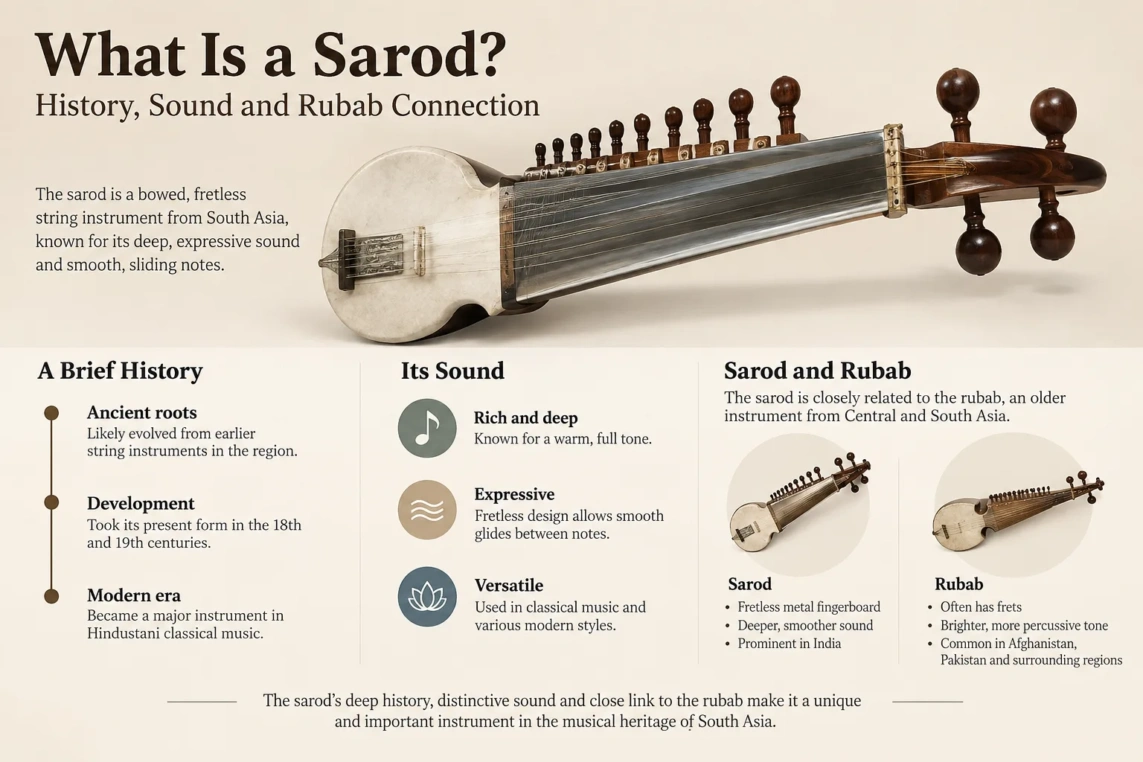
A sarod is a fretless plucked lute used chiefly in Hindustani classical music. Its broad metal fingerboard, skin-covered resonator, metal strings and sympathetic strings give it a sound that combines a firm attack with ringing resonance and exceptionally smooth pitch slides. The modern instrument is closely connected to the Afghan rubab, but the two are not simply different names for the same lute.
The connection becomes clearer when the instruments are examined physically. The sarod retained parts of the rubab’s basic lute architecture while changing the playing surface, strings and left-hand technique. Those changes made the instrument especially suited to sustained meend, detailed intonation and other melodic movements used in North Indian raga performance.
What Makes a Sarod Recognizable?
The easiest feature to identify is the smooth, fretless metal fingerboard. It forms a broad reflective surface beneath the melody strings and has none of the raised frets seen on a sitar.
The lower part of the sarod has a skin-covered resonating surface. A bridge rests over this membrane and transfers string vibration into the body. This combination of a metal playing surface and a skin-covered resonator helps explain why the sarod can sound sharp and immediate at the beginning of a note while retaining a resonant tail.
A modern sarod also carries several kinds of strings. Their exact number and arrangement depend on the instrument, maker and performing lineage, so a single string count should not be treated as universal.
| Part | Function | Why It Matters |
|---|---|---|
| Metal fingerboard | Provides the smooth surface against which melody strings are stopped | Allows continuous pitch movement without frets |
| Melody strings | Carry the principal melodic line | Produce the notes, slides and ornaments of the raga |
| Drone and rhythmic strings | Supply open-string resonance and rhythmic punctuation | Support pulse, tonal reference and jhala-like textures |
| Sympathetic strings | Vibrate in response to related pitches | Add a layer of secondary resonance around played notes |
| Skin-covered resonator | Receives vibration from the bridge | Contributes to the sarod’s direct attack and resonating body |
| Jaba or java | Plucks the strings in the right hand | Shapes attack, stroke patterns and rhythmic articulation |
The Metal Fingerboard Changes How the Instrument Behaves
Calling the sarod merely a “fretless lute” leaves out the most interesting part of its design. The playing surface is not simply a wooden neck without frets. On the modern instrument, a smooth metal plate covers the fingerboard.
A fret normally fixes the vibrating length of a string at predetermined locations. The sarod removes that physical grid. The player chooses the stopping point directly, which permits a note to move continuously rather than jumping from one fret position to another.
This is central to meend, the controlled glide between pitches used in Hindustani music. The performer can move through the interval rather than sounding only its endpoints. Small changes in pitch and ornament are therefore shaped directly by the left hand.
The absence of frets also places more responsibility on the player’s intonation. There is no metal fret to automatically define the final pitch. The ear and hand must locate it.
Why Sarod Players Use the Fingernails
One of the sarod’s most distinctive techniques occurs in the left hand. In common sarod technique, the melody strings are stopped against the metal surface with the edge or tip of the fingernail rather than pressed in the same way a guitarist normally presses a string with the soft fingertip.
The hard contact between string, nail and metal surface helps produce a clear stopped note while allowing the hand to slide smoothly along the fingerboard. This supports both sustained glides and rapid ornamentation.
Exact fingering practice is not identical in every sarod lineage. Different performers may favor different combinations of fingers or slightly different nail contact. It is therefore misleading to describe one left-hand method as the only authentic sarod technique.
The right hand uses a hard plectrum generally called a jaba or java. Its material and shape can vary. What matters acoustically is the firm plucked attack it gives to the strings and the player’s control over alternating, repeated and accented strokes.
Why the Sarod Has Its Metallic, Resonant Sound
The characteristic sarod sound comes from several features acting together rather than from one material alone.
The Initial Attack
A hard plectrum striking a metal string produces a clear beginning to the note. The skin-covered resonating surface also gives the attack a direct quality. This can make individual strokes remain distinct even during fast passages.
The Fretless Slide
After the attack, the left hand can move a stopped string along the smooth fingerboard. The pitch changes continuously. This creates the flowing bends and extended glides that are among the clearest differences between sarod technique and playing on a fretted lute.
Sympathetic Resonance
Below or alongside the main playing strings is a group of sympathetic strings, often called tarab strings. They are not normally used to carry the main melody. Instead, suitably tuned strings respond when related frequencies are sounded.
The result is a secondary ring around the played note. The amount of audible resonance depends on tuning, instrument setup, room acoustics and playing style.
Open Strings and Rhythmic Resonance
Additional open strings can be struck to reinforce tonal reference or rhythmic energy. During faster passages they can become part of the instrument’s rhythmic texture rather than functioning only as passive resonance.
The sarod’s sound is not explained simply by saying that metal makes it bright. Metal strings and fingerboard, a skin-covered resonator, sympathetic strings, open-string resonance, plectrum technique and the player’s left-hand control all shape what is heard.
The Afghan Rubab Connection
The instrument most directly connected with the sarod’s development is the Afghan rubab, sometimes described as the Kabuli rubab. This is a plucked short-necked lute and should not be confused with the many bowed instruments that also appear under names such as rebab, rabab or rebap in other regions.
A traditional Afghan rubab is commonly carved from a solid piece of wood, often mulberry. Its lower resonating chamber is covered with skin. Documented examples use a small group of main melody strings together with drone strings and metal sympathetic strings. Traditional main strings were made from gut; nylon is common on many later instruments. Some Afghan rubabs have a small number of tied frets on the upper playing area.
These features provide several points of comparison with the sarod: a carved lute body, membrane-covered lower resonator, plucked performance, multiple classes of strings and sympathetic resonance.
The relationship is nevertheless historical rather than taxonomic. A modern sarod is not merely an Afghan rubab fitted with different strings. Its construction and technique developed far enough that it became a separate instrument within Hindustani music.
What Changed from Rubab to Sarod?
The most useful way to understand the relationship is to look at what the changes actually allowed musicians to do.
| Feature | Afghan Rubab | Modern Sarod | Effect of the Sarod Design |
|---|---|---|---|
| Playing surface | Short neck, commonly with a small number of tied frets | Smooth fretless metal fingerboard | Allows continuous pitch movement and extended meend |
| Main strings | Historically gut; nylon common in later instruments | Metal | Provides a different attack, response and sustaining behavior |
| Lower resonator | Skin covered | Skin covered | Preserves a clear constructional link between the instruments |
| Sympathetic strings | Present in documented Afghan forms | Used extensively on many modern sarods | Adds resonance tuned around the raga |
| Left-hand technique | Closely connected to its short-necked, partly fretted layout | Strings commonly stopped with the fingernails against metal | Provides direct control over pitch position and sliding ornament |
| Main musical setting | Afghan musical traditions and neighboring regional practices | Hindustani classical music | The instrument developed around a different performance language |
The shift to metal strings and a smooth playing surface was especially important. It opened a different approach to sustain, pitch movement and ornamentation. Those qualities fit the melodic demands of Hindustani raga performance particularly well.
This is why the development should not be reduced to a cosmetic redesign. The mechanics of playing changed along with the instrument.
The Sarod Did Not Appear in One Finished Form
Accounts of sarod history sometimes present a simple sequence: the Afghan rubab entered India, one musician modified it, and the modern sarod appeared. Historical evidence is less tidy.
Research based on nineteenth-century descriptions, pictures, surviving instruments and hereditary musician traditions shows a period of gradual change. The term sarod appears in Indian records by about the 1830s, but instruments carrying that name were not necessarily identical to modern concert sarods.
This matters because even the feature now most closely associated with the instrument—the metal fingerboard—was not immediately universal. A sarod in the Metropolitan Museum of Art dated to about 1885 preserves an earlier stage in which the fingerboard had not yet received the metal plate characteristic of most modern examples.
That surviving instrument is useful evidence. It shows that “sarod” referred to a developing family of instruments during the nineteenth century, not to one design that appeared fully standardized at a single date.
Different Family Traditions Preserve Different Origin Accounts
Several hereditary sarod traditions connect the instrument’s development with musicians of Afghan or Pathan ancestry working in North India.
The Bangash tradition, associated in later generations with the family of Amjad Ali Khan, traces an important line through rubab-playing ancestors and musicians who adapted the instrument in India. Other historical accounts give an important role to musicians associated with Madar Khan and Niyamatullah Khan.
Niyamatullah Khan is linked in musicological research with the use of a metal fingerboard during the nineteenth century. Other families preserve their own accounts of changes in strings, construction and playing technique.
These traditions should not be forced into a single “inventor of the sarod” story. The evidence fits better with a series of adaptations made across several generations and musical centers.
A More Useful Timeline of the Rubab-to-Sarod Transition
| Period | What Can Be Said with Reasonable Confidence |
|---|---|
| 18th century | The Afghan rubab was established in regions linking Afghanistan, present-day Pakistan and northern India, with rubab-playing musicians active across these cultural areas. |
| Early 19th century | Rubab-related instruments were being adapted within North Indian musical settings. Terminology and construction were not yet fixed. |
| Around the 1830s | The term sarod appears in documented Indian sources associated with the developing instrument. |
| Mid-19th century | Metal strings and new fingerboard arrangements became part of the instrument’s changing design. Historical accounts associate metal fingerboard development with this period. |
| Late 19th century | Different sarod forms still coexisted. Surviving instruments show that not every sarod yet had the modern metal-plated fingerboard. |
| 20th century | Major performing lineages developed recognizable approaches to instrument size, string layout, tone and technique, producing the principal modern sarod traditions. |
This sequence is best read as an instrument-development timeline, not a single-inventor chronology.
Why Removing the Frets Changed the Music
The move toward a smooth fretless surface had consequences beyond appearance.
On a fretted instrument, the fret determines where the string stops. The performer can bend or manipulate the string, but the physical fret remains an important reference point. On the sarod, the performer can stop the string anywhere along the metal plate.
That makes several kinds of melodic movement especially natural:
- Meend: a controlled continuous movement from one pitch toward another.
- Fine intonation: precise placement of pitches without a fixed fret grid.
- Gamak and related ornaments: forceful or oscillating pitch movements shaped directly by the hand.
- Connected melodic phrases: notes can be joined through sliding motion rather than separated by fixed fret positions.
The sarod therefore became more than a differently voiced rubab. Its physical design supported a different relationship between the player’s hand and melodic pitch.
What the Sarod Retained from the Rubab
Not every part of the earlier lute concept disappeared. Several features still make the connection visible.
- A skin-covered lower resonating surface remains central to both instrument types.
- Both are plucked lutes played with a plectrum.
- Both may combine melody, drone and sympathetic strings.
- The body architecture of the sarod retains a historical relationship with short-necked rubab forms.
- Both produce a clearly articulated plucked attack rather than the continuously driven sound of a bowed rebab.
These similarities are more informative than the shared name history alone. They show continuity in construction while the metal fingerboard and new performance technique show where the sarod moved in another direction.
Sarod and Afghan Rubab Do Not Sound the Same
An Afghan rubab often has a comparatively dry, woody and percussive main-string character. Its skin soundboard and shorter sustaining main strings give individual attacks a strong presence. Sympathetic strings can add resonance, but the melody retains a compact articulation.
The sarod generally produces a more metallic and sustaining response. Steel strings, the smooth metal fingerboard and the sympathetic string system support ringing notes and long slides. Its tone can move from sharply articulated strokes to fluid melodic lines without changing instruments or adding frets.
The contrast is especially clear during a slow glide. A rubab phrase often reveals the articulation of individual finger positions more clearly, while a sarod can carry one pitch continuously toward another across the metal surface.
Neither sound is a less developed form of the other. They serve different musical practices and use different playing mechanics.
How the Sarod Works in a Raga Performance
The physical design becomes easiest to understand when heard in the stages of a Hindustani performance.
Alap
In an alap, the melodic character of the raga is explored without the full metrical cycle of the later composition. Long notes, gradual pitch movement and carefully placed ornaments expose the sarod’s fretless character clearly. Sympathetic strings respond as important pitches of the raga are sounded.
Jor
As a regular pulse develops in jor, right-hand stroke patterns become more prominent. The jaba can produce a firm rhythmic profile while the left hand continues to use slides and ornaments.
Jhala
In faster jhala passages, open strings and repeated plectrum strokes can create a dense rhythmic texture. The instrument’s separation between melody strings and open resonating strings becomes particularly useful here.
Gat and Tabla
A composed gat introduces a defined rhythmic cycle, commonly with tabla accompaniment. Sarod technique then balances melodic development with rhythmic interaction. Fast plucked patterns, repeated strokes and precise ornaments can all operate inside the tala.
These performance demands help explain why the sarod evolved the way it did. Its fretless surface is not merely a visual trait; it serves the melodic grammar of the music in which the instrument is used.
Why Different Sarods Can Have Different String Layouts
There is no single string count that defines every sarod.
Modern instruments associated with different gharanas and performer lineages may vary in body proportions, peg arrangement, number of main strings, drone strings and sympathetic strings. Bridge design and tuning practice can also differ.
Two authentic sarods may therefore look noticeably different when viewed side by side. One may have a denser group of sympathetic pegs or a different arrangement of open strings. These differences often reflect the needs of a particular playing style rather than errors in construction.
This is also why fixed statements such as “a sarod has exactly this many strings” should be treated carefully unless a particular model or school is being described.
Sarod and Sitar Are Built Around Different Playing Surfaces
The sarod and sitar share several features of Hindustani instrumental practice, including plucked metal strings and sympathetic resonance, but their playing surfaces work very differently.
A sitar has raised frets. The player stops and manipulates the string in relation to those frets, including pulling strings across them to change pitch. A sarod has no frets. Pitch is located directly on the smooth metal surface.
The result is a different tactile system. A sitar player works with a fretted neck and string deflection; a sarod player works with direct stopping and sliding on an uninterrupted surface.
This distinction explains more than appearance. It helps explain why the two instruments produce different types of attack, sustain and melodic movement even when performing the same raga.
Does “Sarod” Mean the Same Thing as “Rubab”?
No. Sarod, rubab, rabab and rebab are not interchangeable names for one modern instrument.
The spelling family rebab/rabab/rubab covers several historically related and sometimes quite different string instruments across North Africa, West Asia, Central Asia and South Asia. Some are bowed. Others are plucked. Their body shapes, strings and performance traditions can differ sharply.
The sarod’s most relevant ancestor is specifically the plucked Afghan rubab tradition, not every instrument known historically as a rebab or rabab.
A useful distinction: the Afghan rubab is part of the sarod’s historical lineage, but a modern sarod is a separate Hindustani instrument. Calling the sarod simply “an Indian rubab” hides the structural and technical changes that produced it.
Where the Name “Sarod” Comes From
The name sarod is generally connected with the Persian word sorūd, a term associated with song, melody or music. Related Persian forms have a much older history than the modern Indian instrument.
That distinction matters. The age of a word does not establish the age of the object now carrying that word. Historical musical terminology often moved between regions and could change meaning over time.
For the sarod, the physical evidence and nineteenth-century written record are more useful than an attempt to project the modern instrument backward simply because a similar word appears in older texts.
How to Recognize a Sarod in a Photograph
A modern sarod can usually be identified by a combination of features rather than one detail alone:
- a broad shiny metal fingerboard with no frets;
- a skin-covered resonating area beneath the bridge;
- metal melody strings running over the smooth fingerboard;
- numerous tuning pegs associated with playing, drone and sympathetic strings;
- a solid wooden lute body rather than the large gourd resonator typical of many sitars;
- a bridge positioned on the membrane-covered lower portion of the body.
An Afghan rubab usually presents a shorter, more compact neck area, a strongly carved wooden body and a visibly different string layout. A sitar is easier to separate because its long neck carries prominent raised frets.
Historical instruments require more caution. Nineteenth-century sarods did not all display the exact combination of features now associated with the concert instrument.
Why the Rubab Connection Is Still Relevant
The rubab should not be treated merely as an extinct prototype that disappeared once the sarod developed. It remains a living instrument with active traditions of playing and craftsmanship across several regions.
In 2024, UNESCO inscribed the Art of crafting and playing rubab/rabab on the Representative List of the Intangible Cultural Heritage of Humanity through a multinational nomination from Afghanistan, Iran, Tajikistan and Uzbekistan. The inscription concerns living knowledge of construction, performance and transmission rather than the sarod’s history specifically.
That modern recognition also helps keep the historical relationship in perspective. The sarod developed partly from Afghan rubab traditions within the musical environment of North India, while the rubab continued along its own paths of performance and instrument making.
The two instruments therefore preserve both continuity and separation: a shared construction history can still be seen in the plucked lute form, membrane resonator and sympathetic-string concept, while the sarod’s fretless metal surface, metal melody strings and fingernail technique define a distinctly Hindustani instrument.