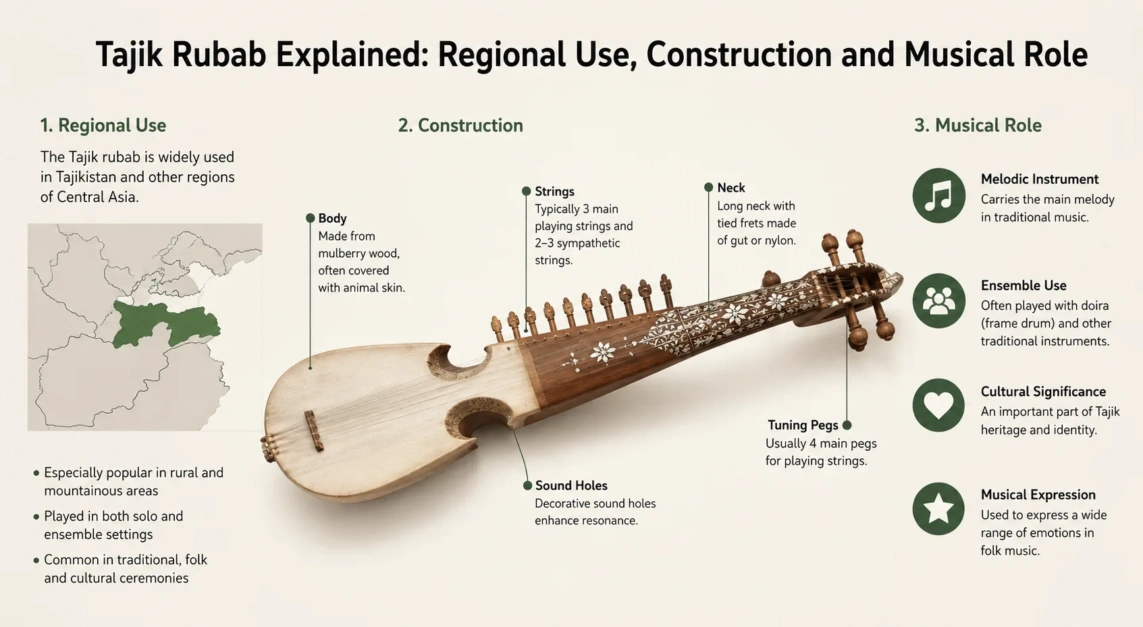
Tajik rubab usually refers to a plucked lute tradition known locally through spellings such as rubab, rubob, rubāb and, in some Pamiri contexts, rabbob. It is best understood as a regional group of related instruments rather than one single factory-standard design. Tajik examples may have a skin-covered soundboard, a carved wooden body, fretted or fretless neck forms, and a plectrum-based playing style that gives the instrument a clear, projecting attack.
What Makes the Tajik Rubab Distinct
The Tajik rubab sits inside the wider Central Asian rubab family, but it should not be reduced to the Afghan rubab or to the Uzbek orchestral rubob. Its identity comes from regional use, local workshop habits, and the way players place it inside Tajik musical life.
In museum records, a Tajik Kasgur Rubob from Dushanbe is classified as a plucked, fretted lute and is documented with wood, wire, gut and hide. That combination is a useful clue: the instrument is not simply a wooden lute. Its skin table and mixed string materials shape the playing feel and the type of resonance a performer expects.
| Feature | What It Usually Means | Why It Matters |
|---|---|---|
| Instrument Family | Plucked lute or necked lute within the rubab/rubob group | Places it near other Central Asian lutes, but not identical to each one |
| Regional Names | Rubab, rubob, rubāb, rabbob in some Pamiri usage | Spelling often follows language, region and transcription habit |
| Soundboard | Often skin-covered in documented examples | Gives a dry, immediate response compared with many all-wood lutes |
| Strings | May include gut, wire, nylon or metal, depending on the form and period | Changes brightness, tension and sustain |
| Playing Method | Usually plucked with a plectrum in Central Asian rubob practice | Supports clear melody, rhythmic figures and ensemble projection |
| Musical Role | Used in folk settings, traditional ensembles and regional performance contexts | Works as both a melodic voice and a rhythmic support instrument |
Names, Spellings and Regional Meaning
The word rubab travels across many languages, so spelling alone rarely tells the full story. Tajik, Persian, Uzbek, Pashto and other regional traditions use related names for instruments that can differ in body shape, strings, tuning and playing technique.
For Tajik contexts, rubab and rubāb are common English forms. Rubob appears often in Central Asian and Uzbek-language contexts. Rabbob is also used when describing Pamiri forms from the Badakhshan and Pamir region. These spellings should be read as regional signals, not as proof that every instrument is built the same way.
Regional Note: A Tajik rubab from Dushanbe, a Pamiri rubab from Badakhshan and a Bukhara-style rubob may all belong to the same wider naming family. Their construction details can still differ enough that they should be identified by form, region and playing context.
Regional Use in Tajik Music
The Tajik rubab has a place in both local music-making and staged ensemble settings. It can carry a tune, answer a singer, support dance melodies, or add a plucked texture beside bowed, wind and percussion instruments.
In Tajik and Uzbek classical heritage, Shashmaqom is one of the best-known vocal-instrumental traditions. The tanbur is often treated as a central reference instrument in that repertoire, so the rubab should not be presented as the sole defining instrument of Shashmaqom. Its role is better described as part of the broader regional soundscape, especially in ensembles, folk repertory and regional performance practice.
Urban and Ensemble Rubob Forms
Urban rubob forms are often associated with fretted necks, a clear plectrum attack and a sound that can sit well in an ensemble. Related Central Asian examples may show a long neck, several strings, a skin soundboard and decorative inlay. These features help the instrument project melody without needing a large body.
When the instrument is fretted, the player can move quickly through scale patterns and dance-like figures. A fretted fingerboard also helps produce clean note placement in ensemble playing.
Pamiri Rubab and Rabbob Contexts
The Pamiri rubab, sometimes written rabbob, belongs to the musical life of the Pamir and Badakhshan region. It is often described as a plucked lute with a skin head and a softer, less metallic voice than many wire-strung instruments. In some documented forms it may be fretless, which changes the left-hand feel and allows a different approach to pitch shading.
This Pamiri form should not be folded casually into the same description as a fretted urban rubob. It belongs to a related name family, yet its playing role, sound and regional identity deserve separate attention.
Construction and Materials
The Tajik rubab is usually built around a wooden resonating body and a skin soundboard. The body may be carved, shaped and joined according to local workshop practice. In Central Asian rubob making, mulberry and apricot are often mentioned, with walnut and other woods also appearing in documented instruments.
Wood choice can shape resonance, weight and durability. It does not create one fixed sound by itself. The thickness of the body, the quality of the skin, string tension, bridge placement and the player’s touch all matter.
Body and Soundboard
The body may be bowl-like, pot-shaped or more elongated depending on the regional form. A skin soundboard gives the instrument a fast response. Notes speak quickly, and the attack can feel direct under the plectrum.
Skin also reacts to humidity and temperature more than many wooden soundboards. A player may notice changes in tension, brightness or response from one room to another.
Neck, Frets and Pegs
Some Tajik rubab and rubob examples are fretted. Frets support accurate note placement and make repeated melodic patterns easier to control. Other regional forms, especially some Pamiri rubabs, may be fretless, giving the player more control over slides and pitch inflection.
The pegbox and tuning pegs are not only decorative. They must hold string tension without slipping. In a handmade instrument, clean peg fitting is part of the instrument’s practical quality.
Strings and Bridge
Documented rubab/rubob examples may use gut, wire, nylon or metal strings. Older and regional instruments may not follow the same string layout as modern stage or conservatory instruments. This is why exact string counts should be checked against the specific instrument rather than assumed from the name.
Luthier’s Note: On a skin-topped lute, the bridge is a small but sensitive part of the sound. A slight change in bridge height or placement can affect action, brightness and response. This is one reason two rubabs with similar outlines may not feel the same under the hand.
Sound and Playing Feel
The Tajik rubab is known for a plucked sound with a firm beginning to each note. The tone may be bright, nasal, dry, warm or mellow depending on string material, body size and skin tension. A skin soundboard often keeps the sound focused rather than long and ringing.
A plectrum helps the player shape rhythm as much as melody. Short repeated strokes can drive dance tunes, while slower strokes can support vocal lines or solo phrases. The instrument can be agile, but it is not only a fast melodic lute; it can also act as a steady rhythmic partner.
Listening for the Instrument
- Listen for a clear plucked attack rather than a bowed tone.
- Notice whether the sustain is short and dry or more ringing.
- Check whether the melody uses fixed fretted steps or smoother slides.
- Listen for dialogue with doira, gijak, tanbur, dutor or voice in ensemble settings.
Listening Note: A Tajik rubab may not dominate a recording by volume. Its role can sit in the middle texture, marking rhythm and giving the melody a sharp edge inside the ensemble.
Musical Role and Performance Settings
The instrument can appear in folk music, regional ensembles, educational settings and staged presentations of Central Asian repertory. Its plucked tone makes it useful where melody and rhythm need to stay close together.
In a small ensemble, the rubab may double a melodic line, answer sung phrases, or fill space between vocal sections. In solo playing, the performer can show ornament, plectrum control and changes in register. The musical role depends on the local tradition and the specific rubab type being played.
Common Ensemble Neighbors
In Tajik and Central Asian settings, the rubab may be heard near instruments such as the dutor, tanbur, gijak, nay, doira and chang. The exact lineup changes by region, repertory and performance setting.
The rubab’s plucked voice offers contrast beside bowed strings and frame drum rhythms. It helps define pulse without turning into a percussion instrument.
How It Differs from Related Rubab Types
Many instruments share the rubab name, but the details matter. A Tajik rubab is not automatically the same as an Afghan rubab, a Kashgar rawap, a Pamiri rubab or an Uzbek orchestral rubob.
| Instrument | Typical Association | Main Difference to Check |
|---|---|---|
| Tajik Rubab / Rubob | Tajik and Central Asian plucked lute contexts | May be fretted or linked to regional rubob forms; construction varies by local type |
| Pamiri Rubab / Rabbob | Pamir and Badakhshan musical contexts | Often discussed as a separate regional form with its own playing role and sound |
| Afghan Rubab | Afghan and related South-Central Asian traditions | Usually treated as a short-necked rubab type with its own body shape and string layout |
| Uzbek Rubob | Uzbek and Central Asian ensemble practice | Modern examples may follow standardised stage or orchestra forms |
| Rawap / Kashgar Rubab | Uyghur and Kashgar-linked traditions | Often has a different neck, body outline and regional repertory |
Identifying a Tajik Rubab in a Collection or Recording
Identification should start with three questions: where the instrument was made or used, how it is built, and how it is played. The name on a label is helpful, but it is not enough on its own.
- Check the region: Dushanbe, Badakhshan, Pamir and wider Central Asian references point to different branches of the rubab/rubob family.
- Look at the soundboard: A skin-covered table is a strong clue in many rubab forms.
- Count the strings carefully: Do not assume a standard number; regional and modern versions may differ.
- Inspect the neck: Fretted and fretless forms suggest different playing systems.
- Notice the playing method: Tajik and Central Asian rubob practice is usually plucked, not bowed.
Collector’s Note: Labels such as “Tajik rubab,” “Kasgur rubob” or “Pamiri rubab” should be read with the object details. Materials, stringing, frets and provenance tell more than the name alone.
Common Misunderstandings
All Rubabs Are Not the Same Instrument
The same name can travel across regions while the instrument changes. A bowed rebab, a short-necked Afghan rubab and a Tajik rubob do not share one identical construction.
Tajik Rubab Does Not Always Mean Pamiri Rubab
Pamiri rubab is one Tajik-region form, but it should not be used as the only model for every Tajik rubab. Urban, museum and ensemble examples may look and play differently.
String Counts Should Not Be Guessed
Rubab-family instruments have many local designs. Exact string count, tuning and fret layout should be tied to a specific instrument or documented tradition.
FAQ
Is the Tajik rubab the same as the Afghan rubab?
No. They are related through the wider rubab name family, but they can differ in body shape, string layout, neck design, repertory and regional use. The Afghan rubab has its own well-known construction tradition, while Tajik rubab and rubob forms should be identified by their local type.
Is the Tajik rubab played with a bow?
In Central Asian rubob practice, the instrument is usually plucked with a plectrum. The word rebab can refer to bowed instruments in other regions, so playing method should always be checked by context.
What is the difference between rubab and rubob?
Rubab is a broad English spelling used across many regions. Rubob is common in Central Asian usage, especially in Uzbek-related contexts, and may also appear when describing nearby Tajik forms. The spelling points to language and region, not always to a separate instrument design.
What materials are used in a Tajik rubab?
Documented examples may include wood, hide, gut, wire, nylon or metal strings. Central Asian rubob-making also uses woods such as mulberry, apricot and walnut in some instruments. Materials vary by maker, region and period.
What does the Tajik rubab sound like?
It often has a clear plucked attack, focused resonance and enough brightness to carry melodic lines. Skin tension, string material and body size can make one instrument sound dry and sharp while another feels warmer or softer.
Why is the Pamiri rubab treated separately?
The Pamiri rubab, or rabbob, belongs to a distinct regional setting in the Pamir and Badakhshan area. Its construction and musical role can differ from fretted urban rubob forms, so it is clearer to describe it as a related regional branch rather than as the only Tajik model.