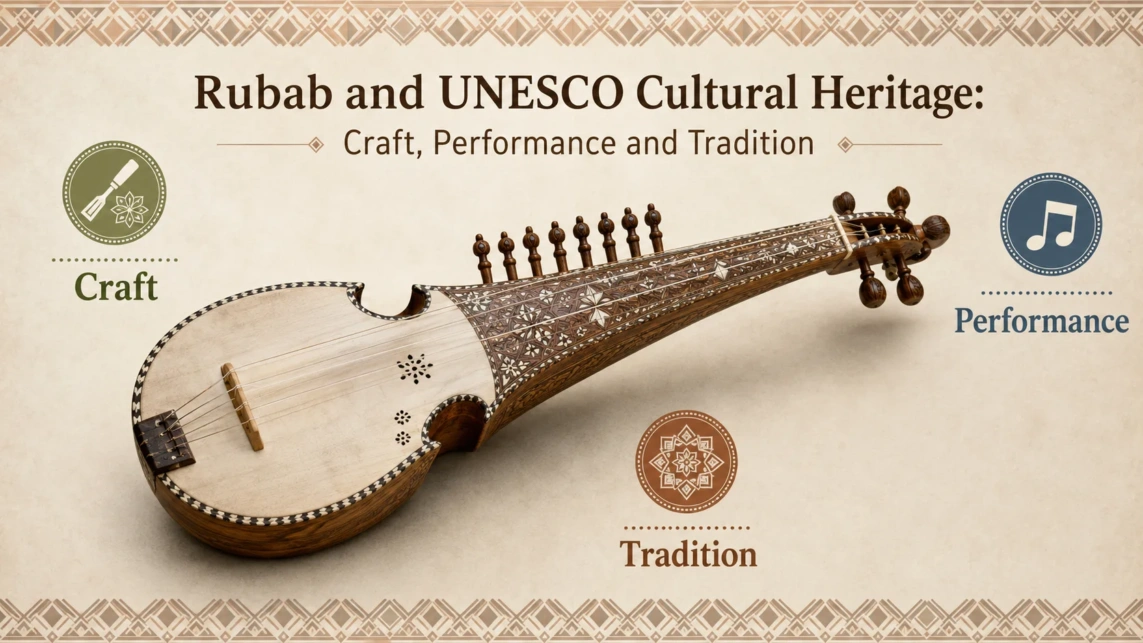
The UNESCO listing for the rubab/rabab protects more than a musical instrument. It recognizes a living chain of craft, performance, teaching, memory, and community use across Afghanistan, Iran, Tajikistan, and Uzbekistan. The instrument matters as an object, but the heritage element is wider: the hands that carve it, the players who shape its voice, the settings where it is heard, and the ways knowledge passes from master to learner.
What UNESCO Recognizes in the Rubab/Rabab Tradition
In 2024, the Art of Crafting and Playing Rubab/Rabab was inscribed on UNESCO’s Representative List of the Intangible Cultural Heritage of Humanity. The nomination was shared by Afghanistan, the Islamic Republic of Iran, Tajikistan, and Uzbekistan.
This matters because the listing does not treat the rubab as a static museum object. It treats the instrument as part of an active cultural practice. A rubab can be carved, decorated, repaired, tuned, taught, performed, remembered in poetry, and carried into new ensembles. All of these actions belong to the heritage around it.
Important distinction: UNESCO recognizes the living practice of crafting and playing rubab/rabab. It does not define one single standard rubab shape, one fixed tuning, or one national ownership of the instrument.
Rubab, Rabab, Rubāb and Rubob: One Heritage Field, Several Names
The instrument appears under several spellings, including rubab, rabab, rubāb, robab, and rubob. These forms reflect different languages, scripts, transliteration habits, and regional traditions.
The UNESCO element uses the paired form rubab/rabab, which helps cover related naming practices without forcing every community into one spelling. In Uzbekistan, rubob is common. In Afghan and Persian-language contexts, rubāb or rabab may appear. English writing often uses rubab.
The spelling can change, but the shared heritage idea remains clear: a plucked lute tradition connected to craft skill, social performance, regional memory, and musical identity across Central, South, and Southwest Asia.
UNESCO Heritage Context
| Heritage Area | What It Includes | Why It Matters for the Instrument |
|---|---|---|
| Craft | Carpentry, woodcarving, soundbox shaping, marquetry, inlay, decoration, and repair knowledge. | The rubab is not only played; it is built through skilled handwork that affects form, durability, and sound. |
| Performance | Solo playing, ensemble use, ceremonial music, gatherings, contemporary stage settings, and teaching contexts. | The instrument stays alive through repeated use in both local and public musical settings. |
| Transmission | Family learning, master-apprentice teaching, community practice, music schools, conservatories, and cultural centers. | The tradition depends on people learning by watching, listening, copying, correcting, and performing. |
| Social Meaning | Celebrations, weddings, funerals, gatherings, ritual settings, poetry, oral memory, and migrant community events. | The rubab carries social memory as much as musical sound. |
Why the Rubab Is Intangible Heritage
The word intangible can sound odd when the rubab is so clearly physical. It has a body, neck, strings, bridge, skin or wooden surfaces depending on the form, and visible decoration. Yet the heritage lies in the knowledge around the object.
A finished instrument can be placed in a case. The tradition cannot. It lives in the maker’s hand pressure, the way a bridge is adjusted, the choice of wood, the player’s attack with the plectrum, the teacher’s correction, the remembered melody, and the social setting that gives the sound meaning.
For the rubab/rabab, UNESCO’s focus fits the instrument especially well. Its craft is highly tactile. Its performance practice is learned through close listening. Its regional forms are connected, but not identical. A printed diagram cannot hold all of that.
The Craft Tradition Behind the Rubab
Rubab making often begins with wood selection and drying. UNESCO’s decision describes the rubab as a string instrument made with dried mulberry wood. Museum examples also show the use of mulberry, apricot, walnut, skin, mother-of-pearl, nylon, metal, and other materials, depending on the regional form and period.
Many Afghan rubabs are carved from a single piece of mulberry wood, with a skin-covered resonating area and a short neck. Uzbek rubob examples may show a longer neck, frets, decorative inlay, and materials such as apricot or walnut alongside mulberry. These differences matter. They show why “rubab” should not be flattened into one universal blueprint.
Wood, Skin and Resonance
Wood choice can shape resonance, weight, carving behavior, and repair needs. Mulberry is strongly associated with rubab construction in many documented examples. The wood needs enough strength for string tension and enough acoustic response to support the instrument’s dry, articulate voice.
Skin soundboards, when present, give many rubab-family instruments a direct and percussive attack. The bridge sits on a responsive surface, so the note speaks quickly. That is one reason the Afghan rubab can sound bright, woody, and rhythmically sharp even when its lower register feels warm.
Luthier’s Note: A rubab’s sound is shaped by several parts working together: body depth, wood density, skin tension, bridge placement, string type, fret arrangement, and the player’s plectrum technique. No single material explains the whole tone.
Carving, Inlay and Decoration
UNESCO describes rubab crafting as a skill involving carpentry, woodcarving, marquetry, and inlay. Decoration is not simply ornament added after the “real” work is done. On many instruments, decoration marks regional taste, workshop identity, ownership, respect for the instrument, and the maker’s command of fine handwork.
Mother-of-pearl inlay appears on some museum-held rubabs and rubobs. Floral patterns, geometric details, brass dots, carved surfaces, and shaped pegboxes can all help identify regional or workshop habits. These details also make the instrument recognizable in performance settings, where sound and visual identity meet.
Performance as Heritage Practice
The rubab/rabab is a plucked string instrument. It is usually played with a plectrum, though the exact playing method depends on the regional form. Afghan rubab performance often uses melody strings, drone strings, and sympathetic strings; other rubob forms may use fretted necks and different string layouts.
The UNESCO listing notes that the instrument is played in many settings: celebrations, weddings, funerals, gatherings, ritual healing contexts, orchestral performances, contemporary music, and multinational ensembles. That range is important. It shows that the rubab is not locked inside one ceremonial role.
It can mark family events. It can support dance. It can carry regional songs. It can appear beside percussion such as tabla or frame drums. It can also enter arranged stage music where older playing habits meet modern ensemble discipline.
The Role of Master Players
Master players hold more than technical skill. In many communities, they carry repertoire, social authority, ceremonial knowledge, and teaching responsibility. UNESCO’s decision notes that master players are often respected as elders and may initiate specific ceremonies or rituals.
This does not mean every rubab player has the same social role. A conservatory-trained performer, a village musician, a family player, and a stage soloist may all relate to the instrument differently. The heritage field is broad enough to include these different paths.
Listening Note: In many Afghan rubab examples, the ear notices a fast attack, a woody resonance, and a shimmering after-sound from sympathetic strings. In some Central Asian rubob forms, fretted playing and a longer neck may give the instrument a different melodic profile.
Transmission: How Rubab Knowledge Moves Forward
Rubab heritage depends on transmission. The instrument cannot survive only through written descriptions or museum labels. Players need teachers. Makers need workshops. Young learners need access to instruments, repertoire, correction, and performance spaces.
UNESCO’s decision points to several paths of learning. In rural areas, players may learn from local masters. In urban areas, training may happen through music academies, conservatories, schools, and cultural centers. Family transmission also remains a central route, especially for craft knowledge.
This mix of learning paths is healthy for the tradition. A family workshop can preserve subtle carving habits. A conservatory can document repertoire and train public performers. A community gathering can keep the instrument connected to lived social use. Each path protects something different.
Communities Named in the UNESCO Element
The shared nomination connects the rubab/rabab tradition with Afghanistan, Iran, Tajikistan, and Uzbekistan. This should be read carefully. The listing does not erase local pride or regional difference. It recognizes that the instrument and its practices cross borders, languages, and communities.
In Afghan contexts, the rubab is often described as a central national instrument and is strongly associated with plucked lute performance. In Uzbekistan, rubob traditions include regional forms with their own construction habits and repertories. Tajik and Iranian contexts add further layers of naming, craft, performance, poetry, and community use.
The result is not one identical instrument repeated four times. It is a family of related practices with shared roots, overlapping materials, and distinct local expressions.
Rubab as Object and Social Memory
A rubab can be studied as a chordophone, a plucked lute, a carved wooden object, or a regional instrument. But the UNESCO context also asks for another view: the rubab as social memory.
The instrument appears in gatherings where music supports hospitality, mourning, celebration, storytelling, and spiritual or ritual settings. It is also remembered in poetry and literature. These references help explain why the rubab can feel larger than its measurements. It is an instrument people attach to voice, place, family, and continuity.
For migrant communities, the rubab may also carry memory across distance. A performance in a new country can still call up a regional sound, a language, a song type, or a family ceremony. That is one reason the instrument works as a cultural connector.
How the UNESCO Listing Helps Safeguarding
A UNESCO listing does not freeze a tradition. It creates visibility and encourages safeguarding. For the rubab/rabab, safeguarding can include documentation, teaching, support for makers, workshops, research, public performance, youth training, and cross-border musical exchange.
The nomination process also described community participation, including local communities, music ensembles, universities, cultural organizations, and masters. This matters because heritage work is strongest when the people who carry the practice are part of the process.
Safeguarding should protect both the instrument and the conditions around it. A rubab needs players, but players need teachers. Teachers need students. Makers need materials, tools, buyers, and repair knowledge. Archives need names, dates, recordings, and object details. Public audiences need clear information that respects regional difference.
What UNESCO Recognition Does Not Mean
UNESCO recognition should not be misunderstood as a ranking system. It does not say that one instrument is better than another, or that one country alone owns the tradition. It also does not turn every rubab into the same object.
The rubab/rabab heritage field includes variation. Some instruments are short-necked; others are longer-necked. Some use sympathetic strings; others follow different layouts. Some are fretless; others are fretted. Materials, decoration, tuning, and repertoire can vary by region, maker, and performance setting.
Regional Note: The words rubab, rabab, rubāb, robab, and rubob should not be treated as automatic proof that two instruments are identical. Naming overlaps can hide real differences in structure, playing method, and musical role.
Rubab, Museum Study and Living Practice
Museum collections help explain rubab construction. They preserve older examples, document materials, and give researchers access to measurements, labels, provenance, and repair history. A museum-held Afghan rubab may show a carved mulberry body, skin covering, inlay, and a plucked-lute classification. A museum-held Uzbek rubob may show frets, five strings, a long neck, and different decorative choices.
Yet museum study has limits. An instrument behind glass cannot show how a teacher corrects a student’s hand. It cannot show how a player adjusts timing for dancers, singers, or percussion. It cannot fully show the social authority of a master player in a local gathering.
The UNESCO approach helps bring these two views together. The rubab is both an object of craft and a practice of people.
Craft Details That Deserve Close Attention
Anyone studying rubab/rabab heritage should look beyond the front view of the instrument. The back, neck joint, pegbox, bridge, skin edge, fretwork, inlay, and string anchoring can reveal much about regional design and workshop habit.
- Body form: Afghan rubabs are often short-necked and bowl-bodied, while some Central Asian rubob forms use longer necks.
- Soundboard material: Skin-covered surfaces are common in many rubab-family instruments, but regional forms should be checked individually.
- Strings: Melody, drone, and sympathetic strings may appear in some forms; other rubobs use different string arrangements.
- Decoration: Inlay, carving, floral motifs, and mother-of-pearl can mark workshop skill and regional taste.
- Playing tool: A plectrum is central to many rubab/rubob playing styles.
The Rubab in Contemporary Cultural Life
The rubab/rabab continues to appear in traditional settings, staged concerts, education programs, recordings, and cross-cultural collaborations. Contemporary use does not weaken the tradition by itself. Many living instruments survive because they adapt while keeping recognizable craft and performance knowledge.
The main challenge is balance. If the instrument becomes only a stage symbol, it may lose contact with local teaching and workshop practice. If it remains only in private circles, younger audiences may never hear it. The strongest future for the rubab likely depends on both: respected community practice and clear public presentation.
Why This Heritage Matters for Instrument Study
The rubab/rabab shows why traditional instruments cannot be understood through shape alone. A carved body and a set of strings are only the visible part. The deeper subject is a network of makers, players, teachers, ceremonies, materials, names, regional variants, and remembered sound.
UNESCO recognition gives that network a formal cultural heritage label. For researchers, collectors, learners, and listeners, the useful lesson is simple: study the rubab as both craft and performance. The instrument’s value sits in the meeting point between handwork, sound, and tradition.