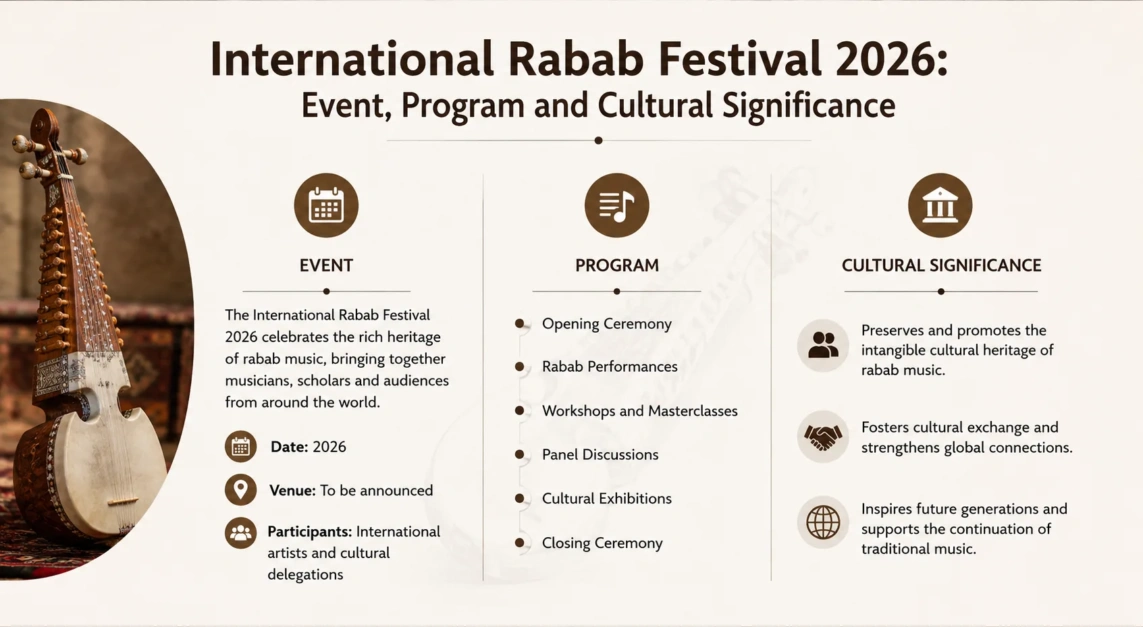
The International Rabab Festival 2026 placed a plucked Afghan rubab at the center of a university program shaped by performance, Sikh musical memory, instrument revival, and formal teaching. Held on January 26, 2026, at Guru Kashi University in Talwandi Sabo, Punjab, the event featured Ustad Homayun Sakhi as the principal rubab artist and ended with outcomes that reached beyond the concert itself: a traditional Afghan rubab was presented to the university, and Sakhi received an appointment as Professor of Practice in Rabab.
The festival was presented by the university’s Guru Nanak Chair, Bhai Mardana Chair, and Faculty of Visual and Performing Arts. Its program brought the Afghan rubab into dialogue with tabla, dilruba, keyboard, sitar, and voice. That combination made the event useful as both a performance record and a case study in how a named instrument can carry different regional histories without becoming one fixed, universal form.
International Rabab Festival 2026 Event Record
| Event Detail | Recorded Information |
|---|---|
| Date | January 26, 2026 |
| Venue | Guru Kashi University, Talwandi Sabo, Bathinda, Punjab, India |
| Presenting Units | Guru Nanak Chair, Bhai Mardana Chair, and the Faculty of Visual and Performing Arts |
| Principal Artist | Ustad Homayun Sakhi, Afghan rubab |
| Named Accompanists | Pandit Sidhartha Chatterjee on tabla, Sandeep Singh on dilruba, and Gaurav on keyboard |
| Additional Musical Role | University reporting also records Dr. Leena Bedi as a sitarist-vocalist in the program |
| Chief Guest | Padma Shri Hans Raj Hans |
| Institutional Collaborators | Sikh Music Heritage Symphony Centre, USA, and Bebe Nanaki Institute of Sikh Studies, USA |
| Longer-Term Outcomes | Presentation of a traditional Afghan rubab to the university and Sakhi’s appointment as Professor of Practice in Rabab |
Event status: This was a completed event, not an upcoming ticketed festival. The available public record does not establish a recurring annual edition, a published attendance total, or a track-by-track set list.
How the 2026 Program Was Built
The program used the rubab as the leading melodic voice rather than treating it as a decorative heritage object. Homayun Sakhi carried the central performance role, while tabla supplied a responsive rhythmic structure. Dilruba added sustained bowed tone, and keyboard supplied a modern harmonic layer. University reporting also describes a sitar-and-vocal contribution associated with Dr. Leena Bedi.
This ensemble matters because the instruments do not produce sound in the same way. The rubab is plucked with a plectrum and gives a clear attack followed by a shorter decay. Tabla can answer that attack with sharply shaped strokes and changing rhythmic density. Dilruba supports longer lines with a bow. Keyboard can hold pitches that the rubab naturally releases more quickly.
| Performer or Instrument | Method of Sound Production | Likely Ensemble Function |
|---|---|---|
| Homayun Sakhi — Afghan rubab | Plucked with a plectrum | Primary melodic line, ornament, rhythmic articulation, and improvisatory development |
| Sidhartha Chatterjee — tabla | Hand-played drum pair | Rhythmic cycle, accents, tempo support, and dialogue with the rubab |
| Sandeep Singh — dilruba | Bowed strings | Sustained melodic support and a smoother contrast to the rubab’s plucked attack |
| Gaurav — keyboard | Electronic keys | Held tones, harmonic support, and connection with a modern stage arrangement |
| Leena Bedi — sitar and vocal role | Plucked strings and voice | Additional melodic exchange and a link with North Indian art-music practice |
Listening Note: The most revealing contrast in an ensemble of this kind is often the difference between attack and sustain. Rubab notes begin with a firm plucked edge. Bowed dilruba and held keyboard tones can continue beneath or around that edge, while tabla turns the rubab’s articulation into rhythmic conversation.
Homayun Sakhi and the Afghan Rubab on Stage
Homayun Sakhi is associated with the classical art of the Afghan rubab and with the ustad-shagird model of master-apprentice learning. His recorded work includes long-form raga performance as well as Afghan regional repertoire, often in partnership with tabla. That background helps explain why the 2026 program paired him with an ensemble rather than presenting the rubab as a solo museum demonstration.
The spelling of his first name appears in more than one form. Homayun Sakhi is common in Smithsonian records, while Homayoun Sakhi appears in some university publicity. Both refer to the same musician.
What the Afghan Rubab Contributed to the Program
The Afghan rubab is a short-necked, plucked lute with a carved wooden body and a skin-covered soundboard. Many documented instruments use a set of main melody strings together with drone and sympathetic strings, though exact layouts vary by maker, period, and playing tradition. A plectrum gives the melody a firm attack, while the additional strings can add resonance around the played pitch.
- Carved body: The body and neck are commonly shaped from a substantial piece of wood, often mulberry in documented Afghan craft practice.
- Skin soundboard: Skin covers the lower resonating area and supports a direct, percussive response.
- Main strings: These carry the played melody and ornament.
- Drone strings: These can reinforce tonal centers and rhythmic emphasis.
- Sympathetic strings: These may respond to matching frequencies and broaden the instrument’s resonance.
- Plectrum technique: Right-hand strokes can shape both melody and pulse.
Luthier’s Note: A skin soundboard reacts differently from a thin wooden soundboard. It can give the rubab a compact, immediate attack, but the final result also depends on skin tension, bridge fit, string material, body mass, and the setup chosen by the maker or player. A single material does not determine the whole sound.
Rabab Revival Without Treating Every Rabab as the Same
The festival was framed as an effort to revive the rabab within Sikh devotional and Punjabi musical heritage. That aim needs one careful distinction: rabab, rubab, rebab, and rababa do not always name one identical instrument. Across Central, South, Southwest, and Southeast Asia, related names may refer to plucked or bowed lutes with different bodies, strings, tunings, and performance uses.
The instrument presented and played by Sakhi was identified as a traditional Afghan rabab. The event’s Sikh setting drew on the cultural memory of Bhai Mardana, Guru Nanak’s musical companion, and on the later Rababi tradition of hereditary performers associated with Sikh devotional music. These histories can meet in one festival without proving that every historical Punjabi rabab had the same construction as a modern Afghan concert rubab.
| Name or Context | General Playing Form | Connection to the 2026 Festival |
|---|---|---|
| Afghan rubab | Short-necked plucked lute with a skin soundboard and multiple string groups in many examples | The instrument tradition represented by Homayun Sakhi |
| Punjabi and Sikh rabab memory | Associated with Bhai Mardana, Rababi performers, and devotional singing; reconstructed forms may differ | The heritage setting used by the Guru Nanak Chair and Bhai Mardana Chair |
| Rebab or rababa | Often a bowed spike fiddle or bowed lute in several regional traditions | Related by name and wider instrument history, but not the form played by Sakhi |
| Sarod | North Indian plucked lute with a skin soundboard and a smooth metal fingerboard | Historically linked to Afghan rubab development, but a separate concert instrument |
Regional Note: A shared instrument name can preserve routes of contact, adaptation, and translation. It does not remove local differences. Identification should begin with the body, soundboard, strings, neck, bridge, and playing method rather than spelling alone.
Bhai Mardana and the Festival’s Sikh Musical Setting
The presence of the Bhai Mardana Chair gave the festival a specific Sikh musical setting. Bhai Mardana is remembered in Sikh tradition as the rabab-playing companion of Guru Nanak. Later musicians known as Rababis became associated with singing Sikh devotional repertoire to rabab accompaniment.
For the 2026 event, this memory served as the reason for placing a rabab-led performance inside a university program concerned with Gurmat Sangeet, Punjabi folk music, and heritage instruments. The festival did not reconstruct a fully documented sixteenth-century performance setup. Instead, it used a living Afghan rubab master and a mixed contemporary ensemble to reconnect present-day listeners with the wider idea of rabab-supported devotional music.
Why the Distinction Matters
Instrument revival can take several forms. One approach rebuilds a historical instrument from surviving objects, images, written descriptions, and workshop knowledge. Another restores a performance role by placing a related living instrument back into musical teaching and public listening. The 2026 festival leaned toward the second approach.
This makes the event culturally useful, but it also sets limits on interpretation. The Afghan rubab should not be relabeled as an exact replica of Bhai Mardana’s instrument without organological evidence. The festival’s value lies in the meeting of living mastery, Sikh musical memory, and institutional teaching.
The Professor of Practice Appointment
The most durable recorded outcome was Sakhi’s appointment as Professor of Practice in Rabab. A performance can introduce an instrument to an audience for one evening. A teaching appointment can place that knowledge within lessons, rehearsals, demonstrations, research activity, and direct contact with students.
The title placed applied mastery within a university teaching role. In a traditional instrument setting, this can support techniques that are difficult to preserve through written notation alone: plectrum angle, stroke weight, ornament, tuning judgment, phrase shaping, rhythmic exchange, and the handling of resonance.
- Technique can be observed closely. Students can see how the right hand, left hand, plectrum, and string groups work together.
- Oral knowledge can enter formal study. Repertoire and stylistic choices can be taught through demonstration and correction.
- Instrument care can be taught alongside performance. Skin tension, bridge position, strings, tuning stability, and climate response all affect playability.
- Related university work can be tested in sound. Research on Rababi history or Gurmat Sangeet can be placed beside actual instrument practice.
Institutional Note: The appointment is a confirmed festival outcome. It does not, by itself, confirm a new degree, a permanent rabab department, a published course schedule, or an annual festival series. Those would need separate university announcements.
The Afghan Rabab Presented to the University
During the event, Sakhi presented a traditional Afghan rabab to Guru Kashi University. The act carried practical as well as ceremonial value. A physical instrument can support handling sessions, construction study, demonstrations, comparison with dilruba or sitar, and discussion of how skin, wood, strings, and bridge design shape playing response.
Its future role has not been publicly defined in detail. It may serve as a teaching instrument, a display object, a study reference, or some combination of these uses. Each choice requires different care.
What Proper Stewardship Would Involve
- Clear object records: maker, place, approximate date, materials, dimensions, string layout, and transfer history
- Stable storage: protection from abrupt humidity and temperature changes that can affect wood, skin, glue, and strings
- Playing policy: a decision on whether the instrument is kept playable, used only under supervision, or preserved mainly for study
- Condition checks: regular review of the skin, bridge, neck, pegs, inlay, and string tension
- Sound documentation: recordings made when the instrument is properly set up, with the setup recorded beside the audio
Collector’s Note: A traditional instrument given for educational use should not be judged only by ornament or age. Provenance, condition, setup, and evidence of actual regional workmanship are more informative than a decorative label such as “old” or “authentic.”
Why the 2024 UNESCO Inscription Matters Here
In 2024, UNESCO inscribed the art of crafting and playing rubab/rabab on the Representative List of the Intangible Cultural Heritage of Humanity through a multinational nomination from Afghanistan, Iran, Tajikistan, and Uzbekistan. The inscription concerns both sides of the tradition: making the instrument and playing it.
The 2026 university festival was not presented as a UNESCO event, and the UNESCO nomination should not be treated as certification of this particular program. The connection is contextual. Both place value on transmission, skilled makers, experienced performers, and learning between generations.
| Heritage Concern | UNESCO Inscription | 2026 Festival Response |
|---|---|---|
| Instrument making | Recognizes craft knowledge and material practice | A traditional Afghan rubab entered the university’s care |
| Performance | Recognizes living playing traditions | A master performer led a public rubab program |
| Transmission | Values learning within communities and between generations | A Professor of Practice appointment opened a route toward direct teaching |
| Regional variety | Covers participating traditions in four countries | The festival joined Afghan rubab practice with a Punjabi and Sikh institutional setting |
What the Festival Added to Rabab Culture
A Master Performer Was Placed at the Center
The event did not rely only on speeches about heritage. A recognized Afghan rubab player led the musical program. That choice kept performance technique, sound, and interaction in view.
The Ensemble Showed Contrast Between Instrument Families
Rubab, tabla, dilruba, keyboard, sitar, and voice created several kinds of musical motion: plucked attack, bowed sustain, drum articulation, held harmony, and sung text. Even without a published set list, the reported instrumentation shows an intentional meeting of older and newer performance resources.
Revival Was Linked to Teaching
The appointment of a Professor of Practice moved the discussion from remembrance toward possible instruction. That shift is especially relevant for an instrument whose technique depends heavily on observation, imitation, repeated correction, and close listening.
A Physical Instrument Remained After the Event
The presented Afghan rabab gave the university a material object for future study. Its value will depend on documentation, care, and whether it becomes part of a sustained educational program.
The Festival Joined Two Rabab Narratives Without Erasing Their Differences
Homayun Sakhi represented a living Afghan classical rubab tradition. The Guru Nanak and Bhai Mardana Chairs supplied a Sikh and Punjabi heritage setting. The meeting is most informative when the two are treated as connected histories rather than identical instruments.
Confirmed Outcomes and Open Questions
| Confirmed in the Event Record | Not Yet Established Publicly |
|---|---|
| The festival took place on January 26, 2026 | Whether it will become an annual festival |
| Homayun Sakhi led the rubab performance | A full published repertoire or concert recording |
| Tabla, dilruba, keyboard, sitar, and vocal roles were reported | A complete minute-by-minute program |
| Sakhi was appointed Professor of Practice in Rabab | A public timetable for regular rabab courses |
| A traditional Afghan rabab was presented to the university | Whether the instrument will be played, displayed, or used for research |
| International institutional collaboration was named | Published research, student ensembles, or certificate programs resulting from the collaboration |
These open questions are not weaknesses in the event record. They mark the difference between a completed festival and a longer institutional program. Future value will be visible through teaching activity, instrument documentation, student performance, workshop practice, and repeat programming.
Frequently Asked Questions
When and where was the International Rabab Festival 2026 held?
It was held on January 26, 2026, at Guru Kashi University in Talwandi Sabo, Bathinda, Punjab, India.
Who was the main rabab performer?
Ustad Homayun Sakhi, also spelled Homayoun Sakhi in some publicity, was the principal Afghan rubab artist. The reported ensemble included tabla, dilruba, keyboard, sitar, and vocal contributions.
Was the festival instrument an Afghan rubab?
Yes. University reporting identified Sakhi’s instrument tradition and the instrument presented to the university as Afghan rabab. The festival also placed that instrument within a Sikh and Punjabi heritage setting connected with Bhai Mardana.
Is the Afghan rubab the same as every Sikh or Punjabi rabab?
No single construction should be assumed. The names rabab and rubab cover related regional forms, and reconstructed Sikh heritage instruments may differ from the Afghan concert rubab in body, strings, setup, and intended repertoire.
Why did the Professor of Practice appointment matter?
It created a route for applied performance knowledge to enter a university setting. Rubab technique includes hand movement, ornament, tuning judgment, rhythmic interaction, and instrument handling that are difficult to preserve through text alone.
Was the festival organized by UNESCO?
No. The event was organized by university units and named partner institutions. UNESCO’s 2024 inscription of rubab/rabab crafting and playing provides a wider heritage context, but it does not make the 2026 festival a UNESCO program.