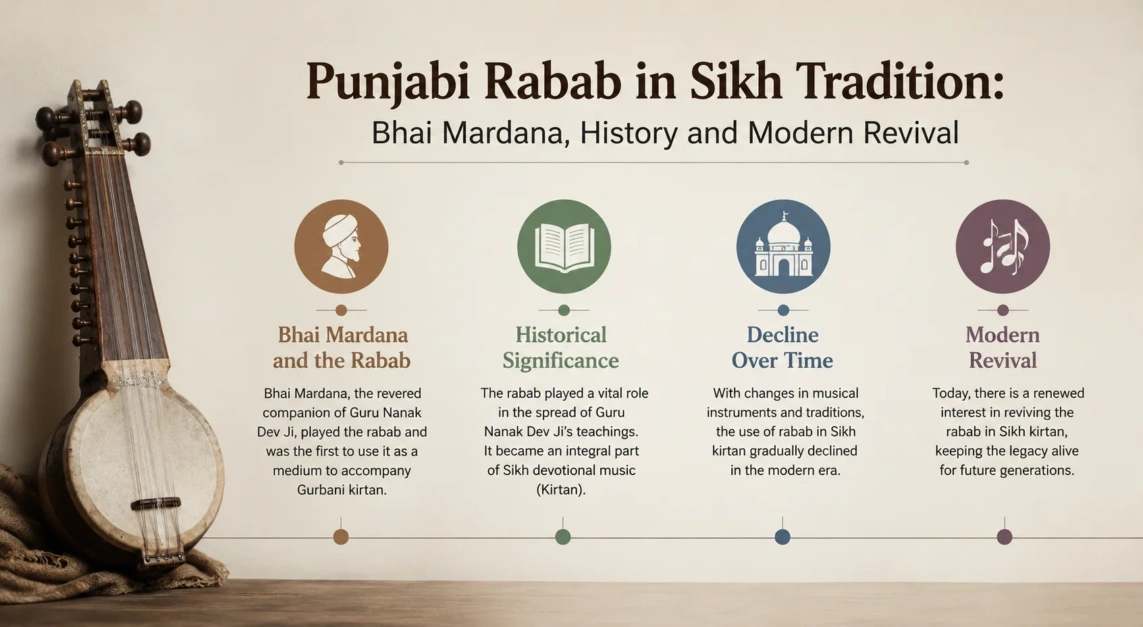
Bhai Mardana’s rabab was not a decorative object beside Guru Nanak. It was a working voice in early Sikh sacred music: a plucked lute that supported sung Shabad, marked melodic movement, and helped shape the listening space around the words. The instrument is now often called the Punjabi rabab, Sikh rabab, Nanakshahi rabab, or Firandia rabab, but those modern labels do not always describe one fixed historical design.
The clearest historical point is the relationship between Guru Nanak, Bhai Mardana, sung verse, raag, and rabab. The less certain point is the exact construction of the instrument Mardana held. No surviving rabab can be securely identified as his, and later paintings are cultural records rather than workshop drawings. A careful account must therefore separate established tradition, later representation, and modern reconstruction.
Why Bhai Mardana’s Rabab Matters in Sikh Tradition
Bhai Mardana, traditionally dated to 1459–1534, is remembered as Guru Nanak’s longtime companion and musician. Sikh historical writing describes him as a member of a hereditary minstrel background in Punjab and as a skilled performer who accompanied Guru Nanak’s singing on the rabab.
His role was active. The rabab helped establish pitch, outline melodic phrases, and answer the sung line without burying the words. This relationship matters because Sikh sacred composition is closely tied to raag. The musical heading of a hymn is not a casual label; it places the text inside a melodic discipline and a performance setting.
Listening Note: In a rabab-led Shabad performance, listen for the space after each plucked note. The sound begins clearly, then falls away. That decay leaves room for the singer’s next phrase and gives the accompaniment a very different texture from a sustained keyboard instrument.
What “Punjabi Rabab” Means Here
The word rabab belongs to a broad family of names used across North Africa, West Asia, Central Asia, Afghanistan, South Asia, and parts of Southeast Asia. Depending on the regional form, the instrument may be bowed or plucked, long-necked or short-necked, fretted or unfretted, and fitted with a skin or wooden soundboard.
Within Sikh musical history, Punjabi rabab usually points to the plucked lute associated with Bhai Mardana and the later Rababi tradition. It should not be treated as a simple alternate spelling for every Afghan rubab, Arab rababa, North African rebab, or Southeast Asian rebap.
| Name or Form | Typical Playing Method | Main Context | Relation to This Topic |
|---|---|---|---|
| Punjabi or Sikh rabab | Plucked | Shabad Kirtan, Gurmat Sangeet, Punjabi heritage | Associated with Bhai Mardana and Rababi musicians; modern examples vary |
| Afghan rubab | Plucked with a plectrum | Afghan and regional art music | Part of the wider rabab name family, but not automatically the same instrument |
| Dhrupad rabab or Seni rabab | Plucked | North Indian court and vocal traditions | Often discussed beside Sikh rabab reconstruction; exact historical overlap needs care |
| Arab rababa or North African rebab | Often bowed | Vocal accompaniment and regional ensembles | Shares the name family but differs in construction and technique |
| Sarod | Plucked | Hindustani classical music | Historically related to Indian and Afghan rabab development, yet a separate modern instrument |
Regional Note: Spelling alone cannot identify the instrument. Rabab, rubab, and rebab may reflect language and transliteration, but the body shape, membrane, neck, strings, and playing method provide better evidence.
Bhai Mardana as Musician and Companion
A Punjabi Minstrel Background
Accounts of Bhai Mardana place him in the musical culture of Talwandi Rai Bhoe, now Nankana Sahib. He is commonly described as a Mirasi, a term connected with hereditary musicians, reciters, genealogists, and keepers of oral memory in Punjab. The label should not reduce him to a social category. His place in Sikh memory comes from musicianship, companionship, and long service beside Guru Nanak.
The respectful title Bhai—brother—also matters. It signals belonging and esteem. Mardana was not presented merely as a hired accompanist. He appears in Sikh tradition as a close companion whose rabab formed part of the way Guru Nanak’s hymns were heard.
The Rabab in the Guru Nanak–Mardana Partnership
Traditional narratives repeatedly show a recurring pattern: Guru Nanak calls for the rabab, Mardana prepares or plays it, and a hymn follows. The musical act joins three elements:
- Shabad: the sacred word being sung;
- Raag: the melodic setting that shapes movement, register, and mood;
- Rabab: the plucked support that frames and answers the voice.
This does not mean the rabab functioned like a modern chordal instrument. Historical South Asian accompaniment often followed the melodic line, reinforced a tonal center, or offered short responses. The exact method used by Mardana cannot be recovered note for note, but the instrument’s short, clear attack fits a voice-led practice.
What the Historical Sources Can and Cannot Show
Bhai Gurdas, Janamsakhi traditions, later Sikh histories, paintings, and oral accounts do not carry the same kind of evidence. Bhai Gurdas provides an early literary memory of Guru Nanak and Mardana together. Janamsakhis preserve narrative traditions with different dates and versions. Painted scenes reveal how later communities pictured the partnership. Modern instruments show present-day attempts to turn those records into playable forms.
These materials support the enduring association between Mardana and the rabab. They do not provide a verified set of dimensions, a complete tuning chart, or a confirmed string count for his instrument.
The Phiranda Account and the Firandia Rabab Name
One well-known account connects the rabab with Bhai Phiranda, a musician and instrument maker associated with Bharoana near Sultanpur Lodhi. In this tradition, Guru Nanak sent Mardana to obtain a rabab from Phiranda before setting out to share his teachings more widely.
The story explains why some present-day makers and performers use the name Firandia rabab. It gives the reconstruction a Punjabi maker lineage rather than treating the instrument as a generic imported lute.
Curator’s Note: “Firandia rabab” is useful as a heritage name, but it does not prove that every modern instrument sold under that label copies Bhai Phiranda’s work. Surviving descriptions are not detailed enough to establish one standard plan.
The same caution applies to Nanakshahi rabab. The name expresses an association with Guru Nanak’s musical setting. Modern examples may differ in neck length, peg layout, number of strings, bridge form, decoration, and tuning.
How the Punjabi Rabab May Have Been Built
Modern reconstructions commonly present the Punjabi rabab as a plucked, skin-faced lute. This places it within the larger rabab family, where a wooden body and stretched membrane create a quick response and a lightly percussive edge. Yet the historical Sikh form should not be forced into the exact measurements of an Afghan rubab or a museum rabab from another region.
Body and Resonator
A rabab body may be carved from a solid block or assembled from shaped wooden parts, depending on the tradition and maker. The resonating chamber supports a membrane across at least part of its face. The bridge rests on that membrane and transfers string vibration into the body.
Wood choice can shape weight, durability, and resonance, but no single wood species can be declared standard for Bhai Mardana’s rabab. Modern makers may select locally available hardwoods or woods already used in lute making. These choices affect working properties as much as tone.
Skin Soundboard and Bridge
The skin face is one of the most useful clues when distinguishing a rabab-type lute from many wood-topped lutes. A thin, well-tensioned membrane responds quickly. It can produce a dry, articulate onset and a clear pulse under the plectrum.
The bridge must balance string height, membrane pressure, and stability. Too much downward load can restrict the membrane or distort it. Too little can weaken energy transfer. Seasonal humidity also changes skin tension, so setup may need adjustment.
Luthier’s Note: A skin soundboard is not acoustically fixed. Dry air can tighten it and raise its response; moisture can soften it and reduce clarity. A historically inspired rabab still needs a practical bridge, string load, and membrane tension for the climate in which it will be played.
Neck, Pegs, and Strings
Modern Sikh rabab reconstructions may use several melody strings with additional drone or sympathetic strings. Other examples are simpler. Because makers work from different paintings, written accounts, and related instruments, the peg arrangement is not uniform.
Claims that Mardana’s rabab had one exact number of strings should be treated carefully unless they refer to a named modern model. Gut, silk, metal, and synthetic strings each change tension and response. A modern performer may choose materials that are stable and obtainable rather than claiming a perfect historical match.
Plectrum and Playing Position
The Punjabi rabab is normally reconstructed as a plucked instrument. It may be held across the lap with the body supported by the player’s legs and the neck angled upward. A plectrum can give a firm attack, while fingers may be used for lighter articulation on some designs.
Historical images can suggest posture, but artists often adjusted scale and proportion. They are better used to compare broad features—short or long neck, rounded or waisted body, visible membrane, pegbox direction—than to calculate measurements.
How the Rabab Supports Shabad Kirtan
Melody Before Harmony
Rabab accompaniment in this setting is best understood as melodic support. The player may establish the tonal center, introduce a phrase, echo part of the sung line, or connect one vocal passage to the next. Full Western-style chord progressions are not required for the instrument to provide structure.
The plucked tone also makes silence audible. Each note ends, leaving a small opening before the next one. That opening helps the text remain clear.
Raag and the Shape of the Hymn
The Guru Granth Sahib is organized largely by raag headings. In performance, raag supplies an ordered melodic vocabulary rather than a loose emotional label. A rabab player therefore needs more than mechanical technique. The player must hear the vocal line, understand permitted movement, and avoid phrases that pull the hymn outside its chosen melodic setting.
The surviving record does not preserve Mardana’s personal tunings. Any current tuning should be identified as a performer’s or maker’s system, not presented as the one original Sikh rabab tuning.
Rhythm Without Overcrowding
A plucked rabab can add pulse through repeated strokes, but its main role need not be that of a drum. In voice-led Kirtan, the articulation may support the meter while another instrument carries the stronger rhythmic cycle. Historical ensembles changed over time, so one modern arrangement should not be projected backward as a fixed early rule.
Listening Note: A good rabab accompaniment does not need constant playing. Short introductions, held tonal reference, measured replies, and controlled pauses can support the Shabad more effectively than continuous display.
From Bhai Mardana to the Rababi Lineage
The association did not end with one musician. Sikh historical tradition remembers Shahzada, Mardana’s son, as continuing Kirtan with rabab after his father. This detail shows that the instrument belonged to an ongoing service and teaching line, not only to the biography of Guru Nanak.
The term Rababi later came to identify hereditary musicians—many from Muslim families—who performed Gurbani in Sikh settings. Their craft joined vocal memory, raag knowledge, pronunciation, repertory, and instrumental accompaniment.
Rai Balvand and Satta
Rai Balvand and Satta are among the best-known later Rababi figures. They are connected with Ramkali Ki Vaar, a composition included in the Guru Granth Sahib. Their presence shows that Rababis were not remembered only as accompanists; named musicians could also stand within the textual and musical record.
Biographical details about Balvand and Satta differ across later accounts. Their place in the tradition is clearer than every story told about their lives.
Music Across Community Boundaries
The Rababi line also preserves an important fact about Punjabi musical life: sacred performance could depend on long relationships between Sikh institutions and Muslim musician families. Bhai Mardana’s identity should not be flattened into a modern slogan. His musicianship, knowledge, discipline, and companionship deserve attention in their own right.
The title Rababi describes more than ownership of a rabab. It refers to a practiced role. A Rababi had to know what to sing, how to shape it, when to respond, and how to serve the text in a communal setting.
Why the Instrument Became Less Common
The rabab’s reduced presence in many twentieth-century Kirtan settings came from several connected changes. The 1947 division of Punjab separated institutions, teachers, workshops, and musician families that had previously worked within a shared regional network. Many Rababi families relocated, and some lines of face-to-face teaching weakened.
At the same time, the harmonium became easier to obtain, teach, tune, and use in group settings. Its keyboard gives students a visible pitch layout, and its sustained reeds support singing without the maintenance demands of a skin-faced lute. The harmonium did not erase the rabab by itself. It entered a setting where rabab makers, teachers, and family transmission were already becoming harder to sustain.
| Feature | Rabab | Harmonium |
|---|---|---|
| Tone production | Plucked string with a quick attack and natural decay | Free reed sustained by bellows |
| Pitch layout | String and fingerboard system varies by design | Visible keyboard with fixed keys |
| Maintenance | Membrane, bridge, pegs, strings, and climate response need attention | Reeds, bellows, valves, and tuning need periodic care |
| Accompaniment texture | Open, articulate, and phrase-based | Sustained, steady, and easy to reinforce in a group |
| Historical association | Bhai Mardana and the Rababi tradition | Later widespread use in South Asian devotional music |
These instruments do different work. A useful revival does not need to dismiss the harmonium. It needs to restore the knowledge required to make the rabab musically usable again.
Punjabi Rabab and Related Plucked Lutes
Punjabi Rabab and Afghan Rubab
The Afghan rubab is a short-necked, plucked lute usually carved from wood and fitted with a skin-covered lower sound table. Documented examples often have melody strings, drone strings, and sympathetic strings. It has a strong, lively attack and a highly developed solo tradition.
A Punjabi Sikh rabab reconstruction may share the membrane, carved body idea, and plucked response. Still, the two names should not be merged. Afghan rubab construction has its own regional standards, repertory, technique, and maker knowledge. A modern Sikh rabab may draw from it, reject parts of it, or combine it with evidence from Indian rababs and Sikh paintings.
Punjabi Rabab and Dhrupad Rabab
The North Indian rabab associated with dhrupad and court music is another nearby reference. It is often linked with the Seni tradition and appears in discussions of older plucked lutes that preceded or influenced later instruments. Some Sikh revivalists use the term dhrupadi rabab for a form associated with Mardana.
That label can describe a musical and constructional relationship, but it should not close the historical question. Early Sikh performance developed within the musical culture of North India and Punjab, yet Mardana’s own instrument remains incompletely documented.
Punjabi Rabab and Sarod
The sarod has a skin-covered resonator and plucked strings, but its modern metal fingerboard, left-hand technique, bridge system, and concert repertory make it distinct. Museum histories often connect the sarod’s development with rabab-type lutes. That history does not make the sarod a modern replacement name for the Punjabi rabab.
Modern Reconstruction: What Can Be Recovered
A maker can reconstruct a plausible instrument by combining regional rabab construction, Sikh visual material, written descriptions, and practical playing tests. The result can recover a convincing family resemblance: skin resonance, plucked articulation, voice-supporting register, and a body form consistent with older lutes.
Some details remain open:
- the exact outline and dimensions of Mardana’s rabab;
- the original number and material of its strings;
- its bridge profile and membrane thickness;
- the tuning used for different raags;
- the amount of drone or sympathetic resonance;
- the balance between repeated accompaniment and melodic reply.
Open questions do not make reconstruction pointless. They change how the finished instrument should be described. Historically informed is a more accurate term than exact replica.
Material Note: Replacing gut or silk with modern metal or synthetic strings can improve stability, but it also changes tension, attack, and sustain. A maker should match string choice to the bridge and membrane rather than copying a string list from an unrelated rubab.
The Modern Revival of the Punjabi Rabab
The revival now works through several channels: instrument making, Gurmat Sangeet education, archival research, public performance, and digital teaching. Each channel solves a different problem.
New Instruments and Workshop Experiment
Builders are testing body outlines, peg arrangements, membranes, bridges, and stringing systems that can work for present-day performers. Some aim for a dhrupad-related rabab. Others favor a design identified as Firandia or Nanakshahi. This variety is evidence of a living reconstruction process, not proof that the tradition has settled on one model.
Clear documentation would improve the field. Makers can record scale length, body depth, membrane material, bridge mass, string gauges, tuning ranges, and climate response. Such records allow performers to compare instruments without turning every workshop choice into a historical claim.
Teaching Gurmat Sangeet with Stringed Instruments
Schools and independent teachers have renewed interest in older tanti saaz, or string instruments, used in Sikh musical settings. Rabab study may be offered beside instruments such as the saranda, taus, dilruba, and stringed drone instruments.
Teaching the rabab requires two linked tracks. The student needs physical control of the instrument, but also needs raag, rhythm, Gurbani pronunciation, and ensemble listening. Learning a few plucked patterns without this musical context does not recreate Rababi practice.
Festivals and Public Demonstration
Public festivals now give reconstructed rababs a place to be heard beside related instruments. The International Rabab Festival held at Guru Kashi University in 2026 is one recent example of this heritage work. Events of this kind can introduce students to different rabab forms, bring makers and performers into the same room, and expose disagreements that remain hidden when instruments are discussed only through labels.
A festival performance is not the same as regular transmission. Long-term revival depends on recurring lessons, available instruments, repair knowledge, repertory study, and chances to accompany singers over many years.
Archives, Recordings, and Family Memory
Old recordings, photographs, catalogues, and interviews can preserve details that a finished instrument cannot show. Useful documentation includes how a player begins a Shabad, the length of instrumental replies, preferred registers, tuning habits, and the language used to teach a phrase.
Rababi family histories also deserve careful recording. Names, teacher–student lines, performance locations, and repertory memories can reveal continuity that is missing from instrument displays alone.
How to Identify a Modern Sikh Rabab Carefully
No single feature proves that an instrument is the historical Punjabi rabab. Identification works best through a group of observations.
- Check the playing method. A Sikh rabab associated with Mardana is normally presented as plucked, not bowed.
- Look for a membrane. Many reconstructions use a skin-covered resonating area beneath the bridge.
- Study the neck and peg layout. Note whether the design is short-necked, long-necked, simple, or fitted with extra drone and sympathetic strings.
- Ask how the model is named. Firandia, Nanakshahi, dhrupad rabab, and Sikh rabab may indicate different reconstruction choices.
- Request the maker’s specification. Scale length, string material, tuning range, and body construction are more useful than a broad heritage label.
- Listen to its musical role. An instrument designed for Shabad accompaniment should sit comfortably under the singing voice.
Collector’s Note: A decorative carving of Guru Nanak or Bhai Mardana does not establish historical accuracy. Provenance, maker records, measurements, repair history, and playable condition are more useful when assessing a modern or older rabab.
What to Listen for in a Rabab-Led Shabad
Clear Attack
The note should begin cleanly. A blurred or rattling onset may come from loose string contact, bridge problems, membrane response, or an intentional buzzing setup. The musical context decides whether the texture is desirable.
Natural Decay
The note usually fades rather than remaining level. This creates breathing room around the voice. Sympathetic strings, when present, may lengthen the halo around selected pitches.
Stable Tonal Center
Drone strings or repeated reference notes can keep the raag grounded. The effect should support intonation without turning into a heavy continuous layer.
Measured Replies
Short instrumental phrases may mirror, complete, or gently answer the singer. Good accompaniment listens first. It does not fill every pause.
Balance with the Text
Shabad Kirtan places the sung word in the foreground. A bright rabab can project strongly, so plectrum force, register, and microphone balance need restraint in modern amplified settings.
Why an Exact “Bhai Mardana Sound” Cannot Be Claimed
No recording preserves Mardana’s playing. No securely attributed instrument provides a full set of measurements. Written traditions establish his association with the rabab, while later art provides visual memory, but neither gives a complete acoustic record.
A modern player can pursue period-aware materials, a skin resonator, plucked technique, raag study, and voice-led accompaniment. That can produce a historically plausible result. It cannot prove the exact pitch, timbre, tuning, or phrase style heard in Guru Nanak’s lifetime.
This distinction protects the tradition from false certainty. It also leaves room for skilled makers and musicians to test ideas openly.
What the Revival Still Needs
Documented Instrument Plans
Published measurements and maker notes would allow instruments to be compared across workshops. A useful plan should state what is copied from a museum object, what is inferred from art, and what has been changed for modern playability.
Repair and Climate Knowledge
Players need access to people who understand membranes, wooden pegs, string tension, bridge fitting, and seasonal movement. An instrument that cannot be maintained will soon return to display use.
Long-Term Teacher–Student Lines
Short workshops can introduce posture and plucking. Rababi musicianship needs years of listening, raag practice, vocal coordination, and repertory memory. Regular accompaniment experience is especially important.
Careful Oral History
Interviews with Rababi families, senior Kirtan performers, instrument makers, and collectors should preserve vocabulary as well as stories. Terms for strokes, tuning, phrase types, and instrument parts may hold information that broad English descriptions miss.
Use in Regular Performance
The most reliable test of revival is repeated musical use. A rabab becomes a living instrument when students can obtain one, maintain it, tune it, accompany singers, and pass the practice to another learner.
Frequently Asked Questions
What Instrument Did Bhai Mardana Play?
Bhai Mardana is remembered as playing a plucked rabab while accompanying Guru Nanak. The broad instrument type is well established in Sikh tradition, but the exact dimensions, string count, and tuning of his rabab are not known.
Is the Punjabi Rabab the Same as the Afghan Rubab?
No. They belong to the wider rabab name family and may share a skin-faced body and plucked technique, but the Afghan rubab has its own established construction, repertory, and playing practice. Modern Sikh rababs vary and should be identified by their actual design.
What Does “Firandia Rabab” Mean?
The name refers to the tradition that Bhai Phiranda made or supplied a rabab for Bhai Mardana. Present-day Firandia rababs are modern reconstructions inspired by that account. The label does not guarantee one standard historical specification.
Did Rababis Continue After Bhai Mardana?
Yes. Sikh historical tradition names Mardana’s son Shahzada and later Rababi musicians. Rai Balvand and Satta are especially well known, and their Ramkali Ki Vaar is included in the Guru Granth Sahib.
Why Is the Rabab Less Common Than the Harmonium in Kirtan?
The change reflects several causes: disrupted teaching lines, fewer specialist makers, the maintenance needs of skin-faced lutes, and the harmonium’s accessible keyboard and sustained tone. The harmonium’s popularity alone does not explain the decline of Rababi practice.
Can a Beginner Learn Punjabi Rabab Today?
Yes, where a suitable instrument and teacher are available. A beginner should learn tuning, plectrum control, posture, basic raag movement, rhythm, and how to leave space for the singer. Studying the instrument without Shabad and vocal listening gives only part of the tradition.