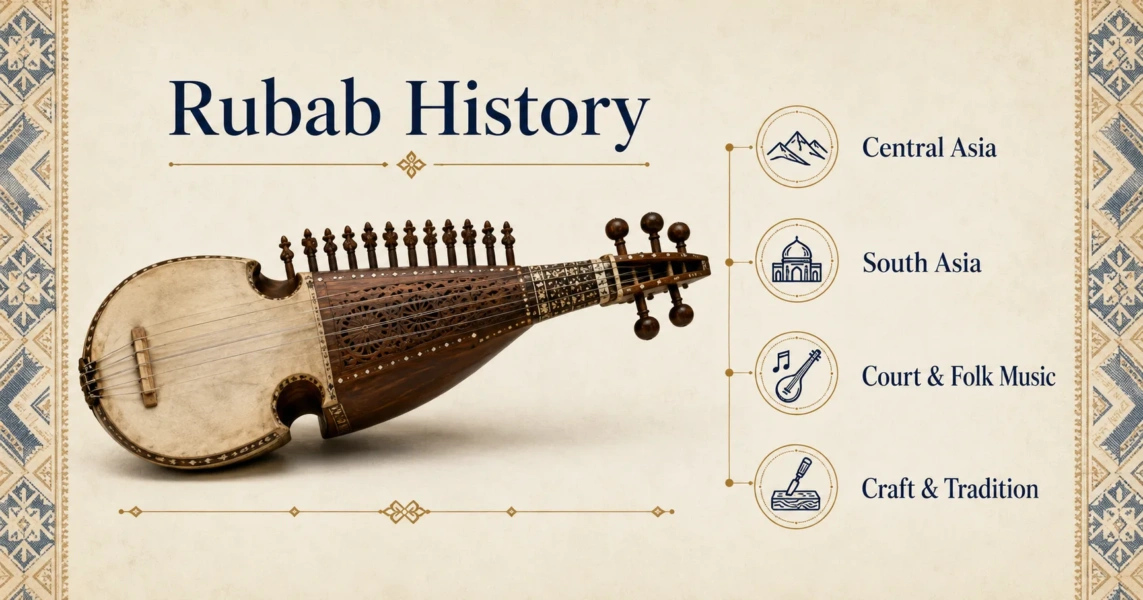
Rubab history is best understood as the history of a name, a family of lutes, and several local craft traditions that developed across Central and South Asian musical life. The word appears in many spellings, including rubab, rabab, rebab, rubāb, rababa, rebap, and rubob, but it does not always point to one identical instrument. In Central and South Asia, the term most often brings to mind short-necked plucked lutes with a carved body, skin soundboard, gut or nylon melody strings, and sympathetic strings in some regional forms.
What “Rubab History” Refers To
The history of the rubab is not a single straight line. It includes Persianate court culture, Central Asian regional music, South Asian devotional and classical settings, and later concert-stage forms. Some rubab types are plucked with a plectrum. Other related instruments in the wider rabab or rebab naming family are bowed. That difference matters.
For Central and South Asian music, the main historical focus usually falls on the Afghan rubab, the Kabuli rubab, the Kashmiri rabab, and older South Asian rabab traditions associated with court and devotional music. These instruments share a broad naming heritage, yet their construction, repertory, and playing roles can differ sharply.
Regional Note: The spelling “rubab” is common in English discussions of Afghan and Central Asian plucked lutes. “Rabab” often appears in South Asian contexts. “Rubob” is often used for Central Asian forms, especially in Uzbek and Tajik musical settings. These spellings are useful clues, not fixed borders.
Names, Regions, and Instrument Types
The same root name moved through several languages and musical cultures. Because of that, a museum label, a musician’s description, and a regional music text may use similar words for instruments that are built or played in different ways.
| Name or Spelling | Common Association | Usual Playing Method | Main Point to Notice |
|---|---|---|---|
| Rubab | Afghan and wider Central Asian usage | Usually plucked | Often linked with a short neck, carved body, skin soundboard, and sympathetic strings in Afghan forms |
| Kabuli Rubab | Afghan classical and regional music | Plucked with a plectrum | A well-known concert and teaching form of the Afghan rubab |
| Rabab | South Asian historical, devotional, and regional use | Usually plucked in these contexts | The name appears in older court and devotional references, though forms vary |
| Rubob | Uzbek, Tajik, and nearby Central Asian traditions | Plucked | May refer to long-necked or modified regional lutes, depending on the local type |
| Rebab or Rebab Family | Wider Middle Eastern, North African, and Southeast Asian naming fields | Often bowed in many regions | Related by name and broad lute heritage, but not the same as the Afghan rubab |
Early Roots and the Movement of a Lute Name
The rubab name belongs to a wide historical zone shaped by Persian, Arabic, Turkic, and South Asian musical vocabulary. Older sources do not always describe instruments with modern precision. A written reference to a rabab may not tell whether the instrument had a skin table, how many strings it carried, or whether it matched a later Afghan rubab.
This is why careful rubab history separates the name from the built object. The name traveled widely. The instruments changed with local wood, playing style, repertory, court taste, and workshop practice.
In Central and South Asian traditions, the rubab became especially tied to plucked lute playing. Its short-necked Afghan form is now the best-known example, but older South Asian rabab traditions also matter because they show how the instrument moved through elite, devotional, and regional music settings.
The Afghan Rubab and the Central Asian Sound Ideal
The Afghan rubab is often treated as the clearest reference point for Central Asian rubab history. In many documented examples, it has a carved wooden body, a membrane soundboard over the lower chamber, a short fretted neck, melody strings, drone or rhythmic support strings, and sympathetic strings that add shimmer to the tone.
The body is commonly carved from a single block of wood, with mulberry often mentioned in connection with Afghan instrument making. Other materials may appear depending on region, maker, age, and repair history. The bridge sits on the skin soundboard, which gives the instrument a dry, clear attack and a warm decay.
Construction Details That Shaped Its Role
- Carved body: Helps create a compact resonating chamber with a firm playing feel.
- Skin soundboard: Gives the plucked note a direct attack and a slightly percussive edge.
- Short neck: Supports melodic work in a focused hand position.
- Sympathetic strings: Add resonance when tuned to the mode or tonal center.
- Plectrum technique: Allows clear rhythmic articulation in solo and ensemble settings.
Luthier’s Note: On a skin-topped rubab, the soundboard is not only a cover. It is part of the instrument’s voice. Humidity, skin tension, bridge placement, and string pressure can all affect response. A maker or repairer must balance volume, clarity, and stability rather than chase one trait alone.
Rubab in South Asian Music Traditions
South Asian rabab history is often discussed through older courtly and devotional settings. The instrument appears in accounts connected with North Indian musical culture, where plucked lutes served singers, poets, and instrumental specialists. Over time, some musical roles associated with the rabab were taken by other instruments, including the sarod in later Hindustani classical practice.
The rabab also has a respected place in Sikh musical memory, especially through associations with early devotional performance. In that context, it is not simply a stage instrument. It is tied to sung poetry, accompaniment, and the transmission of sacred verse through music.
Why South Asian Rabab History Can Be Hard to Standardize
Several problems make simple timelines risky. Historical names are not always paired with exact drawings. Surviving instruments may come from later workshops. Regional oral traditions can preserve details that do not fit one neat museum category.
A careful reading treats the South Asian rabab as a historical instrument field rather than one frozen design.
Central Asian Rubob Forms
Central Asian rubob types show how a related name can develop into different shapes. In Uzbek and Tajik contexts, rubob may refer to plucked lutes used in ensemble and solo music, including forms that differ from the Afghan short-necked rubab. Some are longer-necked and reflect modernized concert practice.
These instruments belong to living regional music systems. Their history includes local teaching lineages, state conservatory settings, folk ensembles, and instrument workshops. The rubob name therefore links older lute vocabulary with newer performance needs.
Material Note: Wood choice can shape resonance, weight, and carving behavior, but it does not work alone. Body depth, soundboard material, bridge design, string type, and setup can change the feel as much as the wood name on its own.
How the Rubab Helped Shape Later Instruments
The rubab is often discussed in relation to the sarod. This connection should be handled with care. The sarod did not simply remain a rubab under another name. It became a different instrument with a metal fingerboard, a smooth fretless playing surface, metal strings, and a different tonal aim.
Still, the comparison is useful. It shows how a plucked lute associated with Afghan and North Indian contexts could influence later instrument design in South Asian classical music.
| Feature | Afghan Rubab | Sarod |
|---|---|---|
| Neck Surface | Usually fretted | Fretless metal fingerboard |
| Main String Feel | Gut, nylon, or similar materials in many examples | Metal strings |
| Tone | Dry attack, warm body, resonant sympathy | Bright, sliding, sustained tone suited to Hindustani melodic work |
| Historical Role | Central and South Asian plucked lute tradition | Later South Asian classical concert instrument |
Sound, Technique, and Musical Function
The rubab’s sound is shaped by a strong attack and a fast, earthy decay. Sympathetic strings can fill the space around the melody, but the core note remains clear. This makes the instrument useful for melodic lines that need rhythmic definition.
Players often use a plectrum to strike the main strings. Depending on the regional style, the rubab may carry melody, support singing, lead an instrumental ensemble, or take a solo role. In some settings, it works as a refined art instrument. In others, it remains close to local song and dance repertory.
Tuning and Mode
Rubab tuning is not one fixed universal system. It changes by regional form, teacher, repertory, and the instrument’s string layout. Afghan rubab players may tune sympathetic strings to match the mode or tonal center of the piece. Central Asian rubob systems may follow their own teaching standards.
Because of this, a historical article should avoid giving one tuning as “the” rubab tuning. Tuning belongs to a specific type, school, and performance need.
Listening Note: A rubab recording can often be recognized by its plucked attack, skin-head warmth, and the faint halo of sympathetic resonance. If the sound is smooth, bowed, and continuous, the instrument may belong to another rebab or rabab tradition rather than the Afghan rubab type.
Why Historical Confusion Happens
Confusion comes from three causes: shared names, regional spelling differences, and real changes in instrument design. A “rabab” in one text may be a plucked lute. A “rebab” in another region may be bowed. A “rubob” in a conservatory ensemble may not look like a Kabuli rubab.
The safest method is to ask three questions:
- Is the instrument plucked or bowed?
- Does it have a short carved body with a skin soundboard?
- Which region, language, or music tradition is being described?
These questions prevent the most common mistake: treating every rebab, rabab, and rubab as the same instrument.
Museum and Heritage Context
Rubab-family instruments are valuable in museum collections because they show how musical ideas move through language, trade, teaching, and craft. A curator cannot rely on the name alone. The body shape, soundboard, neck, pegbox, string layout, and playing wear all help identify the instrument more accurately.
Older examples may also show repairs, replaced bridges, newer strings, or changed tuning hardware. These details do not make the instrument less useful. They show how musicians kept it playable.
Details Worth Checking on an Older Rubab
- Whether the soundboard is skin, wood, or a mixed construction
- The number and placement of melody, drone, and sympathetic strings
- The shape of the pegbox and the arrangement of tuning pegs
- Evidence of regional ornament, carving, inlay, or painted decoration
- Wear marks near the bridge, neck, and plectrum contact area
Rubab History FAQ
Is the rubab the same as the rebab?
No. The names are related, but they do not always mean the same instrument. In Central and South Asian contexts, rubab often refers to a plucked lute. In other regions, rebab may refer to bowed instruments.
Where is the Afghan rubab most closely associated?
The Afghan rubab is closely associated with Afghan music and with wider Central and South Asian musical exchange. It is especially known for its carved body, skin soundboard, short neck, and resonant string layout.
Did the rubab influence the sarod?
Many histories discuss the rubab as part of the background to the sarod. The sarod developed into a separate South Asian classical instrument with a fretless metal fingerboard, metal strings, and a different playing surface.
Why are there so many spellings of rubab?
The name passed through several languages and writing systems. Rubab, rabab, rubāb, rebab, rebap, and rubob can reflect regional pronunciation, transliteration choice, or a different local instrument type.
Does every rubab have sympathetic strings?
No. Sympathetic strings are strongly associated with some Afghan rubab forms, but rubab-related instruments vary by region and period. The string layout should be checked on the actual instrument being described.
Is rubab history mainly Central Asian or South Asian?
It belongs to both areas, but in different ways. Central Asian traditions shaped several rubab and rubob forms, while South Asian traditions preserved older rabab references and helped connect the instrument to later lutes such as the sarod.